
AI & Automation
AI imaging, collaboration and automation — putting AI into real design & print workflows
- Audience
- Designers・Marketers・Brand Owners・Digital Transformation Seekers
- AI Tools
- AI Image Generation
- AI Image Print Submission
- AI Collaboration
- AI Print Advisor
- Automated Workflow

The Second Half of Wide-Format Printing: From Eight-Color to the Cloud
From the MUTOH 64-inch eight-color eco-solvent printer and the EFI Reggiani NEXT Plus eight-color configuration to the Quocirca 2026 Cloud Print Services report, wide-format printing has recently seen a clear shift. From the real-world demands of print shops and brand clients, this wave of change impacts color, materials, AI cloud workflows, and delivery management. Small and medium-sized shops in Taiwan cannot afford to treat this merely as equipment news

Reprints: Don't Just Say "Same as Before" — An AI Proofing Routine from a Seasoned Consultant
Companies reprinting catalogs or packaging most often trip over outdated info. Here's how to use AI to build a reprint check that avoids the nightmare of scrapping an entire run

The Second Half of Wide-Format Printing: Transformation Signals from Eight-Color Expansion to AI Cloud Architecture
Wide-format printing is shifting away from merely competing on size and speed toward a trinity of ultimate color accuracy, green manufacturing, and AI automation. Based on recent equipment manufacturer strategies and supply chain acquisitions, I have summarized practical guidelines that small and medium-sized enterprises must pay attention to

From Design Brief to Layout Plan with AI: The Prep Step That Saves Designers Three Rounds of Revisions
Handing a sales deck or product materials straight to a designer is where almost every major design revision begins. This article explains how to add one step before layout: use AI to organize raw copy into a layout information structure, so the headline, selling points, and CTA are confirmed in the right order before design starts, reducing the cost of repeated rework at the source

How to Catch AI Print Project Risks
The worst part of print procurement is signing off on a job only to discover that delivery dates, materials, regulations, or finishing weren't spelled out. This piece takes a project-management angle and shows you how to use AI to break a print job into a risk map, then turn it into RFQ questions, confirmation milestones, and a responsibility split

AI-Planned Event Print Materials Checklist
The biggest fear with event print materials is a stunning hero visual paired with missing table cards, stickers, booklets, or backdrops on the day This guide uses a senior print consultant's approach to show you how to turn AI from a copywriting tool into an event materials planning assistant, covering objectives, traffic flow, quantities, design rollout, and deadlines all at once
Practical Guide to Building a Print Spec Library with AI
A print spec library isn't about dumping old files into a cloud drive. It's about organizing sizes, paper stocks, finishing, quantities, delivery dates, and finished-product photos into procurement memory you can use for next time. This piece breaks down how companies turn past business cards, stickers, catalogs, packaging, and event materials into spec data you can search, compare, and carry forward, from three angles: print procurement, design handoff, and AI application
How Can an AI-Generated Print Series Stay Truly Consistent Across the Batch?
Same brand, same AI prompts, so why do your stickers, packaging, and social media collateral still look disconnected once printed? From the perspective of a veteran print consultant, this guide breaks down the core pillars needed to keep a print series unified and how to run that key pre-press consistency check before going on press
When Is X5 Nozomi Worth Buying?
When e-commerce outer boxes move from outsourcing to in-house production, buying the machine is not the first step. First, calculate whether orders, corrugated board, and warehouse space are already near the tipping point Using on-demand box-making systems such as Packsize EFI X5 Nozomi as the anchor, this article helps brands and small to midsize print shops decide when to invest in smart cutting and box making

How to Keep Commercial License Records for AI Assets
Once AI-generated images, AI retouching, and mixed-source assets enter the print workflow, the biggest risk is not that the file cannot be produced. It is reaching publication, launch, or exhibition prep and only then realizing no one can clearly explain where the image came from This article looks at license retention from the angle of print purchasing and brand risk control, and lays out a handoff-ready, traceable, auditable way to keep records
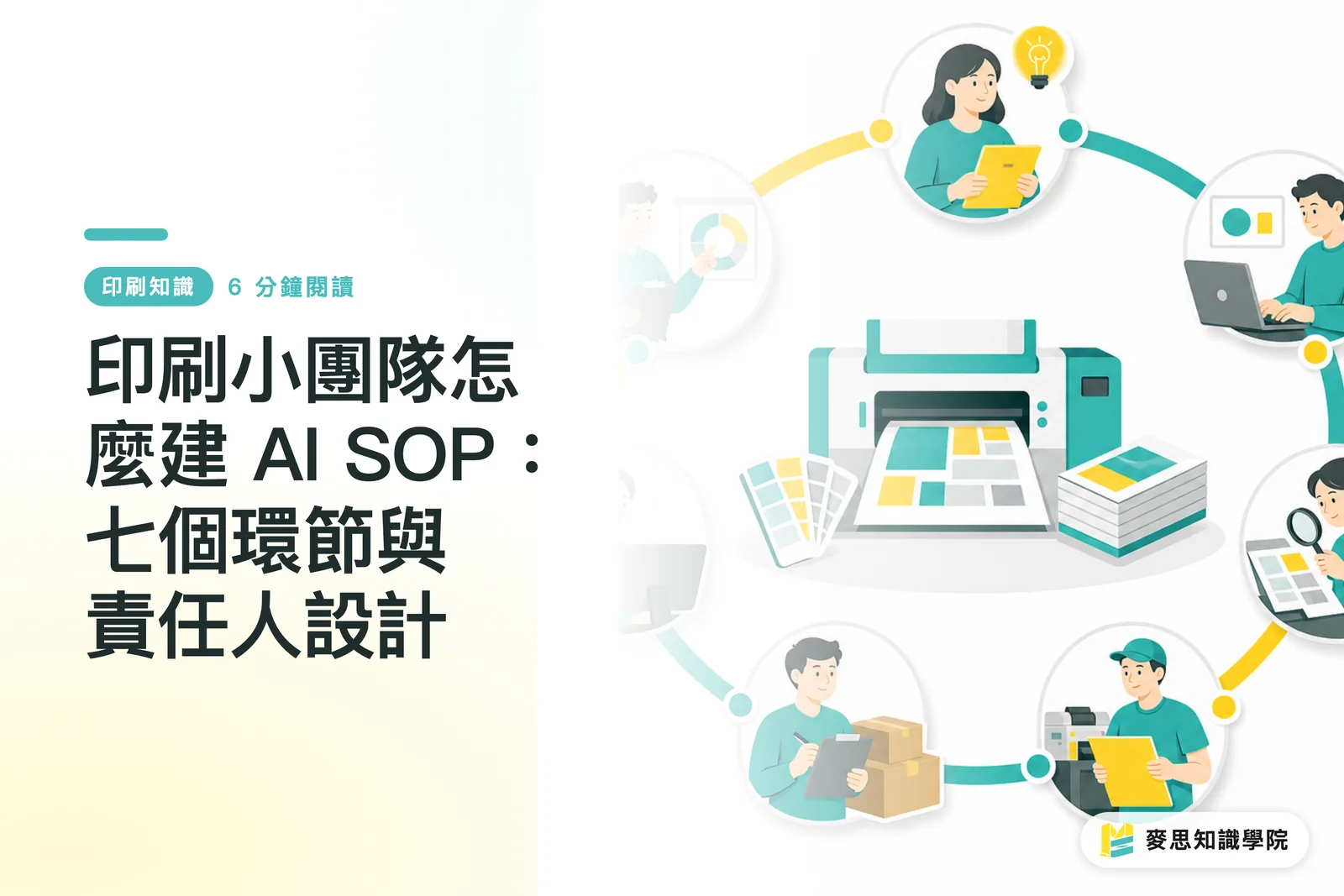
How a Small Print Team Builds an AI SOP: Seven Stages and Who Owns Each One
When print jobs go wrong, it's rarely a tech problem. It's that nobody specified who confirms what. This piece walks through a full AI SOP that a small procurement-and-design team can actually run, from intake to reprint log, and spells out where AI helps and where the human check-in sits. The Mai Strategy Knowledge Academy consulting team distilled the design logic behind these seven stages while helping mid- and small-sized print shops tighten their workflows. The one thing they share: start low-friction, make the human-AI split crystal clear
How AI Compares Print Revision Versions
The real danger in multi-round revisions isn't missing a new change, it's silently breaking content the client already approved while neither the client nor the designer notices. This piece walks through, in print-shop terms, how AI helps diff copy, prices, barcodes, page numbers, spec tables, and image swaps across catalogs, packaging, and flyers

Where the next beauty packaging fight will be
The next round of competition in beauty packaging will push past the bottle's exterior into formulation fit, pumps, refills, and surface finishing, all decided together. Starting from the print and packaging floor, here's a working-method reset brand teams, designers, and small-to-mid print shops can make first
Can Flux.1 Be Used for Print Design?
Flux.1's strengths are output quality, prompt adherence, and self-hostable workflows; its weaknesses are licensing, text rendering, and print files still requiring manual review. I put it in proposals, composite sketches, and style exploration, I wouldn't send a 1024px output straight to the press

How to Get GPT-Generated Images into a Print Workflow? A Senior Consultant Walks You Through the Three Gates Before Sending to Press
GPT-Image-2 output can look gorgeous, but the gap between screen and printed piece has real technical hurdles. Skip them and you'll pay for it later. This article breaks down every key checkpoint from resolution and color mode to bleed setup, so designers and procurement leads can skip the trial-and-error

Can Magnific AI Upscale Images to Print Quality?
Magnific AI can rescue some low-resolution images to a printable range, but only if the original has enough shape, texture, and edge information, you can't turn a blurry screenshot into a perfect print-ready file. This piece uses real print-floor judgment to break down which images are worth AI upscaling, which need to be redone, and gives designers a pre-press checklist to run before sending anything to print
EPR Goes to Court, Packaging Costs Get Recalculated
Oregon's packaging EPR lawsuit is pushing packaging design beyond artwork and material choices, straight into regulation, responsibility, and data governance From a print consultant's point of view, this article breaks down what Taiwanese brands, designers, and small to midsize print shops need to watch: which costs will surface, and which data has to be filled in early

Packaging Plant AI Has to Capture Master Operators' Know-How
EPS updated CommandCore, pointing to something every packaging plant knows well: knowledge gaps turn directly into risks around lead times, yield, and succession Starting from real print and packaging floors, this article looks at how small and mid-sized plants can turn veteran know-how, machine settings, and exception handling into AI work capabilities that can actually go live
Can AI Check the Reading Order of a Layout? A Senior Print Consultant's Hands-On Human-AI Workflow
AI looks at whether readers can get through the piece smoothly, not whether the file is technically correct. This article separates readability checks from prepress technical checks, then walks through a practical human-AI workflow that helps DM pieces, posters, and catalogs avoid a few more traps before going to print
Layout Tool Showdown: A Prepress AI Compatibility Guide for Adobe and Canva
Marketing and design teams often get pulled between Canva's lightning-fast output and Adobe's print-grade precision. From the viewpoint of a physical print production line, this guide breaks down the prepress traps and best-use moments for the AI features in both tools, so you can choose the right weapon before sending a job out
Solving the Labor Shortage on the Production Line: How AI-Assisted Robots Are Reshaping Packaging Workflows and Efficiency
The labor shortage wave has hit manufacturing hard, and upgrading packaging lines is no longer optional, it's survival Drawing on over a decade of production-floor observation, I'll break down how robotic arms paired with machine vision tackle the pain points of picking and quality inspection And find a realistic entry point for small and mid-sized factories looking to automate

Paper Prices Are Going Wild. How Can Print Shops Use AI Auto-Imposition to Squeeze More Value Out of Every Sheet?
With paper costs soaring and quick-print orders shifting toward small runs and high variety, veteran manual layout just is not precise enough anymore This article breaks down how AI auto-imposition really works, so you can see how the system calculates the best layout in seconds and helps both print shops and buyers cut waste to the minimum

Save Fine Reverse Type: A Full Breakdown of AI-Powered Automatic Trapping
Paper stretch and movement at high press speeds can turn a perfect design file into a print run with harsh white edges at color boundaries. Starting from real prepress work, this article explains how AI can finish trapping settings that used to take painfully long in just seconds, pulling fine lines and reverse type back from the brink
Laying Out a Thousand-Page Manual: Use AI to Generate Tables of Contents, Indexes, and Page-Jump Links
Every shareholder meeting season, or whenever a product manual gets updated, long-form documents that run into hundreds of pages become the last straw that crushes the design team This practical guide breaks down how to pair large language models with InDesign automation, handing the most time-consuming index capture and page-jump setup to machines so you can save your energy for the beauty of the layout