

AI Can Help You Sort Out Your Reader, but "Who the Reader Is" Is Still Your Call
It can, but you need to set the boundary first, otherwise you'll just burn time on it
What AI is genuinely good at: hand it a product brief, a few old pieces of copy, or a batch of common customer-service questions, and it'll help you break "who the reader is" into workable pieces. For instance:
・What is this person doing the moment they get the DM in hand (grabbing a flyer on the street, flipping through an envelope insert, scanning a QR code at a trade show that jumps to a PDF catalog)
・What worries them most before they buy (opaque pricing, not sure the specs fit their need, no idea if there's after-sales support)
・How much time do they actually have (30 seconds waiting for an elevator, or a whole evening at home doing homework)
Once you answer those three questions, your layout strategy changes. Same A4 bi-fold DM, but one made for "elevator-waiting readers" vs. "take-it-home-and-study readers"—the information density, the headline-to-subhead ratio, the CTA placement will all be completely different
What AI can't do: decide your product positioning for you. It doesn't have your sales history, your competitor data, or your channel ecosystem. It can think through the logic of "if the reader is X, they need to know Y"—but whether the reader actually is X has to be confirmed by your own business data or market interviews
In years of client work at Mai Strategy Knowledge Academy, I've seen this pattern over and over: the less audience research a client has done, the more their copy sounds like they're talking to themselves instead of the reader. The real value of bringing AI into this step isn't that it hands you an answer, it's that it forces you to spell out the assumptions you haven't been saying out loud
---

How to Give AI Reader Prompts That Actually Help
The key is how you ask. If you just say "help me define the target reader for this catalog," AI will give you a generic profile that has almost no ground-level value. You need to feed it the context, then work through a few dimensions one at a time:
・Reader's task: what is this person trying to solve when they pick up this print piece? Comparing options, understanding specs, convincing someone around them, or just placing an order? Different task, different information order
・Purchase hesitation: where are they most likely to get stuck? Throw this question at AI and it can list out the common customer concerns, then you check whether your copy actually addresses them
・Reading time and setting: trade show floor, store shelf, inside an envelope, sitting on the break-room table, every setting has wildly different attention levels, which directly caps how many words you can put on the page
・Channel context: a salesperson walking a catalog through a client visit is nothing like a customer grabbing one off the shelf on their own. Two completely different reading situations, and your copy's level of detail and assertiveness has to shift with it
・Information priority: what does this reader need to know first before they're willing to keep turning the page? AI answers this one reasonably well, especially if you have customer-service FAQs or old survey data to feed in as material
・Tone: warm or professional, plain or polished. Sounds like a small thing, but it's deeply tied to the reader's background. A spec sheet for engineers and a baby-product catalog for new moms will pick different typefaces, never mind different tones
You don't have to run all six dimensions for every print piece, but if it's your first one or your first time in a new channel, run through them at least once and check whether your assumptions have obvious holes
---
How Does Reader Definition Shape Layout and Print Specs?
Once you work this out properly, "reader first, layout second" stops being an idea and becomes a workflow that actually saves you work
A few concrete examples:
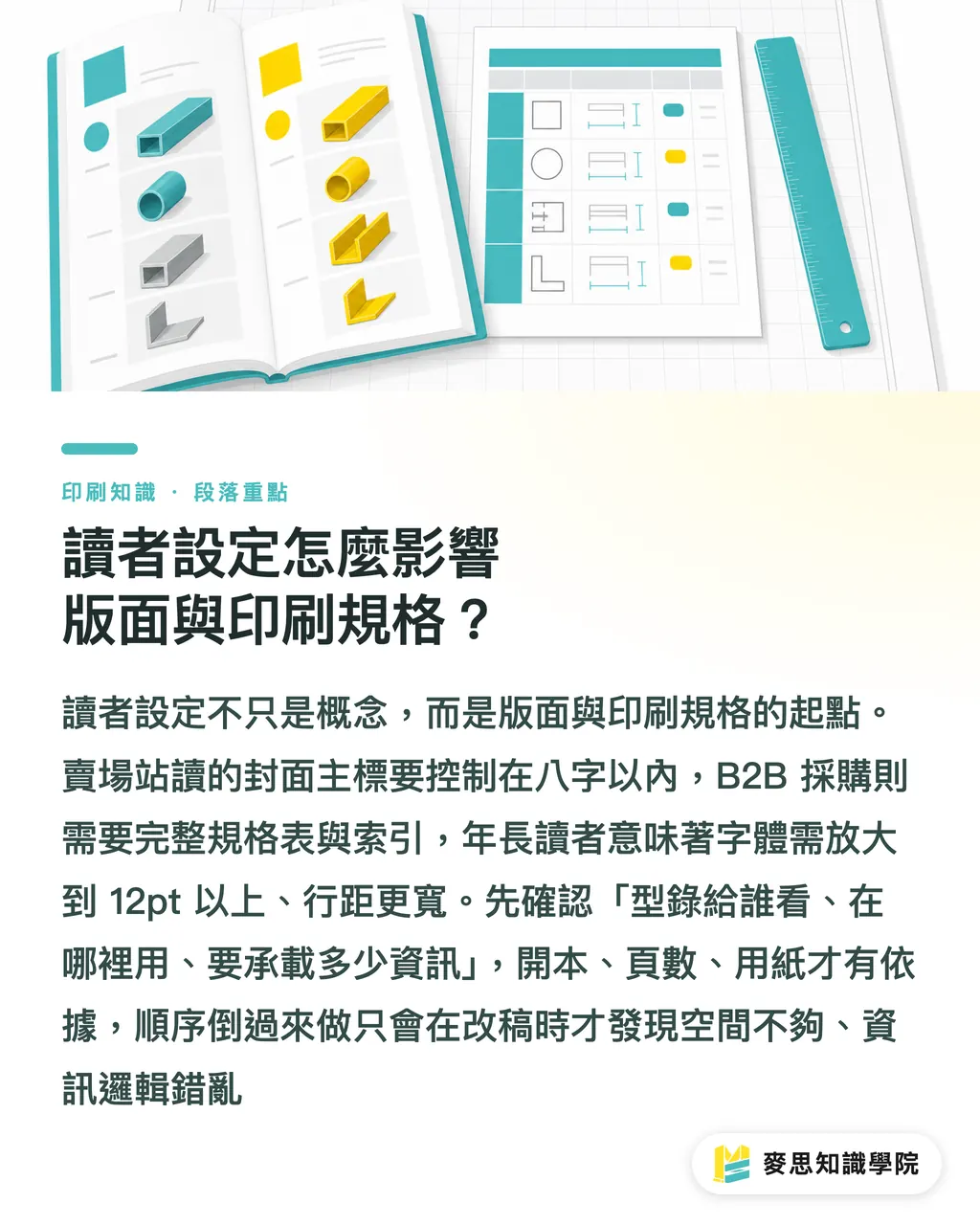
・If the reader is standing at a shelf flipping through it, you've got maybe 20 seconds, so the cover headline under 8 characters now has a clear basis. Flip it around, a B2B procurement catalog the buyer takes back to compare quotes can carry a full spec table, even an index page
・Older readership means baseline type size should jump to 12pt or above, with more generous leading, this is reader definition converting straight into prepress spec
・If the reader only looks at the catalog after a salesperson has already pitched them, the catalog's job is "helping them confirm," not "actively persuading"—you can strip out a lot of explanatory text and swap in images and spec comparisons instead
・Trade show as the channel? Then the paper stock has to think about fold count and weather resistance, not just how nice the print face looks
You'll notice the pattern: reader definition decides layout structure, and layout structure decides print specs. Flip the order, lock in specs first, then figure out the copy, and you'll find yourself mid-revision realizing the space doesn't fit, or after printing realizing the information logic is a mess
When the sales team at MINDS Printing takes on a new project, they usually ask a few questions before quoting: who the catalog is for, where it'll be used, how much information it needs to carry. The answers to those questions directly steer the trim size, page count, and paper-stock recommendations, and that's why
---
How to Use AI-Generated Personas Without Going Off the Rails
An AI-generated reader profile is a hypothetical user, and its function is to help you check whether your content has gaps, not to make brand-positioning decisions for you
I've seen projects where teams produced a slick-looking persona with AI and then used it directly to set pricing strategy or pick sales channels. Completely missed the actual market, because AI was extrapolating from the material you fed it, not analyzing real market data
What an AI persona can do:
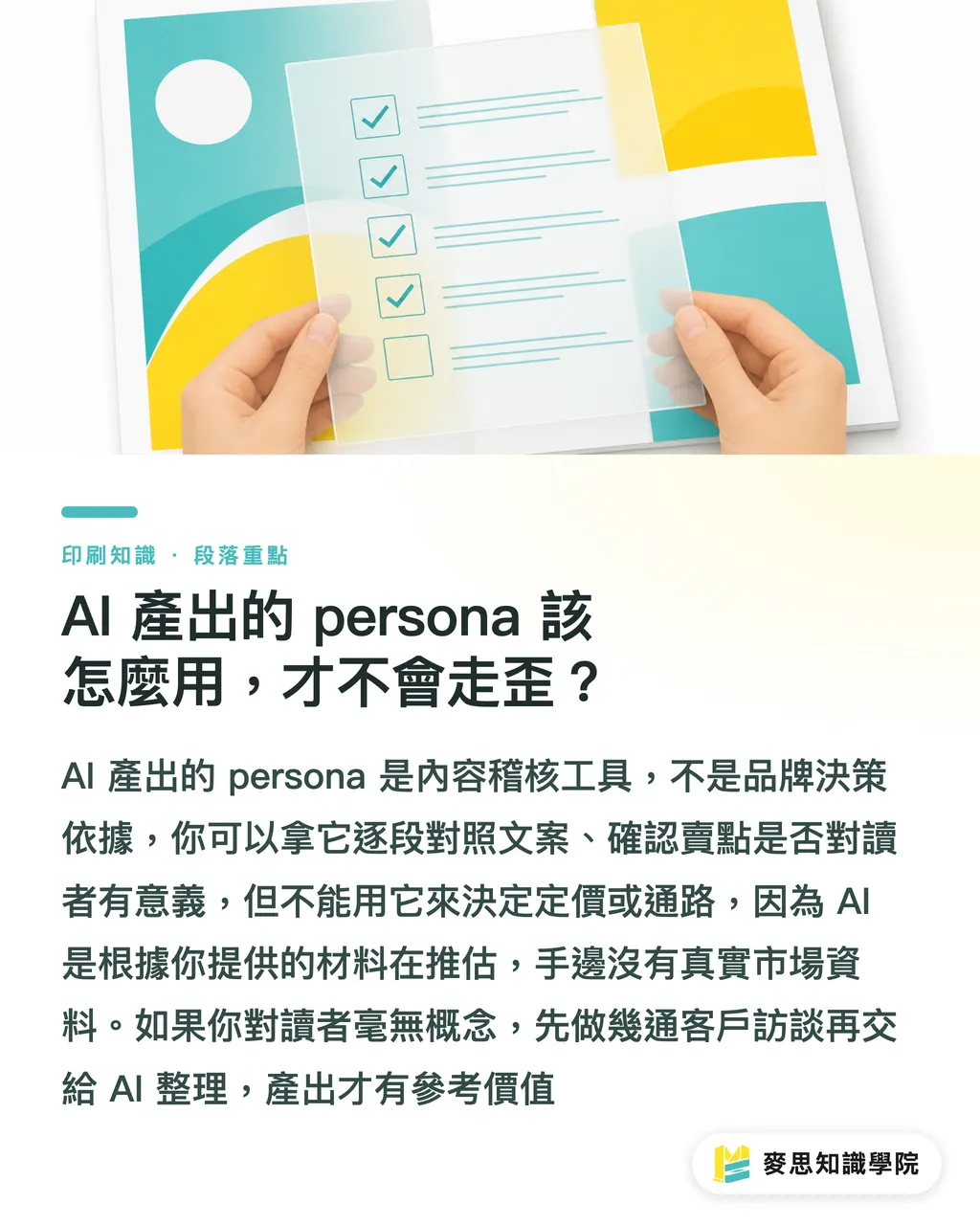
・Take the reader profile AI gives you, walk through your copy section by section, and ask yourself: "Would this reader get lost here?" "Does this reader have any reason to care about this selling point?"
・Use the list of common purchase hesitations AI generates as a checklist, confirm your copy hasn't skipped any key explanation
・Build two or three different reader scenarios and test how the same layout reads for different people
What it can't do:
・It can't replace real user interviews or surveys, especially when you're dealing with a new product or a new channel
・You can't treat AI's analysis as the basis for brand strategy, brand positioning needs competitor analysis and historical sales data, and AI has none of that on hand
・You can't let AI's tone recommendations completely overwrite your existing brand voice, especially for brands that have already built recognition
One line to wrap it up: AI is a great content-audit tool, but only if you already have some grip on who your reader is, not starting from zero with no clue. If you genuinely have no idea who the reader is, make a few customer calls or run a quick survey first, then hand it to AI to organize. That's when the output is actually worth something
Key Takeaways
・AI can help you "say out loud" your reader assumptions, but it can't confirm whether those assumptions are right, that part takes real market data or interviews
・Reader's task, purchase hesitation, reading setting, information priority, get those four questions clear and your layout decisions have a foundation
・An AI-generated persona is a content-check tool, not a brand-positioning basis. Use it in the wrong direction and the printed piece ends up further from the market, not closer
・Reader definition decides layout structure, layout structure decides print specs. Flip that order and you'll never finish revisions
・If you have zero idea about your reader, do the interviews first and let AI organize afterward, that works far better than asking AI to build from scratch
Further Thinking
The biggest impact of using AI to define the reader in a print production flow isn't the time you save, it's that the question "why are we laying it out this way" finally gets an answer
When a designer receives a DM file, the scary part isn't the volume of information, it's having no idea who this thing is for. In that situation the layout just runs on gut feel, and there's no benchmark for revisions. If the planning side ran a round of reader analysis before opening the file, the designer doesn't just get "please lay out a DM"—they get "this DM is for a 30-45 year-old procurement manager reading at the office, they've got about 3 minutes, and what they care most about is spec and price comparison." Every design decision after that has something to lean on
For teams looking to bring AI into their print workflow, the challenge at this step isn't technical, it's the integration point: how to turn AI's reader analysis into part of the design brief, instead of letting it sit in a persona document nobody opens again. Align the output format with how the design side already hands things off, and then you've actually landed it
If you want to go deeper on integrating audience definition into the print production flow, feel free to consult the advisor team at Mai Strategy Knowledge Academy. For fully custom commercial print packages, you can also go straight to the MINDS Printing sales team to talk through the project direction
Further Reading
(This piece draws on topic summaries and existing knowledge; no specific external URLs are attached, so no hyperlinks are listed.)
FAQ
- Can AI replace market research for setting the reader of a print piece?
- No, it can't replace it. AI extrapolates the reader profile from the existing material you feed it, without real sales data, interview notes, or surveys, the output is just a structured hypothesis. Market research tells you who the reader actually is; AI tells you what they would logically need if they were that kind of reader. You need both, working together
- If I have no market data at all, can I just let AI define the reader from scratch?
- You can, but the risk is high. Without concrete material, AI hands you a very generic reader profile that does almost nothing for your actual layout. Better approach: pull together whatever you already have on hand (customer-service questions, past sales records, notes from a few customer calls), then hand it to AI to organize. That's when the output actually has value
- Can I take AI's tone recommendations and apply them directly?
- Use them as reference, not as gospel. Tone is tightly bound to brand identity, if your brand already has a way of talking to the outside world, AI's suggestions need to be filtered and aligned with your existing brand voice. You can't let AI wipe out your style entirely
- Do DMs and catalogs need the same depth of reader definition?
- Not the same. A DM is usually a single touchpoint with a short reading window, the reader definition just needs to nail "the reason you give them in the first glance" and "the one core action." Catalog readers are usually in comparison mode and need a fuller picture: their decision process and the depth of specs they need. Complexity scales with the print piece's task
- After reader definition, what does it hit first, copy or layout?
- Both, almost in lockstep. Once the reader is clear, you'll know what information goes in front and what tone to use, that's the copy layer. At the same time you'll know whether this piece is meant to be flipped through standing up or taken home and read slowly, and that directly decides the layout's information density and type size. Get the reader sorted first and you won't end up ping-ponging between copy and layout
Related articles



The Print × AI weekly
The print and AI know-how designers, brands and enterprises can use before they commit — one email, every week
MINDS Free Tools
AI background removal, brand stamping, and a LINE sticker maker — free design tools, right in your browser, no upload.
MINDS Group
Need actual printing or gifting services?
From premium printing to online ordering and festive gifts — the MINDS Group sister brands take it from here.