

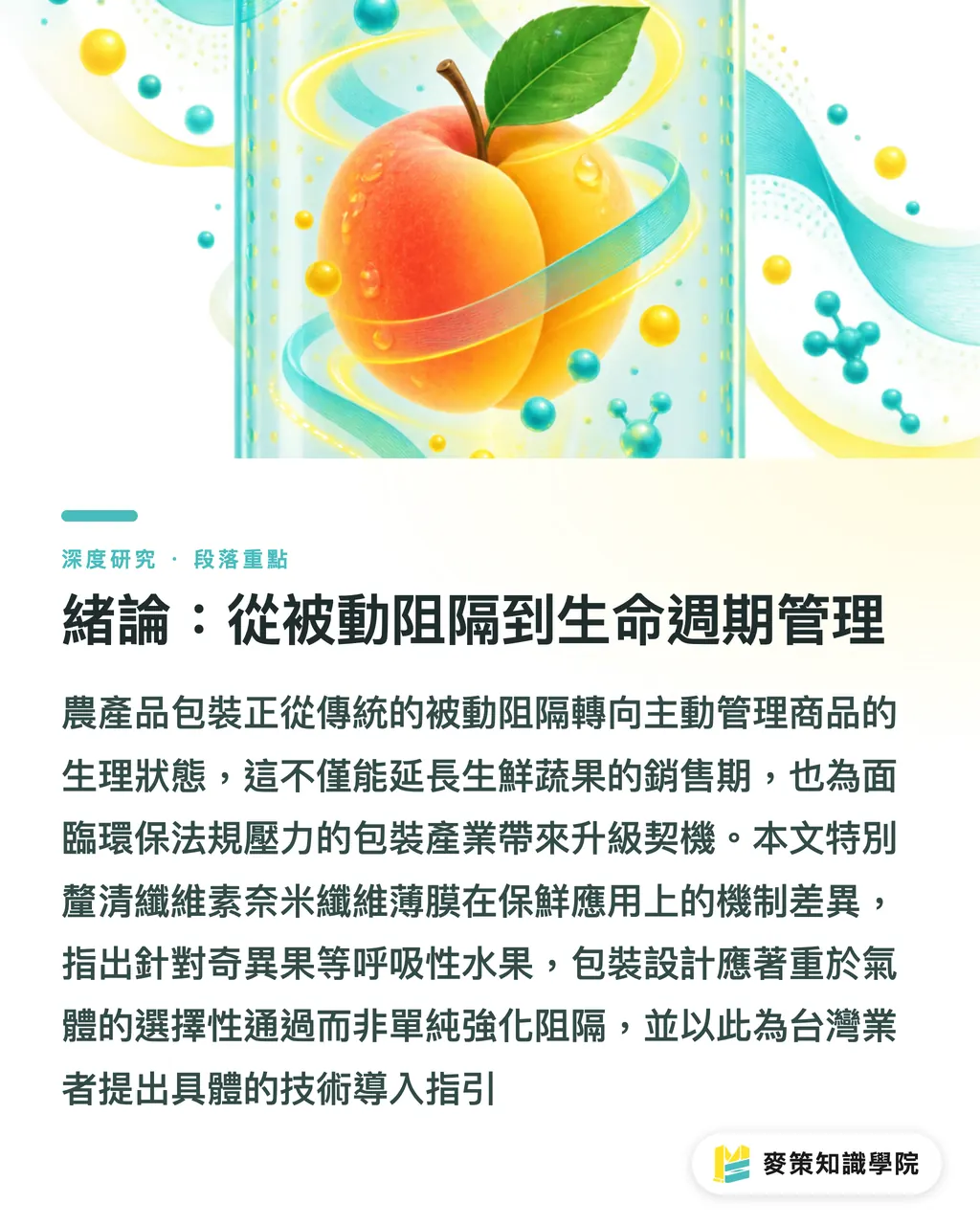
Introduction: From Passive Barriers to Lifecycle Management
Produce packaging is shifting from protecting goods to managing their physiological state. Traditional food packaging relies on passive barriers: multilayer composite films that block oxygen, moisture, and light to seal items in an inert environment. Active packaging works in reverse. It makes packaging materials participate directly in the chemical and biological reactions of the contents, such as scrubbing ethylene, releasing antimicrobials, or adjusting gas permeability based on surrounding conditions. Recent industry intelligence indicates that packaging films made from nanofibers can extend the shelf life of fresh produce like kiwifruit, driven by a combination of breathability control and antimicrobial preservation [1]
This shift holds triple significance across the industry:
・First, produce loss occurs at every stage of the supply chain. Any material that buys an extra 2 to 3 days of sales window immediately rewrites the cost structure of export cold chains
・Second, regulations such as the EU PPWR push for mono-materials and recyclable designs. This puts structural pressure on traditional multilayer lamination used for barrier properties, restoring the strategic value of bio-based single-layer functional films
・Third, for Taiwan's printing and flexible packaging converters, applying functional layers shifts processing value from decorative printing to functional coating. This represents one of the few upgrade paths not yet monopolized by corporate giants
Yet current discussions contain an obvious blind spot. In public literature, empirical evidence for cellulose nanofiber (CNF) films is heavily concentrated in non-climacteric products like raw fish, bakery goods, and milk-protein matrices, where deterioration stems primarily from microbial growth and lipid oxidation [3][5][6]. In contrast, climacteric fruits like kiwifruit, bananas, and avocados deteriorate due to ripening driven by autocatalytic ethylene signals. They do not need absolute barriers, but rather selective gas permeability. These two demands point to nearly opposite material designs, yet existing reviews often lump them together under the generic label of 'CNF preservation films'
This article makes three specific contributions, each aligned with a main section:
・First, it regroups CNF food packaging literature from 2019 to 2023 into three technical paths: hydrophobization, antimicrobial integration, and controlled release with structural reinforcement. It clarifies how they diverge and complement each other in targeting specific degradation mechanisms (see Literature Review)
・Second, it breaks down the hypothesized mechanisms of CNF films on climacteric fruit, distinguishing findings backed by empirical evidence from inferences extrapolated from non-climacteric models (see Mechanism Analysis)
・Third, it outlines practical adoption sequences and cost criteria for three key stakeholders in Taiwan's design and printing industry: SME packaging printers, packaging designers, and brand owners (see Industry Implications)
Definitions of Terms
To prevent terminology drift, the following definitions are used throughout this paper
・Cellulose nanofiber (CNF): Cellulose fibers with nanoscale diameters obtained by mechanical or chemomechanical fibrillation of plant fibers. Characterized by high aspect ratios and specific surface areas, CNF can self-assemble into dense films or act as a reinforcing phase in composite films. This article strictly uses CNF and does not conflate it with cellulose nanocrystals (CNC)
・Active packaging: Packaging systems where the material actively releases or absorbs specific substances to preserve the quality of the contents, distinct from passive barrier packaging that only provides physical separation
・Shelf life: The period during which a product maintains marketable quality under specified storage and transport conditions. When citing studies, this paper explicitly notes test conditions and avoids direct comparisons across differing setups
・Climacteric fruit: Fruits whose ripening process involves a respiratory peak and autocatalytic ethylene production, such as kiwifruit, bananas, and avocados
Literature and Industry Review: Three Diverging Technical Paths
Recent literature on CNF food packaging is not a single continuous line of inquiry, but three distinct sets of technical experiments with different targets. This section groups them by technical objective and explains how each relates to our overall analysis
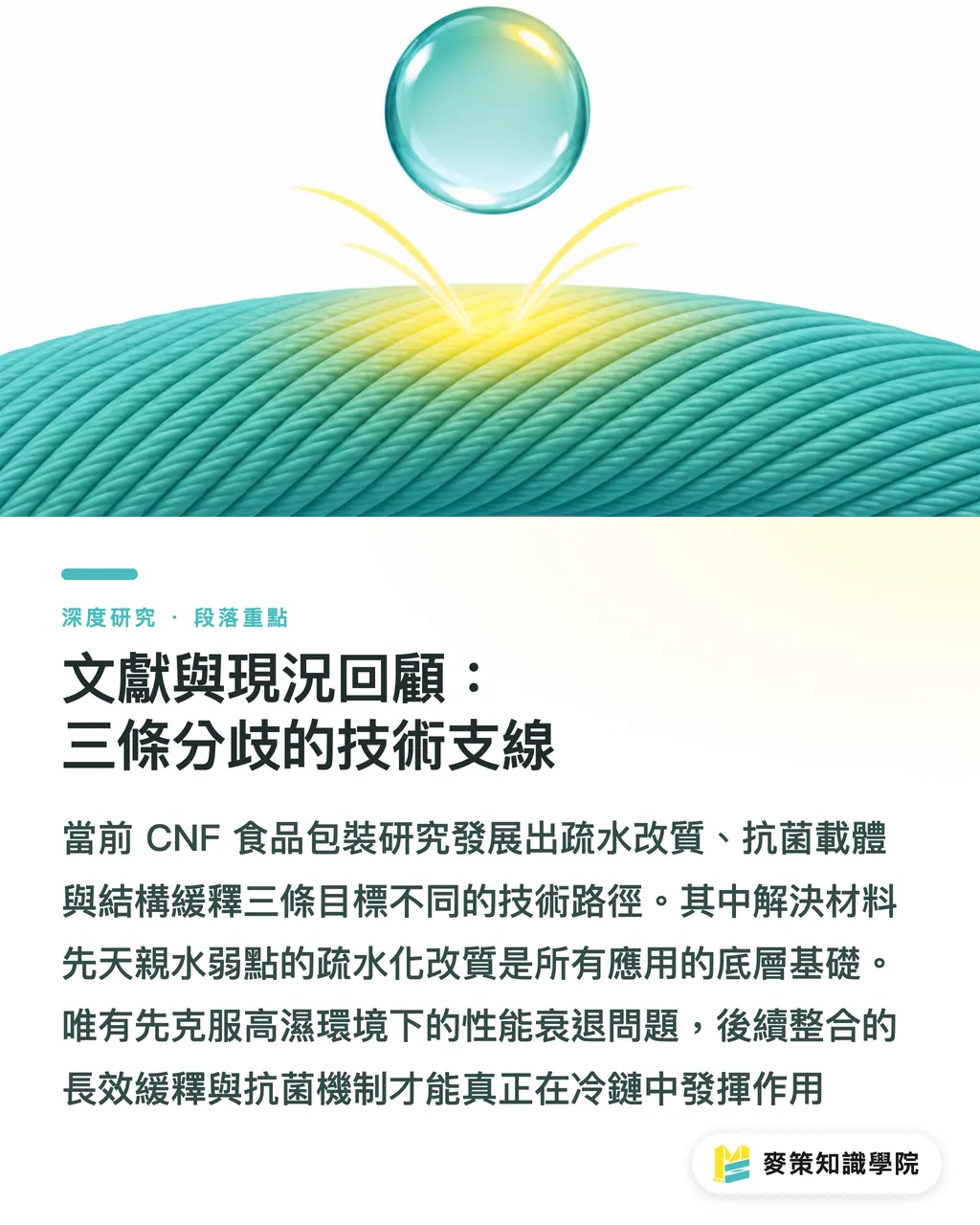
Path 1: Hydrophobic Modification to Overcome Inherent Weaknesses
The main bottleneck for CNF as a packaging material is hydrophilicity. Abundant hydroxyl groups on the cellulose surface cause CNF films to absorb moisture, swell, and lose mechanical strength in high-humidity conditions, which is the exact environment inside fresh produce packaging. Balasubramaniam et al. (2020) modified CNF film surfaces with fatty acids to develop renewable, hydrophobic packaging materials [2]. The value of this approach lies in grafting hydrophobic groups onto the surface without altering the bulk CNF structure, improving moisture resistance while retaining bio-based, biodegradable properties
These studies consistently point out that CNF barrier performance destabilizes under fluctuating humidity. This path is a prerequisite for any fresh produce application. Without resolving moisture-induced degradation, subsequent antimicrobial or gas-regulating features cannot function in real cold chains. We view hydrophobization as the foundational layer of the technology stack rather than an optional parallel branch
Path 2: Antimicrobial Integration to Turn Packaging into an Active Interface
The second group uses CNF as a carrier matrix for antimicrobial compounds. Kim et al. developed composite films combining CNF with deacetylated quaternary chitosan to inhibit Listeria monocytogenes in raw salmon [3]. An earlier study by the same team focused on extending raw salmon shelf life [4]. Both papers show that pairing CNF with cationic chitosan builds antimicrobial functionality directly into a single film structure, removing the need for separate antimicrobial pads or modified atmosphere packaging
Caution is needed when interpreting these results. Inhibiting Listeria addresses microbial spoilage in non-respiring, high-protein, high-water-activity seafood. This mechanism is only partially transferable to climacteric fruit. It explains how CNF films inhibit surface mold and bacteria, but fails to explain how internal fruit ripening is delayed. In other words, these studies back the preservation claims from industry reports [1], but do not address gas permeability control
Path 3: Controlled Release and Reinforcement with CNF as a Functional Phase
The third group treats CNF as a functional additive within composite films rather than the primary base. Ranjbaryan et al. incorporated CNF into sodium caseinate films activated with nanoemulsified cinnamon essential oil, demonstrating that CNF provides both mechanical reinforcement and controlled release [5]. This has broad mechanistic value. The high-aspect-ratio network of CNF strengthens the substrate while lengthening the diffusion path of active agents, turning rapid burst evaporation into sustained slow release
In 2021, Shih and Zhao used CNF to reinforce starch-based biocomposite films, creating and validating an edible muffin liner [6]. The value here lies not in preservation claims, but in completing the full cycle of formulation, characterization, and physical prototyping. It proves CNF composite films can meet the specifications of formed packaging rather than staying stuck as lab-scale cast sheets
This group connects most directly to our analysis. Controlled release is what allows active packaging to remain effective across the entire logistics cycle instead of just at packing. If antimicrobial or antioxidant agents deplete within 48 hours, they offer zero value for produce exports requiring 3 to 6 weeks of ocean transit. The controlled-release capability of CNF is far more valuable to industry than raw barrier metrics
Closing the Research Gap
Synthesizing these three paths, published literature supports clear conclusions: surface modification improves CNF moisture resistance [2], antimicrobial additives inhibit bacteria on seafood [3][4], and CNF acts as a controlled-release reinforcing phase in composite films and molded products [5][6]. Yet every test matrix in these studies is non-climacteric. Industry intelligence claims nanofiber films offer breathability control and antimicrobial preservation to extend kiwifruit shelf life [1], but peer-reviewed literature lacks the gas selectivity data needed to verify this. We will explore the gap between these commercial claims and published empirical data
Mechanism Analysis: Climacteric Produce Demands Selectivity, Not Total Sealing
This section first defines the deterioration pathways of climacteric fruit, then analyzes where CNF films can intervene, and concludes by mapping the limits of current evidence
Deterioration Pathways Define Material Requirements
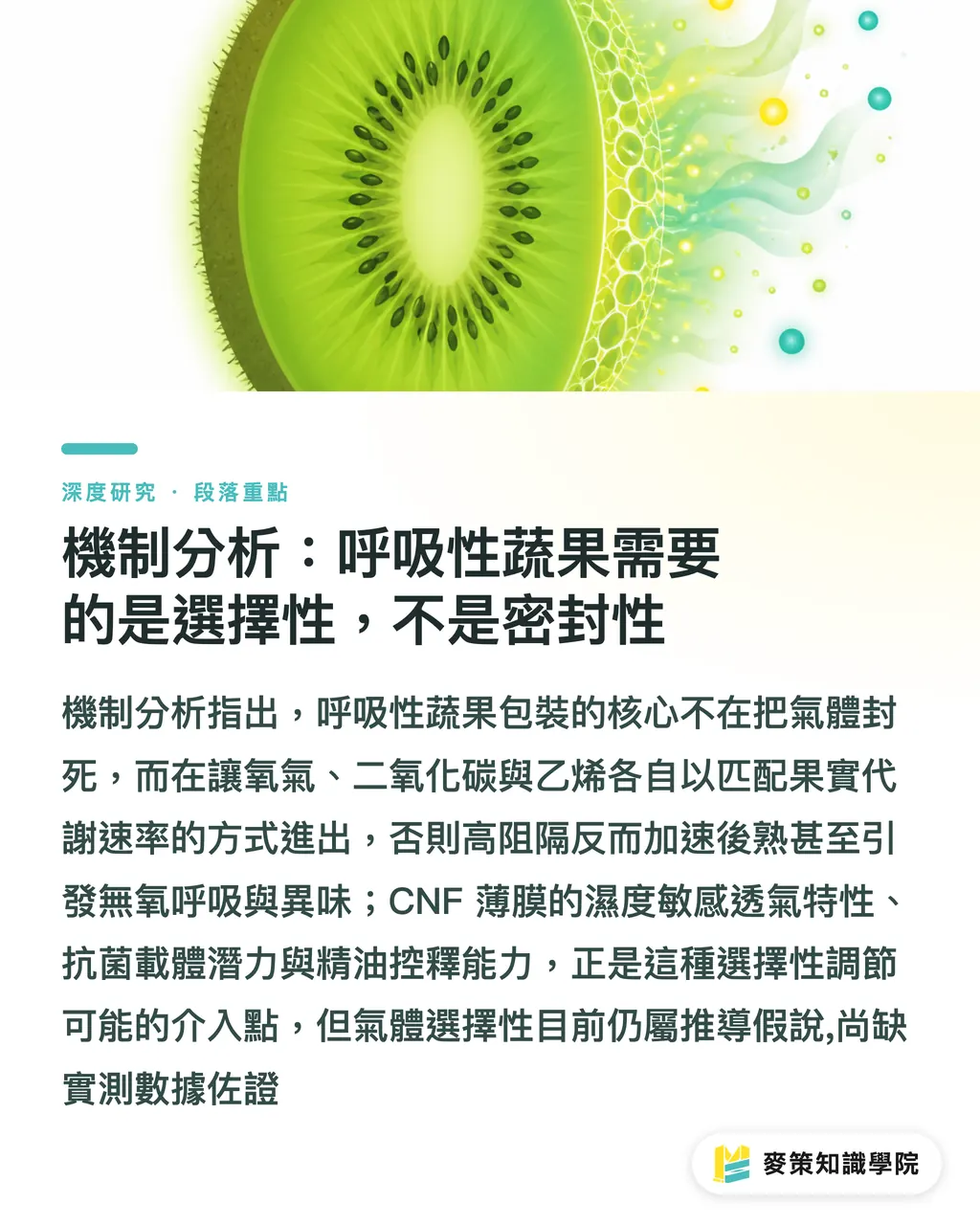
Kiwifruit is a classic climacteric fruit whose ripening is driven by autocatalytic ethylene. As the fruit produces ethylene, that gas triggers even greater ethylene output in a positive feedback loop. If packaged in high-barrier materials, trapped ethylene accumulates and accelerates softening. At the same time, ongoing respiration consumes oxygen and generates carbon dioxide. If oxygen drops too low, the fruit shifts into anaerobic respiration, producing ethanol and acetaldehyde that cause off-flavors and internal breakdown
Produce packaging targets are not about achieving the lowest possible transmission rates, but about balancing three distinct gas fluxes. Oxygen transmission must match the fruit's respiration rate, carbon dioxide must escape to prevent toxic buildup, and ethylene must be removed or blocked. Because a single film must allow different gases to pass at different rates, material design must focus on gas selectivity
Three Potential Intervention Points for CNF Films
The first intervention point is gas selectivity. Dense CNF networks provide high oxygen barrier properties under dry conditions, but transmission rates change drastically with relative humidity. While this humidity sensitivity is a flaw in passive packaging, it could serve as a dynamic regulation mechanism in active packaging. As transpiration raises internal package humidity, film permeability shifts, creating passive self-regulation. We must state clearly: this is a theoretical hypothesis derived from CNF hydrophilic properties. None of the cited literature measures gas selectivity for climacteric fruit, so this hypothesis remains unverified. In addition, hydrophobic modification with fatty acids [2] suppresses humidity responsiveness, pointing to an unexplored design trade-off between water resistance and self-regulating breathability
The second intervention point is antimicrobial preservation. Softened kiwifruit is vulnerable to fungal pathogens like Botrytis cinerea (gray mold). Composite films of CNF and cationic chitosan effectively inhibit Listeria growth by disrupting cell membranes with cationic charges [3]. This antibacterial mechanism cannot be directly extrapolated to fungi without specific testing. From a material architecture standpoint, however, using CNF as a carrier matrix for active agents is fully transferable
The third intervention point is controlled release of active agents. When using essential oils to suppress surface pathogens or block ethylene receptors, sustained release matters far more than initial dosage. Ranjbaryan et al. showed that CNF reinforces sodium caseinate films while regulating the release of nanoemulsified cinnamon oil [5]. This proves that CNF networks extend the release curves of volatile active compounds, aligning with ocean export timelines. For Taiwan exporting mangoes, atemoyas, or imported kiwifruit distribution across 25 to 40-day reefer voyages, sustained release is far more vital than a one-time antimicrobial burst
The Chasm Between Lab Castings and Roll-to-Roll Production
Shih and Zhao carried starch-based CNF composite films through formulation, characterization, and application testing to produce edible muffin liners [6]. The real value of this work is proving converting feasibility: the composite film endured folding, molding, and baking without failing. This proof of convertibility is missing from most materials literature, yet it is the exact data flexible packaging printers need
Substantial hurdles remain. Lab films are typically solvent-cast in small centimeter-scale batches with drying times measured in hours. Commercial flexible packaging runs on wide-web coating or blown-film lines at tens to hundreds of meters per minute. Aqueous CNF dispersions have low solid content and high viscosity, demanding massive energy for drying. Standalone CNF films cannot compete with PE or PP on energy costs. The practical near-term path is a coating approach: applying CNF functional layers inline onto existing substrates rather than producing all-CNF films. This fits directly into Taiwan's flexible packaging lines
Implications for Taiwan's Design and Printing Industry
This section outlines actionable steps for SME packaging printers, packaging designers, and brand owners. Taiwan's agricultural exports rely heavily on sea freight to Japan and Southeast Asia, where end-mile cold chain temperature and humidity fluctuate. Under these conditions, materials that add 2 to 3 days of shelf life carry immediate commercial value
SME Printers: Transitioning from Print Providers to Functional Coaters
A practical roadmap includes the following steps:
・Audit existing coating capacity: Most mid-sized flexible packaging plants already operate varnish or coating stations. Aqueous CNF dispersions share rheological traits with water-based varnishes, meaning machine modifications are far smaller than building dedicated coating lines. Start with small-batch trials on existing presses to test whether solid content, viscosity, and drying tunnel lengths are sufficient
・Focus on functional coatings, not standalone films: Producing standalone CNF films is too energy-intensive. Applying functional coatings over standard base films significantly lowers capital investment and production risk
・Build humidity-controlled testing protocols: Literature proves that CNF degrades under high humidity, which requires hydrophobic surface modification [2]. Before accepting functional coating orders, printers should set up barrier testing at 25°C and 90% RH to avoid field failures after customer delivery
・Manage timelines and costs: Dialing in coating parameters typically takes several months of trials. Small and medium converters should not bet on a single client order. Instead, partner with brands or research institutes on co-development agreements to share trial expenses
Packaging Designers: Write Function into Specs, Not Marketing Copy
Active packaging features are invisible, making design integration challenging. Designers should make three adjustments:
・Specify functional layer placement and area in tech packs: Functional coatings usually go on the inner contact surface while graphics sit on the outer layer. Designers must verify that inks, laminating adhesives, and functional coatings do not cross-contaminate or interfere with each other, an issue often overlooked in standard graphic design workflows
・Avoid unverified consumer claims: Antimicrobial and freshness preservation performance depends heavily on storage conditions. Published inhibition metrics were tested under specific temperatures and pathogen strains [3][4]. Packaging copy must not turn lab data into sweeping shelf-life promises
・Reserve layout space for technical verification: If a brand plans to disclose third-party test data, allocate space for QR codes or explanatory callouts during initial dieline layout instead of slapping on corrective stickers later
Brand Owners: Evaluate by Shrinkage Rates, Not Packaging Unit Cost
The most common mistake brand owners make is evaluating packaging solely on cost per square meter. The true benchmark is the change in landed quality and rejection rates. Functional materials will always cost more than basic PE bags per unit. If a functional coating cuts sea-freight spoilage by even a few percentage points on premium produce, the net financial return turns positive. Run controlled split-shipments on the same harvest batch, record port-of-entry quality grading and rejection figures, and calculate the maximum justifiable packaging budget from real shrinkage savings. This evaluation takes a full shipping cycle, typically 1 to 2 months
Regulatory compliance must be evaluated upfront. If antimicrobial agents or essential oils migrate into food, they fall under food contact material regulations. Standards in export destination markets often differ from domestic rules. Brands must verify target-market food contact regulations during early material selection rather than scrambling right before export shipments
Conclusions and Limitations
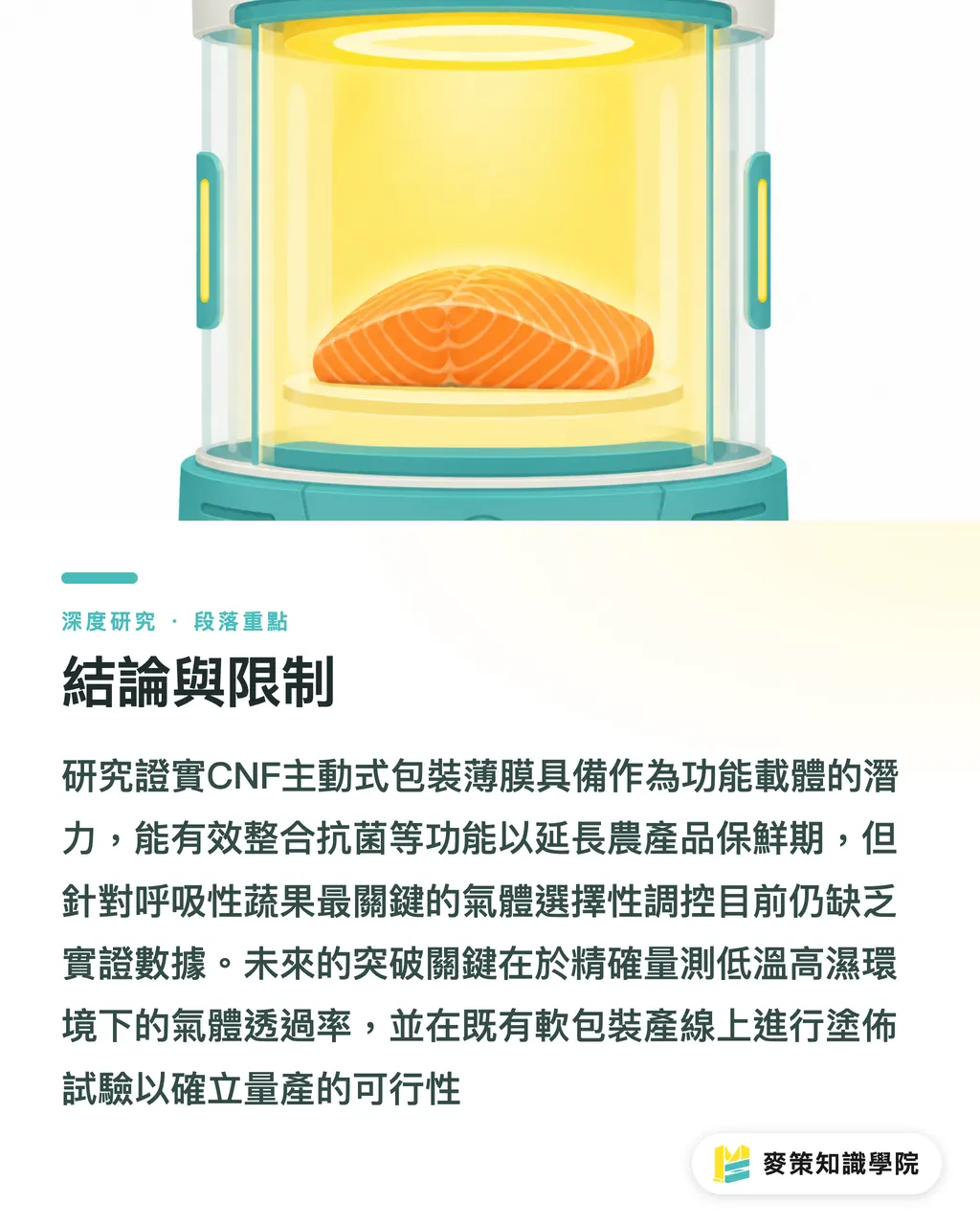
Synthesizing the evidence, CNF active packaging films represent a viable path for extending produce shelf life under specific operating conditions. The technical basis for CNF as a functional carrier is supported by empirical data: surface hydrophobization addresses its moisture vulnerability [2], compounding with cationic chitosan introduces antimicrobial properties validated on raw salmon [3][4], inclusion in composite films provides both reinforcement and controlled release [5], and molded packaging forms have been successfully fabricated [6]. Industry reports claim shelf-life extension for kiwifruit [1]. However, peer-reviewed literature lacks verified data on gas selectivity, which is the most critical factor for climacteric fruit. This mechanism remains a working hypothesis rather than an established fact
This review has three main limitations:
First, literature scope constraints. The peer-reviewed studies examined here span 2019 to 2023 and originate primarily from Food Packaging and Shelf Life [2][3][5][6], along with a related preprint [4]. This creates a concentration of evidence around specific research groups and journals, omitting alternative pathways across wider materials science and agricultural engineering literature. Dedicated studies on modified atmosphere packaging for climacteric fruit were not included, which is why our conclusions on this topic remain strictly hypothetical
Second, boundaries of matrix extrapolation. The antimicrobial and controlled-release data cited here come from raw salmon [3][4], sodium caseinate systems [5], and starch-based bakery liners [6]. These matrices differ fundamentally from fruits like kiwifruit in water activity, pH, surface microflora, and respiration. Antimicrobial findings are partially transferable to fresh produce, but ripening retardation mechanisms are not. Readers should not cite our conclusions beyond these explicit limits
Third, verification level of industry reports. Source [1] is an industry news report where raw methodologies, sample sizes, and statistical validation were unavailable. We could not verify key operational parameters such as exact days gained or test temperatures and humidities. We cite this source purely as qualitative evidence of commercial interest without relying on unverified quantitative claims
Three concrete directions for future research stand out:
・First, measure the transmission rate matrix of CNF films for oxygen, carbon dioxide, and ethylene across 5°C to 15°C and 70% to 95% RH to establish gas selectivity ratios. This is the missing empirical link needed to assess CNF viability for climacteric fruit
・Second, quantify the relationship between fatty-acid hydrophobization levels and gas transmission rates to test our hypothesis of a trade-off between water resistance and self-regulating breathability
・Third, run inline coating trials of CNF functional layers on existing flexible packaging lines. Tracking line speeds, drying energy consumption, and coating uniformity will establish real industrial benchmarks. This requires no new chemistry, can be executed immediately by Taiwan's packaging converters, and offers far greater commercial value than another lab-scale characterization paper
Key Takeaways
Empirical evidence for CNF film preservation is concentrated in raw seafood and bakery products. Peer-reviewed data on gas selectivity for climacteric fruit is still missing
Packaging for climacteric fruit requires balanced transmission rates of oxygen, carbon dioxide, and ethylene, rather than an aggressive barrier seal
The controlled-release properties of CNF in composite films matter far more for 25 to 40-day export sea voyages than a single initial antimicrobial burst
The practical entry point for Taiwan's SME flexible packaging converters is inline functional coating, not building dedicated full-CNF film extrusion lines
Brand owners should evaluate functional packaging by comparing landed quality and rejection savings against material premiums, not by raw cost per square meter
Further Perspectives
In printing and manufacturing, active packaging shifts the competitive battlefield from graphic fidelity to coating stability. For Taiwan's existing coating infrastructure, this is an opportunity rather than a threat. The key is establishing high-humidity test protocols so functional claims can be verified and audited by brand clients. For packaging designers, functional coatings rewrite structural constraints. When the inner contact layer is occupied by active chemistry, ink and adhesive compatibility becomes an upfront engineering spec rather than an afterthought. Integrating AI accelerates parameter discovery across CNF dispersion solids, viscosity, coating speed, and drying profiles, saving months of trial-and-error. On the software side, supply chains lack a unified data layer linking cold-chain sensor logs, packaging specs, and landed quality grading. Today, shrinkage data remains scattered across customs filings and customer complaint emails, making it difficult to calculate true packaging ROI. Two major hurdles remain. First, standardized industrial testing for gas selectivity does not yet exist, preventing apples-to-apples comparisons between competing films. Second, regulatory criteria for active substance migration vary across export markets, creating compliance barriers before volume scaling can begin
References
[1] Active Packaging Evolution: How Nanofiber Films Effectively Extend Produce Shelf Life
[2] Balasubramaniam S., Patel A., Nayak B. (2020). Surface modification of cellulose nanofiber film with fatty acids for developing renewable hydrophobic food packaging. Food Packaging and Shelf Life. DOI: 10.1016/j.fpsl.2020.100587
[3] Kim Y., Kim H., Yoon K., et al. (2023). Cellulose nanofiber/deacetylated quaternary chitosan composite packaging film for growth inhibition of Listeria monocytogenes in raw salmon. Food Packaging and Shelf Life. DOI: 10.1016/j.fpsl.2023.101040
[4] Kim Y., Kim H., Yoon K., et al. (2022). Cellulose Nanofiber/Deacetylated Quaternary Chitosan Composite Packaging Film for Extending the Shelf Life of Raw Salmon. SSRN Electronic Journal. DOI: 10.2139/ssrn.4255460
[5] Ranjbaryan S., Pourfathi B., Almasi H. (2019). Reinforcing and release controlling effect of cellulose nanofiber in sodium caseinate films activated by nanoemulsified cinnamon essential oil. Food Packaging and Shelf Life. DOI: 10.1016/j.fpsl.2019.100341
[6] Shih Y., Zhao Y. (2021). Development, characterization and validation of starch based biocomposite films reinforced by cellulose nanofiber as edible muffin liner. Food Packaging and Shelf Life. DOI: 10.1016/j.fpsl.2021.100655
FAQ
- Can nanofiber films really extend the shelf life of kiwifruit?
- Industry reports indicate that packaging films made from nanofibers can extend the shelf life of fresh produce like kiwifruit through gas permeability control and antimicrobial preservation. In peer-reviewed literature, however, preservation evidence for cellulose nanofiber (CNF) films comes primarily from raw salmon and bakery matrices. Experimental data on gas selectivity for climacteric fruit is currently lacking
- What is the biggest technical hurdle to using cellulose nanofibers (CNF) in food packaging?
- Hydrophilicity. Abundant hydroxyl groups on the cellulose surface cause CNF films to absorb moisture, swell, and lose barrier performance in high-humidity environments, which is the exact condition inside fresh produce packaging. The primary solution today is surface hydrophobic modification using fatty acids
- How does active packaging differ from standard high-barrier packaging?
- Standard high-barrier packaging acts as a passive barrier to isolate contents from the external environment. Active packaging engages directly with the internal atmosphere by releasing antimicrobial agents, scrubbing ethylene, or adjusting gas transmission based on surrounding conditions. For climacteric produce, total barrier sealing can actually speed up ripening by trapping ethylene inside
- How can Taiwan's SME flexible packaging converters adopt these functional films?
- The practical path is applying CNF as a functional coating rather than investing in dedicated full-CNF extrusion lines. Most mid-sized converters already have varnish or coating stations. Because aqueous CNF dispersions handle similarly to water-based varnishes, machine modifications remain minimal. Before commercial rollout, plants should establish testing protocols for barrier performance under high-humidity conditions
- How should brand owners assess the return on investment for functional packaging?
- Evaluate returns by measuring changes in landed quality and customer rejection rates rather than comparing unit cost per square meter. A proven method is running split-shipments with control groups on the same harvest batch, tracking landed quality grades and defect data, and calculating the allowable packaging cost ceiling from total shrinkage savings. This evaluation typically requires a full one to two-month shipping cycle
Related articles


The Print × AI weekly
The print and AI know-how designers, brands and enterprises can use before they commit — one email, every week
MINDS Free Tools
Imposition calculator and preflight file check — free prepress tools, right in your browser.
MINDS Group
Need actual printing or gifting services?
From premium printing to online ordering and festive gifts — the MINDS Group sister brands take it from here.