

Introduction: Framing the Problem of Moving from Planar Fibers to Three-Dimensional Structures
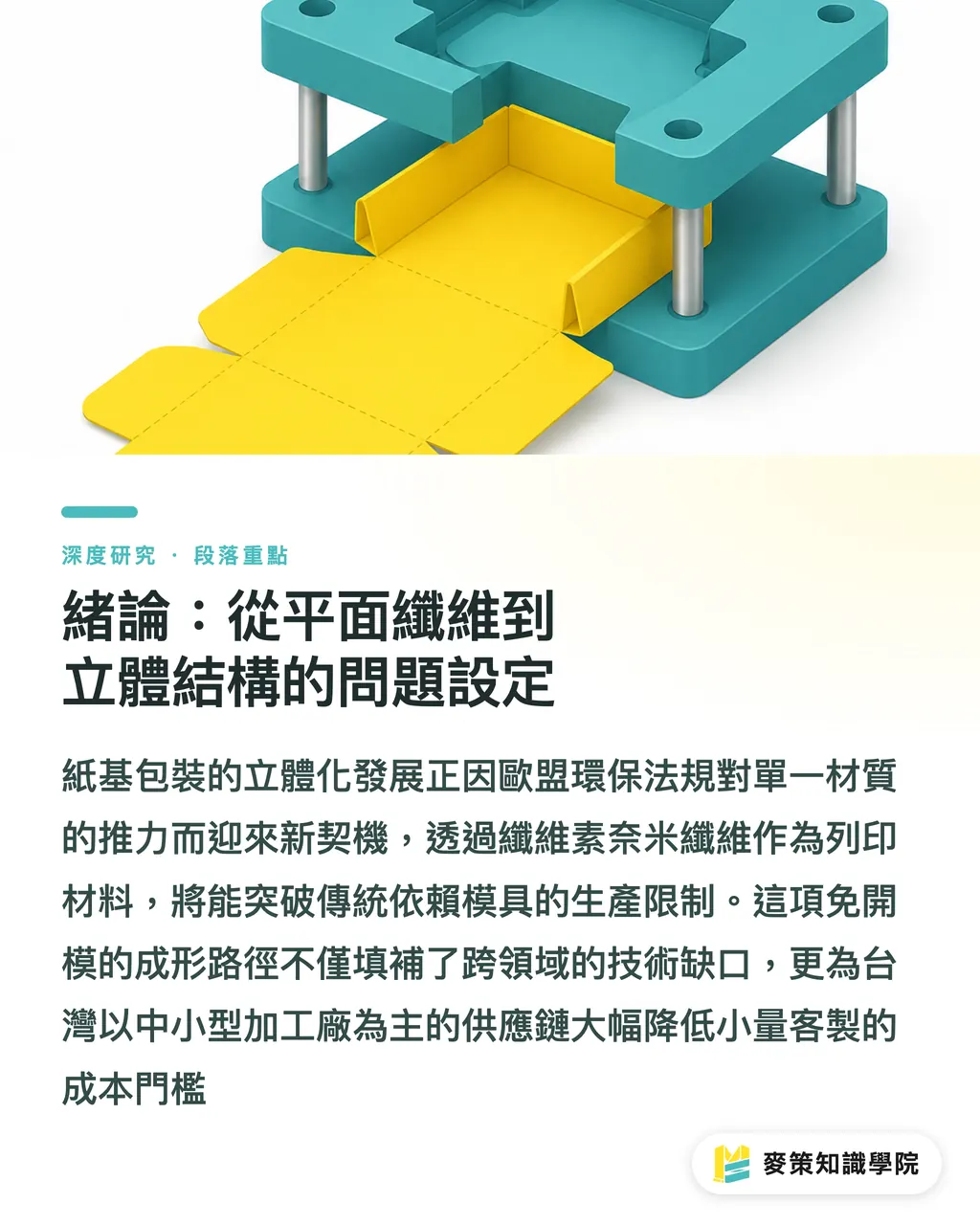
Can pulp only be used for planar packaging? It sounds like a materials-science question, but in practice it cuts across forming processes and industrial economics. The core logic of papermaking is that suspended fibers are dewatered on the forming section, then pressed and dried into a planar interwoven fiber network. That route naturally leads to two-dimensional sheets. The packaging industry has long met the need to give paper three-dimensional form through three established methods: die cutting followed by folding, wet-pressed molded pulp, and paperboard laminating and pasting. All three share one premise: the mold comes first
That mold-first premise is being loosened by regulatory pressure and market structure at the same time. The EU's Packaging and Packaging Waste Regulation (PPWR) has moved into the formal legislative phase, setting out systematic requirements for packaging recyclability by design, minimization, and recycled content [2]. The European Commission's environment pages on packaging waste likewise identify packaging reduction and design for recyclability as core policy directions [3]. This article argues that the regulatory preference for mono-material packaging works in favor of three-dimensional paper-based forming: if a pure-cellulose structural component can replace an EPE or EPS cushioning insert in a paper box, the entire package can remain in a single-material stream, and the recycling sorting stage no longer has to handle composite materials
The literature on cellulose nanomaterials has focused mainly on the relationship among film barrier performance, crystallinity, and mechanical strength, as well as dispersion behavior when they are used as the reinforcing phase in composite materials. The shared morphological assumption is still film or coating. Meanwhile, research on bio-based materials in the additive manufacturing literature has largely focused on melt deposition of thermoplastic bioplastics such as PLA and PHA, which belong to a different process family from water-based pulp formulations. Empirical studies that treat cellulose nanofibers as the core variable in printing rheology have mostly appeared in food-science journals. As a result, the packaging field lacks directly citable evidence for the rheological mechanism, and knowledge from the two fields has not yet been fully integrated
This article makes three contributions, each corresponding to a section of the main text:
・First, it reinterprets the empirical findings from food hydrogel printing on how cellulose nanofiber (CNF) regulates nonlinear rheology and structural stability [1] in the technical context of packaging structural components. It identifies where the mechanism can and cannot be transferred at the mechanistic level, corresponding to the section titled Breaking Down the Mechanism
・Second, using the PPWR preference for mono-material packaging and the methodological limitations of packaging life cycle assessment as its framework [2][4], it evaluates where paper-based 3D printing genuinely stands in sustainability arguments. It separates two criteria that should not be conflated: material recyclability and overall environmental benefit, corresponding to the section titled The Limits of the Sustainability Case
・Third, it works out the practical implications of this technical pathway for Taiwan's small and medium-sized printing plants, packaging designers, and brand owners, including the product ranges to target, cost structure, and timing, corresponding to the section titled Implications for Taiwan's Industry
The importance of this topic to Taiwan's industry lies in its structural conditions. Taiwan's packaging supply chain is dominated by small and medium-sized processors. Although die and mold costs are not high on a per-unit basis, the minimum economical run for making a die or mold creates a real barrier to small-volume customization. Any forming route that can bypass tooling has greater marginal value in this industrial structure than in a market geared toward mass production
Literature and Current-State Review: Three Research Lines That Barely Intersect
This section divides the existing discussion into three groups and explains at the end of each group how it relates to the analysis here
First group: Performance-oriented research on cellulose nanomaterials. This line of research focuses on the relationship between crystallinity, fiber aspect ratio, and mechanical properties, as well as the environmental costs of extraction processes. Its central question is whether higher crystallinity brings better barrier performance and strength, with films, coatings, and composite reinforcement as the application endpoints. This group's contribution is to establish the performance ceiling of cellulose nanomaterials, but its morphological assumptions remain two-dimensional. The difference between that work and this article is simple: this article is not asking how good a film cellulose can make. It is asking what role cellulose plays during three-dimensional forming
Second group: Regulatory and assessment research on packaging sustainability. The PPWR establishes legal obligations for design for recyclability and packaging reduction [2], while policy documents from the EU's environment department position packaging-waste governance as a core circular-economy issue [3]. Running in parallel is a methodological debate over packaging life cycle assessment (LCA). Meta-analysis literature points out that differences in system boundaries and functional units between studies can significantly change the conclusions of material comparisons [4]. This group's contribution is to provide a framework for deciding what counts as sustainable, but it says almost nothing about specific forming processes. This article draws on it to set the validation threshold for the technical pathway and to avoid treating made of paper as a shortcut for environmentally better
Third group: Research on extrusion-based additive manufacturing with water-based formulations. This line appears mostly in food science and focuses on shape fidelity as edible or bio-based pastes are extruded and stacked. A recent study of soy protein isolate emulsion gels showed that adding cellulose nanofibers can regulate the system's nonlinear rheological behavior and improve the structural stability of 3D printing [1]. This group's contribution is direct evidence for a rheological mechanism. But its research motivation, acceptance criteria, and scale are all set by food applications, without considering the post-drying mechanical properties and service environment required of packaging structural components
The point of disagreement among the three bodies of literature is clear. The first treats cellulose's value as a property of the finished material, the third shows that its value may lie in controlling the transient state during forming, and the second supplies criteria that cannot be applied directly to either of the other two. The question none of the three has answered is whether cellulose nanofibers' rheological contribution in water-based extrusion forming still holds after the constraint of food edibility is removed and packaging service-performance requirements are added. This article takes up that question
Breaking Down the Mechanism: The Two Things CNF Does in Extrusion Forming
This section first defines the key term, then breaks down its role in the printing process. Cellulose nanofiber (CNF) refers to a cellulose material produced by mechanically or chemo-mechanically processing plant fibers into fibers with nanoscale diameters, typically a few to a few dozen nanometers, while retaining micrometer-scale lengths and a high aspect ratio. This article uses this wording consistently throughout
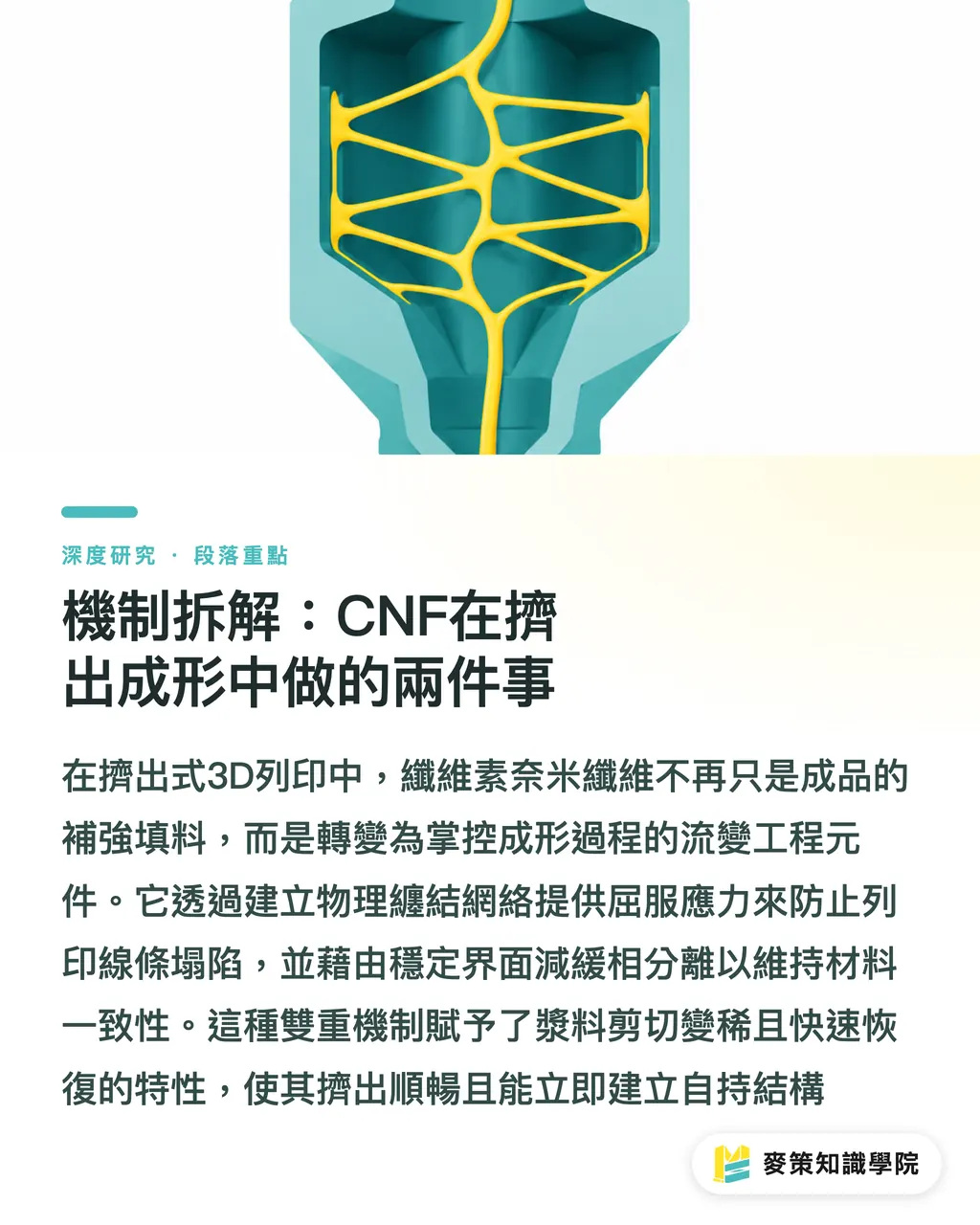
Extrusion-based 3D printing asks a material to satisfy a set of conflicting conditions. It must have low enough viscosity under shear inside the nozzle to extrude smoothly, then recover enough structural strength immediately after leaving the nozzle to support the layers above without collapsing. In rheological terms, this shear-thinning and rapid-recovery behavior depends on two parameters: yield stress and the rate of thixotropic recovery
The study of soy protein isolate emulsion gels showed that adding cellulose nanofibers altered the system's nonlinear rheological behavior and improved the structural stability of 3D printing [1]. For this article's argument, the significance is that it shifts cellulose nanofibers from being a reinforcing phase in the finished product to being a rheological engineering component in the forming process. The conventional view is that cellulose is a filler added to make the finished product harder. This study suggests that it can give the paste self-supporting behavior while it is being printed
This analysis breaks the mechanism into two effects. First is network bridging: high-aspect-ratio fibers form a physically entangled network in the continuous phase and give the system static yield stress. That explains why the lines do not collapse after leaving the nozzle. Second is interfacial stabilization: in an emulsion system, cellulose nanofibers can adsorb at the oil-water interface or hinder droplet coalescence, slowing phase separation and explaining why material consistency can be maintained during long print runs. Both effects depend on the fibers being well dispersed rather than agglomerated. That is also the main formulation-engineering challenge
When moving from food emulsion gels to packaging structural slurries, the continuous phase changes from an aqueous protein phase to a pulp suspension or cellulose hydrogel, but the physical principle that high-aspect-ratio fibers provide yield stress does not change with the medium. The acceptance criteria cannot be carried over directly. Food printing emphasizes shape fidelity over a short period, while packaging structural components must also meet requirements for compressive strength after drying, cushioning resilience, and dimensional stability
The Limits of the Sustainability Case: Recyclable Does Not Mean Better for the Environment
The intuitive sustainability advantage of paper-based 3D printing is that it uses a single material and can enter the paper recycling stream. Under the PPWR's requirements for design for recyclability, that is indeed a compliance advantage [2]. EU packaging-waste policy likewise emphasizes reduction and circular design [3]. But recyclability is only one dimension of the assessment
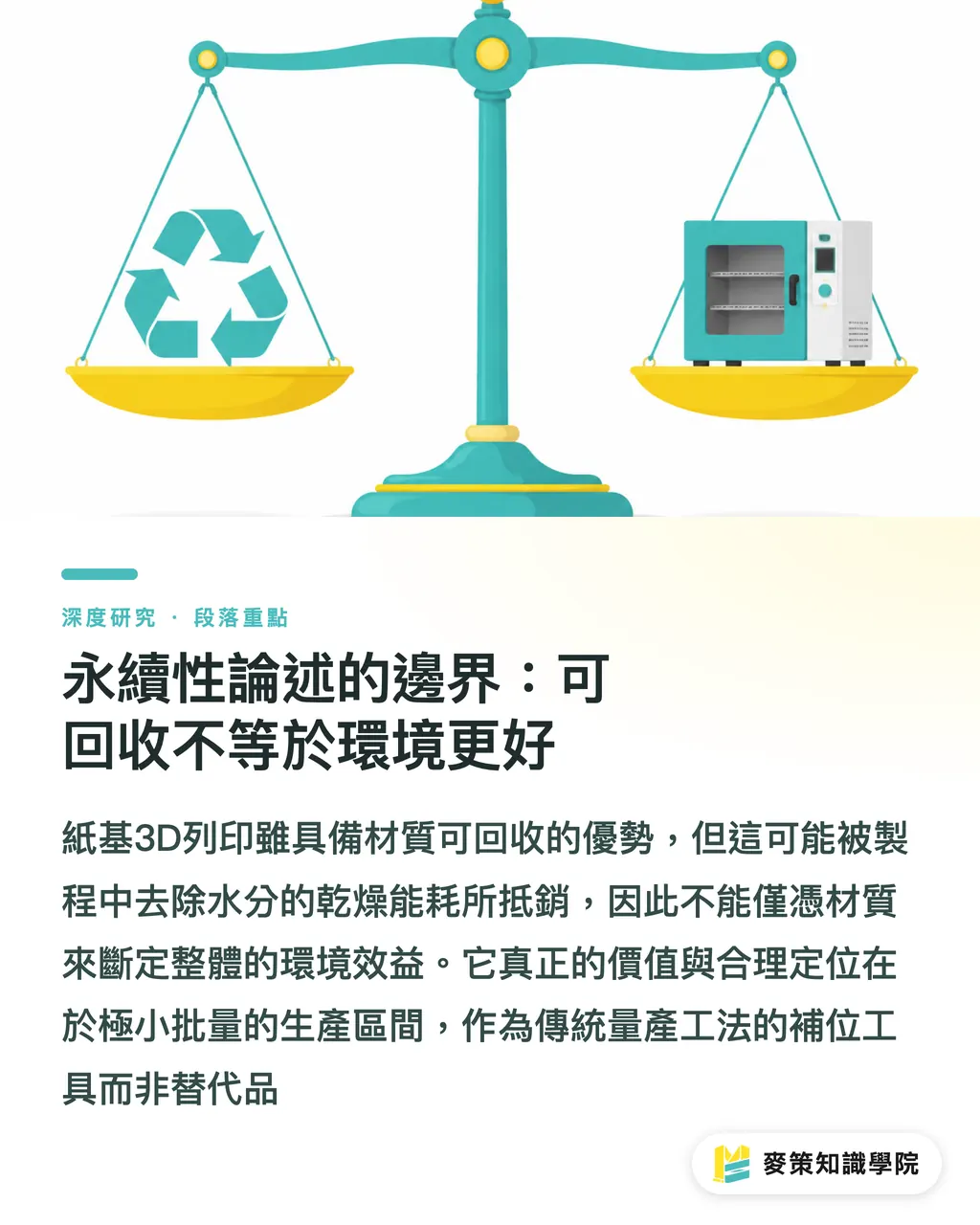
Meta-analysis literature on packaging life cycle assessment points out that differences in system boundaries and functional-unit definitions across studies can substantially sway comparisons between materials [4]. For this article's argument, the methodological warning is clear: the environmental benefit of a paper-based printed part cannot be judged from the material side alone. Energy use has to be counted. Water-based forming has a structural cost: drying. Removing water takes energy, and the drying rate sets an upper limit on throughput. Compared with melting and cooling thermoplastics, where the phase change is fast and there is no mass loss, drying a water-based cellulose system is a mass-transfer process with a much larger time constant
The sustainability advantage of paper-based 3D printing on the materials side may be partly offset by process-side drying energy and long run times. Actual environmental benefit has to be determined through a case-by-case LCA. It cannot be inferred from the material category alone. That is why material recyclability and overall environmental benefit must be assessed separately
The second boundary is scale. The economics of 3D printing are such that unit cost falls very little as batch size increases, while the unit cost of die cutting and molded pulp drops sharply as volume rises. The two cost curves must cross somewhere. Paper-based 3D printing is more sensibly positioned to the left of that crossover, in the very-small-batch range. It is better suited as a supporting tool for mass-production methods. Treated as a full replacement for die-cutting dies, it may deliver less value than expected
Implications for Taiwan's Design and Printing Industry: A Tiered Assessment
This section lays out the practical implications by role
For small and medium-sized printing plants. In the short term, paper-based 3D printing should not be evaluated as a production-line investment. It should be treated as a technology to watch and a capability to build for samples. There are three concrete moves:
・First, within existing molded-pulp or paper-box work, identify quote requests where the customer wants a custom-shaped retaining insert but the quantity is only a few dozen units. Track how often these requests occur and why the work is lost. That is the only reliable basis for deciding whether a future investment makes sense
・Second, open a technical dialogue with suppliers of existing desktop extrusion equipment. Ask specifically about nozzle-clogging rates and drying cycles for water-based slurries, not print resolution
・Third, break out tooling-cost amortization in the quotation process, so customers can see the cost structure of small runs. That step alone will filter for projects suited to the new process
For packaging designers. The implication is a redistribution of design freedom. Under die-cutting logic, three-dimensional structures are constrained by the topology of unfolding a single plane along fold lines. Any overhang, concavity, or continuous curved surface requires splitting the structure into multiple parts and joining them. If forming no longer depends on a mold, the design side can work directly with three-dimensional geometry. The practical approach this article recommends is to mark at the proposal stage which structural features are impossible with die cutting but feasible with additive manufacturing, and at the same time mark the risk level those features carry under drying shrinkage. Linear shrinkage in a water-based formulation is a variable that design has to build in. It is not a problem for the process side to compensate for afterward
For brands. The key is to screen use cases, not to judge the technology in the abstract. Three features mark the suitable range: a unit price high enough to absorb a higher per-unit cost, a quantity small enough that tooling is not worth it, and a structure complex enough that existing methods require multiple parts. Custom-shaped retainers for premium gift boxes, display stands for limited-edition products, and structural validation pieces at the prototyping stage all fit these three features. By contrast, cushioning inserts for everyday products in regular distribution should stay with existing processes in the short term. If a brand wants to use this technology in sustainability communications, this article's warning is straightforward: avoid unconditional claims of environmental superiority. LCA conclusions depend heavily on the system boundary [4], and an unassessed claim can become a compliance risk in sustainability messaging under the PPWR framework [2]
For forming and acceptance, a three-stage checklist can organize the evaluation. At the material stage, confirm that slurry rheology is stable and extrudable. At the forming stage, confirm that the stacked structure is self-supporting in the wet state. At the drying stage, confirm that shrinkage and final mechanical properties fall within the design tolerances. Each stage must be accepted independently. No stage should be passed on the grounds that a later stage can compensate for it. The value of this framework is that it exposes failure modes in water-based forming early, instead of discovering them only in the finished part
Conclusion and Limitations
For the question of whether pulp-based materials can only make planar packaging, the real issue is the choice of forming route. In water-based extrusion forming, cellulose nanofiber has shifted from a reinforcing filler to a rheological engineering component. Empirical research shows that it can regulate nonlinear rheology and improve the structural stability of 3D printing [1]. The physical principle does not depend on a particular medium, so it can in principle be transferred to packaging structural slurries. What transfers is the mechanism, not the acceptance criteria. Packaging components still have to pass tests for compressive strength, resilience, and dimensional stability after drying, and publicly available empirical data on this stage are currently scarce
This article has three specific limitations
First, the evidence base covers a narrow field. The core rheological evidence comes from a single study of food hydrocolloids [1], using soy protein isolate emulsion gels. Its continuous-phase chemistry, solids content, and particle-size distribution differ materially from those of a pulp suspension. The article's inference about transferability is an analogy at the level of physical principle. Without experimental validation in packaging-material systems, readers should not treat it as an established engineering conclusion
Second, the economic inference lacks local cost data from Taiwan. The analysis of the small-batch crossover is based on general cost-structure characteristics of additive manufacturing and mold-based forming. It does not include actual data on die costs, mold-opening fees for molded pulp, or equipment depreciation in Taiwan's printing and converting market. The exact location of the crossover therefore cannot be quantified. Only a directional judgment is possible. Any actual investment decision should be recalculated using local quotation data
Third, the regulatory inference is limited to the EU framework. The regulatory evidence cited here is the PPWR and EU packaging-waste policy [2][3]. The article does not empirically analyze whether the preference for mono-material design will be transmitted to Taiwanese suppliers through export chains, or how quickly and strongly that transmission will occur
There are three concrete directions for follow-up research:
・First, using solids content, fiber aspect ratio, and yield stress as independent variables, establish the relationship between rheological parameters of pulp-based printing slurries and the upper limit of wet-state stacking height. This is the most basic piece of work and can be completed at laboratory scale
・Second, measure linear shrinkage and the degree of anisotropy of different formulations under standardized drying conditions, and build a table of compensation coefficients that designers can use
・Third, for a specific product, such as one style of custom-shaped retaining insert, carry out a comparative LCA of paper-based 3D printing and molded pulp using the same functional unit. Disclose the system boundary clearly to address the comparability problem identified in existing LCA literature [4]
Key Takeaways
Cellulose nanofiber (CNF) in extrusion-based 3D printing is a rheological engineering component, not a reinforcing filler. It provides yield stress so that lines do not collapse after leaving the nozzle
Empirical work in food hydrocolloids shows that CNF can regulate nonlinear rheology and improve the structural stability of 3D printing. The principle can be transferred to packaging slurries, but the acceptance criteria cannot be carried over directly
The real position of paper-based 3D printing is as a solution for very small batches, high unit prices, and irregular structures. It is not a head-on competitor to die cutting or molded pulp in mass production
Single-material recyclability is a compliance advantage under the PPWR framework, but it is not the same as overall environmental benefit. The drying energy of water-based formulations must be included in the LCA
Linear shrinkage in water-based forming is a variable that design must build in. The risk level should be marked at the proposal stage, rather than left for the process side to compensate for afterward
Further Thoughts
For printing manufacturers, the near-term value of this technical pathway lies in sample making and prototyping, not production-line replacement. What needs to be done is to quantify how often small-volume irregular-structure quote requests occur and how often they are lost, so investment decisions rest on local data. For designers, the topological freedom that comes with removing the mold calls for a new design vocabulary, especially one that treats drying shrinkage as a design variable rather than a process error. A sensible entry point for AI is searching the formulation and parameter space. Rheological parameters, solids content, nozzle geometry, and drying curves make up a high-dimensional parameter space where experiments are expensive and the payoff from modeling is clear. That is a classic use case for accelerating the search with a surrogate model. At the SaaS layer, the opportunity lies in quotation and feasibility screening: turn questions such as whether this structure is feasible with a die, how much it would cost to make it additively, and how high the shrinkage risk is into a tool designers can query themselves at the proposal stage. Three questions remain open: the long-run print stability of pulp-based slurries, how predictable drying anisotropy is, and where the batch-size crossover actually falls under Taiwan's local cost structure
References
[1] Lin, Yang, and Liu (2027). Cellulose nanofibers regulate nonlinear rheological behavior and structural stability of soy protein isolate emulsion gels for 3D printing. Food Hydrocolloids. DOI: 10.1016/j.foodhyd.2026.113296
[2] EUR-Lex: Full text of the EU PPWR. EUR-Lex
[3] European Commission's Environment Directorate: EU packaging waste page. European Commission's Environment Directorate
[4] Mendeley (indexing a Journal of Cleaner Production paper): meta-analysis of packaging life cycle assessment. Mendeley (indexing a Journal of Cleaner Production paper)
FAQ
- Can pulp really be 3D printed into three-dimensional packaging?
- In principle, yes. Cellulose nanofiber (CNF) can give a water-based slurry yield stress, keeping extruded lines from collapsing as they are stacked. Empirical work in food hydrocolloids has shown that it can improve the structural stability of 3D printing. Packaging components still need to be validated for compressive strength and dimensional stability after drying, and publicly available empirical data are currently lacking
- What role does cellulose nanofiber play in 3D printing?
- It mainly does two things. First, network bridging: high-aspect-ratio fibers form a physically entangled network in the continuous phase and give the system static yield stress. Second, interfacial stabilization: it slows phase separation in emulsions and keeps the material consistent during long print runs. Its role is to regulate rheology during forming, not to reinforce the finished product
- Will paper-based 3D printing replace die cutting and molded pulp?
- Not in the short term. The unit cost of 3D printing falls very little as batch size increases, while the unit cost of die cutting and molding drops sharply with volume. There is a crossover point between the two cost curves. Paper-based 3D printing makes the most sense in the very-small-batch range to the left of that crossover, as a gap-filling tool rather than a replacement
- Is three-dimensional packaging made of paper automatically more environmentally friendly?
- Not necessarily. A single material does make sorting for recycling easier and fits the EU PPWR's design-for-recyclability requirements, but drying a water-based formulation takes energy, which can partly cancel out the advantage on the materials side. A meta-analysis of packaging LCAs found that differences in system boundaries and functional units can significantly affect the result. Environmental benefit therefore has to be assessed case by case, not inferred from the material category
- Should small and medium-sized printing plants in Taiwan invest in this technology now?
- At this stage, it is better treated as a technology to watch than as a production-line investment. Start with three things: track how often customers request custom-shaped retaining inserts in quantities of only a few dozen and why those jobs are lost, clarify nozzle-clogging rates and drying cycles for water-based slurries with extrusion-equipment suppliers, and break out tooling-cost amortization in quotations so projects suited to the process can be identified
Related articles


The Print × AI weekly
The print and AI know-how designers, brands and enterprises can use before they commit — one email, every week
MINDS Free Tools
AI background removal, a LINE sticker maker, spine & imposition calculators — all free, right in your browser, no upload.
MINDS Group
Need actual printing or gifting services?
From premium printing to online ordering and festive gifts — the MINDS Group sister brands take it from here.