
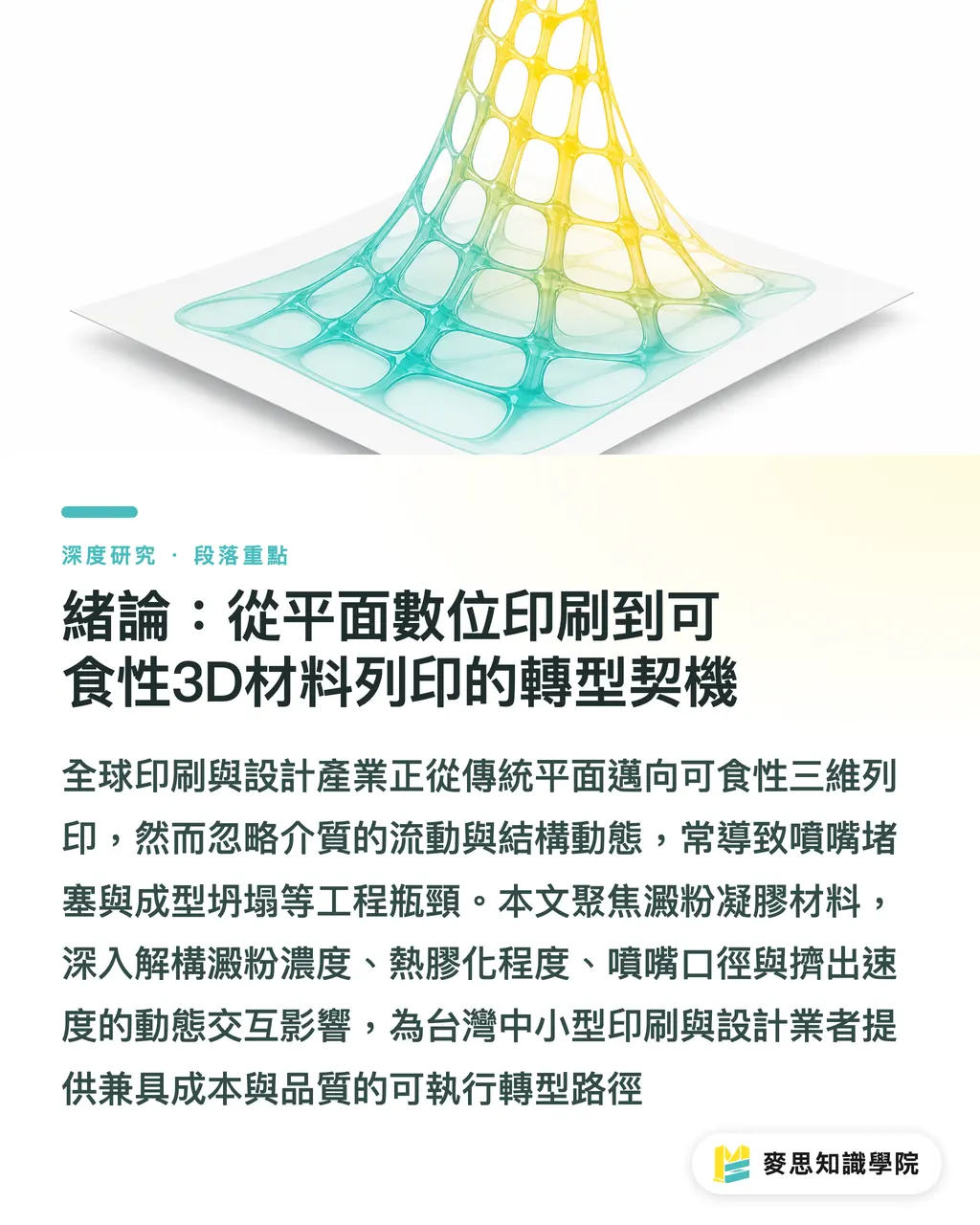
Introduction: Transitioning from 2D Digital Printing to Edible 3D Material Printing
The global design and printing industry is undergoing a major paradigm shift, extending from traditional flat media into 3D structural forming and customized functional materials. Driven by surging brand demand for personalized samples, eco-friendly edible packaging, and unique tactile experiences, 3D extrusion printing is gradually entering traditional printing and design workflows. In practice, however, many designers and print operators reduce 3D printing to pure computer-aided design (CAD) modeling. They overlook the physical and chemical dynamics of the printing medium, triggering frequent engineering bottlenecks like nozzle clogging, broken filaments, and post-layering structural collapse
Starch gel, a natural, renewable, and edible hydrocolloid, has become a popular matrix for 3D fresh samples, display models, and innovative packaging structures. Yet its rheological behavior under mechanical stress and temperature shifts is intricate. Forming quality does not hinge on a single variable. While the industry has accumulated rich experience in 2D printing process parameters and quality control, a marked gap remains in interdisciplinary research on how starch gel rheology dynamically impacts 3D printing accuracy. Existing discussions lean heavily toward pure food science formulation analysis, lacking systematic overviews that connect material rheological boundaries to print parameter control and design execution
To bridge this gap, this paper contributes three key insights:
・First, it systematically examines starch gel rheological mechanisms like shear thinning and yield stress, clarifying the physical principles behind medium extrusion and self-support
・Second, using multi-factor orthogonal analysis, it deconstructs dynamic interactions among starch concentration, thermal gelatinization degree, nozzle diameter, and extrusion speed
・Third, it offers an actionable transformation roadmap covering cost assessment, workflow restructuring, and quality control for small and medium print shops, product designers, and brand decision-makers across Taiwan's print and design supply chain
Literature and Industry Overview: Intersecting Evolution of Material Rheology and Extrusion Parameter Control
Current discussions on extrusion printing and material properties split into two main tracks. The first track centers on the rheological behavior of natural polymers and food gels in 3D printing. Studies show that starch gel must simultaneously satisfy two conflicting requirements during 3D printing: ease of extrusion and shape retention. Its dynamic viscosity and storage modulus (G') dictate post-extrusion filament continuity and resistance to compression under layering [1]. This line of research highlights the central role of rheological parameters, but mostly concentrates on single-material formulations without extending to integrated control over printing parameters and design practice
The second track stems from existing process control practices in the printing industry. 2D printing has long stabilized output quality through standardized management of pressure, speed, temperature, humidity, and substrate properties. This methodology of locking in quality via parameters holds clear potential for transfer to extrusion printing. However, this paper notes that while 2D printing substrates are fixed before running on the press, the viscoelasticity of starch gel shifts continuously with temperature and time. Legacy parameter charts cannot be directly applied, marking the primary disconnect between the two fields
Looking across both areas, material-side rheology research and process-side control experience are mature individually, yet rarely examined under a shared framework. As a result, 3D starch gel printing still faces a rift: precise digital commands, unmanaged physical materials. This analysis argues that pairing print engineering parameters with orthogonal analysis of gel rheology provides the essential entry point for bringing 3D material printing into commercial production and precision sample fabrication
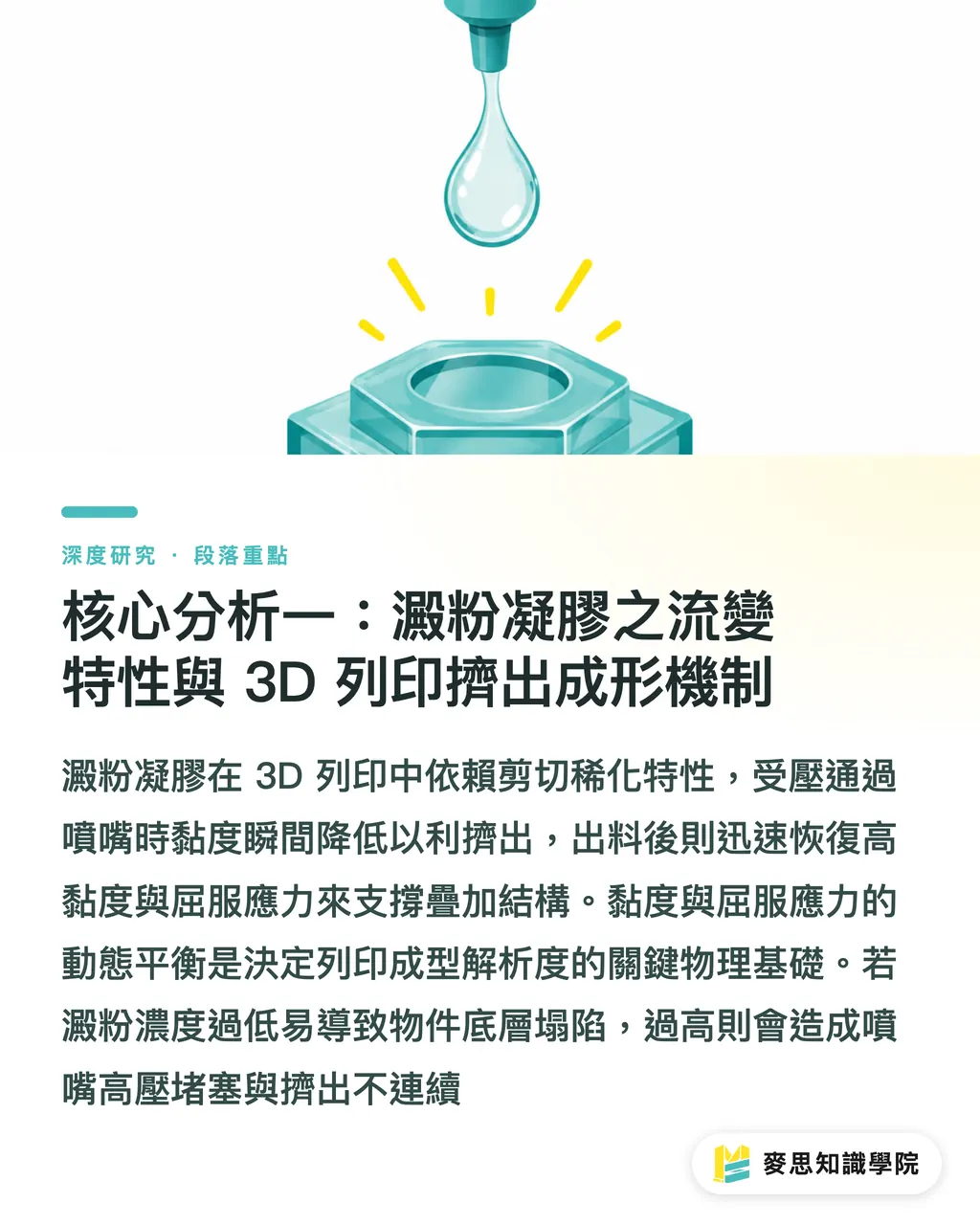
Core Analysis 1: Starch Gel Rheology and 3D Extrusion Printing Mechanics
Starch gel is a 3D polymer network formed when starch granules absorb water, swell, burst, and release amylose and amylopectin during heating, subsequently setting upon cooling. In 3D extrusion printing, starch gel primarily behaves as a non-Newtonian, pseudoplastic fluid. Its core rheological parameters include shear thinning, yield stress, and storage modulus (G')
Shear thinning describes a marked drop in apparent viscosity when material experiences shear stress, such as being forced through a narrow nozzle. Inside the barrel, the gel maintains higher viscosity. When pushed through the nozzle orifice by a screw or piston, polymer chains align with flow, dropping viscosity instantly to allow smooth extrusion. Once the material leaves the nozzle and deposits onto the build plate, shear stress disappears. The gel must recover high viscosity and yield stress almost immediately to support the weight of subsequent layers without flowing or slumping
Multifactor orthogonal experimental data on starch gel rheology and 3D printing show that when starch mass fraction is kept within an optimal window and fully gelatinized, the gel exhibits stable flow behavior under high shear rates, effectively reducing extrusion pressure fluctuations [1]. Data reveal that a dynamic balance between viscosity and yield stress forms the physical foundation for 3D printed line resolution. If starch concentration is too low, yield stress cannot support self-weight, causing bottom-layer collapse. If concentration is too high, shear thinning falls short, causing high-pressure nozzle clogs and discontinuous extrusion
Core Analysis 2: Interactive Effects of Multifactor Orthogonal Parameters on Structural Stability and Accuracy
In 3D starch gel printing, finished product quality is shaped by both material formulation settings and machine engineering parameters. Multifactor orthogonal experiments systematically evaluate how each variable weighs on printing accuracy and structural stability. Primary variables and their impact mechanisms include:
・Starch concentration and gelatinization temperature: set the initial matrix strength and viscoelastic limits of the gel
・Nozzle diameter: directly influences shear rate and extrusion detail
・Extrusion speed and travel speed: dictate the volume ratio of material deposited per unit of time
・Platform temperature and ambient humidity: affect cooling, setting speed, and moisture evaporation after gel deposition
When extrusion speed matches printhead travel speed dynamically, deposited gel line diameter matches internal nozzle diameter precisely. If travel speed is too fast, lines stretch thin or snap. If travel speed is too slow, excessive material accumulation creates thick lines and blurred edges
In existing digital printing workflows, control commands reach print terminals cleanly and execute in sequence. In 3D gel extrusion, however, a time lag separates digital commands from physical deposition. 2D output software can instantly cancel or reroute incomplete jobs. On a 3D gel print floor, if material viscosity drifts due to temperature fluctuations, software re-scheduling alone cannot stop physical deformation in already deposited layers
Orthogonal analysis studies emphasize that cross-matching material rheology curves with engineering parameters determines 3D printing success [1]. This implies future 3D printing systems must evolve from single-direction command execution into real-time rheological sensing. High-precision structural fidelity can only be achieved when equipment monitors gel extrusion resistance on the fly and adjusts travel speed dynamically
Implications for Taiwan's Design and Print Industry: Transformation Roadmaps for Small Print Shops, Designers, and Brands
Faced with trends in edible material printing and 3D sample development, Taiwan's traditional design and printing supply chain must restructure processes and upgrade technology across distinct roles to build competitive differentiation
Practical Operations for Small and Medium Print Shops
Most small and medium print shops in Taiwan excel in agile finishing and proofing. When introducing 3D starch gel printing technology, they should avoid blindly purchasing high-ticket industrial equipment. Instead, they should build small-batch, customized sample development services:
・Equipment and environment adjustments: set up dedicated food-grade or clean proofing areas, and adopt 3D printing modules with temperature-controlled barrels and high-precision pneumatic extrusion systems
・Cost and timeline evaluation: traditional 3D packaging proofing requires steel structural dies, taking 3 to 7 days at high upfront cost. Using starch gel or edible materials for 3D rapid proofing enables 3D structure verification within 2 hours, cutting early testing costs by over 60%
・Product line expansion: apply color management expertise from traditional 2D printing to 3D gel, developing edible display models with natural pigments or limited-edition giveaways for high-value brands
Shift in Design Logic for Designers
When designing 3D gel products and packaging, designers must move past traditional rigid plastic or paperboard CAD modeling logic, fully embracing Design for Rheology:
・Overhang and cantilever limits: because un-cured starch gel offers limited storage modulus, overhang angles should not exceed 45 degrees, or edible internal support structures must be added
・Geometric boundary definition: avoid extreme sharp corners and overly thin walls, favoring continuous curved surfaces and gradual layering paths to match fluid continuity during gel extrusion
・Visual and tactile integration: draw on embossing and debossing concepts from traditional printing to design micro-textures on 3D gel surfaces, elevating product tactile feel and visual richness
Capturing Commercial Value for Brand Strategists
Brands should treat 3D edible material printing as a strategic tool for sustainable packaging and innovative marketing:
・Sustainability and plastic reduction: use the biodegradability and edibility of starch gel to develop single-use custom display stands or interior inserts, meeting strong market demand for mono-material and eco-friendly packaging
・Faster testing cycles: use the short-run advantage of 3D printing to run small focus group tests prior to product launches, avoiding inventory risks and mass stock buildup
・Brand narrative upgrades: showcase the starch gel printing process as raw material for conveying visual flair and tech innovation, reinforcing the brand's position in sustainability and creativity
Conclusions and Limitations
This study systematically examined the mechanisms by which starch gel rheological properties affect 3D extrusion printing quality. Results demonstrate that shear thinning and yield stress are core physical mechanisms determining whether medium extrudes smoothly and maintains structural shape. Multifactor orthogonal analysis helps establish optimal matching windows between material formulas and machine settings. Extending standardized process parameter experience from the printing industry to real-time gel rheology control will advance standardization and automation in 3D material printing
This study carries two specific limitations in scope and application:
・Data timeline and scope constraints: literature review and orthogonal analysis data in this paper rely primarily on starch gel experimental findings published prior to 2026 [1], omitting dynamic data on long-term storage degradation like retrogradation and syneresis over 12 months
・Technical extrapolation boundaries: the rheological models and engineering parameters here focus on pneumatic or screw-driven extrusion (DIW/FDM) 3D printing systems. Conclusions cannot be directly extrapolated to binder jetting, laser sintering, or other 3D printing technologies
Future research should focus on developing printheads equipped with real-time feedback for rheological parameters, alongside unified process parameter standards bridging 2D printing and 3D gel printing to achieve efficient, high-precision custom manufacturing
Key Takeaways
Shear thinning and yield stress in starch gel serve as core physical mechanisms determining smooth 3D extrusion and structural shape retention
3D gel printing quality depends on multifactor orthogonal interactions among starch concentration, gelatinization degree, nozzle diameter, and extrusion speed
Standardized process parameter practices from traditional printing should join real-time material rheology sensing to overcome physical deposition lag
Designers must practice Design for Rheology, capping overhang angles and refining layering paths to prevent structural collapse
Adopting 3D gel printing allows Taiwanese print shops to shorten structural proofing turnarounds to under 2 hours, sharply lowering early development costs
Further Considerations
Starch gel 3D printing represents a landmark shift for the design and printing industry from flat color replication toward 3D functional material deposition. For manufacturers and SaaS developers, the core challenge moving forward lies in quantifying physical rheological parameters into digital drive code to create smart slicing software that adjusts paths based on live material viscosity. On the design and brand side, teams must look beyond paper constraints, taking full advantage of the sustainable and tactile qualities of fresh edible materials to redefine commercial value in next-generation packaging and physical interaction
References
[1] Peng J., Wang D., Wang D. et al. (2027). Starch gel rheology vs 3D printing: Multi-factor orthogonal study. Journal of Food Engineering. DOI: 10.1016/j.jfoodeng.2026.113186
FAQ
- What is the most common cause of quality failure when 3D printing starch gel?
- The most frequent cause of failure is structural collapse at the bottom layer due to insufficient yield stress, or high-pressure nozzle clogging caused by poor shear thinning properties. Balancing these requires dynamic tuning of starch concentration and gelatinization temperature through multifactor orthogonal control
- Do traditional small and medium print shops have advantages in adopting 3D starch gel printing?
- Small and medium print shops possess rich experience in flexible finishing and rapid proofing. Adopting 3D gel printing can compress traditional steel die proofing timelines from several days down to two hours, drastically lowering testing costs and time for new product development
- Why can't traditional 3D printing CAD models be printed directly with starch gel?
- Because starch gel remains a polymer hydrocolloid with limited structural support before curing. Designs must account for material rheology boundaries by capping overhang angles and optimizing layering paths, otherwise the model cannot support its own weight and will collapse
Related articles
The Print × AI weekly
The print and AI know-how designers, brands and enterprises can use before they commit — one email, every week
MINDS Free Tools
Spine width and imposition calculators — skip the manual math, free in your browser.
MINDS Group
Need actual printing or gifting services?
From premium printing to online ordering and festive gifts — the MINDS Group sister brands take it from here.