
Overview
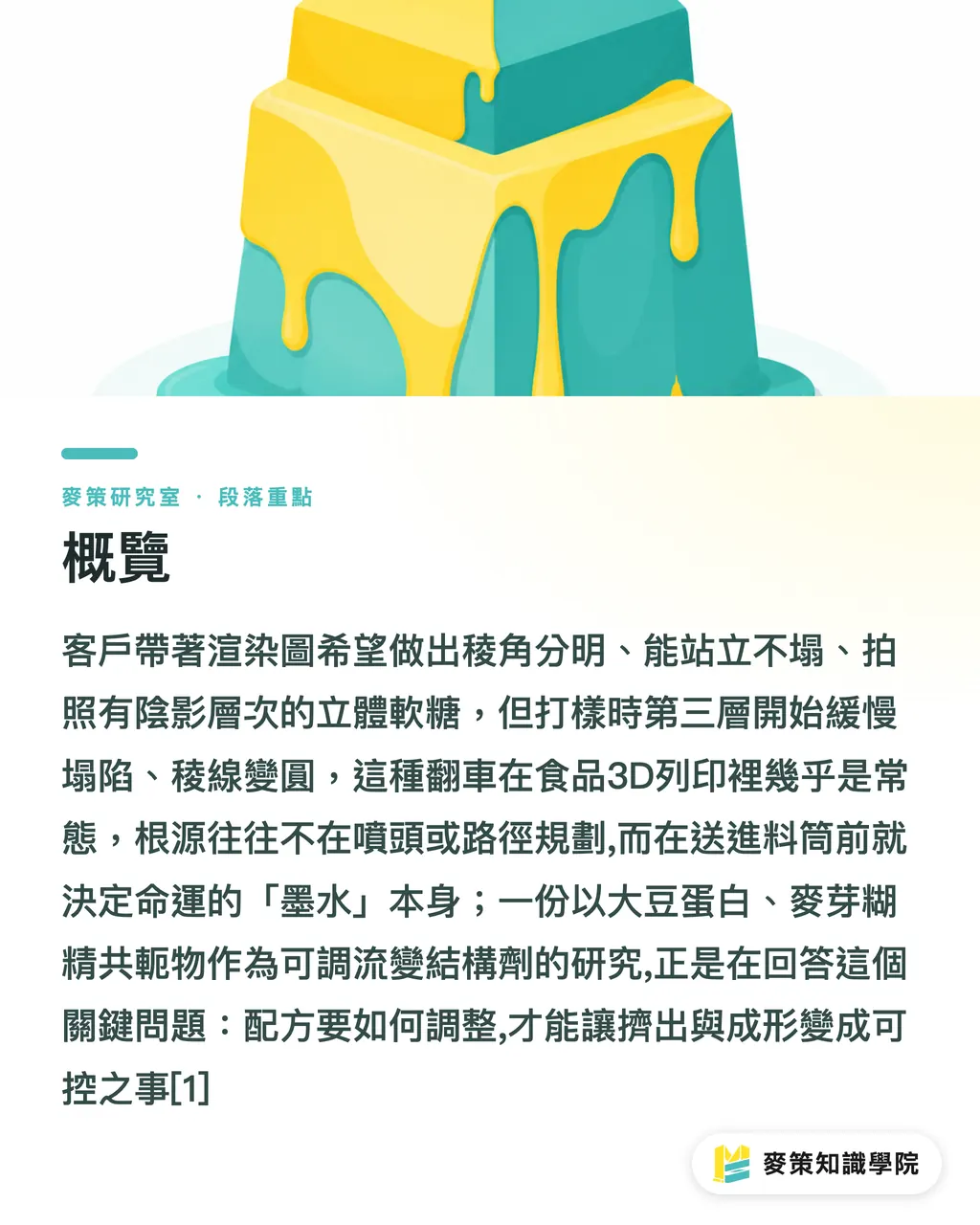
A client sits down with a 3D render, asking for a sharp, geometric gummy. It needs to stand upright in the packaging without slumping and cast clean shadow lines in product photos. You glance over your equipment list and figure it should be doable. Then the first proof comes off the bed. By the third layer, it slowly sags, and crisp edges melt into rounded corners
This kind of failure is practically routine in 3D food printing. The issue rarely lies with the nozzle or the toolpath. It is decided long before extrusion by the ink. A recent study on soy protein-maltodextrin conjugates as rheologically tuneable structuring agents tackles this head-on for extrusion-based food inks: how to formulate materials so that extrusion and shape retention become predictable [1]
To fix this, we need to clarify the exact mechanisms that dictate whether a formula can print cleanly and hold its structure
Why Formulation Dictates Success, Not Machine Settings
Because the physical operating window of extrusion printing is set by the material. The hardware can only operate inside that window
Extrusion-based food printing demands two contradictory properties at once. Under shear inside the nozzle, the paste must thin out enough to flow smoothly and continuously. The moment it leaves the nozzle and shear drops to zero, it must stiffen within seconds to support the layers stacked on top. This is the trade-off between shear thinning and thixotropic recovery. Yield stress determines whether the structure collapses under its own weight
On the hardware side, you can only tweak nozzle diameter, extrusion rate, print speed, layer height, and temperature. These settings expand or shrink the usable window, but they cannot create one out of thin air. If a formula lacks the yield stress to support five layers of self-weight, slowing the speed by ten times only means it collapses in slow motion
The study identifies soy protein-maltodextrin conjugates as "rheologically tuneable structuring agents" [1]. That phrasing captures the core shift: treating protein not just as a nutritional or gelling ingredient, but as an adjustable structural dial. For anyone running proofs, it turns material selection from a binary pass/fail into a calibratable axis
How Protein-Polysaccharide Conjugates Make Materials Tunable
They give a single material both emulsifying capability and structural support, with the balance between the two adjustable through the degree of conjugation
Protein-polysaccharide conjugates rely on Maillard-type covalent grafting. The protein provides interfacial adsorption and network-forming capability, while the polysaccharide (in this case, maltodextrin) contributes steric stability and hydrophilic volume. Once grafted, protein solubility and stability near the isoelectric point or under high salt conditions usually improve. That is essential for food inks, which almost always contain sugars, salts, acids, flavorings, and active ingredients. Pure protein systems often collapse under these conditions
The study establishes these conjugates as structuring agents for extrusion-based 3D printing inks [1]. As for the optimal grafting degree, ideal inclusion rate, or exact dimensional accuracy, the public title and study positioning do not provide citeable quantitative metrics. We should not claim specific figures without direct verification against experimental data in the full text
From my experience on the proofing floor (author's note): the real value of conjugates is not pushing a single metric to its absolute peak. It is widening the workable operating window. In production, batch-to-batch variation and shifts in temperature and humidity quickly ruin formulas that depend on a narrow sweet spot. Formulation tolerance matters far more than chasing a single performance peak
Three Questions to Ask During Proofing to Avoid Late Failures
When evaluating a project, always verify materials first, equipment second, and geometry last. Reversing this order is the fastest way to derail a project
Gate 1: The rheological window. Require your supplier (or test in-house) for three datasets: the shear thinning curve, the yield stress, and the structural recovery time after shear stops. The third metric is the most frequently ignored, yet it directly determines how many layers you can stack. If recovery is too slow, layer one is still liquid when layer two presses down on it
Gate 2: Extrusion feasibility. Can this paste extrude continuously through the target nozzle diameter without breaking, clogging, or surging from built-up pressure? This failure mode looks a lot like poor ink transfer in printing: it is not that the material will not print, but that it prints inconsistently. Inconsistency compounds exponentially when scaling up
Gate 3: Shape retention. What will this structure go through between the print bed and the consumer? Refrigeration, freezing, drying, pasteurization, transport vibration? The structural strength of water-rich formulations changes as they lose moisture, retrograde, or undergo phase separation. Holding shape right after printing does not mean it will hold up seven days later
This three-step check (rheology, then extrusion, then retention) can go straight into your proofing spec sheet. It keeps shape discussions grounded in physical limits. Geometry still matters, but you should only lock it in after confirming rheology and extrusion parameters
What This Means for Design, Packaging, and Print Planning in Taiwan
It means changing the language of quotes and proposals from "can we make this" to "under what material window can we make this."
In Taiwan, 3D food printing mostly pops up in a few areas: distinctive shapes for functional gummies and supplements, branded 3D inserts for gift boxes, display mockups and expo props, and short-run custom festive foods. These projects almost always start with visual design. The design team builds a 3D model and hands it to production to assess feasibility, creating an immediate gap between concept and reality
If you treat rheological conditions as part of the spec sheet during the pitch stage, designers get meaningful guardrails: minimum feature size, maximum overhang angle, maximum stackable layers, and minimum setting time. These constraints do not kill creativity. They keep designs from being scrapped entirely downstream
Packaging teams face the exact same reality. Supporting, cushioning, and moisture-sealing 3D food items dictate the design of blister trays, inserts, and barrier films. If the physical properties of the printed piece are only settled late in proofing, packaging designers are left scrambling to adapt
In practice, add three fields to your proofing spec sheet: target yield stress range, acceptable structural recovery time, and post-print processing and storage conditions. If these parameters cannot be confirmed, hold off on finalizing the geometry
Let's be clear on the boundaries: these rules apply to water-based extrusion systems built on biopolymers like proteins, polysaccharides, and hydrocolloids. For materials like chocolate where solidification is driven by thermal phase changes, or for binder jetting powder systems, the hardening mechanism is completely different. The rheological window carries less weight there, while temperature control and powder characteristics take center stage, requiring a different checklist
Key Takeaways
The physical window for extrusion-based 3D food printing is set by the formulation. Machine settings can only fine-tune within that window, not create a new one
Shear thinning, yield stress, and structural recovery time must be evaluated together. Recovery time is the most commonly overlooked metric, yet it directly determines stackable layer count
Soy protein-maltodextrin conjugates serve as rheologically tuneable structuring agents for extrusion-based 3D food printing inks [1]
A formulation's value lies in its operating tolerance rather than a single optimum point. Batch and environmental variations in production quickly penalize formulas that rely on a narrow sweet spot
Proofing spec sheets should include three dedicated fields: target yield stress range, structural recovery time, and post-print processing and storage conditions
Further Considerations
For the print and manufacturing sector, 3D food printing extends material spec sheets from printing inks to edible matrixes. The printing industry's existing vocabulary around viscosity, transfer, drying, and trapping transfers over directly. Extrusion breaks and poor ink transfer, or inter-layer sagging and insufficient wet-on-wet drying, are fundamentally the same rheological problems. Design teams need to get used to receiving material boundaries before drafting shapes. That requires a parameter format that design software can interpret, an area where the industry currently has zero consensus and a clear void. This is also the entry point for AI and SaaS: aligning rheological measurements, extrusion settings, and finished geometries into searchable datasets so proofing does not start from zero every time. One step further is a recommendation engine that works backward from a target geometry to suggest viable formulation windows. Two major hurdles remain: the lack of open benchmark datasets across materials and equipment, and the lack of standardized accelerated aging methods to bridge "prints successfully" and "survives until reaching the consumer." In commercial projects, the latter poses far greater risk than the former
References
[1] Bae, Lee, Lee (2027). Soy protein, maltodextrin conjugates as rheologically tuneable structuring agents for extrusion-based 3D food printing inks. Food Hydrocolloids. DOI: 10.1016/j.foodhyd.2026.113234
FAQ
- When 3D food printing fails, is it usually a machine problem or a formulation problem?
- In most cases, it is a formulation problem. The usable physical window for extrusion printing is determined by the material's shear-thinning behavior, yield stress, and structural recovery speed. Machine parameters can only adjust within that existing window and cannot fix sagging caused by insufficient yield stress
- What metrics indicate whether a food ink is printable?
- At least three: the shear thinning curve (determines smooth extrusion), yield stress (determines whether it collapses under self-weight), and structural recovery time after shear stops (determines stackable layer count). All three must align. Falling short on any one will cause failures at specific layer heights or shapes
- What role do soy protein-maltodextrin conjugates play in 3D food printing?
- They serve as rheologically tuneable structuring agents in extrusion-based 3D food printing inks, enabling protein to provide both emulsification and structural support [1]
- During proofing, should you discuss geometry first or confirm materials first?
- Confirm materials first. The recommended sequence is rheological window, then extrusion feasibility, then shape retention. Lock in geometry only after establishing material boundaries. Otherwise, designs risk getting scrapped entirely during mass-production feasibility reviews
- Does this evaluation framework apply to all types of 3D food printing?
- It primarily applies to water-based extrusion printing using biopolymers like proteins and polysaccharides. Materials that solidify through thermal phase change like chocolate, or binder jetting powder systems, rely on different curing mechanisms. Temperature control and powder properties carry far more weight there, requiring a different checklist
Related articles


The Print × AI weekly
The print and AI know-how designers, brands and enterprises can use before they commit — one email, every week
MINDS Free Tools
Spine width and imposition calculators — skip the manual math, free in your browser.
MINDS Group
Need actual printing or gifting services?
From premium printing to online ordering and festive gifts — the MINDS Group sister brands take it from here.