
Overview
If you've worked on food packaging or supplement print jobs, you've definitely run into this kind of client: they want shapes that stand up on their own, but the material contains water and can't be too tough. Traditional molds won't work, and injection molding can't handle aqueous phases. In the past, you could only answer cases like this with 'can't be done.' But a study published in Food Hydrocolloids in early 2027 [1] used 'coagulation-assisted extrusion' to 3D print soy and pea protein isolates into scaffolds for cells to grow on. That's a clear signal for printers
The core question this piece answers: when we bring printing back into the technical language of extrusion molding and structural stacking, what practical clues does this protein scaffold study give us?
Can Water-Containing Formulas Be 'Printed' Into Structures?
The quick answer: yes, but rheology has to fit into the formula design first. You can't treat it like standard ink
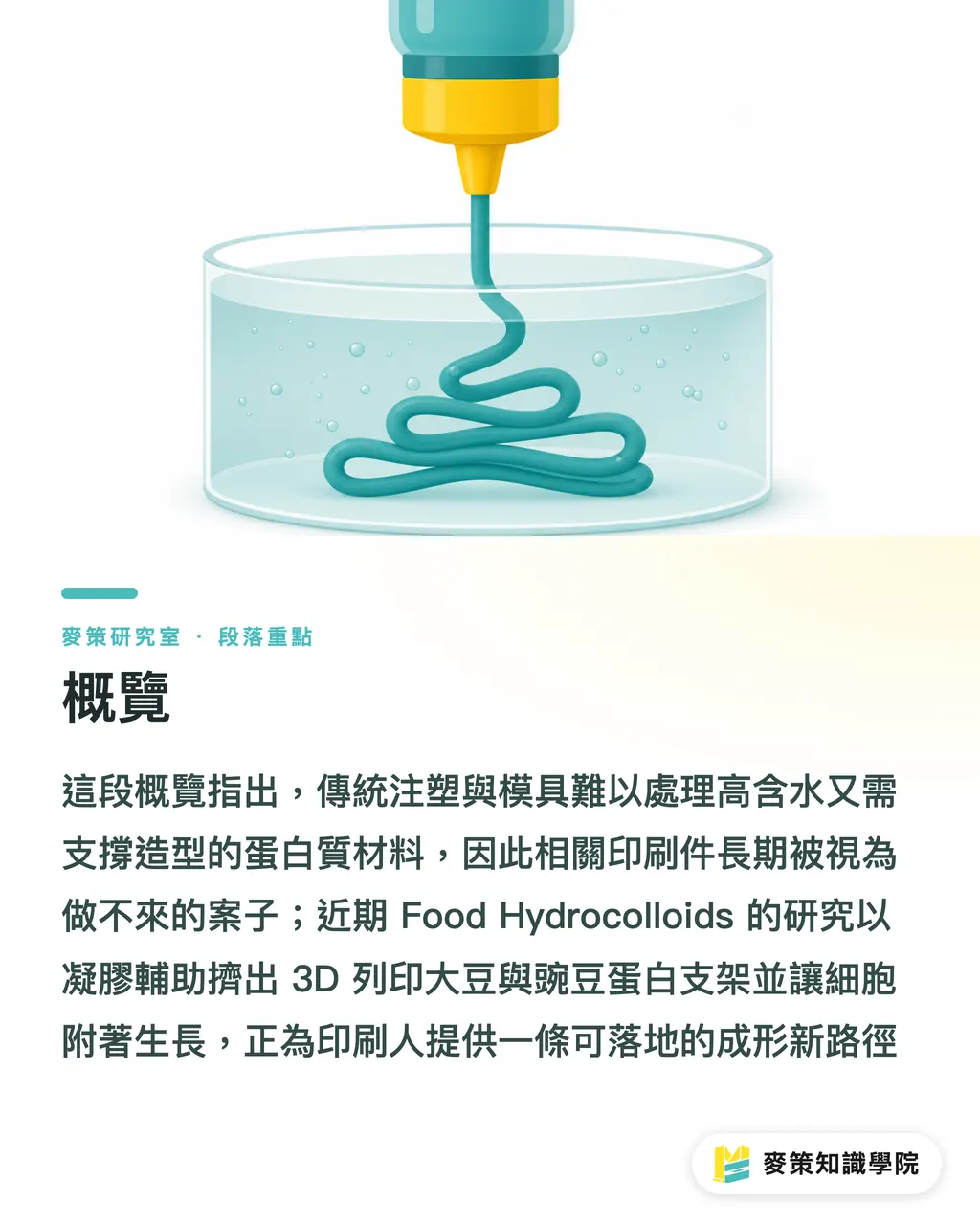
Saraf and Selvaganapathy's study uses 'coagulation-assisted extrusion 3D-printing' [1]. On the materials side, it relies on soy protein isolate and pea protein isolate, two high-purity plant proteins. On the process side, an extrusion head stacks a wet geometric shape first, then a coagulation bath sets the structure
Brought to the press floor, this means two things:
・First, the process path of 'water-containing formula + layer-by-layer stacking' has moved from lab formula research into structural application. It isn't limited to extruding flat patterns anymore
・Second, the coagulation bath is the key node for successful forming. Unlike the UV curing or thermal curing we know well, it uses a chemical environment to lock 'wet ink' into a 'solid structure.' In other words, to make a structure stand firm, you can't just adjust nozzle temperature and feed rate. The fit between material formula and coagulation environment must be factored in together
Why Should People in Printing Care About Cultivated Meat Scaffolds?
The quick answer: because this study essentially answers a printing process question, just asked by people in food and biomedicine
The scaffold's role in cultivated meat is to give cells a 3D frame to attach to and grow along muscle fiber directions. In a printing context, that is the base substrate holding the ink. What Saraf and Selvaganapathy handled specifically in their research was the trade-off among pore structure, mechanical support, and nutrient permeability [1]. For the printing industry, these three parameters match halftone dot structure of ink layers, stiffness limits on stack height, and post-press permeability into substrates
To put it simply, when it comes to 'printing something that stands, breathes, and has direction,' cultivated meat labs and print shops look for the same kind of engineers. The product just ends up in a Petri dish instead of a gift box

What Does This Have to Do With Edible Packaging and Custom Shapes?
The quick answer: opportunities lie in 'high-unit-price, small-batch, structure-driven value' items, not mass production
The most commercially viable applications for plant protein extrusion molding aren't replacing injection molding to make hundreds of thousands of bottle caps. They fit three product types instead [1]:
・Edible packaging: edible cups or dissolvable capsule shells, for example. If regulations and taste fall into place down the road, they could skip the recycling process entirely
・Customized nutritional supplements: textures designed for people with swallowing difficulties, or protein release profiles tailored for athletes
・Display food shapes: custom 3D sugar pieces for wedding dessert tables or brand events. These used to need manual mold casting, but printing now offers a way to prototype first before making production decisions
The common link across each type is that 'structure itself is the differentiator.' This is different from the traditional printing question of 'what pattern to print' and turns into 'what shape to form.'
Which Three Engineering Boundaries Is the Industry Stuck On?
The quick answer: extrusion heads, production rate, and material standardization. None of them are ready yet
To take this research out of the lab, printers need to face three limits honestly [1]:
First is the trade-off between extrusion head and resolution. Plant protein filament extrusion is stickier and more prone to clogging than plastic filament, so nozzle design directly dictates how fine the printed structure can get. Second is production rate. Coagulation-assisted extrusion takes a bath and time, unlike thermoplastic filament that stacks quickly and continuously. Mass production takt times need to be recalculated. Third is material standardization. Rheological behavior changes with every batch of protein isolate. Without mature color management or formula databases like ink has, managing formula tolerance is a separate task
These three unmet thresholds happen to be where printing equipment makers and material suppliers can pick up their next wave of business
What Can Printers Do Right Now?
The quick answer: treat 'extrusion molding' as a new design variable, not a new print effect
Three concrete starting steps:
・Add a 'plant protein ink' category to your material library, run small test extrusions, and measure shear thinning and yield stress
・Lay out structural design variables clearly. When talking to clients, ask 'what are the support needs for this shape' instead of 'what pattern do you want to print.'
・When talking to equipment suppliers, ask 'can the nozzle be swapped out' instead of accepting a full machine replacement
These judgments assume the formula is controllable and coagulation conditions are reproducible. If your product line runs high-volume, fast, repeatable plastic parts, plant protein extrusion can't support that yet. But if you are looking for items with structural rarity and unit prices that cover process costs, this path is worth exploring now

Key Takeaways
'Coagulation-assisted extrusion 3D-printing' allows water-containing formulas to build 3D structures, and it is no longer exclusive to cultivated meat
The three parameters of plant protein scaffolds, porosity, stiffness, and permeability, are essentially the halftone dots, stacking limits, and substrate penetration familiar to the printing industry
The most promising market entry is high-unit-price, small-batch items where structure determines price, not mass production
Extrusion heads, production rates, and material standardization remain three engineering boundaries to cross, opening order opportunities for equipment and material suppliers
Further Reflections
For print manufacturing, this research reminds us that extrusion molding is shifting from 'printing patterns' to 'printing shapes.' This calls for a new BOM mindset: material formulas, coagulation conditions, and structural design must be managed together rather than handed off entirely to prepress
For designers, when 'structure' becomes a printable variable, mechanics and rheology belong in the brief. Delivering just a pretty 2D layout isn't enough anymore
For AI implementation, the main bottleneck with these materials is managing formula tolerance, which happens to be a clear target for AI formula inference and digital twins. G-code path planning and flow field simulation could also grow into new SaaS modules
For SaaS and platform providers, an 'extrusion molding parameter database' will be the next service layer worth securing, similar to where color management systems sat in the printing industry
Open questions: supply stability of plant protein sources, wastewater treatment for coagulation baths, and regulatory safety verification for edible structural parts. If any of these three lacks an answer, it will hold back mass production schedules
References
[1] Saraf, Selvaganapathy (2027). Coagulation-assisted extrusion 3D-printing of soy and pea protein isolate scaffolds for cultivated meat applications. Food Hydrocolloids. DOI: 10.1016/j.foodhyd.2026.113193
FAQ
- What exactly are 3D-printed soy and pea protein scaffolds?
- High-purity soy or pea protein isolate is stacked layer by layer into a 3D structure using an extrusion head and set in a coagulation bath. It is most commonly used as a cell growth framework for cultivated meat [1]
- What does this have to do with traditional printing?
- The process of 'water-containing formula + extrusion stacking' has reached structural applications. It can extend to high-unit-price, small-batch goods such as edible packaging, custom food shapes, and structural parts for nutritional supplements [1]
- Why not just use plastic filament?
- Plant protein is a water-containing formula that must coagulate in a chemical environment. Its forming logic is entirely different from thermoplastic filament, requiring a fresh approach to nozzle and process design
- Can this technology be mass-produced right now?
- It remains stuck behind three engineering boundaries: extrusion nozzle resolution, production rate, and batch-to-batch material consistency. Standardization across materials and equipment is needed before mass production [1]
- What preparations can printers make right now?
- Add plant protein inks to your material library for small test extrusions, include 'structural support needs' in client discovery, and factor mechanical variables into design from the start
Related articles

The Print × AI weekly
The print and AI know-how designers, brands and enterprises can use before they commit — one email, every week
MINDS Free Tools
Spine width and imposition calculators — skip the manual math, free in your browser.
MINDS Group
Need actual printing or gifting services?
From premium printing to online ordering and festive gifts — the MINDS Group sister brands take it from here.