
Overview
A client comes in with a rendering and says they want a "3D-shaped functional gummy." The shape needs crisp edges, and it also has to carry 5% botanical extract inside. You quote the job, book the machine, and print the sample. By day three, half the edges have slumped. Cut it open, and the oil phase has floated to the top. At that point, the problem is no longer the nozzle. It is the formulation
When 3D food printing is treated as a shaping service, the spec sheet usually lists only appearance, dimensions, and delivery date. But for extrusion forming to work, the material first has to support itself. Beyond size, the spec has to include load-bearing items: stackable layer count, stable holding time, and active ingredient loading. The next sections break food-printing load-bearing specs into items that can actually be accepted or rejected
Why Are "Printable" and "Able to Hold Up" Two Different Things?
Because flow during extrusion and support after stacking are two requirements pulling against each other
If the material is too thick, the nozzle clogs and the line breaks. If it is too thin, the output looks clean, but the third layer starts to collapse. Recent food-printing research has pushed high internal phase Pickering emulsions, or HIPPEs, to the front because they aim directly at this conflict: particles, rather than small-molecule emulsifiers, adsorb at the oil-water interface, form dense packing, and give the system both extrusion-friendly shear thinning and structural recovery after resting. Some studies focus on the relationship between the formation mechanism, processability, and 3D printing applications of these emulsions [3]. Others position Pickering emulsion gels directly as tailorable soft materials for printing needs [2]
I would read this route as a tuning method. Particle type, internal phase ratio, and interfacial crosslinking can all be adjusted, which means formability has a chance to be written into the spec and checked during acceptance
What Should a Load-Bearing Spec Include?
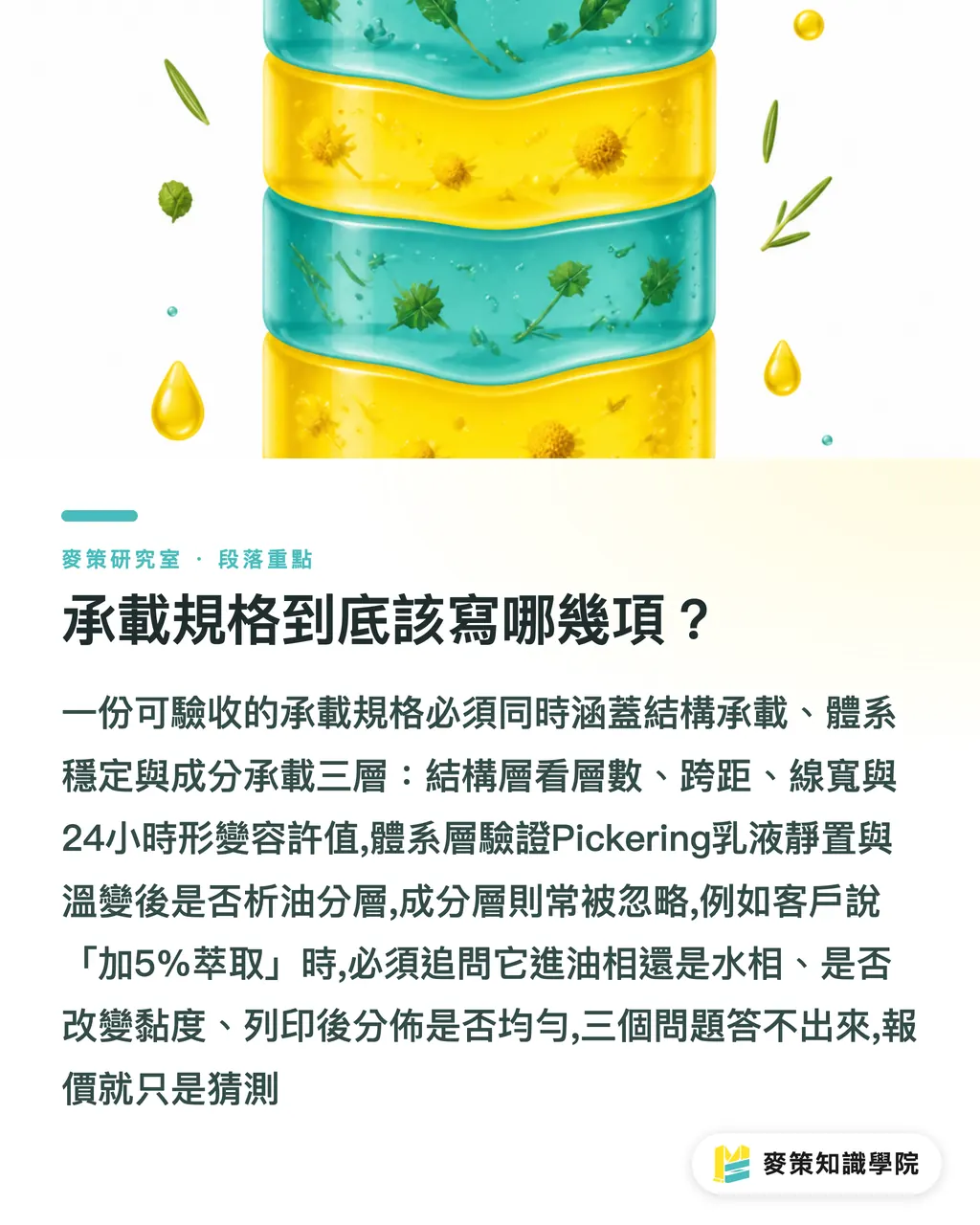
An acceptable load-bearing spec should cover at least three layers: structural load, system stability, and ingredient loading
・Structural load: target layer count and unsupported span, single-layer line width, and allowed deformation 24 hours after forming. This is what clients care about most, and it is also the easiest to measure objectively
・System stability: whether oiling-off, phase separation, or syneresis appears after resting and temperature changes. The selling point of a Pickering system is being "ultrastable," and that property deserves to be written as an acceptance condition [3]
・Ingredient loading: whether the active ingredient loading and distribution are uniform. Existing research has handled 3D printing and quercetin delivery within the same material system, using protein-polysaccharide high internal phase Pickering emulsions to serve both forming and delivery [1]
The third item is the one most often missed. When a client says, "add 5% extract," what you need to ask is: does it go into the oil phase or the water phase, will it change the emulsion viscosity, and will the distribution remain uniform after printing? Without answers to those three questions, the quote is just a guess
How Does Interface Design Decide the Shelf Life You Can Promise?
The bond strength at the interface maps directly to the stability period you can dare to put in the spec
Current technical routes branch into at least three lines: stabilization with protein-polysaccharide composite particles [1], phytosterol-based emulsion gels [2], and reinforcement through covalent bond interfacial recognition between polysaccharides and silica [4][5][6]. In plain terms, the difference between the three is how reliably the particles hold onto the interface: physical adsorption, complexation, or covalent bonding. The fact that the covalent-reinforcement route has been studied repeatedly and paired with multiple sets of supporting information [4][5][6] shows that interfacial strength is a core variable in this field
Bringing that into practice, and this is my judgment, not a quoted conclusion: short-lived display samples can tolerate weaker interfaces because they only need to survive shooting and trade shows. Products headed for retail, with a labeled shelf life, need stronger interface design. The cost is higher formulation complexity and higher expense. A shelf-life promise in the spec sheet is, at heart, an endorsement of the interface design
What Three Questions Should You Ask the Client Before Prototyping?
Before prototyping, clarify the use case and ingredients before talking about shape. Get the order wrong, and the sample will usually need to be redone
1. Is this piece for display or for eating? This decides whether non-food reinforcement methods are allowed, and whether acceptance is based on appearance or safety
2. Are there functional ingredients to carry? How much? If yes, forming and delivery have to be solved together in one formulation. You cannot print first and figure out the addition later [1]
3. How long does it need to hold, and under what temperature and humidity? This turns "stability" from an adjective into a measurable condition
Once these three questions are answered, you know which interface route to lean toward. You also know whether this order is a prototyping job or an R&D job, and the pricing logic is completely different
In practice, it comes down to this: write "load-bearing" into the spec before sending the job to print. Then 3D food printing can price material engineering as part of the service, instead of being treated as art outsourcing. The method is direct. Add one material load-bearing confirmation step to the existing print approval process, with four explicit columns: layer count, deformation tolerance, stability period, and loading amount. Have the brand owner and materials side sign off together. Do not leave the printing side to carry the formulation risk alone
The boundary of use also has to be clear: the judgment above is based on extrusion-based 3D food printing, with materials belonging to aqueous emulsion or gel systems. If you are working with powder binding, sugar melting, or chocolate tempering printing, the dominant variables shift toward thermal history and crystallization control. This load-bearing spec would need to be rewritten, not copied over. Also, most of the studies cited here discuss mechanisms and processability at the material level. Stability after production scale-up still has to be verified by each manufacturer
Key Takeaways
For acceptance in 3D food printing, shape and dimensions are not enough. Load-bearing also has to be specified: stackable layer count, stability period, and active ingredient loading
High internal phase Pickering emulsions belong in the spec discussion because formability can be tuned through parameters such as particles, internal phase ratio, and interfacial crosslinking [3]
Forming and delivery have to be solved together in one formulation. Existing research has handled 3D printing and quercetin delivery within the same material system [1]
Interfacial bond strength, from physical adsorption to complexation to covalent bonding [4][5][6], decides the shelf life you can promise
Before prototyping, confirm the use case and ingredients before moving into shape. Reverse the order, and the sample will be easy to redo
Further Thoughts
If print manufacturers only provide shape-based contract production, their bargaining power gets pushed down to labor hours. Build load-bearing specs into the quote structure, and there is a reason to charge R&D fees, as well as a position from which to reject promises that cannot be met. The design process has to change too. A rendering cannot be the sole starting point. Shape feasibility has to be finalized together with the materials side, or design freedom exists only on paper. When AI enters the workflow, the mapping between formulation parameters, such as particle type, internal phase ratio, and crosslinking method, and forming results is a small-sample, multi-variable problem. It is better suited to accumulating cases in an internal prototyping database than restarting trial and error on every order. SaaS productization can begin with an approval form built around the four load-bearing fields: layer count, deformation tolerance, stability period, and loading amount. That lets the brand owner, materials supplier, and printing side leave records on the same spec. The unresolved issue is also clear: public bridge data between material-level mechanism studies and production-line yield is still thin. For now, each manufacturer has to build that baseline on its own
References
[1] Li, Wang, Ji (2027). Egg white protein-polysaccharide high internal phase Pickering emulsions for 3D printing and quercetin delivery. Journal of Food Engineering. DOI: 10.1016/j.jfoodeng.2026.113267
[2] Engineered Phytosterol-Based Pickering Emulsion Gels as Tailorable Soft Materials for 3D Printing. DOI: 10.1021/acsapm.6c00600.s001
[3] Ultrastable High Internal Phase Pickering Emulsions: Forming Mechanism, Processability, and Application in 3D Printing. DOI: 10.1021/acs.jafc.3c05653.s001
[4] Covalent Bond Interfacial Recognition of Polysaccharides/Silica Reinforced High Internal Phase Pickering Emulsions for 3D Printing. DOI: 10.1021/acsami.3c03642.s001
[5] Covalent Bond Interfacial Recognition of Polysaccharides/Silica Reinforced High Internal Phase Pickering Emulsions for 3D Printing. DOI: 10.1021/acsami.3c03642.s003
[6] Covalent Bond Interfacial Recognition of Polysaccharides/Silica Reinforced High Internal Phase Pickering Emulsions for 3D Printing. DOI: 10.1021/acsami.3c03642.s002
FAQ
- What is a "load-bearing spec" in 3D food printing?
- A load-bearing spec defines how well a material supports and holds itself after extrusion forming. It includes three levels: structural load, such as stackable layer count and deformation tolerance, system stability, such as whether oiling-off or phase separation occurs, and ingredient loading, such as active ingredient amount and distribution. It is a more critical acceptance basis than appearance dimensions alone
- Why are Pickering emulsions often used in 3D food printing?
- Pickering emulsions use solid particles adsorbed at the oil-water interface in place of small-molecule emulsifiers. They can provide both the shear thinning needed for extrusion and the structural recovery needed for stacking. Recent studies have examined the links between their formation mechanism, processability, and 3D printing applications [3]
- Can 3D-printed food also encapsulate functional ingredients?
- Yes, but forming and delivery have to be designed together in the same formulation. Existing research has used protein-polysaccharide high internal phase Pickering emulsions to serve both 3D printing and quercetin delivery [1], showing that this is a material-level integration problem, not something added after printing
- What should be confirmed first before prototyping?
- Confirm the use case first, whether display or edible. Then confirm whether there are functional ingredients and their ratio. Only after that should shape be discussed. Reversing the order can leave you with a finalized shape that the material cannot support, which means the sample has to be redone
- Does this load-bearing spec apply to all food-printing technologies?
- No. The judgment in this article is based on extrusion-based 3D food printing using aqueous emulsion or gel materials. For powder binding, sugar melting, or chocolate tempering printing, the dominant variables are thermal history and crystallization control, so the spec has to be developed separately
Related articles

The Print × AI weekly
The print and AI know-how designers, brands and enterprises can use before they commit — one email, every week
MINDS Free Tools
Spine width and imposition calculators — skip the manual math, free in your browser.
MINDS Group
Need actual printing or gifting services?
From premium printing to online ordering and festive gifts — the MINDS Group sister brands take it from here.