

Introduction: A Material Proposition Rewritten by Crystallinity
Packaging plastic reduction has long faced a technical bottleneck not in "whether bio-based materials exist," but in "whether bio-based materials can meet structural strength, barrier performance, and recycling compatibility all at once." Over the past decade, PLA, bio-based PE, and cellulose-derived films have entered the market one after another, yet actual commercial adoption remains limited by insufficient mechanical strength, narrow heat resistance windows, and the inability of existing recycling systems to identify and sort them. The reason nanocellulose (cellulose structural units with nanoscale lateral dimensions, covering both cellulose nanocrystals and cellulose nanofibrils) has regained attention in this context lies not in being "bio-based," but in how its crystalline regions deliver specific strength and modulus performance close to engineering plastics
On the academic side, technical pathways for nanocellulose from biomass resources to biocomposites have been systematically summarized, covering raw material selection, defibrillation mechanisms, and composite applications [4]. Recent studies have focused even further on pairing non-wood plant fibers with eco-friendly extraction processes, such as using natural Walikukun plant fibers as raw material to obtain high-crystallinity nanocellulose through low-pollution processes, explicitly targeting sustainable packaging applications [1]. This pathway matters because it challenges two existing assumptions at once: first, that high crystallinity must rely on strong acid hydrolysis, and second, that packaging-grade cellulose raw materials must come from wood pulp
However, a specific gap remains in current discussions. Material literature extensively addresses "how to make better nanocellulose," while packaging practice heavily addresses "how to make packaging recyclable," with the two rarely meeting within the same analytical framework. In other words, a material study might prove higher crystallinity and lower process pollution, but it seldom answers: once such a material enters existing printing and packaging converter lines, which steps must change, how much costs will rise, and whether it will break existing recycling routes for paper boxes or flexible packaging. Our analysis suggests that this gap is precisely where industry adoption decisions get stuck in practice
This paper makes three contributions, each corresponding to a section in the main text:
・First, examining the extraction path of high-crystallinity nanocellulose within a triangular trade-off among crystallinity, performance, and process pollution, showing why green extraction is not mere environmental rhetoric, but a key variable setting the cost structure (corresponding to the section "The Triangular Trade-off of Green Extraction")
・Second, distinguishing between two role positions for nanocellulose in packaging: barrier/reinforcement coatings versus bulk film-forming materials, demonstrating a significant gap in their near-term commercial feasibility (corresponding to the section "Coating First or Total Replacement")
・Third, grounding these judgments in the supply chain conditions of Taiwan's predominantly small and medium-sized printing and packaging converters, proposing an operational adoption sequence and verification checkpoints (corresponding to the section "Implications for Taiwan's Design and Printing Industry")
The importance of this issue for Taiwanese industry lies in its structural position. Taiwan's printing and packaging sectors consist mainly of small and medium plants with long equipment replacement cycles and limited internal R&D capacity, mostly reacting passively after brand clients demand specific materials. As packaging regulations in markets like the EU continue converging toward "design for recycling," whether one can judge in advance which new materials are worth investing in and which are merely signals at the laboratory stage directly affects quoting power and client retention, independent of environmental stance itself
Literature and Current Status Review: Three Divergent Research Strands
Current discussions on nanocellulose and sustainable packaging can be split into three clusters based on focus, each holding a clear disagreement on "what constitutes the bottleneck."
Cluster 1: Material synthesis and biomass pathways. This group views nanocellulose as the core vehicle for adding value to biomass resources, paying attention to the full transformation chain from biomass to biocomposites, including raw material pretreatment, defibrillation methods, and composite interface design [4]. Recent non-wood fiber research continues this strand, emphasizing eco-friendly extraction to obtain high-crystallinity products and directly naming sustainable packaging as the application domain [1]. The implicit stance of this cluster is: material performance still has room for improvement, and the breakthrough point lies in processing methods. Our analysis shares this question awareness, but differs in that we do not treat process improvement as an endpoint, but rather as an input variable for cost structure, asking further about the industry adoption threshold after process optimization
Cluster 2: Functional applications and optical properties. Another strand focuses on special functional behaviors of nanocellulose, among which optically transparent paper and transparent composites represent a mature direction [5]. The significance of this path for packaging lies in suggesting that the value of nanocellulose may not be replacing bulk plastic films, but filling specific niches that "require transparency without petroleum-based films," such as windowing materials for windowed boxes. The connection between this cluster and our paper is that it provides direct material proof for our second contribution (distinction in role positioning), while the difference is that existing studies mostly demonstrate feasibility at the material performance level without evaluating market scale or line compatibility for that niche
Cluster 3: Institutional and structural conditions for sustainable transition. The third cluster does not deal with materials themselves, but with "why technically feasible sustainable solutions are not necessarily adopted." Related discussions point out that transitions toward sustainability are often constrained by path dependence in existing infrastructure systems, requiring structural redirection rather than single-point technical substitution [3]. In agricultural sustainability, reconfiguring policy tools is similarly viewed as a prerequisite for changing industry behavior [2]. What this cluster highlights is: recycling systems, raw material supply chains, and testing standards are infrastructure themselves. If a new material cannot fit into existing sorting and conversion workflows, performance advantages will not convert into adoption rates. We apply this structural view to explain why Section 3 argues for "coating first," because the coating route creates the least disruption to existing infrastructure
Synthesis and Gap. The three clusters locate the bottleneck in process, in application domain, and in institutional structure respectively. They do not contradict one another, but lack intersecting analysis. Specifically unresolved is: when a study proves high-crystallinity nanocellulose can be obtained through eco-friendly processes [1], where exactly does this outcome of "meeting high crystallinity and low pollution at the same time" alter the packaging industry's adoption curve? Is it raw material cost, processing compatibility, or recycling compatibility? This paper takes that exact question as its starting point
The Triangular Trade-off of Green Extraction: Why Crystallinity and Process Pollution Are the Same Problem
Core argument of this section: High crystallinity and low-pollution extraction display an antagonistic relationship in traditional processes. Achieving both at the same time changes the cost structure, not just adding extra environmental credentials
Mechanical performance of nanocellulose comes mainly from the ordered arrangement of cellulose molecular chains in crystalline regions. Higher crystallinity leads to a denser intermolecular hydrogen-bonding network, yielding better tensile strength and modulus performance while reducing moisture-swelling tendencies. The latter matters especially for packaging, as moisture sensitivity has always been the primary reason bio-based packaging fails in high-humidity environments. Systematic summaries from biomass to biocomposites show that controlling crystallinity and defibrillation degree is the core parameter deciding composite interface performance [4]. The significance of this data anchor is: crystallinity is not a single physical property metric, but an upstream variable driving strength, dimensional stability, and composite compatibility all at once. Once crystallinity is compromised, every downstream processing step must make up for it, accumulating costs that often exceed the savings gained upstream
The issue lies in traditional means of achieving high crystallinity. Removing amorphous regions to highlight crystalline zones typically relies on acid hydrolysis, which brings three chain costs: strong acid use and neutralization treatment, wastewater treatment facilities, and acid residue concerns for subsequent food-contact certifications. This makes high-crystallinity nanocellulose attractive on paper, yet long uncompetitive in actual packaging quotes
Recent studies using eco-friendly processes to obtain high-crystallinity nanocellulose from non-wood plant fibers, directly targeting sustainable packaging [1], break this trade-off. Our analysis indicates that if low-pollution processes can reliably yield high-crystallinity products, what changes is not material performance itself, but three specific cost conditions: lower capital expenditure for wastewater treatment, shorter validation paths for food-contact compliance, and raw material sources expanding from wood pulp to non-wood agricultural fibers. The latter holds supply chain value for regions lacking forest resources but rich in agricultural by-products
Inference boundaries must be honestly defined. Research results from a single raw material (Walikukun fiber) [1] belong to raw-material-level feasibility verification. They do not equal process generalization across materials, nor do they cover energy consumption or yield performance upon scaling up. We do not claim "this process can be directly commercialized," but merely point out that it changes the list of variables worth tracking
Coating First or Total Replacement: Feasibility Gap Between Two Role Positions
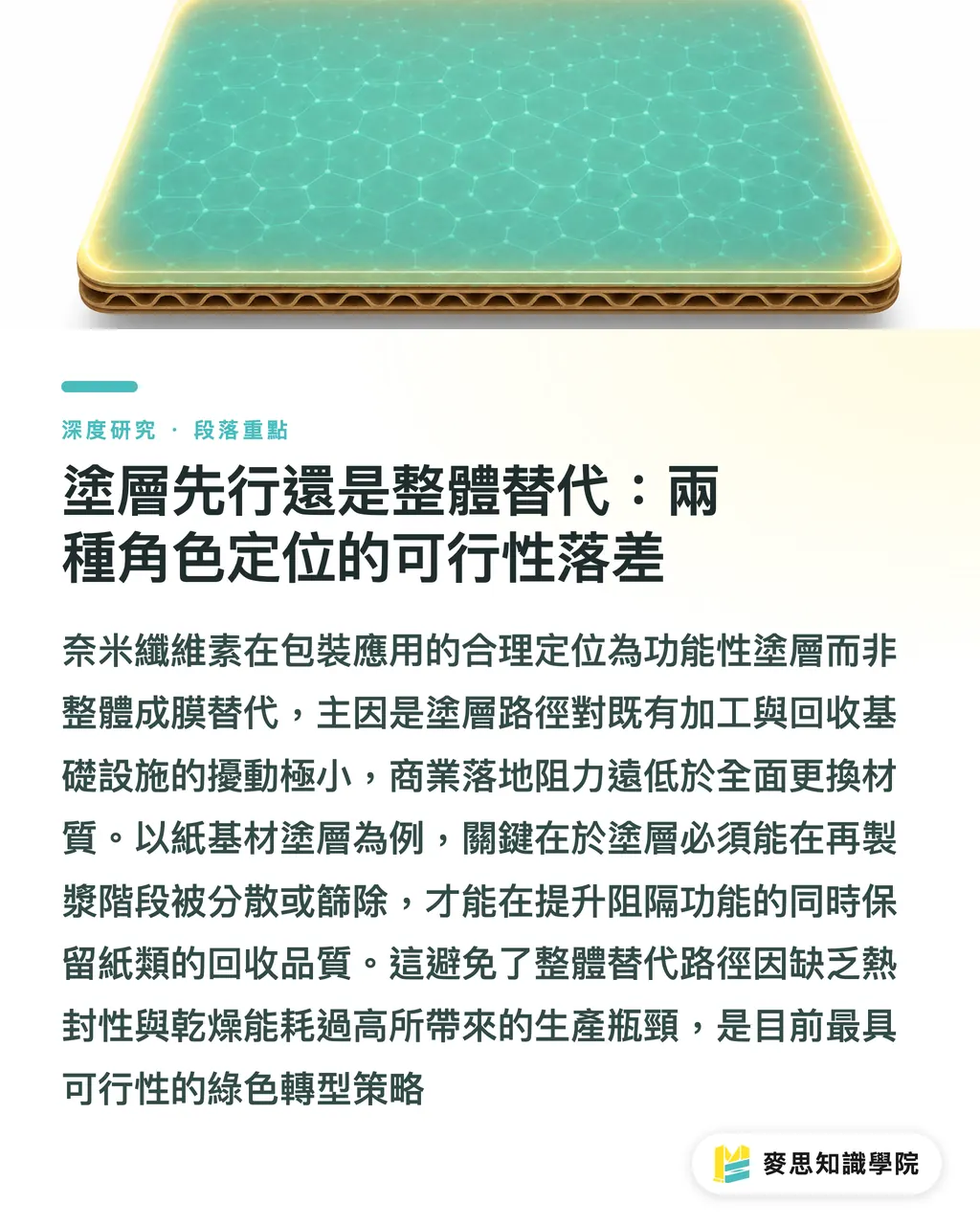
Core argument of this section: The reasonable positioning for nanocellulose in near-term packaging applications is functional coatings and composite reinforcement, rather than bulk film-forming materials replacing existing films. Production line disruption and verification costs between the two differ by an order of magnitude
Defining the two paths first. The total replacement path uses nanocellulose as the main film body to directly replace existing packaging films like PE, PET, or BOPP. The coating/reinforcement path applies nanocellulose as a water-based dispersion onto paper substrates or existing film surfaces, providing barrier properties or mechanical reinforcement while keeping the primary structure unchanged
Looking at material evidence, transparent applications are a relatively mature direction in nanocellulose research, with systematic technical reviews available for optically transparent paper and transparent composites [5]. The reading of this evidence anchor is: nanocellulose possesses the capability to form films while retaining optical transparency, a point no longer in dispute at the material level. What remains unresolved is uniformity in scaled production, costs, and compatibility with existing printing and converting conditions. The gap between laboratory transparent films and commercial specs that can be fed into machines, printed, die-cut, and sealed lies in processing conditions, not in the material itself
Specific obstacles facing the total replacement path are summarized here into four items:
・Wet strength: Dimensional stability and seal strength of pure cellulose substrates in high-humidity environments usually demand extra crosslinking or composite treatments, which turn around and threaten mono-material recycling claims
・Heat sealability: Cellulose itself lacks thermoplasticity, so without a heat-seal layer, it cannot directly run on existing form-fill-seal packaging equipment
・Capacity scale: Nanocellulose dispersions incur high drying energy consumption, and the production economics of large-scale film forming have not been publicly verified
・Recycling identification: If a new material cannot be identified by existing sorting equipment, even if biodegradable, its actual destination remains incineration or landfill
In contrast, the coating path creates far less disruption to existing systems. Paper boxes or paper bags keep their paper main body, with the nanocellulose coating serving as a barrier layer. In theory, this enhances grease or moisture barriers while preserving paper recycling routes. The key constraint here lies in coat weight and repulping compatibility: if the coating disperses or can be screened out during repulping, the recycling path holds; if it forms non-dispersible residues, paper recycling quality suffers. Our analysis suggests this is precisely the item where suppliers must be asked for third-party data during adoption evaluations, rather than accepting vague claims like "biodegradable."
From a structural transition perspective, why the coating path is more feasible relates not to materials, but to infrastructure. Existing studies note that system transitions toward sustainability are constrained by infrastructure path dependence, requiring structural redirection rather than single-point substitution [3]. The direct implication for packaging is: solutions causing less disruption to existing recycling and processing infrastructure face lower adoption resistance. The coating path preserves the paper substrate body and existing sorting logic, whereas total replacement requires simultaneous changes across filling, sorting, and recycling ends, stretching implementation timelines even if valid on the material side
Implications for Taiwan's Design and Printing Industry: Layered Judgment and Operations
Core argument of this section: Taiwan's small and medium printing and packaging plants should adopt "keep main structures unchanged, verify coatings first" as their implementation sequence, putting resources into verification capabilities rather than equipment investments
Structural characteristics of Taiwan's printing and packaging supply chain feature high density of small and medium plants, long equipment depreciation cycles, limited R&D staff, and mostly starting evaluations only after brand clients specify materials. This dictates that adoption strategies for new materials should not involve rushing to build production capacity, but building interpretation and verification capabilities
For small and medium printing and packaging plants: Recommended operational steps are as follows:
・Short term (3 to 6 months): Avoid equipment investment. Use existing coating or varnishing equipment to execute small-batch trial runs of water-based nanocellulose coatings, establishing baseline internal data on adhesion, printability, coefficient of friction, and sealing impact. Costs at this stage are primarily sample materials and machine downtime testing hours
・Medium term (6 to 18 months): Request three types of third-party documents from suppliers: food-contact compliance certificates, repulping compatibility test reports, and testing condition details for barrier data (temperature, humidity, basis weight, coat weight). Barrier data missing testing conditions holds no comparative value
・Long term: Evaluate dedicated coating equipment only when stable client demand exists and annual volume for a single spec is sufficient to amortize costs
For designers: Practical implications apply mainly during structural design. If a client's sustainability request focuses on "reducing plastic windows," priority should be given to windowless die-cut designs and paper-based transparent options rather than specifying unproduced new materials directly. Nanocellulose transparent films have a research foundation at the material level [5], but design proposals must clearly distinguish between "feasible as a material" and "purchasable for mass production," avoiding client quotes that later fail due to lead times or minimum order quantities
For brand owners: Three evaluation criteria are recommended: first, require suppliers to separate "bio-based content" and "recycling compatibility" into two independent metrics that cannot replace each other; second, confirm target market recycling and sorting reality before introducing any new material, as actual environmental benefits depend on local infrastructure rather than material labels; third, build verification checkpoints directly into procurement schedules rather than treating them as post-hoc submissions. Policy and institutional conditions substantially affect whether sustainable options land successfully [2][3], so material decisions on the brand side should incorporate readings of target market regulations and recycling systems in parallel
Conclusions and Limitations
The research question of this paper was: what does technical progress in extracting high-crystallinity nanocellulose from non-wood plant fibers through eco-friendly processes [1] actually change for packaging industry adoption decisions? Our synthesized analysis yields three conclusions
・First, the primary value of such technical advances lies in altering cost structures rather than raising performance ceilings: reducing wastewater treatment burdens, shortening food-contact compliance paths, and expanding non-wood raw material sources. Together, these three determine whether packaging materials can be competitive in quotes
・Second, the feasible role in the near term is functional coatings and composite reinforcement, rather than total film-forming replacement. The latter is hindered by four concrete obstacles: heat sealability, wet strength, film-forming energy consumption, and recycling identification
・Third, the level of adoption resistance is primarily determined by the degree of disruption to existing infrastructure [3], rather than by the environmental attributes of the material itself
Two limitations must be specifically stated. One is data coverage: material evidence cited here centers on raw-material-level extraction research [1], general reviews from biomass resources to composites [4], and optical transparency applications [5], without covering mass production scale-up, unit costs, or measured comparisons of packaging-grade barrier performance. Thus, our assertions on cost structure represent mechanism-level analysis and inference, unverified by quantitative data. The second is extrapolation boundaries: extraction results from a single plant raw material are insufficient to support the claim that "non-wood pathways are universally feasible." Variations in lignin content, fiber length, and impurity composition across raw materials directly impact process parameters and yields, so we do not claim cross-material generalization
Future research directions can focus specifically on three items: first, moisture and grease barrier curves of paper substrates at identical basis weights under varying nanocellulose coat weights, clearly noting test temperature and humidity conditions; second, repulping tests of coated paper substrates to quantify the impact of coating residues on recycled paper quality; third, origin supply stability evaluations for non-wood raw materials, particularly seasonal and impurity fluctuations when using agricultural by-products as raw materials. All three can be carried out under existing pilot-plant equipment conditions without waiting for further material-side breakthroughs
Key Takeaways
・Packaging value of nanocellulose comes from high specific strength and dimensional stability delivered by crystalline regions, rather than the "bio-based" label itself
・High crystallinity and low-pollution extraction act against each other in traditional acid hydrolysis processes. If eco-friendly processes achieve both simultaneously, what changes is cost structure, not performance ceiling [1]
・The near-term feasible role is water-based coatings and composite reinforcement. Total film-forming replacement is blocked by four obstacles: heat sealability, wet strength, drying energy consumption, and recycling identification
・Adoption resistance is mainly determined by the degree of disruption to existing recycling and processing infrastructure, which forms the structural reason why coating routes precede total replacement [3]
・The reasonable investment for small and medium printers is not equipment, but verification capability: start with small-batch trials on existing coating machines, and demand third-party data complete with test conditions from suppliers
Further Reflections
For printing manufacturing, the short-term value of nanocellulose lies not in changing materials, but in turning "whether coatings affect recycling" into a self-verifiable item. Repulping compatibility testing is currently mostly claimed unilaterally by suppliers; plants able to build baseline internal data gain negotiating power during quoting phases. For design teams, proposals must clearly state that "feasible at the material level" and "purchasable at the mass production level" are not the same thing. The former has research support [5], while the latter is constrained by minimum order quantities and delivery lead times. An entry point for AI implementation lies in knowledge retrieval for material decisions. Barrier data missing test conditions cannot be compared, making such evaluation rules suitable for solidifying into structured checklists rather than relying on individual sales reps' experience. At the SaaS level, an unmet need is a lookup tool connecting "material, recycling system, and target market regulations," because variations in actual environmental benefits for the same material across different markets stem from infrastructure rather than the material itself [3]. Unresolved questions remain in quantification: all cost structure inferences in this paper are mechanism analyses, lacking public mass-production unit costs and measured packaging-grade barrier data as verification benchmarks
References
[1] Andoko, Harmayanti, Prasetya (2027). Eco-friendly extraction of high-crystallinity nanocellulose from Walikukun fiber for sustainable packaging applications. Biomass and Bioenergy. DOI: 10.1016/j.biombioe.2026.109657
[2] Redirecting Government Policies for Agricultural Sustainability. Crisis and Opportunity. DOI: 10.2307/j.ctt1dgn4cr.22
[3] Kaijser A. (2017). Redirecting Infrasystems Towards Sustainability. Individual and Structural Determinants of Environmental Practice. DOI: 10.4324/9781315252377-7
[4] Nanocellulose: Harnessing Sustainability from Biomass to Biocomposites. DOI: 10.1016/c2024-0-03433-9
[5] Quero F. (2018). Applications of Nanocellulose as Optically Transparent Papers and Composites. Nanocellulose and Sustainability. DOI: 10.1201/9781351262927-8
FAQ
- Can nanocellulose directly replace plastic packaging films?
- In the short term, replacing existing plastic films through complete film forming is not recommended. Cellulose itself lacks thermoplasticity and thus lacks heat sealability, dimensional stability under high humidity requires extra treatment, and drying energy consumption together with mass production economics for full film forming have no publicly verified data. A more realistic position is as a water-based barrier coating or composite reinforcement on paper substrates
- What is high-crystallinity nanocellulose, and why does crystallinity matter?
- Nanocellulose refers to cellulose structural units with nanoscale lateral dimensions. Crystallinity indicates the proportion of regions where molecular chains are ordered. Higher crystallinity brings better tensile strength and modulus as well as lower moisture-swelling tendencies, thereby determining material strength, dimensional stability, and composite compatibility all at once [4]
- Why is "eco-friendly extraction" a cost issue for packaging companies, not just an environmental one?
- Traditionally, increasing crystallinity depends on acid hydrolysis, generating costs from wastewater treatment facilities, neutralization, and acid residue concerns for food-contact compliance. If low-pollution processes can reliably produce high-crystallinity yield [1], what decreases is capital expenditure and validation timelines, which directly reflects in the pricing competitiveness of packaging materials
- If a printing plant wants to introduce nanocellulose coatings, what should be the first step?
- Do not invest in equipment first. Start by taking on small-batch water-based coating trial runs using existing coating or varnishing machines to build baseline internal data on adhesion, printability, coefficient of friction, and sealing impact, while requesting food-contact compliance certificates and repulping compatibility test reports from suppliers
- Will nanocellulose coatings destroy the recyclability of paper boxes?
- The key lies in coat weight and repulping compatibility. If the coating disperses or can be screened out during repulping, paper recycling routes remain intact; if it forms non-dispersible residue, recycled paper quality is compromised. Evaluations should demand third-party repulping test data rather than accepting vague claims like "biodegradable."
Related articles




The Print × AI weekly
The print and AI know-how designers, brands and enterprises can use before they commit — one email, every week
MINDS Free Tools
AI background removal, a LINE sticker maker, spine & imposition calculators — all free, right in your browser, no upload.
MINDS Group
Need actual printing or gifting services?
From premium printing to online ordering and festive gifts — the MINDS Group sister brands take it from here.