
What is active packaging? Why this time is different
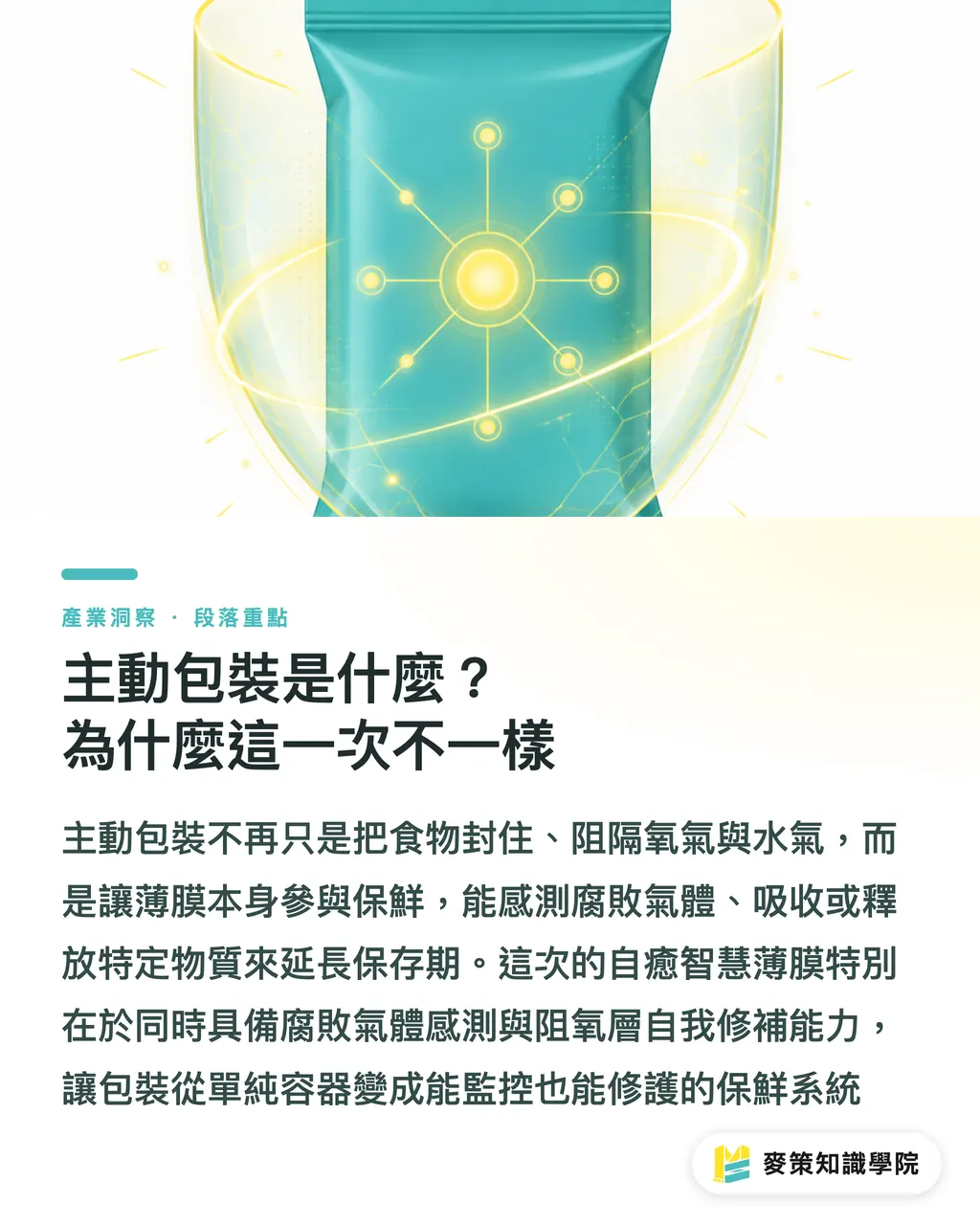
Traditional food packaging mostly relies on passive barriers: seal everything in, block as much oxygen, moisture, and light as possible, and hope it lasts. Active packaging flips the script. The film itself reacts to the contents by absorbing oxygen, taking in moisture, releasing antimicrobials, or sensing gases to actively extend shelf life
The self-healing smart film reported by Packaging Insights delivers two functions at once:
・ Spoilage gas detection: The film detects volatile gases released as fresh meat, seafood, and ready-to-eat meals spoil (typically biogenic amines and sulfur compounds), displaying changes through color shifts or electrical signals
・ Oxygen barrier self-healing: When micro-cracks or scratches appear on the film surface, the internal material repairs the damaged oxygen barrier structure on its own, restoring its original oxygen blocking capability
Combining both on a single film is rare. In the past, sensor labels and self-healing coatings lived in separate worlds. Stacking them together turns the film from a simple container into a monitoring station plus repair unit
How does it work? The design logic behind the two functions
On the sensing side, the common approach embeds dyes or indicators sensitive to specific gas molecules into the film, triggering visible changes upon contact. More advanced versions use electrochemical sensing, outputting signals to phones or dedicated readers. The big perk for brands is a clear spoilage signal that consumers or warehouse staff can spot without opening the package
The self-healing side usually relies on a multilayer structure:
・ The outer layer provides mechanical strength and printability
・ The middle layer contains microcapsules or flowable self-healing precursors
・ The inner layer delivers the oxygen barrier (often EVOH ethylene vinyl alcohol copolymer, or vapor-deposited metal oxide coatings)
When the outer layer suffers damage or cracks, the microcapsules release healing agents that polymerize across the cracks, sealing off oxygen pathways again. This mechanism already has commercial track records in electronics packaging and aerospace coatings. Bringing it to food film has been the focus of materials teams in recent years
The real challenge of pairing these two is interference. If the sensing layer is too thick, it hurts breathability. If the self-healing layer is too soft, it ruins printability. Getting both to work on one film means materials scientists and process engineers have finally cracked the balance
Why does it matter? It hits brand pain points head-on
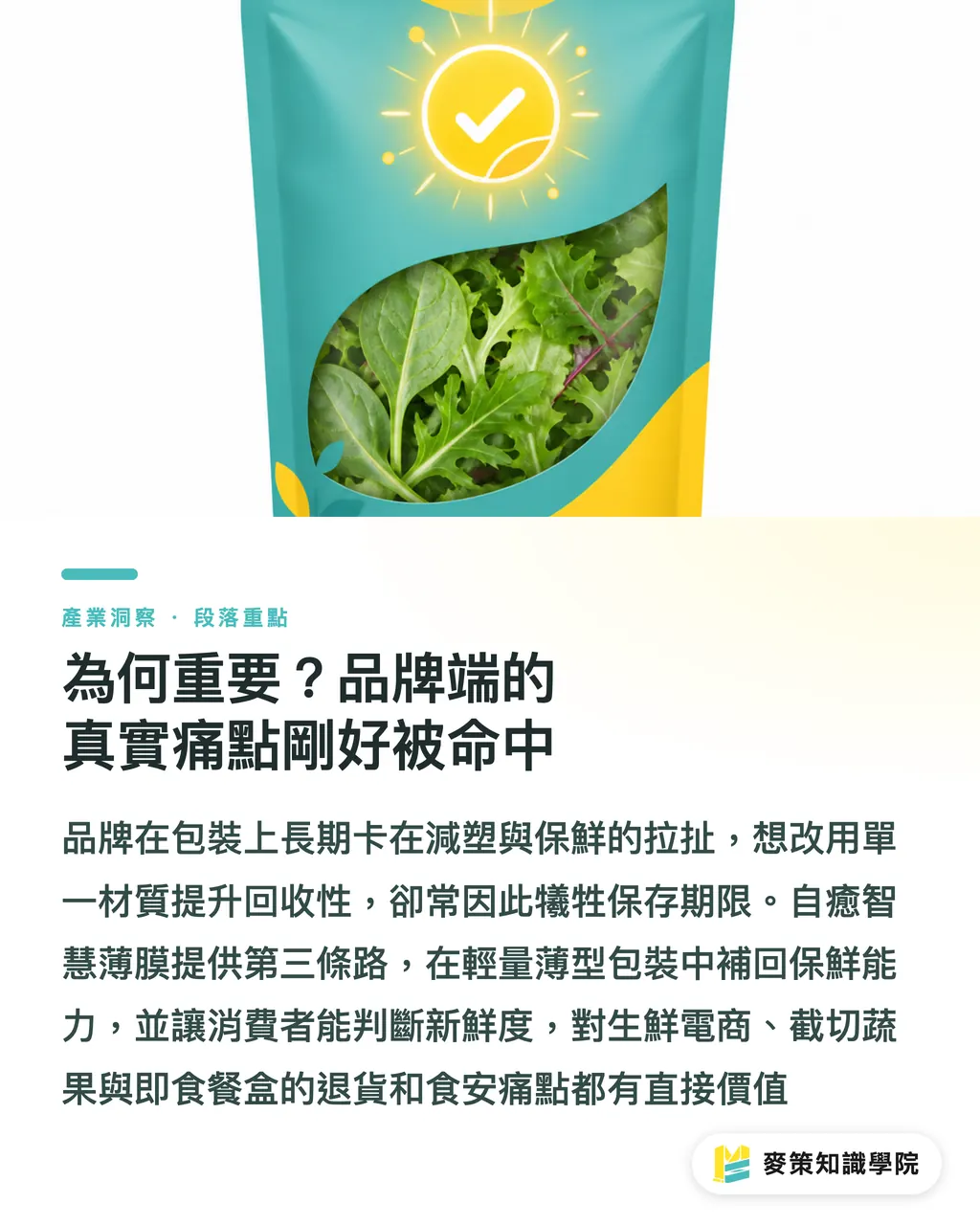
Working with brand clients on packaging over the years, the most common dilemma I hear is plastic reduction clashing with freshness preservation. Brands want mono-materials for easier recycling, but stripping down multilayer structures often trades away shelf life for recyclability
Self-healing smart film opens up a third path:
・ It claws back lost shelf life without sacrificing lightweight, thin profiles
・ It introduces sensing value, letting shoppers check freshness at a glance or with a phone
・ For fresh e-commerce, pre-cut produce, and ready-to-eat meals, it directly tackles returns and food safety disputes
For brands, this goes beyond packaging upgrades into product experience upgrades. It gives you solid talking points across pricing, gross margin, and brand storytelling
What should packaging printers worry about? Which processes will be reshuffled
Once functional films enter mass production, printers face the first real test. The substrate surface is fundamentally different from traditional PET, OPP, or NY. Flexographic ink adhesion, curing conditions, and color density must all be rebuilt from scratch, while digital inkjet priming also becomes unpredictable
Here is what will actually change across the workflow:
・ Surface treatment: Corona and plasma treatment parameters need full re-evaluation. If the sensing layer compromises surface energy, ink flaking risks shoot right up
・ Inks and varnishes: Traditional polyurethane varnishes can block gas permeability for the sensing layer and require proofing tests. Selection rules for low migration inks must also be reset
・ Lamination and slitting: Because the self-healing layer responds to heat and pressure, processing windows for lamination become much narrower
・ Quality inspection: Beyond color variance and adhesion, tests must check whether converting damaged the sensing function or compromised self-healing after slitting
In other words, the real challenge for printers shifts from looking good on press to keeping functions intact after conversion. That is a whole new dividing line for technical competence
How can brands and packaging printers take action now?
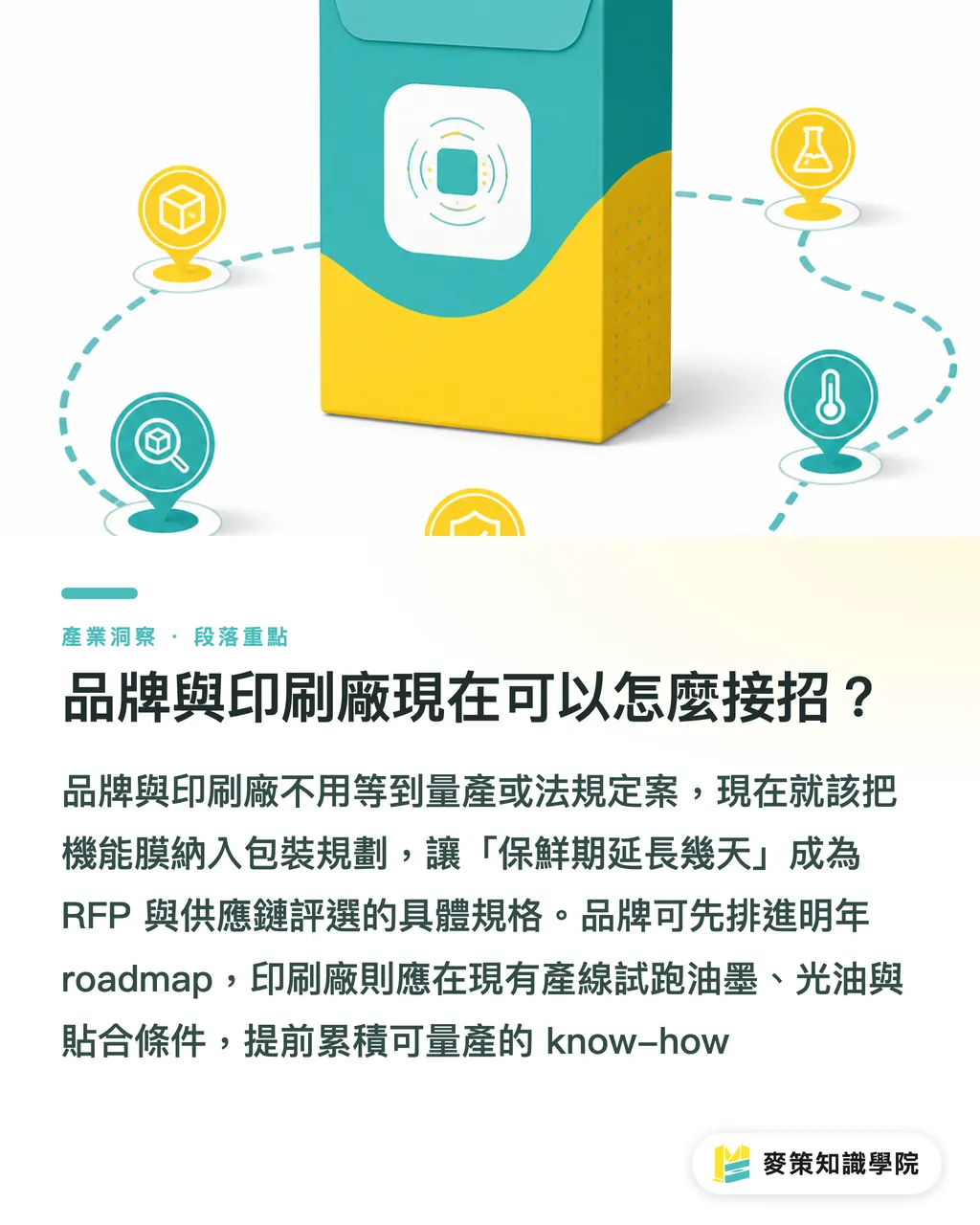
You do not have to wait for full commercialization or new regulations. Here are a few practical steps to take right now:
・ Brands: Include extending shelf life by X days as a product spec in your RFPs. Do not just shop on price; bring functional performance into vendor evaluation
・ Supply chain: Run proofing runs with materials suppliers and printers in the same room. Specifying solely with material vendors leaves printers blindsided during scale-up
・ Printers: Run simulated trial prints with functional films on current production lines to test ink, varnish, and lamination windows, building your own in-house know-how
・ Regulatory compliance: The EU PPWR (Packaging and Packaging Waste Regulation) imposes disclosure rules on active packaging, so material declarations and functional claims must be prepared early
If you are a brand looking to stand out in fresh or ready-to-eat categories, put functional films onto your packaging roadmap for next year. If you run a print shop, put mastering these materials on your priority list within the next twelve months
Key Takeaways
・ Active packaging is not new, but combining sensing and self-healing on a single film is the real breakthrough
・ The self-healing layer restores oxygen barrier integrity rather than cosmetic scratches. Keep marketing claims grounded in actual mechanics
・ The biggest hurdle for printers is not print quality, but whether the functional features survive the press run
・ Adding functional specs to brand RFPs separates capable packaging suppliers from low-cost bidders much faster
・ The EU PPWR sets clear disclosure rules for active packaging, requiring compliance documentation alongside material adoption
Further Thoughts
Looking at my work guiding clients from plastic reduction to shelf life preservation, the next battlefield in food packaging is not purely structural mono-material conversion, but value-driven functionality. Mono-materials solve recycling facility problems, while functionality solves retail shelf and refrigerator problems. The latter connects directly to revenue and return rates, speaking the exact ROI language brand clients care about
The takeaway for printers is clear: as packaging evolves from a passive container to a functional platform, post-press converting gets revalued. Basic printing margins will only get squeezed, while bundled printing, functional testing, and converting integration hold real pricing power. Any capable converter should start building trial printing capabilities for functional films now. It will pay off within three years
Brand buyers and packaging teams can also ask printers a different question: Can you print on functional films? And can you guarantee the sensing and self-healing properties survive the process? That question weeds out unqualified suppliers much faster than asking for standard quotes
Further Reading
FAQ
- Is self-healing smart film commercially available right now?
- It is currently in laboratory and early commercialization stages and has not reached mass-market pricing. Interested brands should partner with material suppliers and packaging printers to run pilot testing
- Does the self-healing film repair cosmetic scratches or oxygen barrier performance?
- It repairs the oxygen barrier structure. When micro-cracks form and degrade barrier performance, the internal self-healing mechanism seals the pathways back up, rather than fixing visual surface scratches
- Can this functional film be printed like standard flexible packaging?
- Yes, but inks, varnishes, and converting parameters need re-evaluation. Ink adhesion, lamination temperatures, and nip pressure can all affect sensing and self-healing performance, making proofing trials essential
- What restrictions apply to active packaging under the EU PPWR?
- The EU PPWR mandates disclosure and functional claim substantiation for active packaging. Material ingredients and preservation mechanisms must be clearly labeled, requiring regulatory documentation alongside rollout
- Should brand clients adopt this right now?
- There is no rush to mass-produce, but adding functional films to your packaging roadmap for next year makes sense. Start by running pilot prints through suppliers with proofing capabilities like [MINDS](https://www.mindscmyk.com/) to build real-world performance data
Related articles
The Print × AI weekly
The print and AI know-how designers, brands and enterprises can use before they commit — one email, every week
MINDS Free Tools
Spine width and imposition calculators — skip the manual math, free in your browser.
MINDS Group
Need actual printing or gifting services?
From premium printing to online ordering and festive gifts — the MINDS Group sister brands take it from here.