
Overview
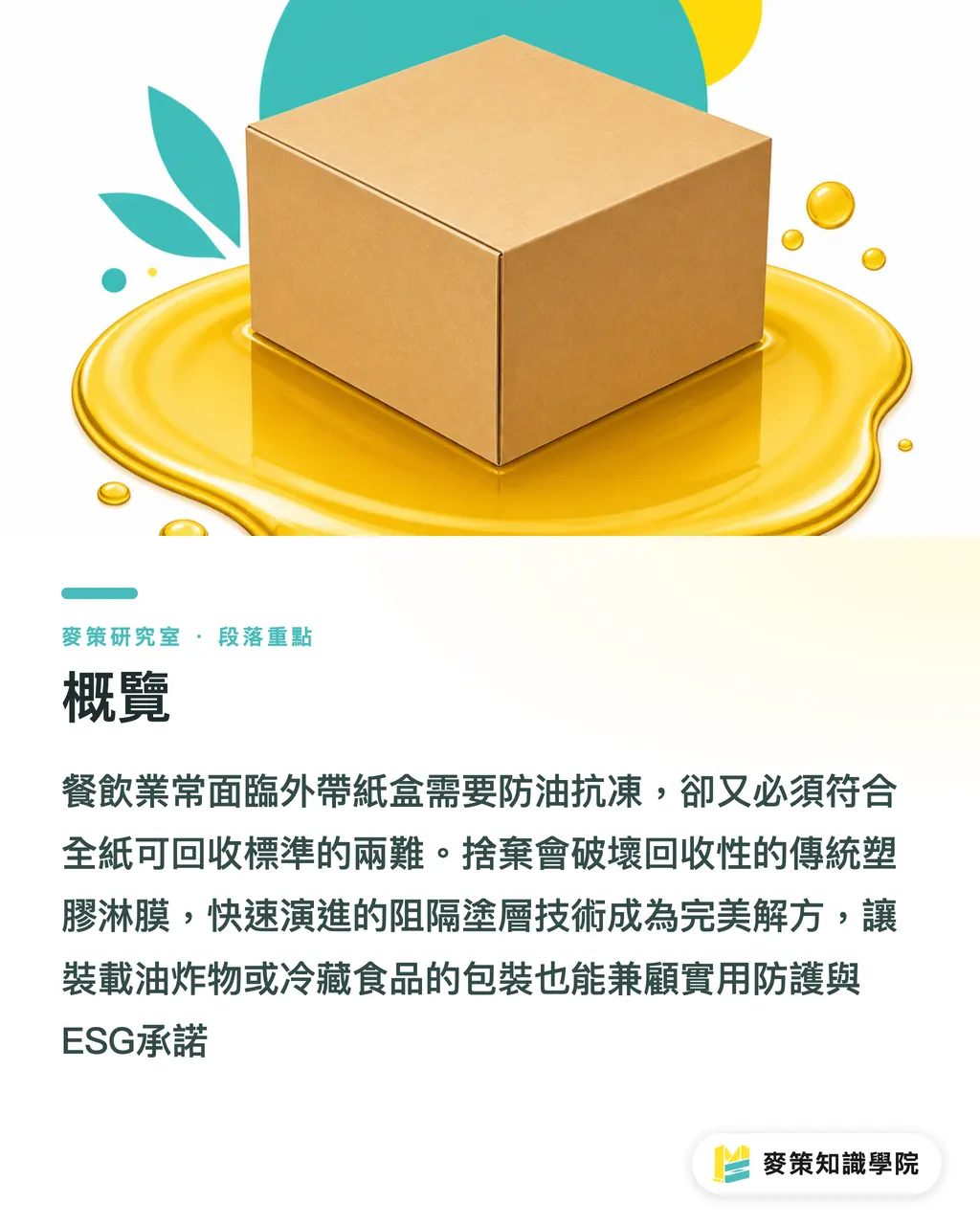
A client walks in with a takeout container project and asks: Can we make it all-paper and recyclable, but keep fried food from leaking grease and stop it from going soggy in the fridge? Most printers immediately default to PE extrusion coating. Protection is fine, but recyclability is ruined, and the client's ESG commitments fall apart. This dilemma actually has a fix, and the key lies in barrier coatings, a rapidly evolving technical field
Why Can't Paper Packaging Block Water and Grease on Its Own?
Because paper is essentially a hydrophilic, porous web. It is made of interwoven cellulose fibers. The fibers themselves are hydrophilic, and the pores between them form capillary channels that let water, grease, and gases penetrate quickly [1]. Once wet, paper quickly loses strength and warps, destroying structural integrity. Grease migration creates oily stains, while gas and aroma molecules pass straight through untreated fiber networks, accelerating oxidation and flavor loss [1]
This explains why plastic-reduction projects that simply swap in paper often crash during sampling. The issue comes down to paper's inherent structure, not the quality of the paper itself. The old fix was adding a PE coating or BOPP film lamination, which basically sticks plastic onto paper. You get protection, but separating paper from plastic is extremely difficult, completely blocking paper recycling. Watching paper packaging transitions over the years, I keep seeing the exact same bottleneck. What is really in the way is that protective film layer
How Do Barrier Coatings Protect Without a Plastic Film?
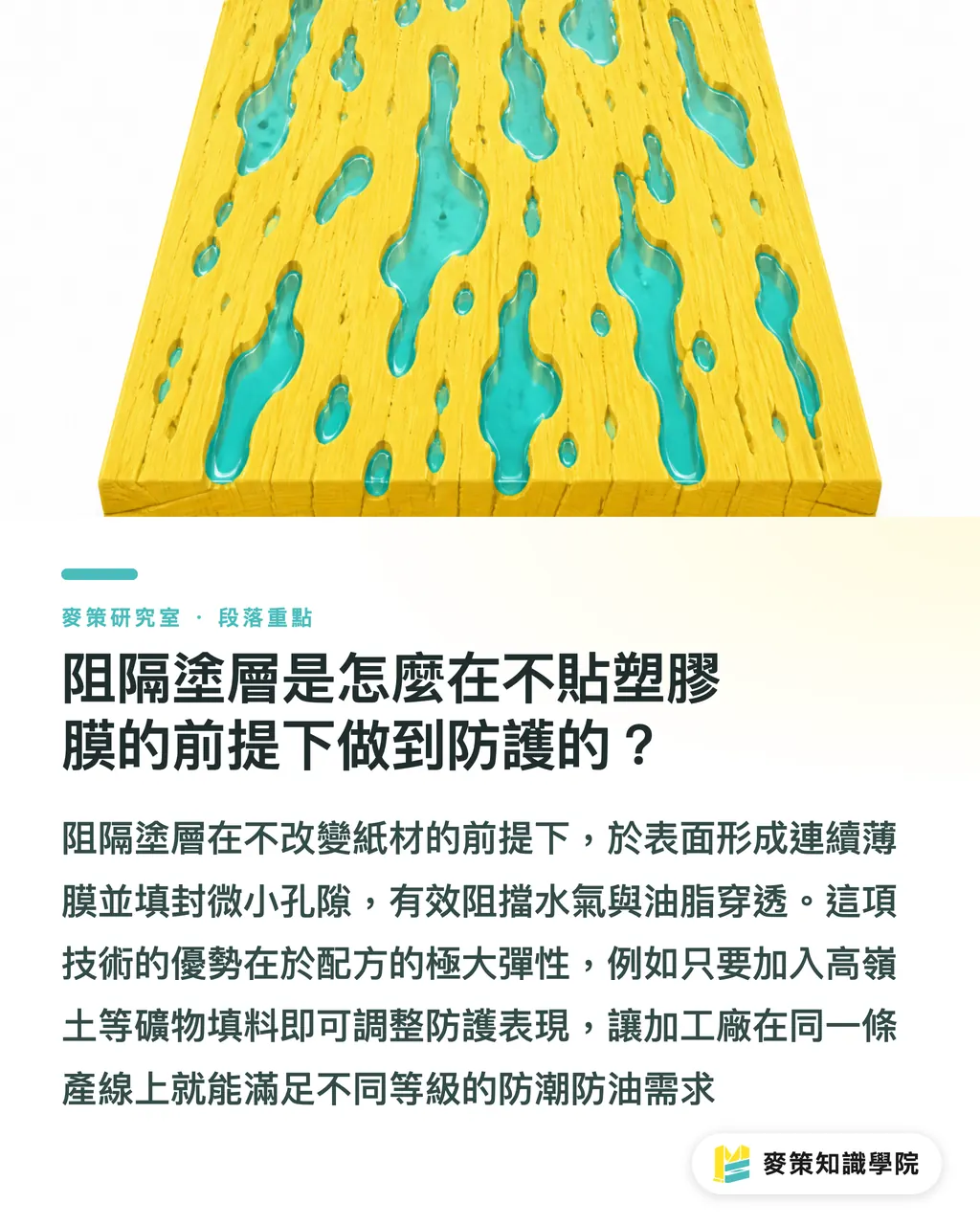
The approach modifies the surface without changing the base substrate. A barrier coating is a functional polymer or bio-based material applied to the paperboard surface. Once dry, it forms a continuous film that lowers surface wettability and seals micron- and nanoscale pores in the paper structure. This lengthens the diffusion path for molecular migration, cutting down penetration from liquids, vapors, oils, and aromas all at once [1]. In water-based systems, for example, the coating consists of polymer particles dispersed in water. When the water evaporates, the particles fuse into a film, and formulation additives can fine-tune specific barrier requirements [1]
Formulation offers far more flexibility than most people think. Research shows that adding kaolin mineral fillers to styrene-butadiene water-based dispersion coatings significantly affects water, moisture, and grease barrier performance in paper packaging [2]. Barrier performance does not rely on a single miracle material. Polymers, fillers, and coating processes must work together. For converters, this is good news: on the same coating line, tweaking the formulation lets you handle orders with different protection grades
How Does the Industry Measure Barrier Performance?
Different barrier properties have different measurement metrics. Understanding them is essential when aligning specifications with brands. Water resistance relies on two indicators: the Cobb test measures water absorption on the paper surface, while contact angle measures liquid spread across the surface, where a higher contact angle means greater water repellency [1]. Grease resistance uses the standardized KIT test, evaluating a coating's grease holdout using oils of increasing aggressiveness [1]
The practical value of these numbers is clear: when a brand says 'we need grease resistance,' you can push back and ask, 'What KIT level? Is the food contact hot oil or room temperature?' That turns vague demands into testable specs. In my consulting experience, most disputes in paper packaging projects happen not because the coating failed, but because both sides never aligned on testing standards from day one. Projects where the spec sheet only states 'water and grease resistant' are almost guaranteed to need resamplings
Have Bio-Based Coatings Caught Up with Petroleum-Based Ones?
They are closing the gap fast, and the technical paths are more varied than expected. Academia has already systematically reviewed bio-based grease barrier coatings for paper food packaging, covering the current research state and commercialization prospects of multiple bio-based materials [6]. In concrete terms, biopolymer coatings blended with carnauba wax have demonstrated simultaneous improvements in oxygen barrier, water vapor barrier, and grease resistance on paper [3]. Blended coatings of polycaprolactone and cutin, which can be extracted from agricultural by-products like tomato peels, have also been proven to enhance moisture barrier and grease resistance for food-contact paper [4]
My takeaway is that the technical bottleneck for bio-based coatings is shifting from 'is it possible' to 'scaling cost and coating runnability.' For print converters, most of these new coatings use water-based dispersion or extrusion coating routes. Whether they can run on existing coating equipment will be the deciding factor for adoption speed. Academic literature rarely covers this practical side, so the industry has to do its own homework
How Should Printers Position Themselves Now?
Translate testable barrier specifications into sales language first, before committing to equipment investments. Specifically:
・When taking orders, quote barrier requirements across four dimensions: Cobb, contact angle, KIT level, and oxygen barrier, avoiding vague promises of 'water and grease proof' [1]
・For low-to-medium barrier needs (bakery bags, dry food boxes), evaluate water-based dispersion coatings first, since this route easily integrates with existing coating units [1]
・For high-barrier, high-margin orders (fried takeout, frozen food), monitor the commercial scale-up of bio-based coatings. Both carnauba wax and PCL/cutin formulations belong on your material radar [3][4]
Application boundaries: These guidelines apply to standard food-contact and consumer packaging. If a product demands extreme specifications like retort sterilization or long-term high oxygen barrier (such as coffee or nitrogen-flushed snacks), current coating solutions may not fully replace flexible barrier laminates. Test on a case-by-case basis rather than making blanket promises
Key Takeaways
・Paper's inherent weakness lies in its hydrophilic fibers and porous structure. Water, grease, and gases penetrate quickly through capillary channels, which is the root cause of failed 'just switch to paper' projects
・Barrier coatings lower surface wettability and seal pores to form a continuous film, replacing the protective function of plastic films without sacrificing recyclability
・Measure water resistance with Cobb tests and contact angle, and grease resistance with KIT tests. Converting vague 'water and grease proof' requests into verifiable specs is the first step to avoiding project failures
・Bio-based coatings (carnauba wax composites, PCL/cutin blends, kaolin-filled water-based systems) have delivered proven results in moisture and grease resistance. The bottleneck is now shifting to production costs and coating runnability
・Extreme specifications (retort pouches, long-term oxygen barrier) remain the boundary of current coating solutions. Case-by-case validation is far better than blanket commitments
Further Thoughts
On the print manufacturing side, 'protection' can shift from lamination back to coating. Plants with existing varnish or coating units can use their current machines to win orders previously reserved for flexible packaging converters. The prerequisite is building in-house Cobb and KIT barrier testing capabilities, expanding quality control metrics from color variance to barrier performance. On the design side, all-paper recyclable structures change how box structures and sealing methods are selected. Designers need to understand coating processing constraints early on, such as coating integrity along fold lines. When it comes to AI and SaaS adoption, multi-dimensional barrier specifications (water, oil, oxygen, aroma × test standards × food regulations) create a natural use case for automated quoting and spec-matching systems. Structurally matching material databases, testing standards, and project requirements is far more dependable than human memory. The unresolved challenge remains bio-based coating runnability on high-speed coating lines and long-term supply stability, which requires industry and academia to bridge the gap in commercial-scale validation together
References
[2] Marinelli A., Diamanti M., Pedeferri M. et al. (2023). Kaolin-Filled Styrene-Butadiene-Based Dispersion Coatings for Paper-Based Packaging: Effect on Water, Moisture, and Grease Barrier Properties. Coatings. DOI: 10.3390/coatings13010195
[3] Biopolymer and Carnauba Wax Coating for Improved Paper Oxygen Barrier, Water Vapor Barrier, and Grease Resistance. DOI: 10.1021/acsami.5c09638.s001
[4] Lo Faro E., Licciardello F., Pulvirenti A. et al. (2026). Polycaprolactone/cutin blends for the improvement of moisture barrier and grease resistance of paper for food use. Food Packaging and Shelf Life. DOI: 10.1016/j.fpsl.2026.101722
[5] Lo Faro E., Licciardello F., Pulvirenti A. et al. (2025). Polycaprolactone/Cutin Blends for the Improvement of Moisture Barrier and Grease Resistance of Paper for Food Use. DOI: 10.2139/ssrn.5356197
[6] Chen Q., Zhang R., Su Y. et al. (2023). Research Status and Prospects of Bio-based Materials for Grease Barrier Coatings on Paper Food Packaging. Paper and Biomaterials. DOI: 10.26599/pbm.2023.9260025
FAQ
- Why Can't Paper Packaging Directly Replace Plastic Packaging?
- Because paper consists of hydrophilic cellulose fibers whose pores form capillary channels. Water, grease, and gases quickly seep through, causing strength loss, grease stains, and content oxidation. Untreated paper lacks the barrier performance needed for most food packaging applications
- What Is the Difference Between Barrier Coatings and PE Extrusion Coating?
- PE coating laminates a layer of plastic film over paper, which protects well but makes separating paper from plastic difficult, ruining recyclability. Barrier coatings form a continuous functional film via liquid coating, protecting the substrate by reducing surface wettability and filling pores. This preserves water and grease resistance while keeping the paper fully recyclable
- How Is Water and Grease Resistance Measured in Paper Packaging?
- Water resistance uses the Cobb test to measure water absorption and contact angle to evaluate surface repellency. Grease resistance uses the standardized KIT test, grading coating performance with oils of increasing aggressiveness. When quoting jobs, align specs around these indicators rather than relying on vague terms like 'water and grease proof.'
- Are Bio-Based Barrier Coatings Mature Enough for Commercial Use?
- Feasible options already exist for low-to-medium barrier needs. Carnauba wax combined with biopolymers has demonstrated proven gains across oxygen barrier, moisture barrier, and grease resistance, while PCL/cutin blends are proven to boost moisture and grease holdout on food paper. Extreme requirements like retort pouches or long-term high oxygen barrier still require case-by-case testing
- Do Printers Need New Equipment to Adopt Barrier Coatings?
- Not necessarily. Water-based dispersion coatings share a similar process workflow with existing aqueous coating units, making them the easiest path to integrate. However, bio-based materials requiring high-barrier formulations or extrusion coating require evaluating coater compatibility and drying capacity before investing in new machinery
Related articles

The Print × AI weekly
The print and AI know-how designers, brands and enterprises can use before they commit — one email, every week
MINDS Free Tools
AI background removal, a LINE sticker maker, spine & imposition calculators — all free, right in your browser, no upload.
MINDS Group
Need actual printing or gifting services?
From premium printing to online ordering and festive gifts — the MINDS Group sister brands take it from here.