
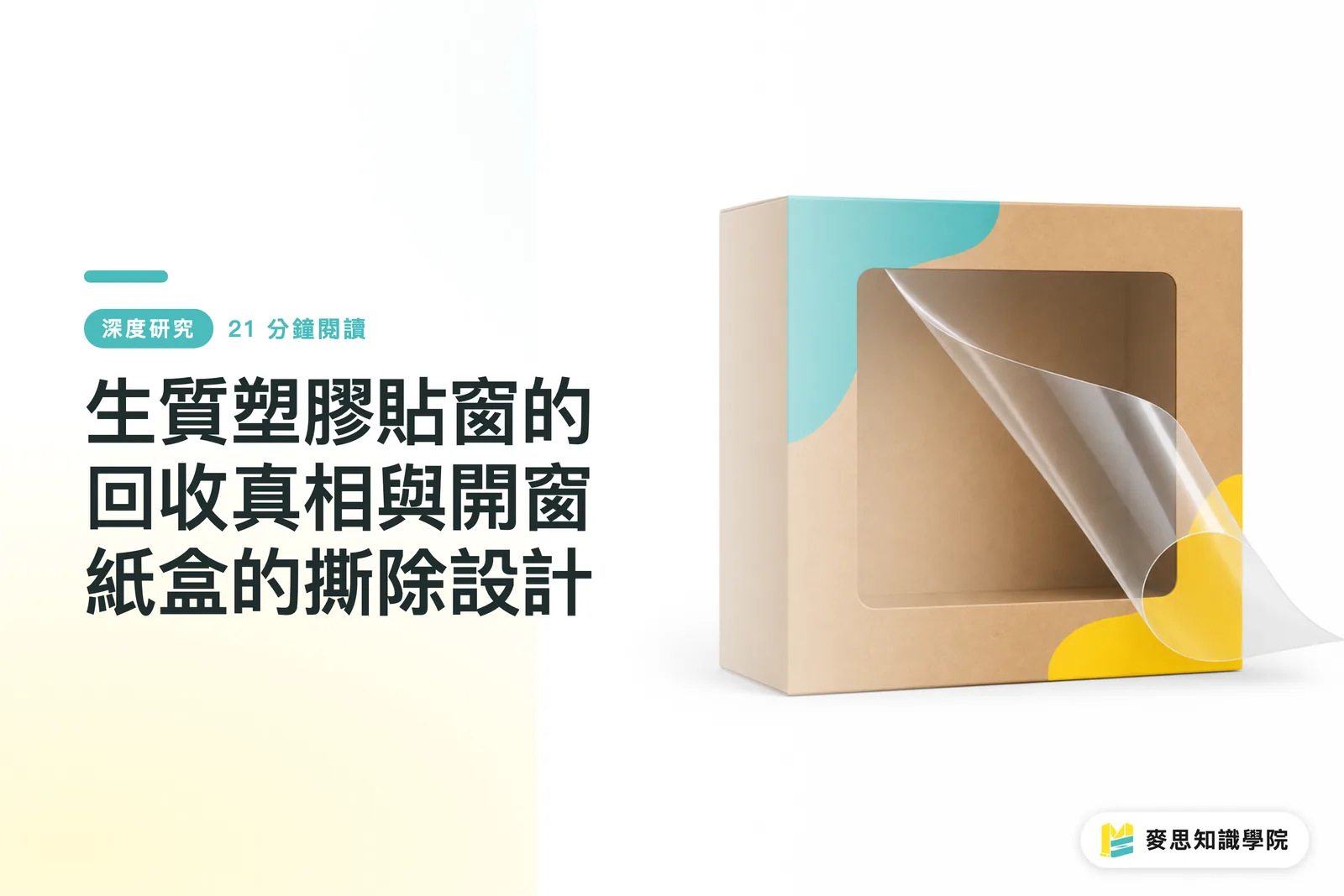
Introduction: Why Window Cartons Are a Hidden Hurdle in Sustainable Packaging
Window cartons (packaging where an opening is cut into the carton panel and covered with transparent film to show the contents) are among the most common display packages in food, bakery, stationery, and retail. Their design value lies in what-you-see-is-what-you-get, letting consumers view the item right on the shelf. Yet that single transparent window turns a seemingly simple paper box into a complex multi-material sorting headache
This paper argues that the sustainability controversy around window cartons has long been ignored due to three structural gaps:
・First, a gap between material labels and actual recycling outcomes: even if a window uses bioplastic labeled compostable, that does not mean it will be processed correctly in Taiwan's recycling system
・Second, an information gap between designers and recyclers: designers select materials based on clarity, stiffness, and cost, rarely factoring in how recycling plants sort that film
・Third, a gap in alternative maturity: whether emerging technologies like water-based barrier coatings can truly replace windows remains an open debate between academia and production lines
In academic and industry discussions, cellulose-based barrier materials have emerged as a promising direction to replace plastic barrier layers. Microfibrillated cellulose (MFC) and cellulose nanofibrils (CNF) have been systematically studied for their barrier properties[1][2]. However, most of these studies focus on barrier performance itself. They rarely extend to high-clarity display scenarios like windows, nor do they reflect the sorting realities of local recycling chains in Taiwan
This paper makes three contributions, each corresponding to a subsequent section:
・First, defining and comparing the recycling pathways of four window methods (PLA film, cellulose water-soluble film, translucent paper film, and die-cut open windows), clarifying why compostable does not equal recyclable, corresponding to the Material Comparison section
・Second, breaking down how window separability can be guided by front-end tear lines and creases, demonstrating how design choices actively alter recycling outcomes, corresponding to the Tear Design section
・Third, evaluating the technical feasibility and limits of water-based barrier coatings as window alternatives, reviewing literature evidence on cellulose-based barrier materials[1][2][5], corresponding to the Coating Alternatives section. This topic matters to Taiwan's industry because small and medium printing plants face increasingly specific sustainability demands from brand clients, while current material selection knowledge remains stuck at the intuitive level of using paper equals eco-friendly
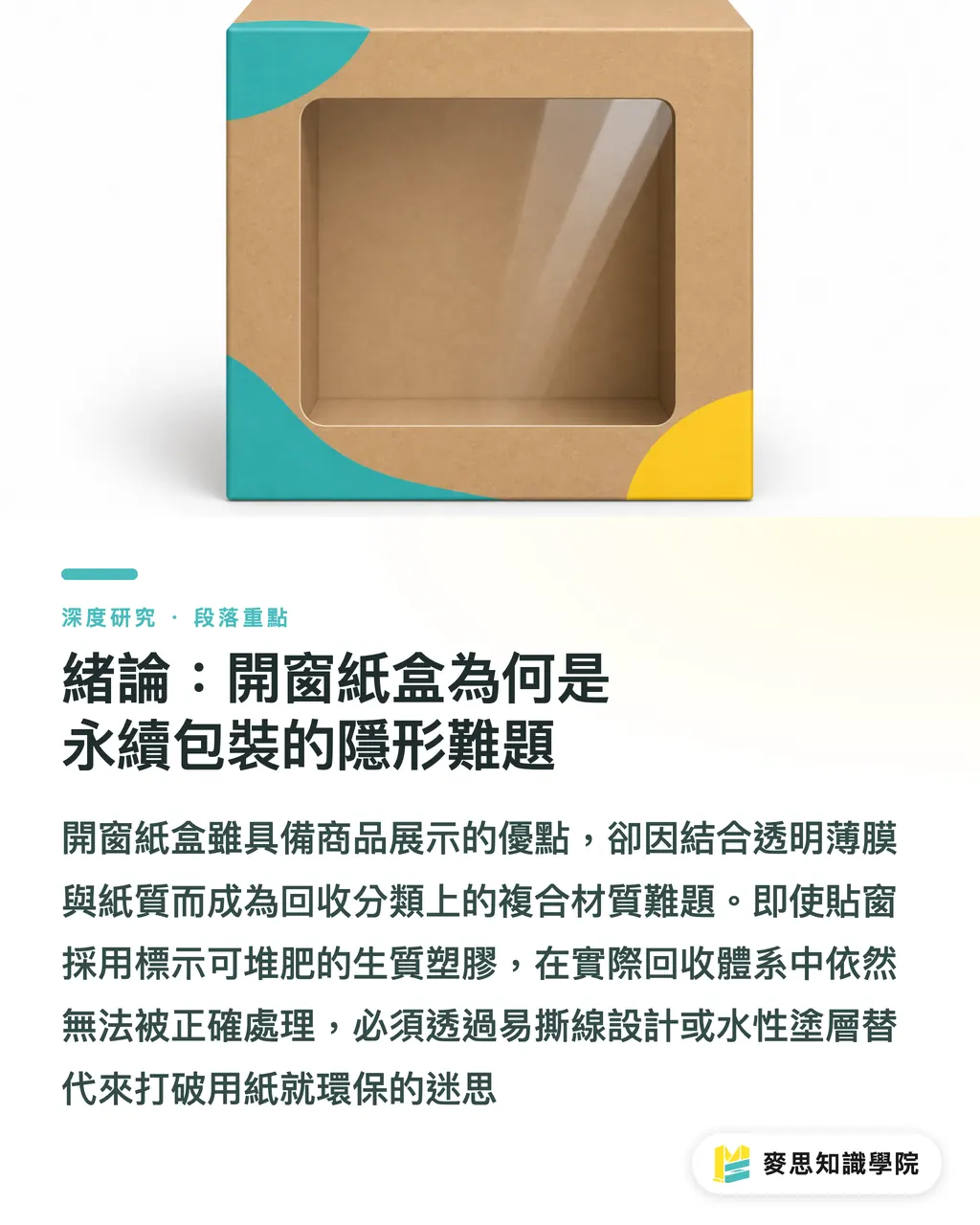
Literature and Industry Review: The Disconnect Between Barrier Performance and Recycling Systems
Existing discussions on eco-friendly packaging materials fall into three distinct clusters, each with its own focus and blind spots
The first cluster focuses on the barrier performance of cellulose-based materials, which has been the main focus of barrier material research over the past decade. Studies show that microfibrillated cellulose can serve as the foundation for developing new barrier materials, as its dense fibril network significantly reduces oxygen and grease permeation[1]. Subsequent work compared the coating barrier properties of different types of cellulose nanofibrils, confirming the effectiveness of cellulose nanofibrils for oxygen barrier applications and exploring their scope in packaging[2]. To improve oxygen barrier capacity, researchers also used cellulose nanofibers to reinforce microcapsules, showing the potential of cellulose-based materials in barrier layer design[3][4]. This cluster provides a materials science foundation for replacing plastic barrier layers with cellulose. However, most experimental scenarios involve flat coatings for oil and oxygen resistance. They do not directly address the high-clarity display needs of window cartons, leaving an application gap with our focus on transparent window replacement
The second cluster examines hybrid processes combining cellulose-based coatings with traditional coatings, attempting to resolve the poor film formation and water resistance of pure cellulose coatings. Studies propose combining microfibrillar cellulose with shellac to achieve high-barrier packaging, showing that single cellulose materials often require blending with other natural film-forming agents to balance barrier performance and processability[5]. The implication for this paper is clear: replacing plastic windows with water-based barrier coatings is rarely a simple swap of one material for another. It is a formulation engineering problem, pointing to challenges in cost and mass production
The third cluster centers on recycling systems and sorting practice, tracking where materials end up in real-world recycling chains. This literature is fragmented and often appears in industry practical reports and recycler feedback. Its core argument is that material recyclability depends on whether the sorting system can identify and separate it, rather than its chemical degradability. Bioplastics (polymers made from bio-based materials such as PLA) spark the most debate here: PLA degrades under industrial composting conditions, but if mixed into standard plastic or paper recycling streams, it becomes a contaminant. Unlike materials science research, this cluster shifts focus to whether resource recovery systems can handle the material properly
Looking across these three clusters reveals a clear disconnect. Materials science proves the barrier potential of cellulose-based options[1][2][5], while recycling practice highlights sorting and separation. Yet no bridge connects them to explain how the window material and design of a specific carton together determine its fate in a real recycling system. This paper bridges that gap by establishing an actionable decision framework based on sorting realities in Taiwan
Material Comparison: Recycling Pathways Across Four Window Methods
Paper recycling systems for window cartons are relatively mature. The main variable affecting environmental impact is how the transparent window gets sorted. This section defines four main window methods, analyzes their recycling pathways, and establishes the core principle that separability matters more than compostability labels
The first method is PLA (polylactic acid) windows. PLA is the most common bioplastic window material. It offers high clarity, good stiffness, and manageable cost, making it widely used in food and retail packaging. The recycling debate stems from the fact that PLA looks and feels almost identical to traditional PET plastic. If consumers toss the box into recycling without removing the film, PLA windows can enter paper recycling streams with the carton or PET streams with plastic. PLA contaminating PET streams is the more common problem in practice. Because PLA and PET have different melting points and recycling traits, even tiny amounts of PLA degrade recycled PET quality. PLA's compostable label requires high heat and humidity found only in industrial composting facilities. Taiwan lacks widespread industrial composting infrastructure. In practice, PLA windows often end up unable to compost while simultaneously contaminating plastic recycling, creating a double loss scenario. This gap between label promises and actual facility access explains why compostable claims hold little weight in Taiwan right now
The second method is cellulose water-soluble film (transparent films made from cellulose with water-soluble or high biodegradability traits). These films claim eco-friendly degradation and are theoretically closer to the re-pulping process in paper recycling. Their main advantage is better compatibility with paper fibers. However, practical limits include lower clarity, weaker moisture resistance, higher cost compared to PLA, and a sparse supply chain in Taiwan, making reliable sourcing tough for small and medium printers. As a result, this option suits niche brand trials willing to absorb higher costs rather than high-volume standard products
The third method is translucent paper film and paper substrates (such as tracing paper or glassine). Strictly speaking, this provides translucency rather than true transparency, failing to deliver the crisp product view of PLA. But its recycling advantage is direct: the film comes from the same source material as the box, allowing them to be recycled and re-pulped together. This represents a clear trade-off: sacrificing display clarity for recycling simplicity. It fits product categories where crystal-clear visibility is secondary to uniform recycling, such as dry goods, stationery, or handmade soaps
The fourth method is die-cut open windows without film (cutting an opening into the carton panel with a die cutter and applying no film). This route offers the simplest recycling path because the entire package consists of a single paper substrate with no composite film to separate. The trade-off is losing dust protection, moisture defense, and content security. It works best for products that can handle exposure or composite structures that use an inner bag. For brands seeking maximum recycling certainty, a die-cut window with an inner bag often guarantees a clean paper stream far better than a compostable film window
These four methods point to a central rule: recycling success hinges on whether the window can be peeled off cleanly before entering the processing stream. Material degradability alone means very little. Literature demonstrates the barrier and degradation potential of cellulose materials[1][2], but realizing that potential in real recycling chains relies heavily on separation. This brings us directly to tear design in the next section
Tear Design: Guiding Consumer Separation Through Tear Lines and Creases
Whether a window gets recycled comes down to whether the consumer tears it off. Front-end structural design can actively prompt this behavior instead of passively hoping for it. This section analyzes the mechanics of tear lines and creases, showing how design choices change separation rates
The core mechanism of easy-tear design is creating a path of least resistance at the joint between the carton and the window, or right on the carton panel. Common techniques include adding tear lines around the window edge (perforated or laser-cut lines), adding creases on the panel to weaken paper fiber resistance, and leaving a clear tear tab. The shared logic across all three is simple: turn separation from an extra chore requiring willpower into an intuitive action done without thinking. When physical resistance drops low enough and visual cues are clear, consumer separation rates rise sharply
Small design details directly affect separation results. For example, if a window film is glued edge-to-edge across the entire inner panel, tearing causes the film and paper to rip apart unevenly. Residual glue and shredded paper cling together, creating a mixed waste stream that is even harder to sort. Conversely, if adhesive is applied only in dots or strips along with a tear line around the opening, consumers can strip the entire film and glue off in one clean pull. This comparison shows that for PLA windows, how you apply the film matters just as much as what film you choose. This is often the most overlooked opportunity in design: tweaking glue application and adding tear lines costs almost nothing extra, but can dramatically boost separation rates
Adhesive selection is another variable. Even if both the window film and carton are recyclable, using strong, tear-resistant glue locks the two materials together, making manual separation nearly impossible. Glue selection for window cartons should follow the principle of secure enough to hold, easy enough to peel by hand. Adhesive, material type, and application pattern should be evaluated together during the design phase, rather than left to chance at the printer. This matches what we frequently see on production lines: recycling failures rarely stem from choosing the wrong material, but from processing steps and glues turning good materials into unseparable composites
While tear design works well, it has limits: it still relies on consumer action. No matter how user-friendly the design is, manual separation cannot guarantee a 100% success rate. To eliminate reliance on manual tearing at the source, alternatives like water-based barrier coatings offer higher recycling certainty
Coating Alternatives: Can Water-Based Barrier Coatings Replace Windows?
If water-based barrier coatings can form a functional barrier directly on paper, window cartons could rely less on plastic film, returning packaging to a single paper-based recycling path. This section evaluates the technical foundation and real-world limits of this alternative approach
On the technical side, research on cellulose-based barrier materials offers solid support. Studies show microfibrillated cellulose can serve as a foundation for new barrier materials, forming an effective barrier layer[1]. Different types of cellulose nanofibril coatings also show distinct oxygen barrier performance[2]. These findings indicate that applying water-based cellulose coatings to paper to replace certain plastic barrier functions is not far-fetched. For window cartons, this means grease and moisture barrier needs could eventually be met right on the paper surface, keeping the box mono-material and simplifying recycling
However, barrier protection and transparent display serve two totally different purposes. This is the main limit of coating alternatives. Water-based barrier coatings excel at forming grease-proof and moisture-resistant functional layers on paper. They cannot replace film windows when it comes to showing the product clearly. In the short term, coating replacement is more likely to work for categories where functionality replaces display, such as using coatings for oil resistance while shrinking or removing window cutouts. For large transparent windows used purely for display, coatings cannot deliver the needed clarity
Cost and mass production present a second barrier. Literature notes that pure cellulose materials often require blending with other film-forming agents to balance barrier performance and processability, such as pairing with shellac for high-barrier packaging[5]. This reveals that water-based barrier coatings on real production lines involve complex formulation engineering. They require fine-tuning coating equipment, drying conditions, and re-pulping compatibility, rather than just swapping out inks. This explains why coating solutions remain out of reach for many small and medium printing plants: material sourcing, coating uniformity, and re-pulping tests all demand investment, making initial adoption more feasible for larger paper converters and brands
Re-pulping compatibility is the single most critical factor to verify when evaluating coating options. Even if a coating offers stellar barrier properties, if it fails to disperse during re-pulping or leaves stickies in recycled pulp, it simply shifts the problem from the film window to the coating layer. Any water-based barrier coating marketed as eco-friendly should provide test data on re-pulpability, rather than relying on buzzwords like water-based or biodegradable. This aligns with our core rule for window carton material selection: prioritize what the recycling system can actually process
Implications for Taiwan's Design and Printing Industry
Selecting eco-friendly window carton options carries specific action items for three distinct roles across Taiwan's supply chain. This section breaks them down step by step
For small and medium printing plants, the most practical entry point is making separability a standard checklist item during quoting and sampling. In practice, when taking window carton orders, printers should proactively confirm window material, glue application methods, and whether tear lines are needed. During sampling, test whether the window can be peeled off cleanly by hand. This check adds virtually no cost, yet catches recycling failure risks before press runs, serving as a value-added service for brand clients. For newer methods like water-based barrier coatings, small printers do not need to build coating lines right away. Instead, build partnerships with paper converters that already have coating capabilities, adopting the tech once re-pulping data and costs stabilize
For designers, the key is treating the recycling pathway as a core design parameter right from layout design, rather than fixing it after the fact. In practice, first evaluate whether die-cut windows without film or translucent paper films can meet display goals. If PLA film is necessary, add tear lines and tear tabs to the die-line template, and specify pattern or strip gluing instead of full-coverage adhesive. Designers hold direct control over how, where, and whether a window is attached. These choices often exert far more influence over recycling outcomes than picking a material label
For brand owners, the main goal is avoiding the communication trap of assuming a compostable label equals eco-friendly. In practice, ask suppliers for clear proof of where window materials actually go in Taiwan's recycling stream, state the industrial composting prerequisites for compostable claims, and add simple icons on the package guiding consumers to peel off the window and recycle the paper box. Honest brand messaging around separation steps builds long-term trust far better than vague green claims, while aligning with tightening sustainability regulations and retail requirements
Bringing these supply chain efforts together, the most viable near-term path for window cartons is combining tear design, proper glues, and honest communication, without rushing into unproven new materials. Emerging tech like cellulose coatings is worth watching[1][2][5], but until mass production costs and re-pulping data mature, design and processing tweaks remain the most actionable path for Taiwanese companies today
Conclusion and Limitations
This paper addresses a core research question: whether bioplastic window film can be thrown into standard recycling bins, and how window cartons should balance material choice and tear design for eco-friendly outcomes. Our main conclusion is that bioplastic windows like PLA struggle to enter industrial composting channels in Taiwan while risking contamination of plastic recycling streams. Therefore, compostable does not equal recyclable. The primary variable driving recycling success is whether the window can be cleanly separated beforehand, which depends heavily on front-end design choices like tear lines, creases, and glue types. Water-based barrier coatings offer materials science potential for replacing plastic barrier functions with cellulose[1][2][5], but their barrier properties cannot replace transparent display windows, and they face real-world constraints in formulation, cost, and re-pulping compatibility
We must explicitly disclose two main limitations:
・First, cited literature centers on barrier performance studies of cellulose-based materials[1][2][3][4][5], lacking quantitative research on sorting outcomes within Taiwan's local recycling chains. Conclusions regarding where PLA ends up in Taiwanese waste streams and how tear design impacts separation rates represent author analysis grounded in shop-floor and recycler practices. Readers should view them as testable hypotheses rather than proven facts
・Second, our evaluation of water-based barrier coatings relies on existing barrier literature[1][2][5]. These experiments mostly involve flat coatings for grease and oxygen resistance, which differs significantly from high-clarity display windows. Extrapolating those findings to transparent window replacement carries notable uncertainty
Future research directions are clear and actionable:
・First, conduct field tracking at representative recycling facilities in Taiwan to quantify the actual sorting ratios of PLA windows in paper versus plastic recycling streams, bridging materials science and recycling systems
・Second, design controlled experiments comparing consumer separation rates across different tear lines and gluing methods, elevating tear design from a rule of thumb to a quantifiable design standard
・Third, establish standardized re-pulping compatibility tests for water-based barrier coatings, setting assessment standards that weigh barrier performance and recycling compatibility side by side
Key Takeaways
・Compostable does not equal recyclable: PLA windows in Taiwan rarely reach industrial composting and risk contaminating plastic recycling streams, failing on both fronts
・Whether the window separates cleanly before recycling directly determines its fate. Material degradability alone does not reflect real-world recycling impact
・Tear design (tear lines, creases, tear tabs) and glue selection represent low-cost, highly effective tools to improve recycling success
・Die-cut open windows or translucent paper films offer the simplest recycling routes, making them ideal for products that do not require crystal-clear visibility
・Water-based barrier coatings can replace some plastic barrier functions in materials science[1][2][5], but cannot replace clear display windows and remain limited by cost and re-pulping compatibility
Further Considerations
For print manufacturing, the sustainable value of window cartons lies not in chasing new materials, but in institutionalizing separability as a standard checklist item for sampling and quoting, using near-zero-cost tear lines and glue tweaks to prevent recycling failures. For design, recycling pathways must become a layout design parameter, where tear tabs and glue patterns offer far more influence than eco-labels. For AI integration, an exciting direction is using computer vision to automatically audit die-line templates for tear lines and proper glue zones, or querying databases to map material fates in local recycling chains, turning scattered shop-floor experience into searchable decision support. For SaaS, a pre-press sustainability compliance checking tool holds strong potential demand, but its accuracy depends heavily on local sorting data, which remains the biggest missing link today: materials science evidence is rich, yet empirical data on local recycling systems remains thin
References
[1] Raynaud S. (None). Development of new barrier materials using microfibrillated cellulose. DOI: 10.70675/353754cfz1803z46bezb189zb7915d2a209a
[2] Yook S., Park H., Park H. et al. (2020). Barrier coatings with various types of cellulose nanofibrils and their barrier properties. Cellulose. DOI: 10.1007/s10570-020-03061-5
[3] Review for "Improving the Oxygen Barrier of Microcapsules using Cellulose Nanofibers". DOI: 10.1111/ijfs.15013/v1/review2
[4] Review for "Improving the Oxygen Barrier of Microcapsules using Cellulose Nanofibers". DOI: 10.1111/ijfs.15013/v2/review2
[5] Hult E., Iotti M., Lenes M. (2010). Efficient approach to high barrier packaging using microfibrillar cellulose and shellac. Cellulose. DOI: 10.1007/s10570-010-9408-8
FAQ
- Can PLA bioplastic window film be thrown directly into regular recycling bins?
- Not recommended. Taiwan lacks widespread industrial composting channels for PLA. If tossed in whole, PLA windows can contaminate plastic or paper recycling streams. The safer method is peeling off the transparent window film first and recycling the paper box separately
- Does a compostable label mean a material can be recycled?
- No. Compostable means a material decomposes under the high heat and humidity of industrial composting facilities, which is a completely separate system from standard resource recycling. Without proper composting facilities, compostable materials can actually contaminate recycling streams
- What is the most eco-friendly option for window cartons?
- The simplest recycling route is a die-cut open window with no film, followed by translucent paper films made from the same source material as the box. If PLA film is necessary, add tear lines and tear tabs while using pattern gluing so consumers can peel it off cleanly by hand
- Can water-based barrier coatings replace plastic window film?
- Partially. Water-based cellulose coatings can form grease and moisture barrier layers directly on paper, replacing films that serve purely as barriers. However, coatings cannot provide clear product display and face constraints in complex formulation, cost, and re-pulping compatibility
- What can designers do for window carton recyclability?
- Treat recycling as a design parameter right from the start: evaluate open die-cuts or paper films first. If plastic film is required, include tear lines and tear tabs on the die-line template, and specify peelable glue types and pattern application to prevent full-coverage adhesive from locking materials together
Related articles

The Print × AI weekly
The print and AI know-how designers, brands and enterprises can use before they commit — one email, every week
MINDS Free Tools
AI background removal, a LINE sticker maker, spine & imposition calculators — all free, right in your browser, no upload.
MINDS Group
Need actual printing or gifting services?
From premium printing to online ordering and festive gifts — the MINDS Group sister brands take it from here.