
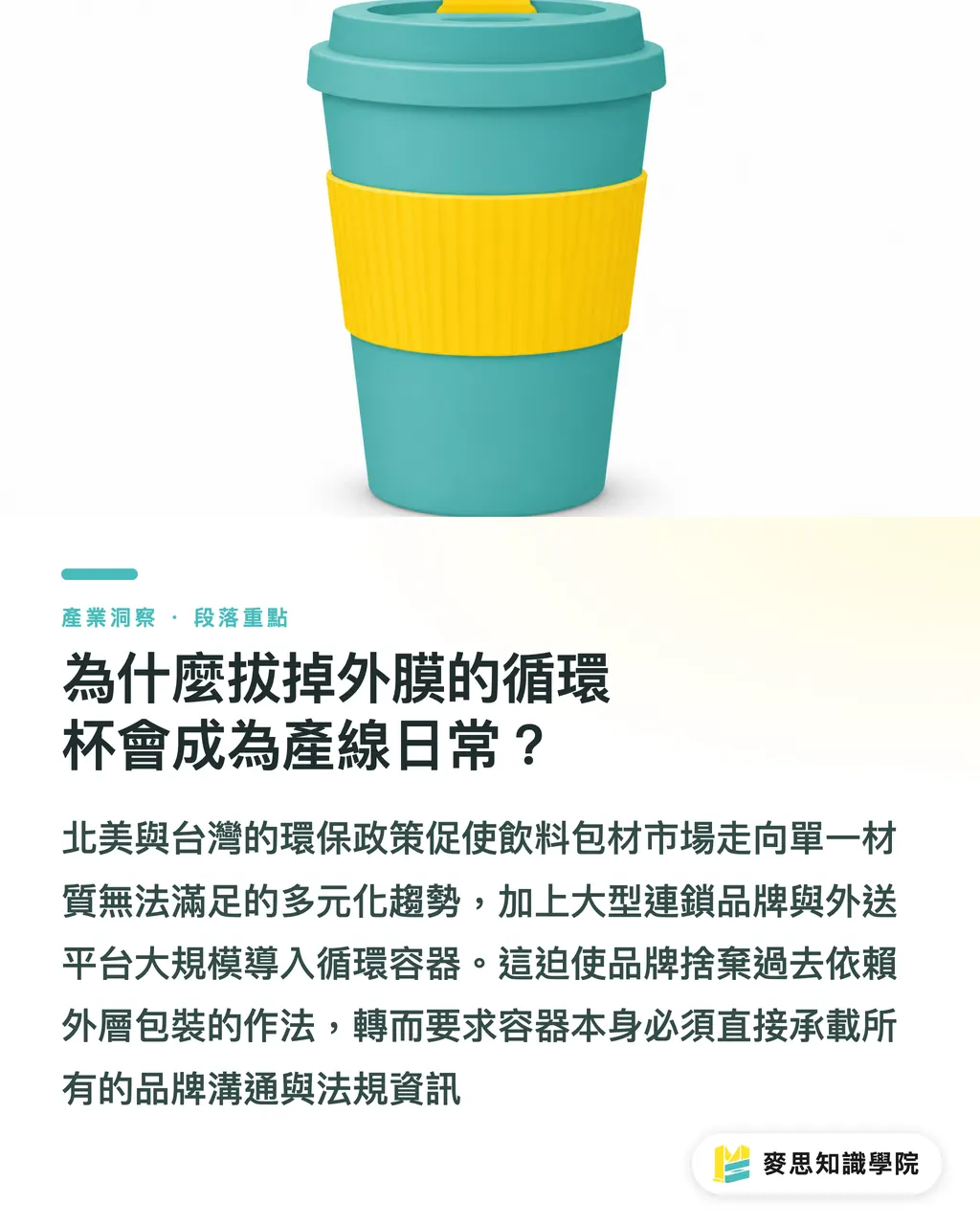
Why is Removing Outer Films from Reusable Cups Becoming the Production Norm?
In recent meetings with export clients specializing in beverage packaging, the conversation inevitably revolves around Portland's BYO (Bring Your Own) mandate and Taiwan's plastic reduction regulations
Industry trends, such as Eco-Products expands compostable, recyclable and reusable cup portfolio, clearly show that a single material choice no longer satisfies the market
This major manufacturer has simultaneously expanded its product line into three categories: compostable, recyclable, and reusable, a very clear signal of a shift in order types
As chain brands and delivery platforms begin large-scale implementation of reusable containers, the old method of relying on outer shrink films or paper sleeves for visual presentation is no longer viable
Brands are now forced to strip away redundant outer packaging, meaning the container itself must directly carry all branding and regulatory information
How Can Visual Designers Adapt to a 3D Canvas Without Paper Films?
When the medium shifts from flat paper to a 3D reusable cup, design logic must be completely overturned
Designers used to open a flat dieline in Illustrator and overlay colors and gradients to their heart's content
Now, facing a plain plastic or metal cup body, you must learn to create memory points by using the lines and limitations of the vessel itself
・Abandon full-wrap coverage: Concentrate the visual focus on a single area, using negative space to highlight the substantial texture of the material itself
・Use single and dual-color screen printing: High-contrast minimalist colors reduce alignment errors and ensure edges remain sharp after repeated washings
・Integrate 3D structures: Design brand logos or anti-slip textures directly into the molding stage, using tactile elements to compensate for visual constraints
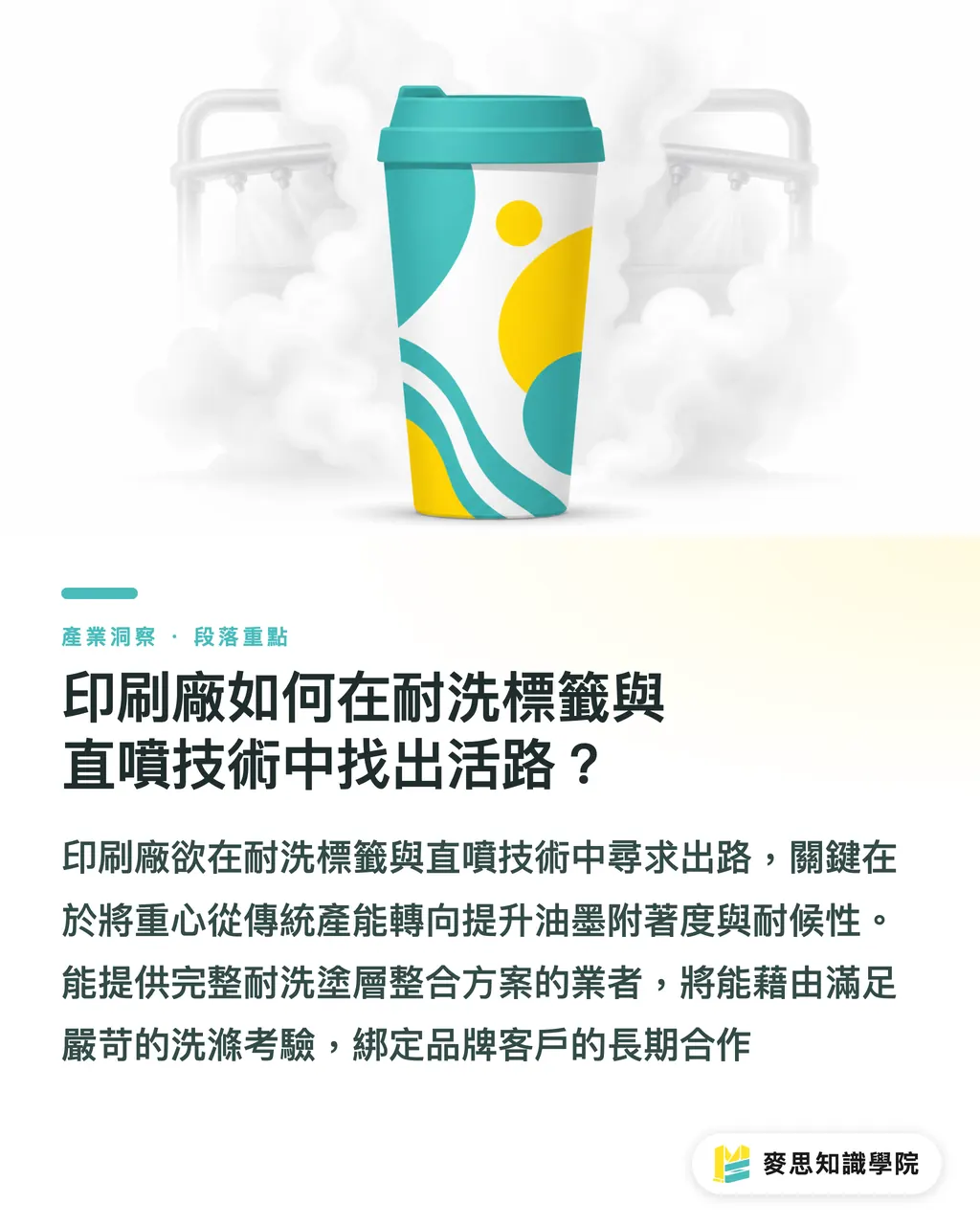
How Can Printing Plants Find a Path Forward with Wash-Resistant Labels and Direct Inkjet Technology?
The real test for a reusable cup isn't the moment it leaves the factory; it's the dozens or even hundreds of high-temperature cycles in a commercial dishwasher
This is a significant cross-industry challenge for manufacturers traditionally focused on single-use paper printing
I often remind production managers that the metric to evaluate now isn't hourly capacity, but rather the limits of ink adhesion and weather resistance
Current processes capable of handling these demanding orders primarily focus on a few core technologies:
・Screen and Pad Printing: Suitable for large batches with clear color blocks, but requires extreme adaptability to curved surfaces and specialized ink formulas
・Digital Direct Inkjet: Can handle gradients and customized variable data, though ink scratch resistance and acid/alkali resistance are key to yield rates
・Wash-Resistant Coating Integration: Facilities that offer complete solutions, from primer and printing to topcoat protection, will secure long-term contracts with brand clients
Key Takeaways
・Reusable cups evolve packaging design from flat dielines to 3D visuals that rely on vessel shape and material expression
・High-frequency washing is the sole standard for verifying print quality; ink durability has replaced color vibrancy as the primary procurement consideration
・Printing plants with the capability to integrate wash-resistant coatings and digital direct inkjet will escape price wars and gain substantial bargaining power
Further Reflection
From Lavazza's film-free capsules to Eco-Products' reusable cup arrays, this is an irreversible industry trajectory
Brand clients no longer buy into superficial eco-friendly packaging; they want mass-production solutions that can be tossed into a commercial dishwasher and still show a recognizable logo after 100 washes
For Taiwan's SMEs in the printing industry, rather than clinging to the slim margins of single-use paper boxes, it is better to pivot early into process testing for specialized inks and curved-surface inkjet
The MINDS team is also continuously helping clients evaluate machine compatibility for emerging processes, stabilizing yield rates before environmental regulations are fully implemented
Further Reading
FAQ
- Why are brands phasing out shrink films and paper sleeves?
- Regulations like Portland's BYO policy and Taiwan's standards are tightening. A 'naked' cup made of a single material is easier to integrate into circular washing systems, whereas extra packaging only adds disassembly costs
- What is the difference between printing on reusable containers and regular cardboard boxes?
- Cardboard boxes emphasize color vibrancy and surface finishes like foil stamping. Reusable containers face the trial of high-temperature commercial washing, requiring highly durable screen printing, pad printing, or direct inkjet with protective coatings
- What is the first step for a printing plant wanting to take reusable cup orders?
- Re-evaluate the factory's machinery limits for processing 3D curved surfaces and conduct practical tests on the adhesion and scratch resistance of various inks in commercial washing environments
References
Related articles

The Print × AI weekly
The print and AI know-how designers, brands and enterprises can use before they commit — one email, every week
MINDS Free Tools
Spine width and imposition calculators — skip the manual math, free in your browser.
MINDS Group
Need actual printing or gifting services?
From premium printing to online ordering and festive gifts — the MINDS Group sister brands take it from here.