
Overview
Here is a scenario you probably know well. A brand's procurement rep sits down to negotiate next year's long-term contract. First, they demand 'recyclable, mono-material.' Next, they ask, 'Can the barrier properties match our current multi-layer film?' Then comes the kicker: 'We need full supply chain carbon data.' Each request makes sense on its own, but together, they form an impossible triangle
Packaging Digest distilled the 2026 flexible packaging landscape into five key directions: faster commercialization of high-barrier monomaterial films, recyclability verification shifting from voluntary to mandatory, rising penetration of active and smart packaging, digital printing driving demand for short-run plate changes, and brands requiring full-chain carbon disclosure [1]. These five shifts might seem separate, but for converters, they all hit the same spot: your material selection logic. Let's break them down one by one
Why Monomaterials Force You to Recalculate the Barrier Equation
Flexible packaging historically relied on multi-layer laminates. PET, AL, and PE each served a distinct purpose, with one layer blocking oxygen, one blocking moisture, and one sealing the pouch. The extrusion coating and lamination chapters of Flexible Packaging lay this logic out clearly: assigning different functions to distinct layers has been the industry standard for decades [2]. The problem is that this blended structure is virtually impossible to recycle. If you cannot separate the layers, it ends up in the trash
Going mono-material means using a single polymer family, usually all-PE or all-PP, to deliver the performance that used to require several different layers [6]. Everyone understands the push to cut plastic. The real pain point has always been barrier performance. Without AL and PET, how do you make up for lost oxygen and moisture barrier properties?
That explains why high-barrier coatings are attracting so much attention. Whether it is EVOH co-extrusion, inorganic vacuum coatings, or cutting-edge nanomaterials, the goal remains identical: boost barrier performance to retail-ready levels without compromising the recyclability of the mono-material. When evaluating any new film, your first question should not be 'is it eco-friendly?' It should be 'show me the OTR and WVTR data.' Without those two numbers, sustainability claims mean nothing
Recyclability Shifts from Voluntary to Mandatory: What Does It Mean for Converters?
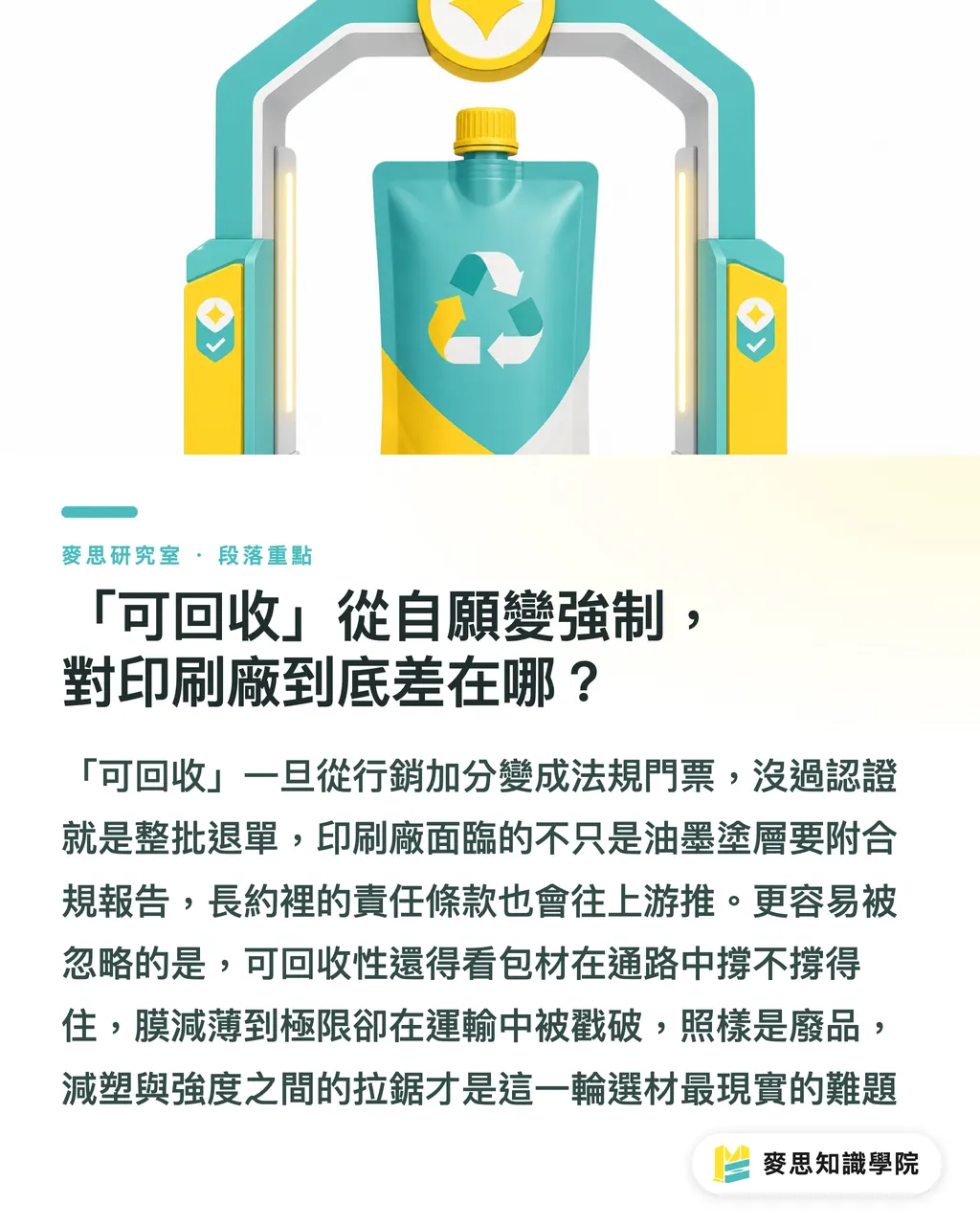
The difference comes down to who absorbs the cost, and the penalties involved. When verification was voluntary, recyclability was a marketing bonus. Once it becomes legally mandated, it turns into a ticket to enter the retail market. Fail the test, and your entire batch gets rejected. Packaging Digest lists this shift from voluntary to mandatory as one of the five major trends for 2026 [1]
For converters, the direct impact lands in two areas. First, certification pressure on inks and coatings. You will likely need test reports proving your inks do not degrade the purity of recycled resins. Second, brand contracts will increasingly include compliance clauses that push legal responsibility upstream to suppliers
There is an easily overlooked detail here: recyclability is not just about whether material can be reprocessed, but whether it holds up through distribution. Puncture resistance is a key benchmark, and standardized testing procedures have long been established [3][4]. If you down-gauge a film to the absolute limit and fix the barrier issues, but it punctures during transit, it is still scrap. Balancing plastic reduction against physical strength is the most practical tug-of-war in this material selection cycle
Are Smart Sensor Films Just a Gimmick, or Ready for Mass Production?
Bottom line: smart films are moving from trade show prototypes to retail shelves, but do not expect them to take over overnight. Active and intelligent packaging, such as time-temperature indicators, freshness sensors, and anti-counterfeiting tags, is highlighted as an area of growing adoption [1]. The key phrase is 'growing adoption,' not 'universal rollout.' Keep that distinction clear
Its real value lies in turning packaging from a passive container into an active carrier of data. An indicator film that shows whether cold-chain storage was broken gives fresh food and pharma clients a real tool for loss prevention, not a marketing gimmick. That is also why its growth is tied to printed electronics and functional inks, because the sensor layer is often printed directly onto the film
To scale, you have to clear several hurdles first. How do smart components coexist with mono-material recyclability (adding a sensor complicates recycling again)? Is printing yield stable? Can you offset the unit cost? In 2026, smart packaging will gain ground first in high-value categories with clear loss-prevention pain points. Everyday mass FMCG is still a long way off. Do not rush to retool your production lines. Figure out which customers are actually willing to pay a premium for smart films first
Digital Printing Short-Run Flexibility: Why Is This Demand Real This Time?
Because higher changeover frequency is not something printers are pushing, it is being forced by brand inventory strategies. Packaging Digest lists digital printing driving short-run agility and frequent version changes among the five major shifts [1]. As brands launch more SKUs, more regional exclusives, and shorter promotional cycles, the economics of conventional plate-making break down
This connects directly to the earlier points. Carbon disclosure requires complete supply chain data, and digital printing eliminates plate-making, making emissions easier to track and verify. Short runs, customization, and variable data also align neatly with the serialization and anti-counterfeiting needs of smart packaging
Do not treat digital printing as a cure-all, though. Its sweet spot is short-to-medium runs with high version variation. For massive high-volume jobs, gravure and flexo unit economics remain hard to beat. Instead of choosing one over the other, split your setup into a dual-track model: digital for short-run flexibility, conventional for volume baselines, with pricing tailored to run length
Next Steps: What to Tackle First
Here is how to translate these five trends into action items for next month:
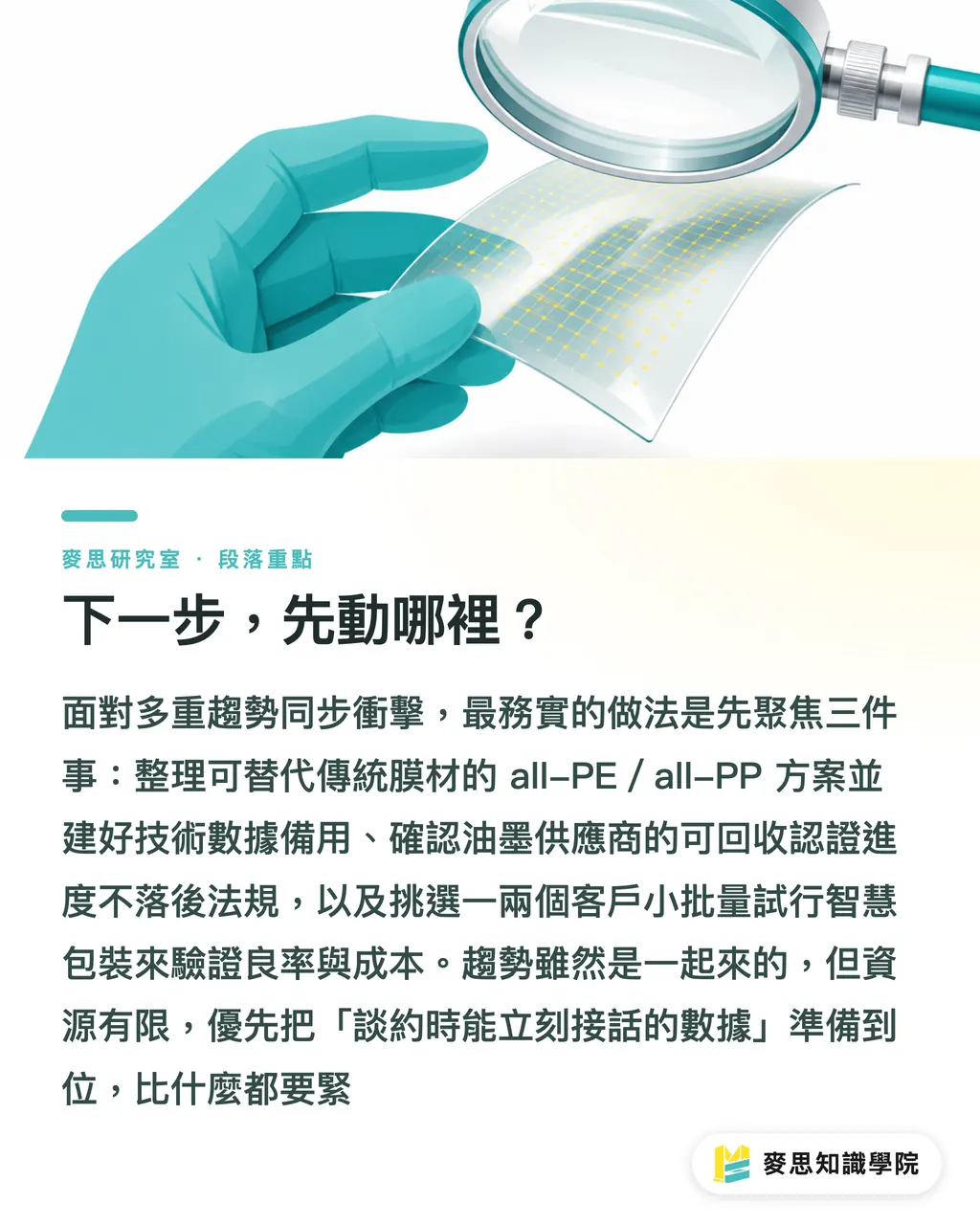
・First, audit your current film portfolio. For any film supplied to brands with plastic reduction commitments, document all-PE and all-PP alternatives along with their OTR, WVTR, and puncture resistance data, so you can respond immediately during contract talks [3][6]
・Second, check in with your primary ink suppliers on their recyclability certification progress, rather than scrambling after regulations take effect
・Third, select one or two clients with high loss-prevention stakes to test active or smart packaging. Run small batches to verify yield and costs instead of going all-in at once. Trends arrive together, but you do not have to tackle everything at the same time
Key Takeaways
・The true bottleneck of mono-materials is barrier performance. When evaluating new films, ask for OTR and WVTR data before discussing sustainability [6]
・Once recyclability verification becomes mandatory, it will hit converters through ink certification demands and contractual compliance clauses [1]
・Balancing plastic reduction with film strength is a real trade-off. Standardized testing exists for mechanical properties like puncture resistance, so do not look only at barrier performance [3][4]
・Smart sensor films will land first in high-ticket categories with clear loss-prevention needs. Mass-market FMCG is not there yet, so hold off on retooling production lines [1]
・Digital printing handles agile short runs with frequent changeovers, while conventional printing covers high-volume baselines. A dual-track strategy works better than choosing between them
Further Thoughts
The takeaway for the industry is clear: flexible packaging competition in 2026 is no longer an isolated battle over substrates or printing methods. It is the convergence of materials, regulations, and digitalization into a single material decision. For packaging converters, the most urgent task is structuring barrier and mechanical data into readily accessible assets during contract talks [2][3]. For designers, mono-material constraints will narrow down available substrates and finishing options, requiring recyclability to be factored into creative boundaries early on. For AI and SaaS, the opportunity is tangible: build a searchable decision database covering OTR, WVTR, puncture resistance, ink compatibility, and carbon metrics. That lets sales teams answer questions in seconds on feasibility, barrier adequacy, and recycling compliance. That tool layer is where the biggest gap and value lie today. Many questions remain unresolved, including how smart components can coexist with recyclability, and when high-barrier mono-materials will achieve true cost and yield parity in mass production. These points are worth tracking closely
References
[1] 5 Flexible Packaging Trends for 2026: From High-Barrier Monomaterials to Smart Sensor Films
[2] Dunn T. (2015). Flexible Packaging Extrusion Coating/Laminating Line. Flexible Packaging. DOI: 10.1016/b978-0-323-26436-5.00014-x
[3] Packaging. Flexible packaging material. Determination of puncture resistance. Test methods. DOI: 10.3403/30017043u
[4] Packaging. Flexible packaging material. Determination of puncture resistance. Test methods. DOI: 10.3403/30017043
[5] Glossary of packaging terms. DOI: 10.3403/00336460u
[6] Niaounakis M. (2020). Polymers Used in Flexible Packaging. Recycling of Flexible Plastic Packaging. DOI: 10.1016/b978-0-12-816335-1.00003-7
FAQ
- What are the five key flexible packaging trends for 2026?
- According to Packaging Digest, they are accelerated commercialization of high-barrier monomaterials, recyclability verification shifting from voluntary to mandatory, rising adoption of active and smart packaging, digital printing driving short-run changeovers, and brand demands for full supply chain carbon disclosure [1]
- Why is mono-material flexible packaging so difficult to produce?
- Conventional flexible packaging uses multiple laminated layers that each block oxygen or moisture. Switching to a single polymer family drops barrier performance significantly, requiring high-barrier coatings to compensate. That remains the biggest technical hurdle in plastic reduction [2][6]
- What data points should you check first when evaluating a new mono-material film?
- Check the oxygen transmission rate (OTR) and water vapor transmission rate (WVTR) first, then verify whether mechanical strength like puncture resistance can handle retail distribution. Standardized test methods exist for all of these [3][4]
- Will smart sensor packaging become widespread across all categories in 2026?
- No. Adoption is rising, but it will stay concentrated in high-value categories with clear cold-chain loss-prevention needs. For standard FMCG goods, unit costs and recycling compatibility mean it is still too early [1]
- Will digital printing replace gravure and flexographic printing?
- It will not replace them, but complement them. Digital printing fits short-to-medium runs, frequent version changes, and variable data, while conventional printing still dominates unit costs for high-volume long runs. A dual-track setup is the practical route
References
- 軟包裝 2026 五大趨勢速覽:從高阻隔單材質到智慧感測膜 · packagingdigest.com
- Flexible Packaging Extrusion Coating/Laminating Line · doi.org
- Packaging. Flexible packaging material. Determination of puncture resistance. Test methods · doi.org
- Packaging. Flexible packaging material. Determination of puncture resistance. Test methods · doi.org
- Glossary of packaging terms · doi.org
- Polymers Used in Flexible Packaging · doi.org
Related articles





The Print × AI weekly
The print and AI know-how designers, brands and enterprises can use before they commit — one email, every week
MINDS Free Tools
Spine width and imposition calculators — skip the manual math, free in your browser.
MINDS Group
Need actual printing or gifting services?
From premium printing to online ordering and festive gifts — the MINDS Group sister brands take it from here.