
Why Does Plastic Reduction in Flexible Packaging Always Get Stuck on 'Barrier Properties'?
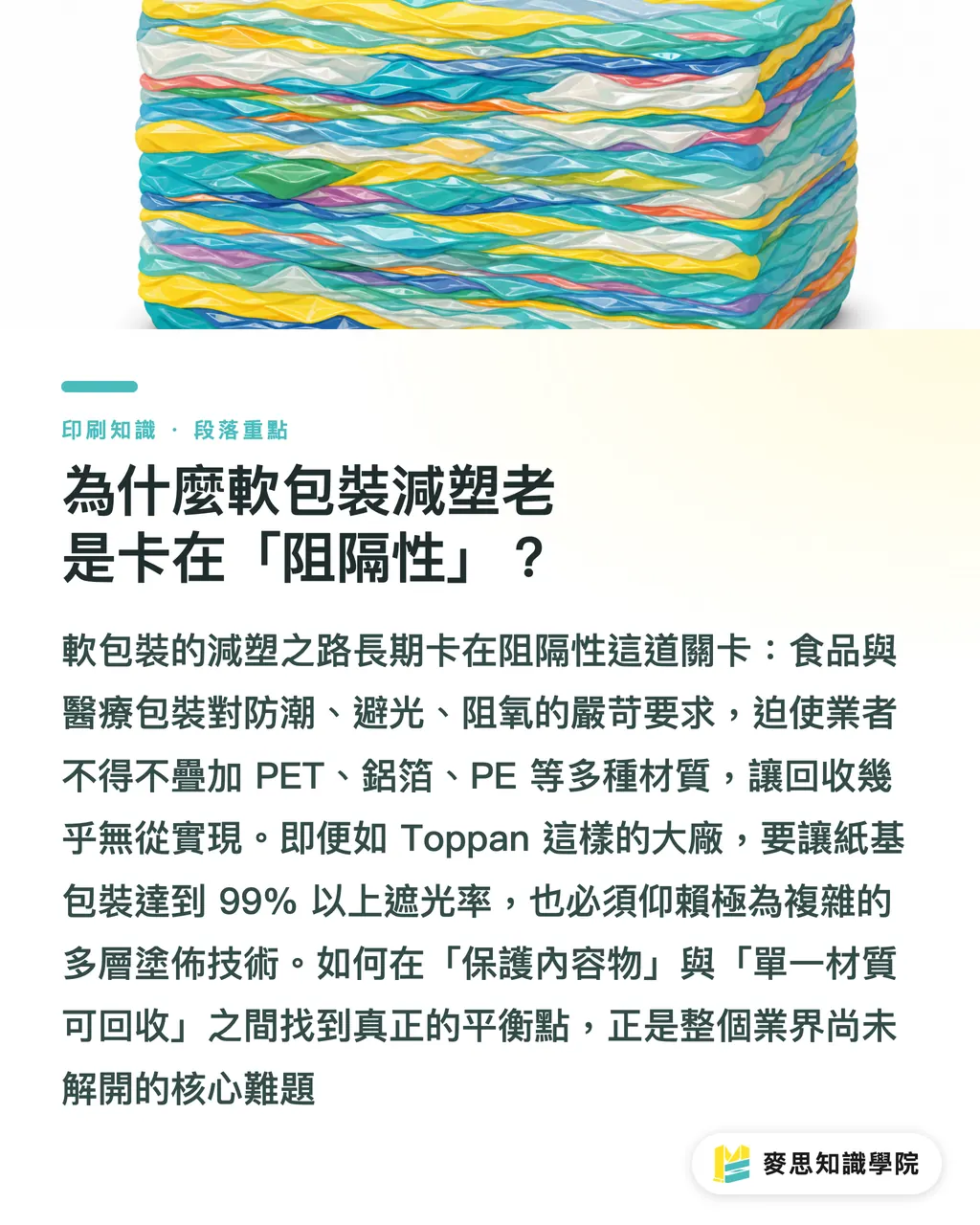
In recent years, brand clients have been demanding plastic reduction and mono-materials daily. However, whenever they encounter high-spec requirements for moisture resistance, light shielding, and oxygen barriers in food or medical packaging, they often have no choice but to return to traditional multi-layer composite plastic materials
This is a common bottleneck I encounter on the front lines. To protect the contents, we have to stack different materials like PET, aluminum foil, and PE together, which makes recycling extremely difficult
Just like we saw before, in order to achieve a light-shielding rate of over 99% for paper-based packaging, Toppan had to employ highly complex multi-layer coating technology
Whether it's home-compostable stretch films or high-spec paper packaging, the industry is searching for a game-changing solution that balances 'protection' with 'mono-material simplification'
What Makes This Graphene Coating Technology Different?
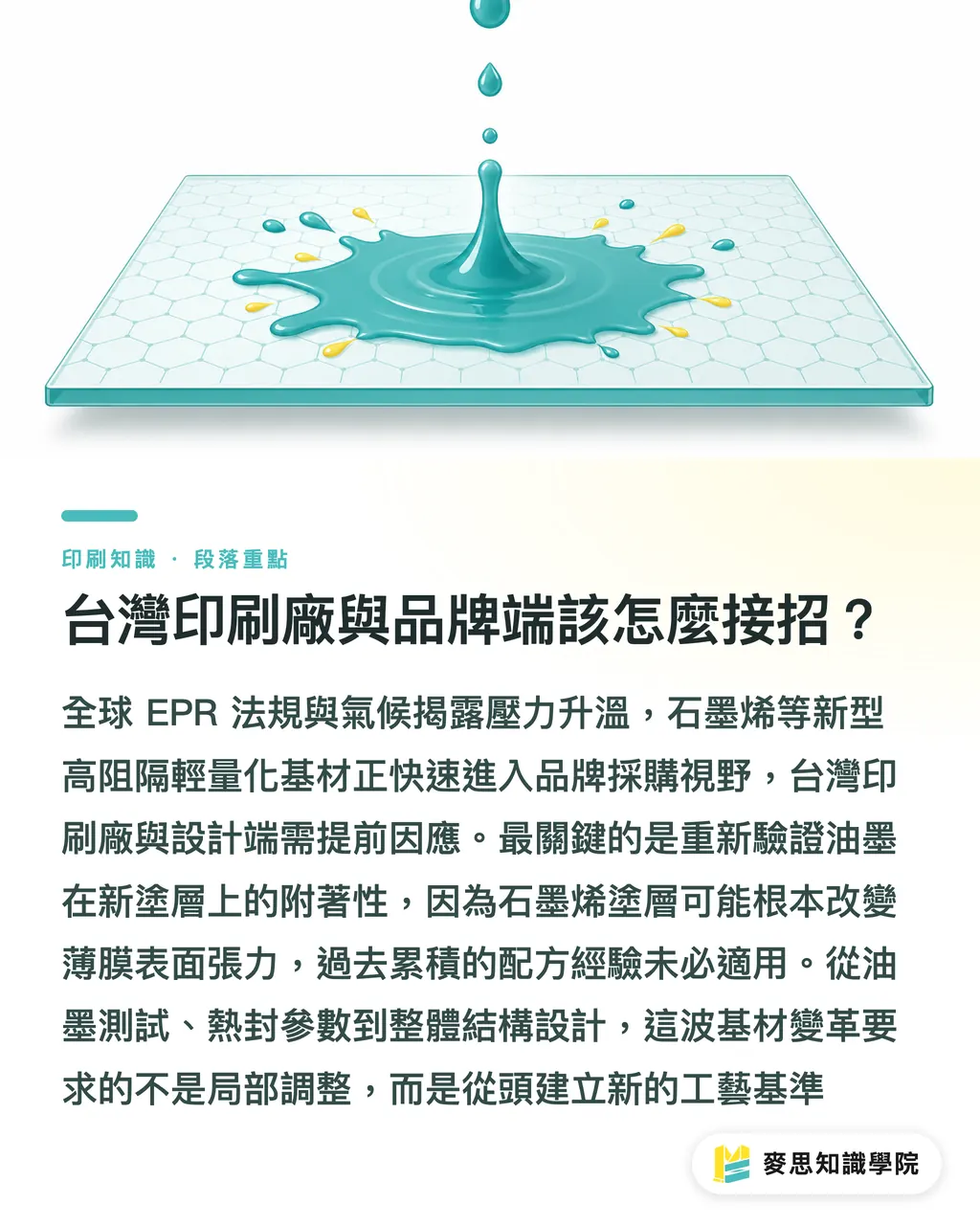
According to Packaging Insights, NanoXplore and Techmer PM have recently partnered to launch graphene-enhanced plastic film coatings
This is not purely academic research confined to a laboratory; it is a concrete solution already targeting the commercial market
・Working Mechanism: By introducing nanoscale graphene into the coating, it directly reinforces the physical structure of the film
・Key Breakthrough: This technology can boost oxygen and moisture barrier performance by 30% to 50% without increasing the film thickness
・Application Value: This means food and medical flexible packaging could potentially discard thick, hard-to-recycle multi-layer composite structures, achieving the same or even better protective effects with a thinner, reinforced mono-layer film
How Should Taiwanese Printers and Brands Respond?
When new materials are adopted, the first things affected are printability on the production line and processing yields
Recently, global packaging regulations (such as EPR) and climate disclosure requirements have become increasingly strict, so brands will inevitably show great interest in these high-barrier, lightweight materials
In response to this wave of substrate evolution, printing peers and design teams can start preparing in three ways:
・Ink and Surface Tension Testing: Since the graphene coating may alter the surface properties of the film, ink manufacturers and converters must explore suitable formulas in advance to verify ink adhesion
・Lamination and Post-processing Adhesion: If local lamination or heat sealing is still required, the impact of the new coating on interlaminar peel strength must be tested to establish new parameters
・Redesigning Packaging Structures from Scratch: Traditional multi-layer printing and composite specifications may face disruption, meaning designers and procurement teams will need to re-evaluate the necessity of their material combinations
Key Takeaways
Graphene-enhanced coatings can improve moisture and oxygen barrier properties by 30-50% without increasing thickness
This technology has the practical potential to directly replace traditional multi-layer composite films in food and medical packaging
Taiwanese printers need to conduct stress tests early on ink adhesion and post-processing adhesion for the new substrate
The design logic of flexible packaging will shift from multi-layer stacking to highly efficient mono-layers
Further Thoughts
For the MINDS team and the small-to-medium printers we collaborate with, substrate revolutions represent both a crisis and an opportunity. When brand clients start asking about the feasibility of such new materials, whoever can master its printability fastest and provide stable proofing data will capture high-margin sustainable packaging orders. We recommend establishing a testing framework now, rather than waiting for materials to arrive on the production line only to find the ink won't stick
Further Reading
FAQ
- Can graphene-coated films be printed directly using existing printing machinery?
- Re-testing is required. Although the film substrate remains the same, the graphene coating may alter the surface tension, affecting ink adhesion and interlaminar adhesion in post-processing
- Can this technology replace all aluminum foil composite bags?
- It has the potential to replace multi-layer structures in food or medical packaging with specific moisture and oxygen barrier requirements (improving barriers by 30-50%). However, applications with extreme light-shielding requirements will still depend on the specific coating formula
- What are the benefits for brands switching to this mono-material reinforced film now?
- It can significantly simplify the packaging structure to comply with increasingly strict EPR regulations, while achieving lightweighting without sacrificing product shelf life
References
- 石墨烯塗層來了:軟包裝薄膜阻隔性能的下一個突破點 · packaginginsights.com
Related articles

The Print × AI weekly
The print and AI know-how designers, brands and enterprises can use before they commit — one email, every week
MINDS Free Tools
Spine width and imposition calculators — skip the manual math, free in your browser.
MINDS Group
Need actual printing or gifting services?
From premium printing to online ordering and festive gifts — the MINDS Group sister brands take it from here.