
What Packaging Can Rapeseed Waste Become?
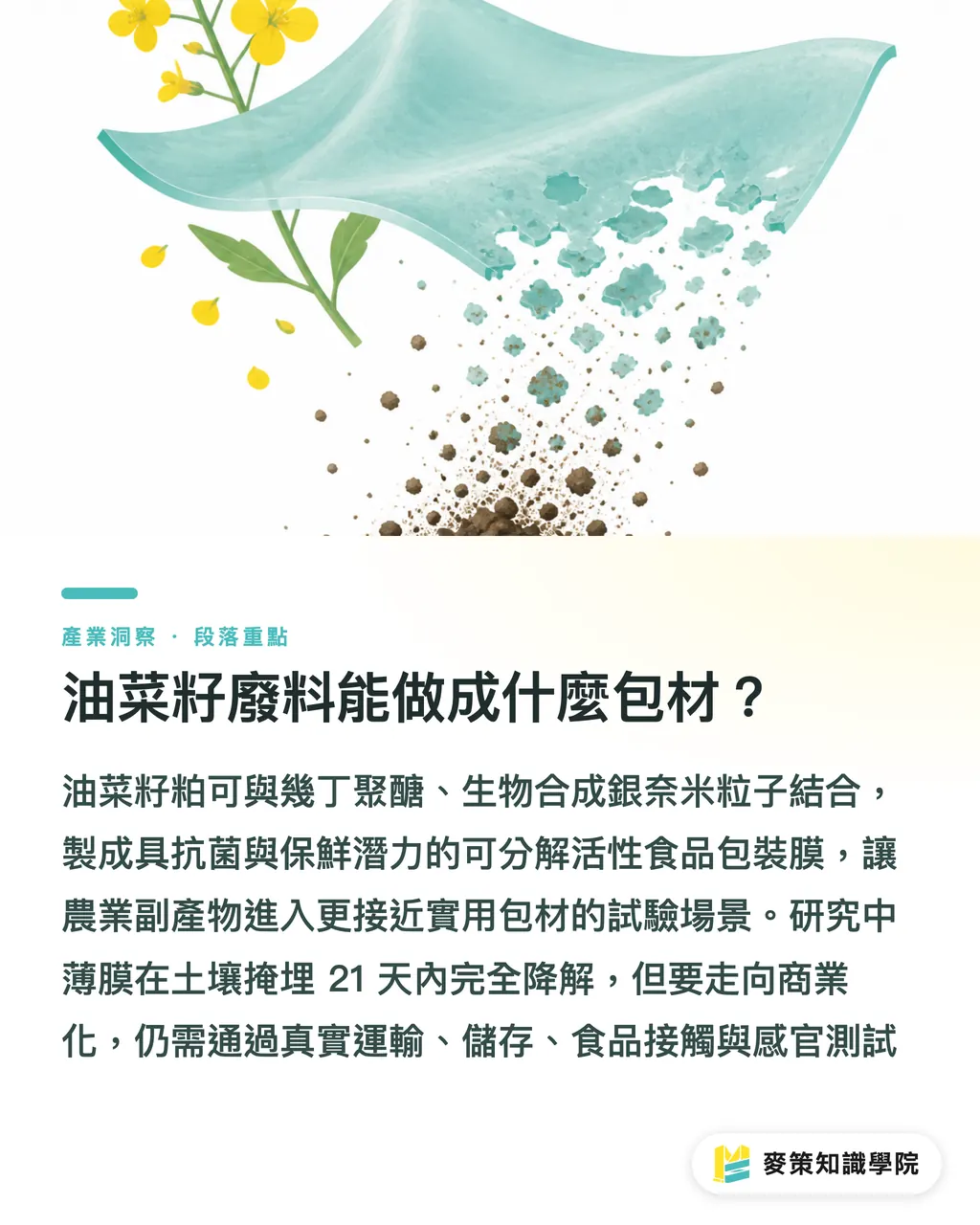
Rapeseed meal can be turned into biodegradable active packaging film. Materials like this bring agricultural byproducts into food-packaging trial lines, instead of stopping at a waste-reuse story
Packaging Insights published Rapeseed waste turns into biodegradable active food packaging film on August 7, 2026. The report notes that Dalian Polytechnic University's School of Biological Engineering and Innobio Corporation combined rapeseed-processing residues with chitosan, a natural film-forming polymer, then added biosynthesized silver nanoparticles to strengthen antibacterial and freshness performance
Bio-based materials are made from plant, agricultural byproduct, or microbial carbon sources. Whether they can be used in packaging depends on barrier performance, processing, labeling, and end-of-life handling
The most interesting part of this case is that a soil-burial test showed the film could fully degrade within 21 days. The research side still says commercialization needs real transport, storage, food-contact, and sensory testing
Why Are Brands Watching Active Packaging?
Brands are watching active packaging because it turns packaging from a shell into a freshness interface. A brand can talk about food preservation, waste reduction, and sustainable materials at the same time
Active packaging adds oxygen-absorbing, antibacterial, or antioxidant functions inside the package, so the material directly helps preserve the product and maintain quality
The rapeseed-film preservation test used cherry tomatoes and enoki mushrooms. The direction is clear: fresh foods with high water content, easy browning, and high sensitivity to microbes need packaging to share some of the freshness burden
Market estimates in packaging industry coverage put active packaging at about a 6.8% CAGR, with the market expected to reach USD 3.8 billion by 2028. For brands, that number says something very direct: consumers may listen to a sustainability story, but retailers will ask first about preservation, package failure, returns, and labeling responsibility
How Should the Three Commercialization Routes Be Chosen?
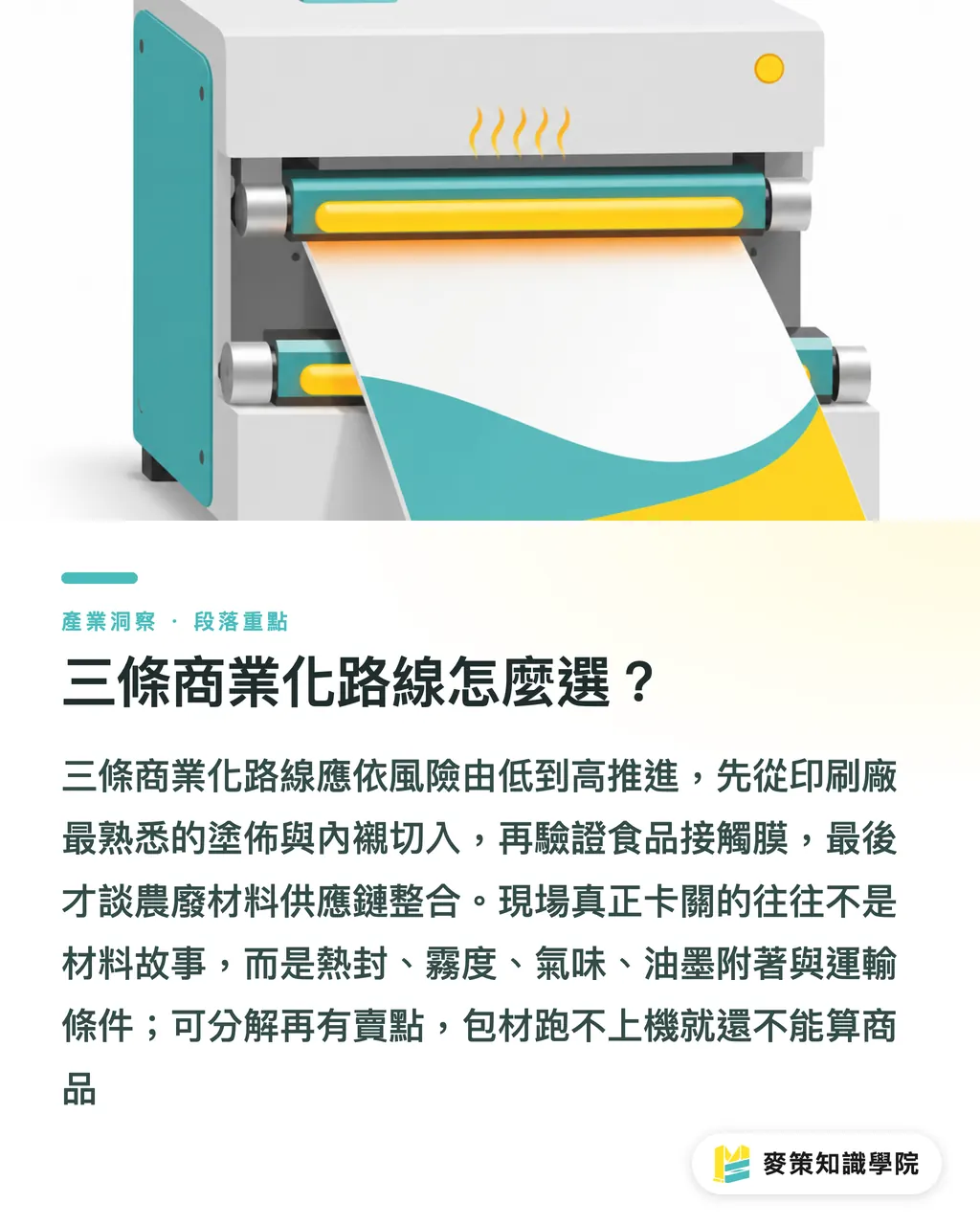
The three commercialization routes should be chosen from low risk to high risk: test coatings and liners first, then validate food-contact films, and talk about agricultural-waste material integration last
・Route 1: Functional coatings. Applications: carton liners, localized freshness coatings, short-term promotional packaging. Benefit: Taiwanese printers already know coating, lamination, varnishing, and small-batch sampling. Risk: freshness claims need test support
・Route 2: Biodegradable active film. Applications: fresh fruits and vegetables, chilled foods, oxidation-sensitive products. Benefit: the 21-day degradation test can support the environmental story. Risk: food contact, odor, transparency, heat sealing, and transport conditions all need to be tested again
・Route 3: Agricultural-waste material supply chain. Applications: long-term ESG projects, local agricultural co-branding, mass-production packaging replacement. Benefit: the story is complete. Risk: raw-material stability, extraction quality, batch variation, and cost are often harder to manage than print converting
Not so fast
I have seen too many brands treat "biodegradable" as a purchasing condition, only to get stuck in the first sampling round on heat sealing, haze, or ink adhesion. No matter how good the material story looks, if the packaging cannot run on the machine, it is not yet a product
What Should Brands Validate Before Adoption?
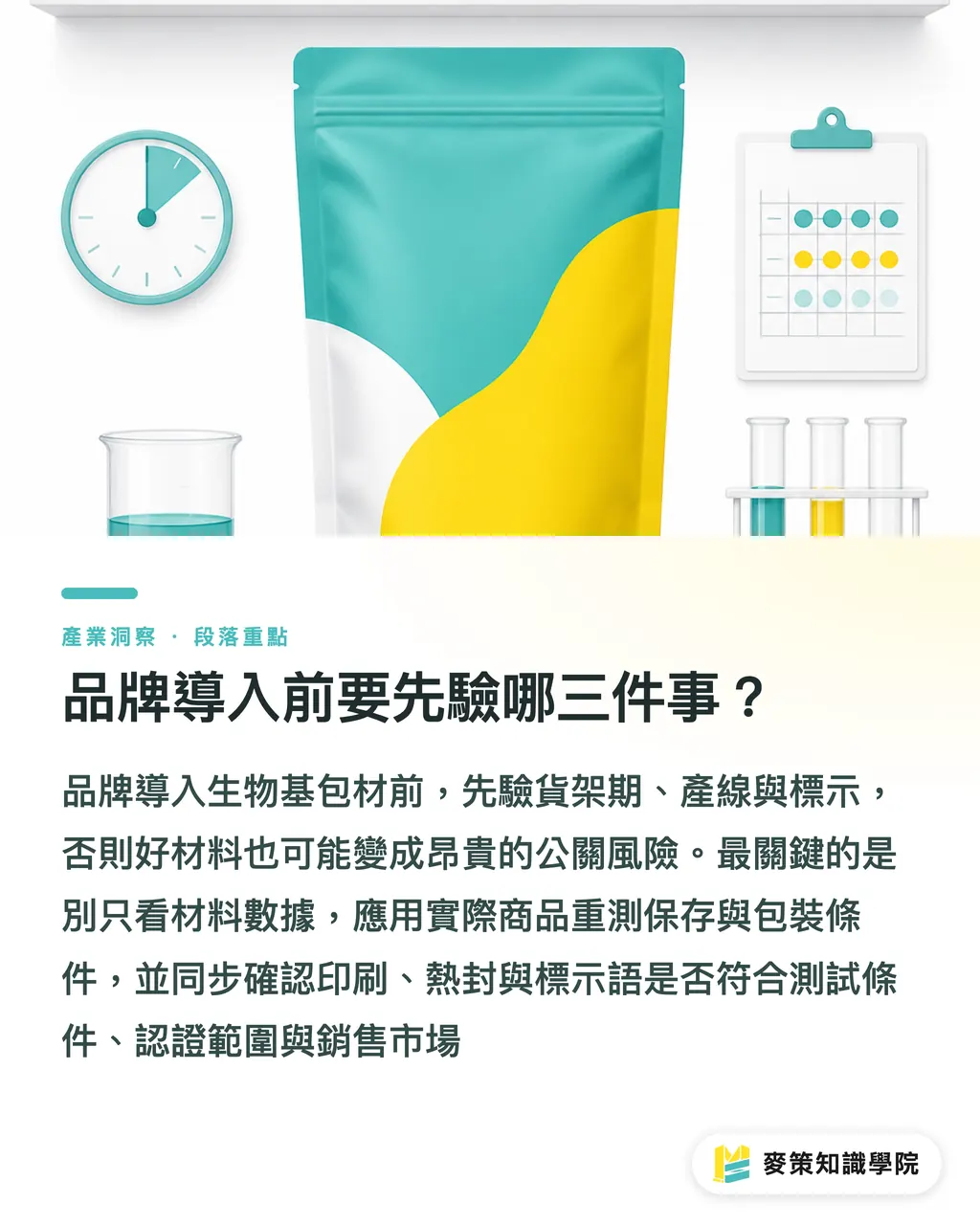
Before adoption, brands should validate three things first: shelf life, production line, and labeling. If these three fail, bio-based packaging turns into an expensive PR risk
Mai Strategy's Three Gates for Biomass-Based Packaging can work like this:
・Shelf-life gate: test preservation with the actual product, not just material data. The rapeseed-film case has tested cherry tomatoes and enoki mushrooms. Brands still need to retest with their own products
・Production-line gate: first confirm printing, lamination, heat sealing, cutting, and filling. Chilled foods in particular often magnify packaging weaknesses. Small and midsize plants can start with small-batch sheets and short-run trial production
・Labeling gate: 21-day soil degradation cannot be written directly as home compostability. Active antibacterial performance also cannot be written as a food-safety guarantee. Packaging copy needs to return to test conditions, certification scope, and sales market
If a food brand is already taking a new product into small-batch validation, MINDS can first help turn outer cartons, labels, and flexible-packaging visuals into testable versions, putting the design files, material samples, printing conditions, and labeling language into the same round of checks
Key Takeaways
・For bio-based packaging, check the food and the production line first, then talk about the brand story
・A 21-day degradation result is a good signal, but it cannot instantly become an environmental claim for every channel
・For small and midsize Taiwanese printers, the entry points are coating, lamination, sampling, and test documentation, not forcing their way into material synthesis
・Active packaging should be managed as a freshness solution, not treated only as a material swap
Further Thinking
Print manufacturers should first build out small-batch test orders, material batch records, and processing condition sheets. Design teams should write sustainability claims as verifiable statements. SaaS and AI adoption can begin with data management for packaging specifications, test records, and labeling versions. If a brand wants to include bio-based materials in its annual ESG project, the Mai Strategy Knowledge Academy consulting team recommends choosing one product with high return risk or high topic value for validation first. After it passes shelf-life and production-line tests, then expand the story into retail channels and PR content
Further Reading
FAQ
- Can rapeseed meal packaging film really replace plastic film?
- For now, rapeseed meal packaging film is more like a high-potential material platform. The research reported by Packaging Insights has shown 21-day degradation and freshness-test results, but commercialization still needs scalable manufacturing, food-contact testing, transport trials, and storage trials
- Can 21-day complete degradation be written directly on the package?
- Not so fast. The 21-day result comes from soil-burial test conditions. Brand labeling still needs to go back to actual certification, usage scenarios, and regulations in the sales market. It cannot be treated as the same as home compostability or assumed to degrade in any environment
- Can small and midsize Taiwanese printers take part in bio-based packaging?
- Yes. For small and midsize Taiwanese printers, the more practical entry points are coating, lamination, short-run sampling, label integration, and outer-packaging integration. Material synthesis itself has a high barrier, while agricultural-waste supply chains and food-contact validation are the tougher gates
- Which test should brands run first?
- Brands should start with shelf-life testing and production-line trial runs, confirming product preservation, odor, heat sealing, ink adhesion, and transport condition before deciding how to write sustainability claims. That is much safer than changing the whole packaging system first
Related articles
The Print × AI weekly
The print and AI know-how designers, brands and enterprises can use before they commit — one email, every week
MINDS Free Tools
AI background removal, a LINE sticker maker, spine & imposition calculators — all free, right in your browser, no upload.
MINDS Group
Need actual printing or gifting services?
From premium printing to online ordering and festive gifts — the MINDS Group sister brands take it from here.