
Overview
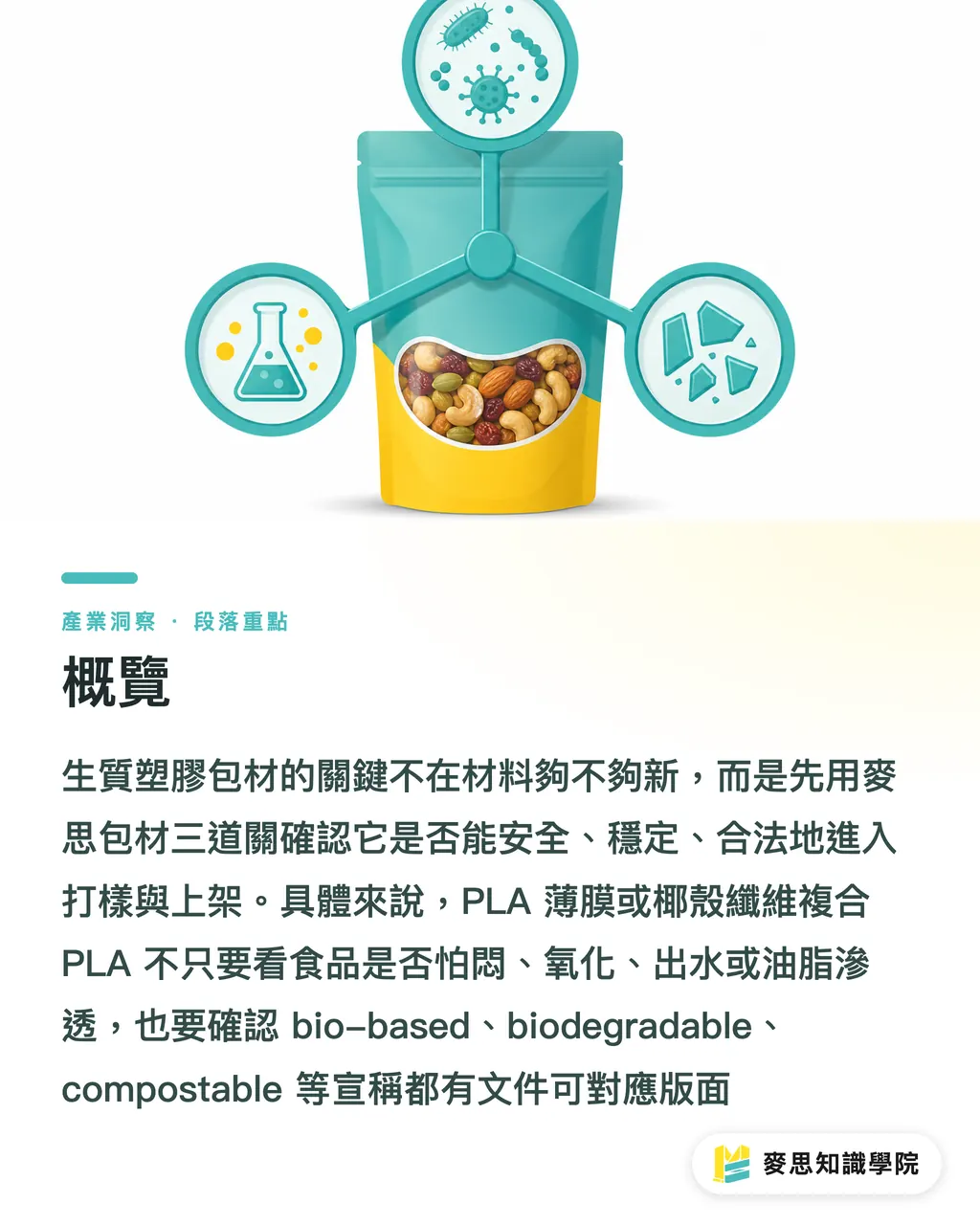
The hands-on answer for this wave of bio-based plastic packaging is to first run the material through MINDS Printing (MS, mid-to-high-end fully custom commercial print) packaging's three gates before PLA film or coconut-fiber-reinforced PLA earns the right to go into proofing. How new the material is comes second; whether the product can ship safely, stably, and legally comes first
・Product risk: first check whether the food hates being sealed in, oxidation, moisture weep, or oil bleed-through
・Process risk: first check whether printing, laminating, heat-sealing, and slitting can repeat reliably
・Claim risk: first check whether terms like bio-based, biodegradable, and compostable actually have documents to back up the artwork
What is this wave of bio-based packaging actually changing?
On 2026-07-23, Packaging Insights reported on Südpack's bio-based PLA plant packaging film. Planova turns PLA sourced from sugarcane or corn starch into film, aimed at potted plants, flowers, and herbs. In the same material wave, coconut-fiber-reinforced PLA pushes the spotlight toward oxygen barrier. Both routes are challenging the inertia of conventional PE film
I'd split the signal into 2 routes:
・PLA film commercialization: leads with renewable sourcing, compostable narrative, breathability, and printability
・Coconut-fiber-reinforced PLA: leads with oxygen barrier, trying to take share from petrochemical PE film
PLA is a polylactic acid made from renewable feedstocks like corn starch or sugarcane. It works as film, tray, and fiber, but heat resistance and barrier depend on the formulation
Lately on packaging projects, the real blockers usually come down to 4 questions:
・Does the product sweat
・How long does the shelf life need to hold
・Can it still be heat-sealed after printing
・Can the compostable wording on the pack be backed with proof
MINDS Printing (MS) packaging's three gates break the problem into smaller pieces, so material choice doesn't get dragged around by the name on the data sheet
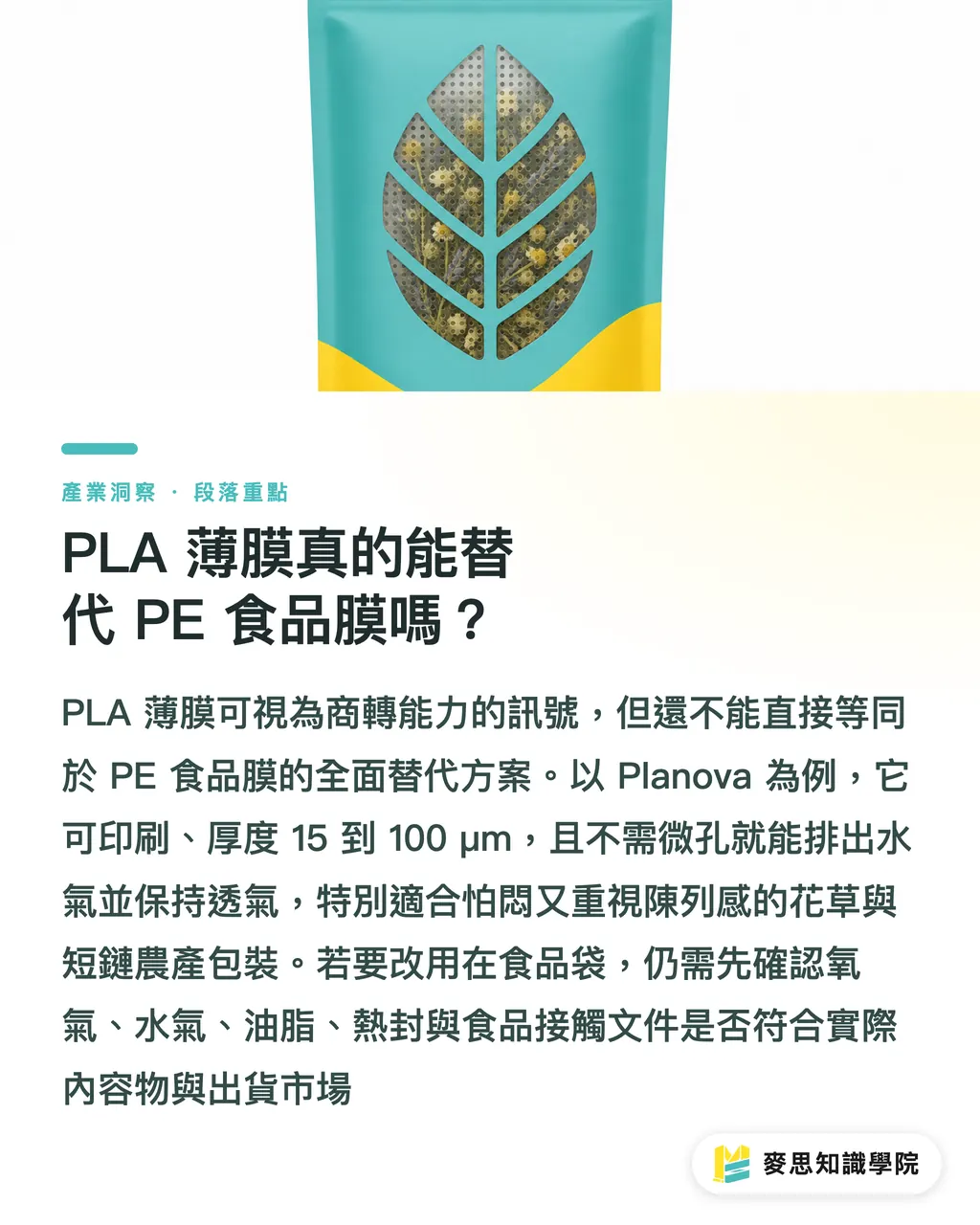
Can PLA film really replace PE food film?
Südpack's Planova is documented for potted plants, flowers, and herbs. I'd treat it as a signal of PLA film's commercialization readiness, not a blanket pass to convert every food bag to PLA
A few Planova specs are worth printers tracking:
・Thickness: 15 to 100 μm
・Width: 200 to 2,300 mm
・Processing: printable, and unlike paper it doesn't lose its look when it meets water
・Breathability: water vapor gets out and air circulates without microperforation
That design matters for herb pots, short-chain produce displays, and floral gift sets, because the product hates being sealed in, hates rotting, and hates looking shabby on the shelf. For food bags, I'd start with 5 floor-level questions:
・Will oxygen spoil the contents
・Will moisture throw off the texture or the look
・Will oil affect the film or the printed layer
・Will the heat-seal temperature deform the material
・Can the food-contact documents match the shipping market
If the brand client already has a custom outer box, belly band, or display pack, start by talking to MINDS Printing on one SKU to run a material proposal and print test, looking at PLA film, paperboard, spot lamination, and the on-pack wording all together
Don't look at them in isolation
What pain point does adding coconut fiber to PLA actually solve?
The value of coconut-fiber-reinforced PLA sits in those two words: barrier. The source material notes a research team using coconut-fiber-reinforced PLA for oxygen barrier packaging, targeting partial replacement of petrochemical PE film. This route pulls the conversation away from degradation and back to the shelf life that actually matters in food packaging
Conceptually, putting coconut fiber into PLA is like adding a fiber wall inside a transparent film. The oxygen path gets longer, so the product's oxidation rate has a chance to drop. But I'd start by testing it on items that need barrier and where the process conditions aren't as brutal as retort sterilization, not push it to every food category on day one
For Taiwan's small and mid-size shops, the headache with this kind of composite usually sits in converting. I'd check 6 things first:
・Will ink adhesion fail
・Will the drying temperature warp the film surface
・Is the heat-seal window too narrow
・Will it curl after winding
・Will slitting generate dust
・Can the food-contact documents be supplied in full
A pretty sample turning into scale-up cost usually means these 6 items weren't laid out first
How do you write compostable claims without stepping on a landmine?
Compostable means the material breaks down under specified composting conditions and meets residue and toxicity thresholds. It is not the same as vanishing on its own when you toss it in the dirt. Taiwan still lacks a domestic compostable labeling system fully aligned with the EU, so when food brands pick PLA packaging, they mostly get pulled along by export demand and customer audits
Get the regulatory wording right: the Green Claims Directive proposal was withdrawn by the European Commission in 2025-06, so it can't be written up as settled law. But EU Directive 2024/825 already requires member states to transpose it by 2026-03-27, with application from 2026-09-27, and it will tighten the rules on general environmental claims, sustainability labels, and consumer communication
I'd run packaging copy through a 4-box check:
・Claim type: don't mix bio-based, biodegradable, and compostable in one breath
・Applicable conditions: industrial compostable and home compostable have to be split out
・Supporting documents: certificates, test conditions, and material lot numbers have to trace back to the print file
・Market version: export to the EU and Taiwan domestic don't share the same environmental claim set
Hold up
MINDS Printing (MS) packaging's three gates puts the claim wording and the packaging certificates on the same checklist, so designers know which words they can print before artwork goes out, and buyers know which certificates to chase suppliers for
What three things should Taiwan's small and mid-size printers do first?
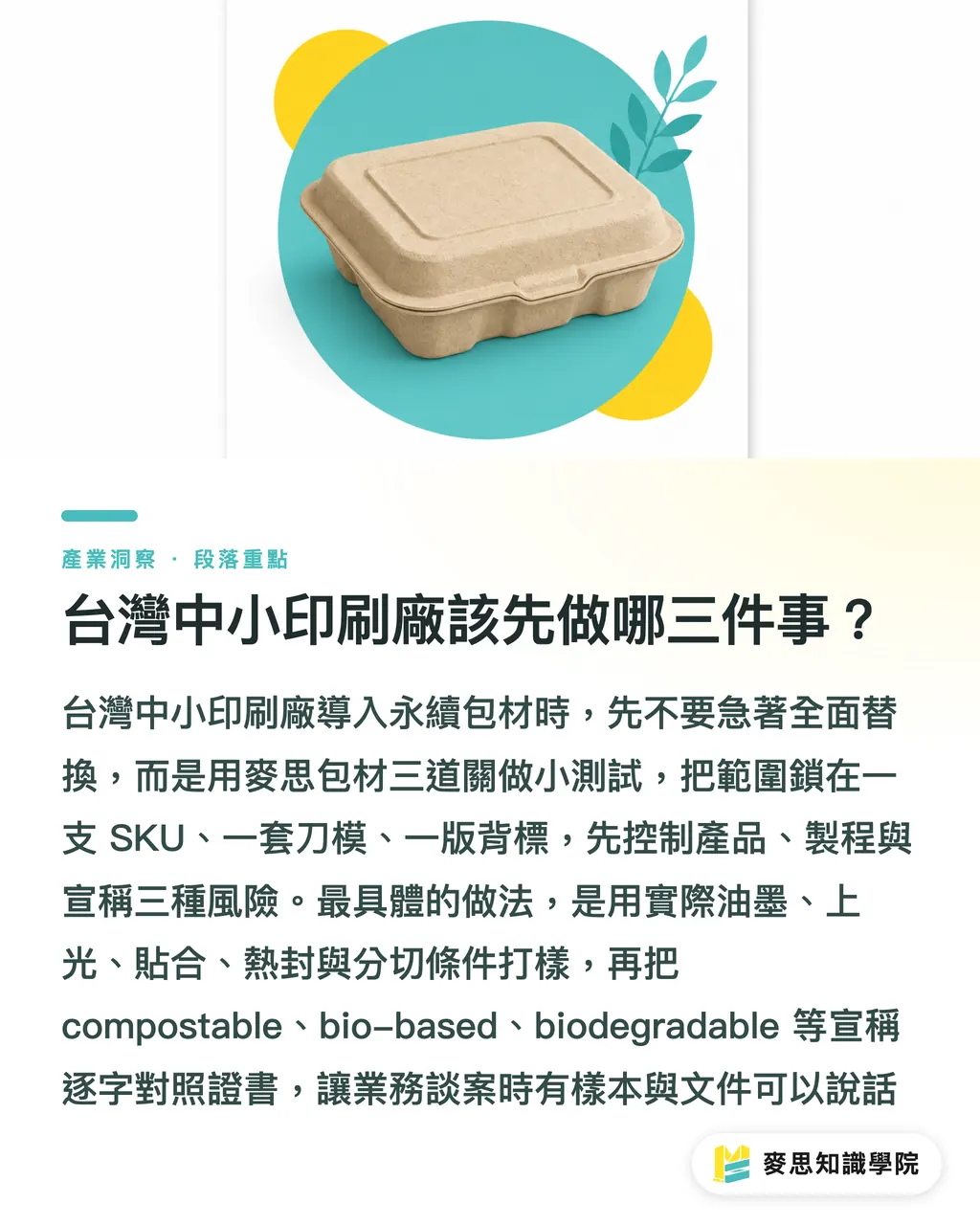
I'd suggest running 3 small tests through MINDS Printing (MS) packaging's three gates first. Scope it to one SKU, one set of dies, one back-label version, so failure cost stays contained
・① Product risk: list out moisture, oxygen, oil, light, and whether it's chilled or ambient. PLA film is a sensible first pick for short-chain display and herb-type products; coconut-fiber-reinforced PLA should first be checked on whether the oxygen barrier actually matches that product's shelf life
・② Process risk: proof with real ink, coating, lamination, heat-seal, and slitting conditions, not just the clear swatch the supplier happens to hold. A 15 to 100 μm thickness range looks flexible, but once it's on the machine you still have to watch tension and shrinkage
・③ Claim risk: every word on the pack, compostable, bio-based, biodegradable, has to be matched letter for letter against a certificate. For EU export, prepare English or local-language versions of the proof. For Taiwan domestic, don't just paste the export claim onto the shelf verbatim
Printers can put together 4 sample cards:
・PLA film: show clients breathability, clarity, and printability
・Paperboard: show clients stiffness, water pickup, and display presence
・PE: show clients current cost and heat-seal stability
・Composite bio-film: show clients the barrier pitch and where the regulatory paperwork is missing
Sales doesn't have to prop up the pitch with adjectives
Key Takeaways
・Bio-based packaging isn't a contest over material names. Food packaging has to clear moisture, oxygen, heat-seal, and labeling first
・PLA film has a commercialization signal, but Südpack Planova's public cases are mainly for potted plants, flowers, and herbs
・Coconut-fiber-reinforced PLA is worth watching because it pulls the conversation away from degradation and back to oxygen barrier
・The word compostable needs conditions, certificates, and a market version. No evidence, don't print it
・For small and mid-size printers, proofing on one SKU beats a full-line switch
Further Thinking
On the print manufacturing side, bio-based film only becomes business when it becomes repeatable proofing records, especially the chain of evidence from material lot number to client-approved artwork. On the design side, the layout should leave room for certification conditions and recycling or composting guidance. For AI and SaaS teams, the most useful job is turning spec sheets, certificates, test photos, and version logs into a queryable material-selection database. When packaging testing workflows need to be productized, the Mai Strategy Knowledge Academy consultant team can help wire consultant judgment, print proofing, and client FAQs into a maintainable content pipeline
Further Reading
FAQ
- Can PLA film directly replace PE food packaging?
- Direct swap isn't recommended. PLA film has to be checked on oxygen, moisture, oil, heat-seal, and food-contact documents first. Südpack Planova's public cases are mainly for potted plants, flowers, and herbs
- What kind of food packaging is coconut-fiber-reinforced PLA suited to?
- The angle with coconut-fiber-reinforced PLA is oxygen barrier. It fits items that need lower oxygen exposure where the process conditions aren't as harsh as retort sterilization, a good place to start testing
- Are compostable and biodegradable the same thing?
- No. Compostable needs specified composting conditions, test proof, and residue thresholds. Biodegradable without condition language easily turns into empty environmental claims
- Why should Taiwan food brands pay attention to PLA right now?
- Taiwan's domestic market still lacks a fully aligned certification system, but export customers will ask for material sourcing, composting conditions, and environmental claim evidence. Testing PLA early cuts the risk of redesigns and reprints
- What's the first step for a printer adopting bio-based packaging?
- Proof on one SKU first. Record thickness, ink, heat-seal, slitting, label wording, and certificate matching, then decide whether to roll it out across the full line
Related articles


The Print × AI weekly
The print and AI know-how designers, brands and enterprises can use before they commit — one email, every week
MINDS Free Tools
Spine width and imposition calculators — skip the manual math, free in your browser.
MINDS Group
Need actual printing or gifting services?
From premium printing to online ordering and festive gifts — the MINDS Group sister brands take it from here.