
Why has flexible packaging sustainability entered the verification phase?
Flexible packaging sustainability has entered the verification phase because brands can no longer just say they use less material. They also need to explain where the packaging goes after use
End-of-life means the path packaging takes after use: collection, sorting, recycling, composting, or incineration. Brand claims should be worked backward from there
When I read 5 updates in flexible packaging sustainability on August 5, 2026, what stood out most was how the routes are starting to split
・INTA and Intema tested a compostable biopolymer film as an alternative to PVC in beef packaging
・BIG-ALGAE planned 4 cultivation approaches, 5 local algae species, and 14 products, including flexible packaging films
・LyondellBasell, Mondelez International, Amcor, and Taghleef Industries turned non-recyclable plastic waste into chocolate packaging
・HolyGrail 2030 tested intelligent sorting and recycling for PP snack packs
・Dow Thailand and its partners launched a 700mL mono-material PE refill pouch in June 2026 to replace non-recyclable multilayer laminate pouches
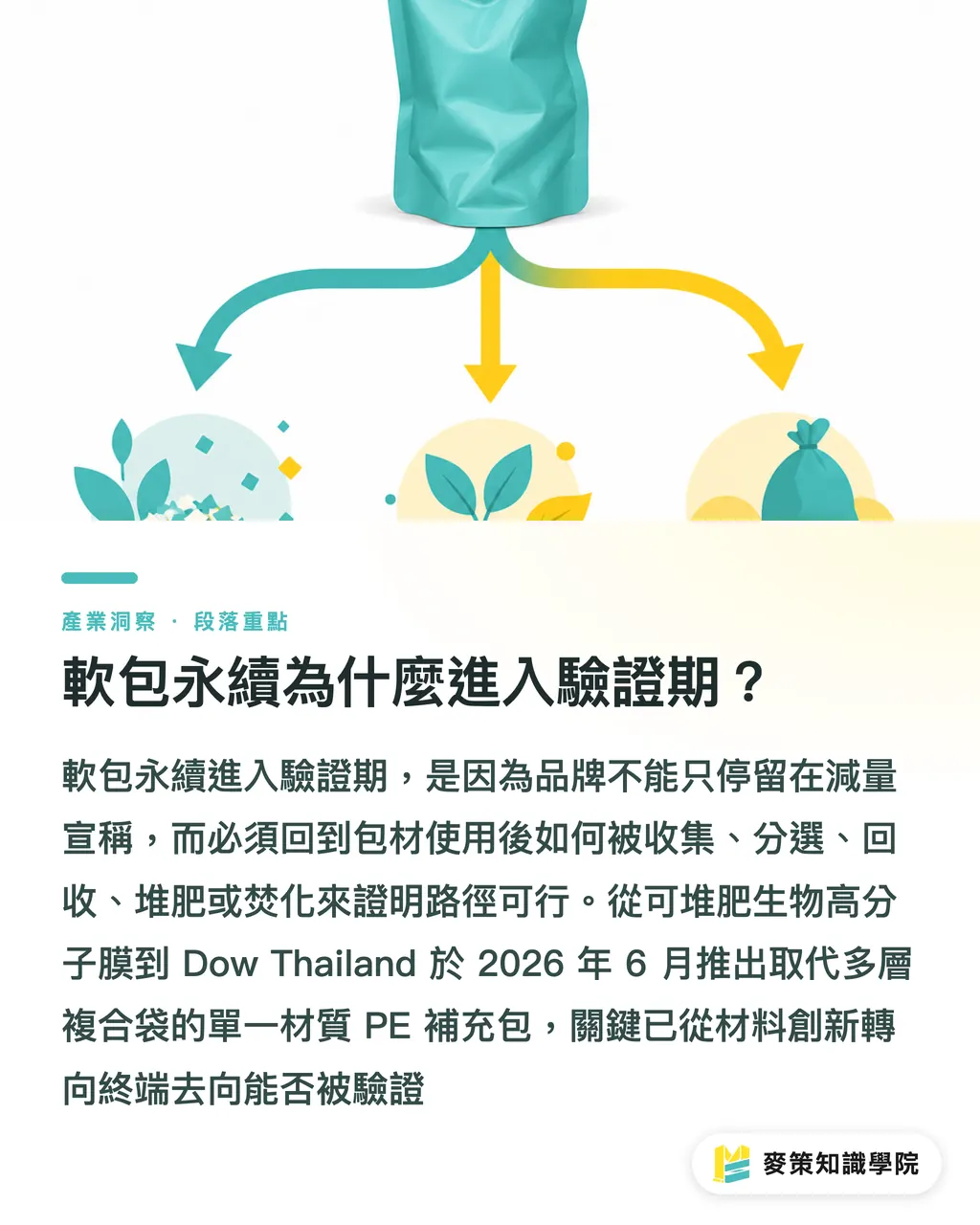
What food packaging is compostable film suited for?
Compostable film is suited for food packaging projects with clear composting conditions and labeling responsibility. It should not be used to endorse every kind of plastic packaging
Compostable film is a thin film material that can be broken down by microorganisms into biomass, CO2, and water under specified composting conditions
The beef packaging test by INTA, Argentina's National Institute of Agricultural Technology, and Intema, Argentina's Institute of Materials Science and Technology, focused on replacing PVC, or polyvinyl chloride, with biopolymer film and allowing the material to break down into biomass, CO2, and water
What worries me most on real projects is seeing people equate "bioplastic = compostable = eco-friendly." That pushes the material story too far
・Is there an actual composting treatment path on site, instead of just placing a certification mark on the front panel?
・Will printing inks, adhesive layers, windows, or labels weaken the compostability claim?
・After reading the label, will consumers know whether to put it in general waste, recycling, or compost?
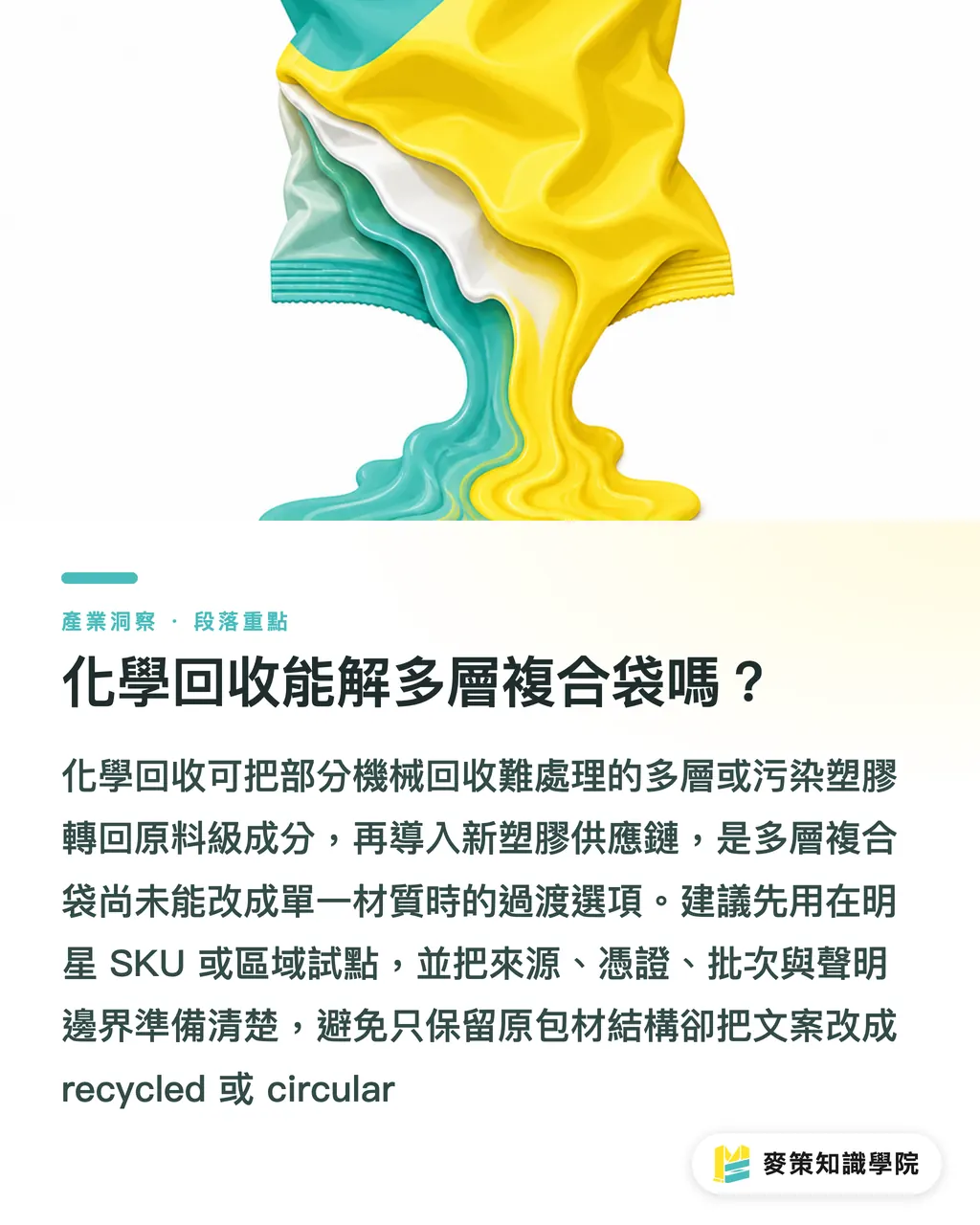
Can chemical recycling solve multilayer laminate pouches?
Chemical recycling can handle some multilayer or contaminated plastics that are difficult for mechanical recycling, but brands still need to prepare source data, certificates, and clear claim boundaries
Chemical recycling is a recycling route that turns plastic waste back into raw-material-grade components, then feeds them into the supply chain for new plastics
The chocolate packaging case from LyondellBasell, a plastics material supplier, Mondelez International, a food brand, Amcor, a packaging supplier, and Taghleef Industries, a film supplier, shows brands starting to bring non-recyclable plastic waste back into highly visible products
For this route, I would suggest starting with a hero SKU or a regional pilot, because the supply chain data has to connect, and the label must hold up under questions from legal teams and retailers
・Suitable for: existing multilayer laminate pouches that cannot yet switch to mono-material, where the brand is willing to handle certificates, batches, and purchasing costs
・Hold off if: the goal is simply to keep the original packaging structure and change the packaging copy to say recycled or circular
What is the difference between intelligent sorting and mono-material?
Intelligent sorting improves the eyes of the recycling system. Mono-material first changes the packaging into something that can more easily enter PE or PP recycling streams
Intelligent sorting uses identifiable markers or sensing technologies so recycling lines can separate specific materials, uses, and food-grade streams
Mono-material means changing the main structure of the pouch to the same plastic family, making it easier for mechanical recycling to identify and remake
PE, or polyethylene, and PP, or polypropylene, are the two plastic families most often used when designing recycling streams for flexible packaging
・Intelligent sorting: HolyGrail 2030 tested PP snack packs. The value is that the system can sort them. The risk is whether recycling lines and marking systems can keep up
・Mono-material PE: Dow Thailand's 700mL refill pouch was commercially launched in June 2026. The value is that brands can start with household cleaning refill pouches. The risk is that barrier performance, stiffness, and the heat-seal window need to be retested
How should brands choose a flexible packaging sustainability route?
Brands should start with the route that can be verified most clearly: mono-material PE for household cleaning refill pouches, intelligent sorting for PP snack packs, and compostable film only for categories with a real composting scenario
I would use the "Mai Strategy three print-readiness checks" often used by the Mai Strategy Knowledge Academy consulting team to help brands pull the decision back from slogans to actual print conditions
・1. end-of-life: first confirm whether the package can be collected, sorted, remade, or composted after sale in Taiwan
・2. production-line risk: use the same artwork to test print adhesion, heat sealing, drop resistance, barrier performance, and shelf display
・3. labeling evidence: only write it into ESG, or environmental, social, and governance, external messaging when there is a collection, transport, or recycling stream behind it
If a refill pouch or food flexible package needs to move into sampling, MINDS can start by reviewing structure, surface treatment, and label layout together, so the design does not look beautiful while the production line keeps needing adjustments
Key Takeaways
・For flexible packaging sustainability, ask the recycling end first. Even the prettiest material name cannot prove end-of-life
・Compostable film works for controlled scenarios. Without a composting route, do not fill the copy with claims
・Chemical recycling is better suited to high-visibility pilots first. It should not be used to cover for an old structure
・Mono-material refill pouches are the easiest first project for brands, because the production line and recycling end are easier to verify in sync
・The value of intelligent sorting depends on system support. Packaging design alone cannot fulfill a recycling promise
Further Thoughts
Print manufacturing teams need to manage sustainable materials as new specifications. Design teams need to review label text, inks, labels, and seals together. AI, or artificial intelligence, can first be used for claim wording checks and version comparison. SaaS, or Software as a Service, teams are well suited to connect materials, test records, supplier certificates, and legal approvals into a workflow. The brand's next step is not to shout a big target, but to pick 1 SKU and run a full verification
Further Reading
FAQ
- Which material should a brand choose first when redesigning flexible packaging for sustainability?
- Brands should look at the end-of-life path first. Household cleaning refill pouches can start with mono-material PE, while short-life food packaging can then consider compostable film or PP intelligent sorting
- Can compostable film directly replace all plastic flexible packaging?
- Compostable film cannot directly replace all plastic flexible packaging. Brands need to confirm composting conditions and compatibility with inks and labels, and they also need to tell consumers how to dispose of it
- Can chemically recycled packaging be described as recyclable?
- Chemically recycled packaging depends on supply chain certificates and the local regulatory context. If a brand lacks batch, source, and flow data, the copy should stay conservative and frame it as a design or pilot description
- What does intelligent sorting do for brands?
- Intelligent sorting can help PP snack packs be identified on recycling lines. The brand value lies in making recycling flows more verifiable, but recycling infrastructure has to support it
- Will mono-material refill pouches affect print results?
- Mono-material refill pouches may change stiffness, heat sealing, barrier performance, and surface tension. Brands need to sample with the actual artwork before printing. They cannot rely only on the material specification sheet
Related articles
The Print × AI weekly
The print and AI know-how designers, brands and enterprises can use before they commit — one email, every week
MINDS Free Tools
AI background removal, a LINE sticker maker, spine & imposition calculators — all free, right in your browser, no upload.
MINDS Group
Need actual printing or gifting services?
From premium printing to online ordering and festive gifts — the MINDS Group sister brands take it from here.