
Overview
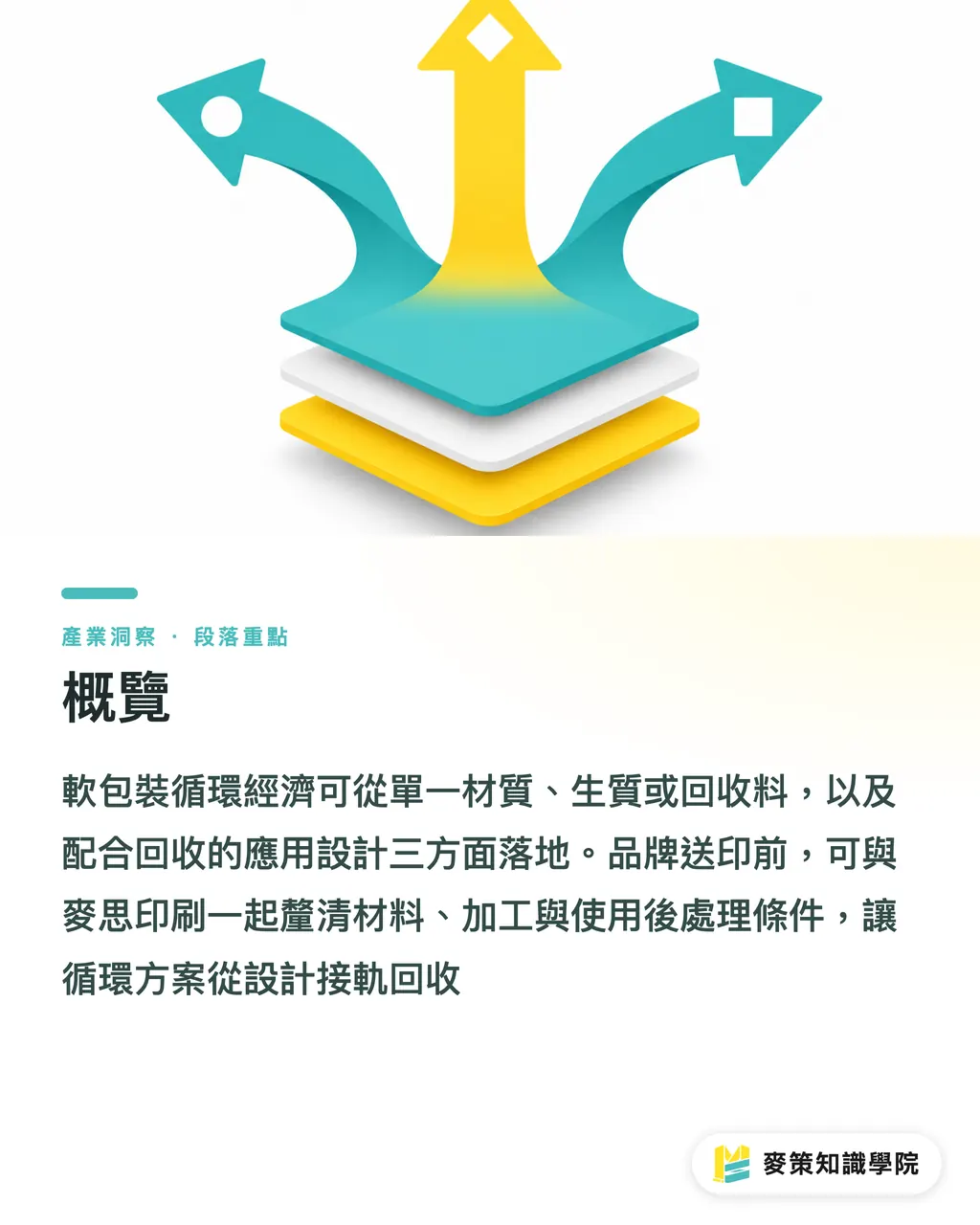
The circular economy for flexible packaging has three practical paths: switch to mono-materials, introduce biobased materials or recycled content, and make end-use design work with recovery. When brands are preparing a job for print, they can work with MINDS to break these issues down into requirements for materials, processing, and post-use handling
Why should flexible packaging move toward a circular economy?
Whether flexible packaging can be recovered is often decided at the material and design stages. Adding "recyclable" after launch is too late
In flexible packaging, a circular economy means planning for materials from design and manufacturing through use and recovery, so the package's function connects to the return of its materials to the system
Packaging Insights' The Circular Shift in Flexible Packaging: Three Innovation Paths Driven by Materials, Design, and Application organizes industry practice into three paths: mono-material structures, blends of biobased materials and recycled content, and end-use design built around recovery
Mono-material packaging means the main package structure uses a single material system. mono-PE is based mainly on polyethylene, while mono-PP is based mainly on polypropylene. The aim is to reduce the burden of separating composite layers
Based on my years of watching production lines and working with clients, when brands see the word "mono," they still need to ask about the seal layer, inks, adhesives, bag format, and local recovery conditions. A material name does not automatically give the package a route into the recovery system
How should brands choose between mono-materials, biobased materials, and recycled content?
The choice should start with product function, the recovery route, and supply stability. Only then should you decide which material fits. Looking only at a "biobased" or "recycled" label narrows the purchasing decision too much
・mono-PE / mono-PP address the composite-structure problem first. Brands still need to verify that barrier performance and sealing hold up, and that printing and converting can still meet requirements
・Biobased materials are materials whose feedstock partly comes from biological sources. They change the source of the raw material, but do not automatically mean the package is recyclable after use
・PCR (post-consumer recycled material) brings material recovered after use back into packaging. Procurement teams need to ask about its source, quality consistency, and the blend ratio the supplier can reliably provide
These three choices answer different questions. Structure, raw-material source, and recycled-material supply cannot be collapsed into a single sustainability metric. After a package switches materials, color, sealing, barrier performance, and appearance all need new samples. If supply instability only shows up in mass production, the money has already been spent
Not so fast
・First identify the product function that cannot be compromised
・Then confirm which recovery route the package should enter after use
・Finally confirm whether the supplier can deliver the same specification over the long term
This is more practical than chasing material labels
Why does end-use design determine whether packaging can be recovered?
The way consumers take a package apart and dispose of it determines whether a package that is theoretically recyclable actually makes it into the recycling stream
The third path is application-driven design. It means bringing the package's eventual use, disassembly, and disposal into structural and graphic decisions from the start
Bag format, seals, labels, adhesives, inks, and component separation all affect product protection, brand recognition, and downstream sorting. These conditions need to be considered together in the design file and during sampling
On the production floor, ask at least three questions
・What function does this component made from a different material provide? Can the product still be protected if it is removed?
・Can consumers follow the package graphics and instructions to separate the components and place them in the right recovery stream?
・Can printing and converting reliably deliver what the design calls for, or does it only look good on screen?
Packaging can look simple on screen. The trouble often hides in the seal, adhesive layers, and how the package gets disposed of at the end
How can brands turn the three paths into purchasing decisions?
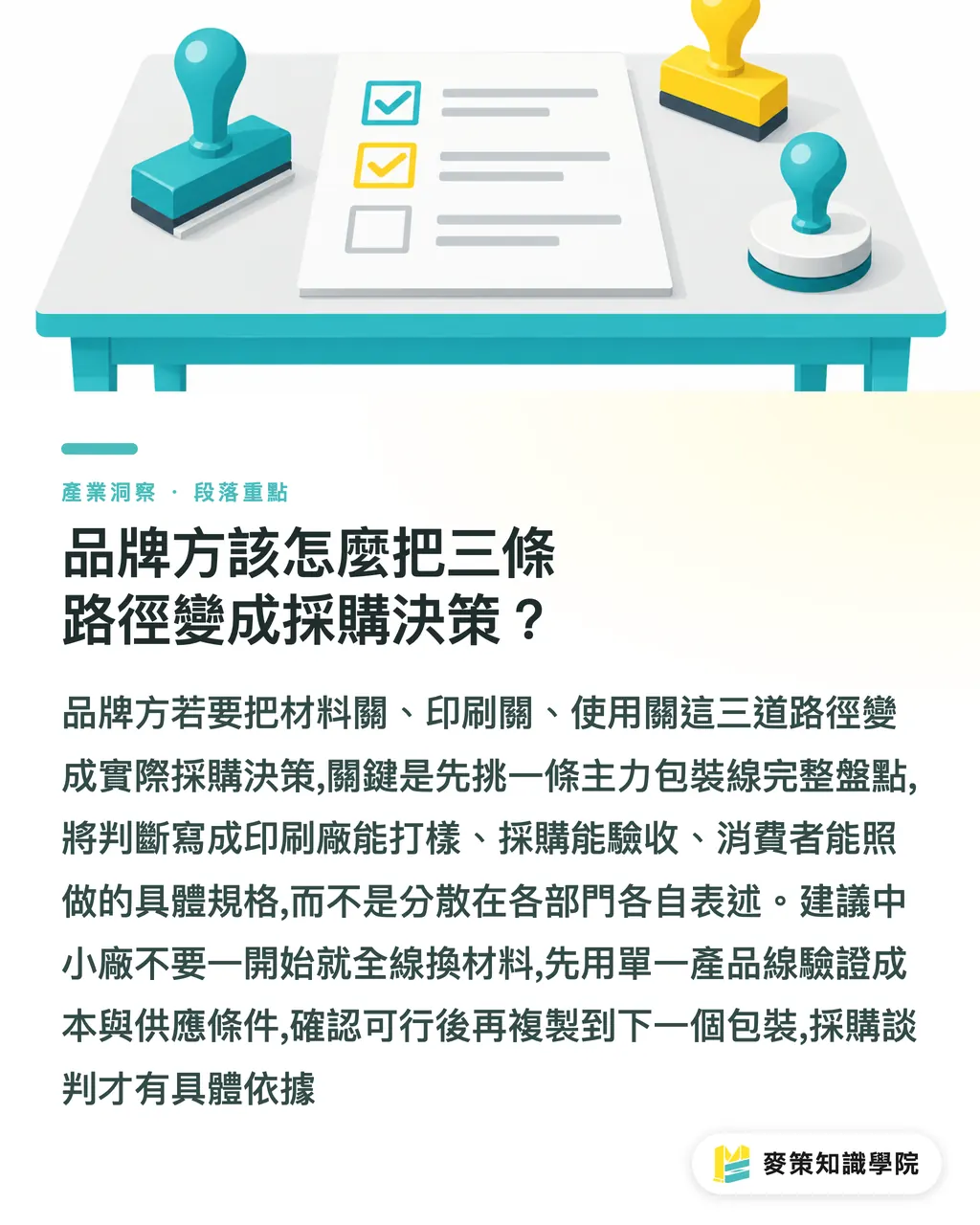
The approach is for Taiwan's small and midsize printers and brands to choose one core package, review it from end to end, and then turn the findings into specifications the printer can sample against, procurement can verify, and consumers can follow
When a cross-functional specification is needed, see the Mai Strategy Knowledge Academy advisory team and its "Mai Strategy Three-Gate Prepress Check"
・① Materials gate: confirm the choice of mono-PE, mono-PP, biobased materials, or PCR, and spell out the structure, supply, and recovery route
・② Printing gate: use samples to verify color, graphics, sealing, and converting constraints. Do not treat material changes and printing costs as separate issues
・③ Use gate: put component separation, recovery guidance, and what consumers actually do into the same specification
I do not recommend that small and midsize printers switch materials across the entire line at the outset. Start by validating one product line. Once the conditions, cost, and supply are clear, apply the approach to the next package. Then procurement has a concrete basis for negotiation
Key takeaways
・For circular flexible packaging, look at the material structure before making brand promises
・mono-PE and mono-PP are only the starting point. The recovery route is the acceptance criterion
・Biobased materials change the raw-material source. PCR changes the supply of recycled material. Both must be tied back to product function
・End-use design brings how consumers take the package apart, use it, and dispose of it into the packaging specification
・For small and midsize printers, testing one core package first is the easiest way to turn sustainability requirements into deliverable conditions
Further thoughts
Printing and manufacturing teams can turn mono-material structures, PCR blend ratios, sealing, and converting constraints into specifications that can be quoted. Designers can put component separation, recovery guidance, and brand recognition into the same layout decision. AI (artificial intelligence) can help compare material specifications, organize sampling feedback, and spot version differences, but it cannot decide whether the local recovery system can actually handle the package. SaaS (software as a service) should retain material batches, supplier commitments, sampling records, and approved versions, so the next packaging change has a clear data trail
Further reading
FAQ
- Does mono-PE or mono-PP guarantee recyclability?
- Not necessarily. A mono-material structure can reduce the burden of separating composite layers, but brands still need to confirm that the seal, inks, adhesives, bag format, and local recovery system are compatible
- What is the difference between biobased materials and PCR?
- Biobased materials change the source of the raw material. PCR increases the use of post-consumer recycled material. Both need to be checked against product function, supply stability, and where the package goes after use
- What should a small or midsize printer in Taiwan do first?
- Start with one core package. Review its material structure, printing and converting, and recovery route, then use sampling to confirm whether it can be mass-produced. There is no need to replace every package at once
- How can designers move packaging closer to a circular economy?
- Design the bag format, component separation, recovery graphics and instructions, and consumer actions together. First confirm that every different-material component actually provides a product-protection or use function
Related articles
The Print × AI weekly
The print and AI know-how designers, brands and enterprises can use before they commit — one email, every week
MINDS Free Tools
AI background removal, a LINE sticker maker, spine & imposition calculators — all free, right in your browser, no upload.
MINDS Group
Need actual printing or gifting services?
From premium printing to online ordering and festive gifts — the MINDS Group sister brands take it from here.