
What exactly is changing in the soft packaging circular economy?
The soft packaging circular economy is no longer about whether a single material looks good on paper. It's about whether the package can be sorted, whether PCR can be produced at consistent quality, and whether brands are willing to back recyclate with long-term offtake. When MINDS helps clients plan packaging, we put these conditions into the pre-press conversation, not as a patch job after the first proof
The Alliance to End Plastic Waste's 2026 "The Quest for Quality" report notes that advanced mechanical recycling can now process post-consumer flexible packaging into higher-quality recyclates, with applications in shrink films, pouches, and labels, and recycled content reaching 30% or more
My first reaction when I read that was pretty blunt: soft packaging isn't unrecyclable. The problem is that too many people have been boiling it down to four words, "just switch to recyclable material"
In practice, whether a film makes it into the loop depends on ink, adhesive, layer structure, contamination, sorting capability, brand-side procurement commitment, and regulatory fees. If any one of these gets stuck, it ends up back on the print shop and the brand buyer's desk
Taiwan working definition of EPR: EPR stands for Extended Producer Responsibility. It requires brands or producers to take responsibility for the recovery, treatment, and cost of packaging once the product is sold. The focus extends from "what happens when it sells" to "how it's collected and reused after use"
Taiwan working definition of PCR: PCR stands for post-consumer recycled content. It refers to material that has been collected, processed, and remanufactured after consumer use. It's different from factory scrap recycling. PCR is what regulations and brand sustainability targets actually count as recycled content
Why does sorting decide whether recycling succeeds or fails?
The Alliance to End Plastic Waste technical and economic assessment models a soft-plastic advanced mechanical recycling plant at 50,000 metric tons per year. The report specifically flags that upstream sorting accounts for about 25% of total capex
That 25% number has a real shop-floor feel to it
Anyone in print knows that if you want stability downstream, upstream can't be a mess. Recycling works the same way. If individual recyclers process raw bales directly, contamination drives roughly 50% yield loss. That means even the best equipment can get dragged down by feed quality
The trouble with soft packaging is that it isn't as easy to identify as a rigid bottle. Multi-layer film structures, printed surfaces, residual contents, and mixed resins all tangle together. If the sorting stage doesn't clearly separate the material streams, recyclate quality is hard to hold steady
For a print shop, this loops back into three design choices:
・Package structure: mono-material or more easily sorted structures are more likely to enter a recycling pathway than complex multi-layer constructions
・Print design: full-bleed dark areas, metallic effects, special coatings, and large masking areas can make identification and reprocessing harder
・Client communication: a pretty mockup doesn't equal compliance. Before sending to press, you need clarity on the sales market, EPR requirements, and PCR targets
Simple as that
No stable sorting means no stable PCR. No stable PCR means brand sustainability commitments eventually just become procurement pressure
How will EPR and PCR change brand procurement?
An FPA industry note puts several key terms on the same table: EPR, mandated recycled content targets, concessionary capital, and long-term offtake agreements
Those phrases read like policy language, but they land as very practical issues in packaging procurement: brands can't just ask about unit price anymore. They need to ask about material source, where it ends up after recycling, whether PCR supply is stable, and whether suppliers can carry compliance documentation alongside the product
To scale advanced mechanical recycling, the report FPA cites says you can't get there on technology alone. You need a functioning EPR system, mandatory recycled content targets, lower-cost capital, and brand-side long-term offtake agreements
My suggestion for brand clients is to reshape the procurement spec into four fields:
・Target market: whether the product is going to the US, EU, or other markets where EPR pressure runs high
・Package structure: whether there's room to move toward structures that sort more easily and interfere less with recycling
・PCR conditions: whether you need to hit 30% or higher recycled content, or start with a supply availability assessment
・Long-term arrangements: if recyclate quality and pricing are volatile, whether an offtake agreement is the way to lock down supply
Print shops should adjust how they quote, too. From now on, a packaging quote isn't just print labor, film material, and converting fee. It has to spell out regulatory risk, material availability, testing cycles, and delivery flexibility all at once
For projects that need to clean up the spec early on, you can bring in the Mai Strategy Knowledge Academy advisory team for a packaging decision review, then hand printability, cost, and compliance risk back to the printer for calibration
What should small and mid-size print shops do first?
Small and mid-size print shops don't need to invest in a recycling plant overnight. What they do need is to become the compliance communication window their brand clients can actually trust
In the same release, FPA also flagged the agenda direction of the 2026 FlexForward Conference and a US House recycling bill hearing covering advanced recycling, mass balance, PCR mandates, eco-modulation, and microplastics. These topics will push soft packaging from marketing label to supply chain design
Four things I'd start with:
・Build a package structure catalog: break down the films, laminations, inks, adhesives, and coatings you actually use, and flag which ones are easier to route into recycling or PCR conversations
・Rewrite the send-to-press checklist: add sales market, EPR reporting responsibility, PCR targets, recycling marking, and brand sustainability requirements
・Set a fixed question set with material suppliers: don't just ask whether they have an eco film. Ask about PCR ratio, available volume, batch consistency, and whether they can supply documentation
・Brief designers on the limits early: if a client is going for circular packaging, design needs to know up front that full-bleed, special effects, and multi-layer composites can carry downstream cost
Some owners ask, what happens if we don't do this now
Short term, you might just lose out on a few sustainable packaging jobs. Mid term, brand clients will start scoring suppliers on compliance capability. Long term, if a print shop can only answer "this material is more eco," it's going to have a hard time getting into packaging projects with real spec thresholds
What can design and SaaS teams learn from this shift?
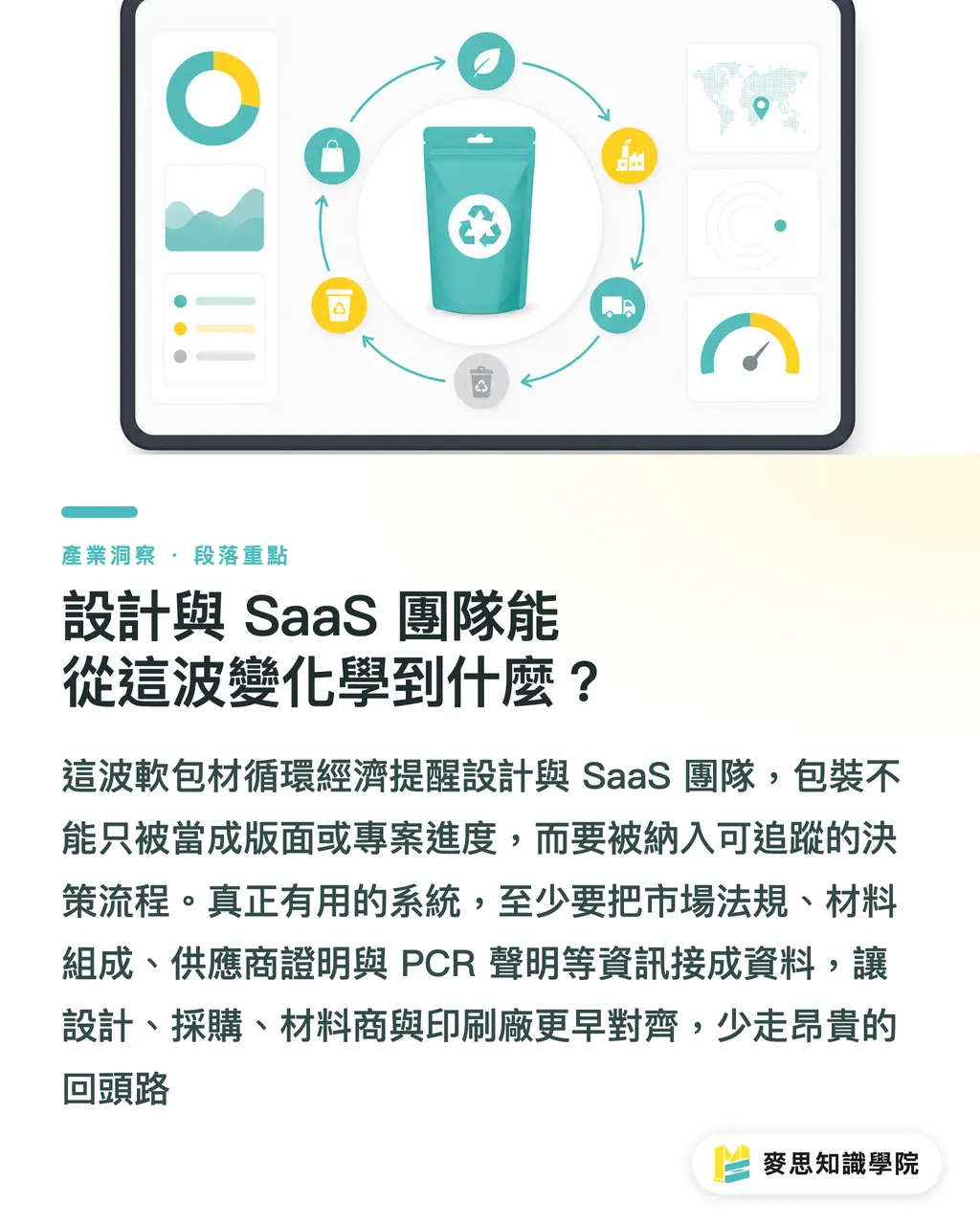
What the soft packaging circular economy is telling design and SaaS teams is to stop treating packaging as a visual output and start treating it as a decision flow
Take pouches or labels as the example. The report FPA cites already points to high-quality recyclates flowing back into these applications, but only if sorting, feed quality, PCR demand, and brand long-term commitments line up
If design tools only manage layout, they miss the material and regulatory conditions. If SaaS only tracks project progress, it misses the change cost buried in packaging specs. A system that's actually useful should turn the following fields into trackable data, not fragments scattered across email threads
・Market field: where the product sells and whether EPR or recycled content requirements apply
・Material field: film, ink, adhesive, converting method, and likely recycling interference
・Document field: supplier certificates, PCR statements, test records, and version updates
・Procurement field: short orders, long-term contracts, alternative materials, delivery, and price fluctuation
From what I've seen on the production floor and the client side, packaging decisions don't usually go wrong because nobody cares about sustainability. They go wrong because design, procurement, material suppliers, and the print shop sit down at the same table way too late
Get the problem on the table early, and a lot of cost stops looping back around
Key Takeaways
・The point of the soft packaging circular economy isn't shouting "recyclable." It's getting sorting, PCR supply, and brand procurement to actually connect
・A 50,000-metric-ton plant assessment tells the industry that scaling recycling is now a capital and supply chain question, not just a material question
・If raw bales cause roughly 50% yield loss, front-end sorting quality directly eats into back-end equipment performance
・EPR will push packaging responsibility out of the brand marketing department and back into design, procurement, printing, and material specs
・The sooner small and mid-size print shops build their package structure catalog and compliance questionnaire, the better their shot at upgrading from job shop to procurement advisor
Further Thinking
For print manufacturing, the next step isn't chasing the latest material. It's getting your existing materials, processes, and documentation capability in order first. For designers, sustainable packaging can't wait until the file is finished to ask the printer whether it's doable. For AI and SaaS teams, the most valuable application isn't writing pretty copy, it's wiring EPR, PCR, material versions, test records, and long-term agreement terms into a workflow that's searchable, editable, and transferable. If packaging specs are still stuck in PDFs, LINE chats, and a handful of emails, the circular economy is going to turn into a cost you re-quote every time the version changes
Further Reading
FAQ
- Is the soft packaging circular economy just about switching to recyclable materials?
- No. The soft packaging circular economy also depends on sorting capability, contamination control, PCR supply, EPR responsibility, and brand long-term commitments. Material is only one piece of it
- What does advanced mechanical recycling do for soft packaging?
- The Alliance to End Plastic Waste report notes that advanced mechanical recycling can process post-consumer flexible packaging into higher-quality recyclates usable in shrink films, pouches, and labels, with recycled content reaching 30% or more
- Why is sorting so important in soft packaging recycling?
- The Alliance to End Plastic Waste assessment indicates that upstream sorting accounts for about 25% of total capex. If recyclers process raw bales directly, contamination can drive roughly 50% yield loss. Sorting quality directly decides PCR quality and cost
- What should small and mid-size print shops in Taiwan prepare now?
- Small and mid-size print shops in Taiwan should first build a material structure catalog, update the send-to-press checklist, consistently ask material suppliers for PCR and supply documentation, and start discussing EPR and recycling marking with brand clients early in the design stage
- Why should brand clients care about long-term offtake agreements?
- Long-term offtake agreements let brands commit to buying a set volume of recyclate, which helps recycling investments secure stable demand and turns PCR supply from a spot quote into a procurement plan you can actually schedule around
References
- Alliance to End Plastic Waste《The Quest for Quality》軟性包裝先進機械回收報告 · recyclingtoday.com
Related articles
The Print × AI weekly
The print and AI know-how designers, brands and enterprises can use before they commit — one email, every week
MINDS Free Tools
AI background removal, a LINE sticker maker, spine & imposition calculators — all free, right in your browser, no upload.
MINDS Group
Need actual printing or gifting services?
From premium printing to online ordering and festive gifts — the MINDS Group sister brands take it from here.