
Switching Paper Without Changing Coatings Is the Most Common Blind Spot in Sustainable Packaging
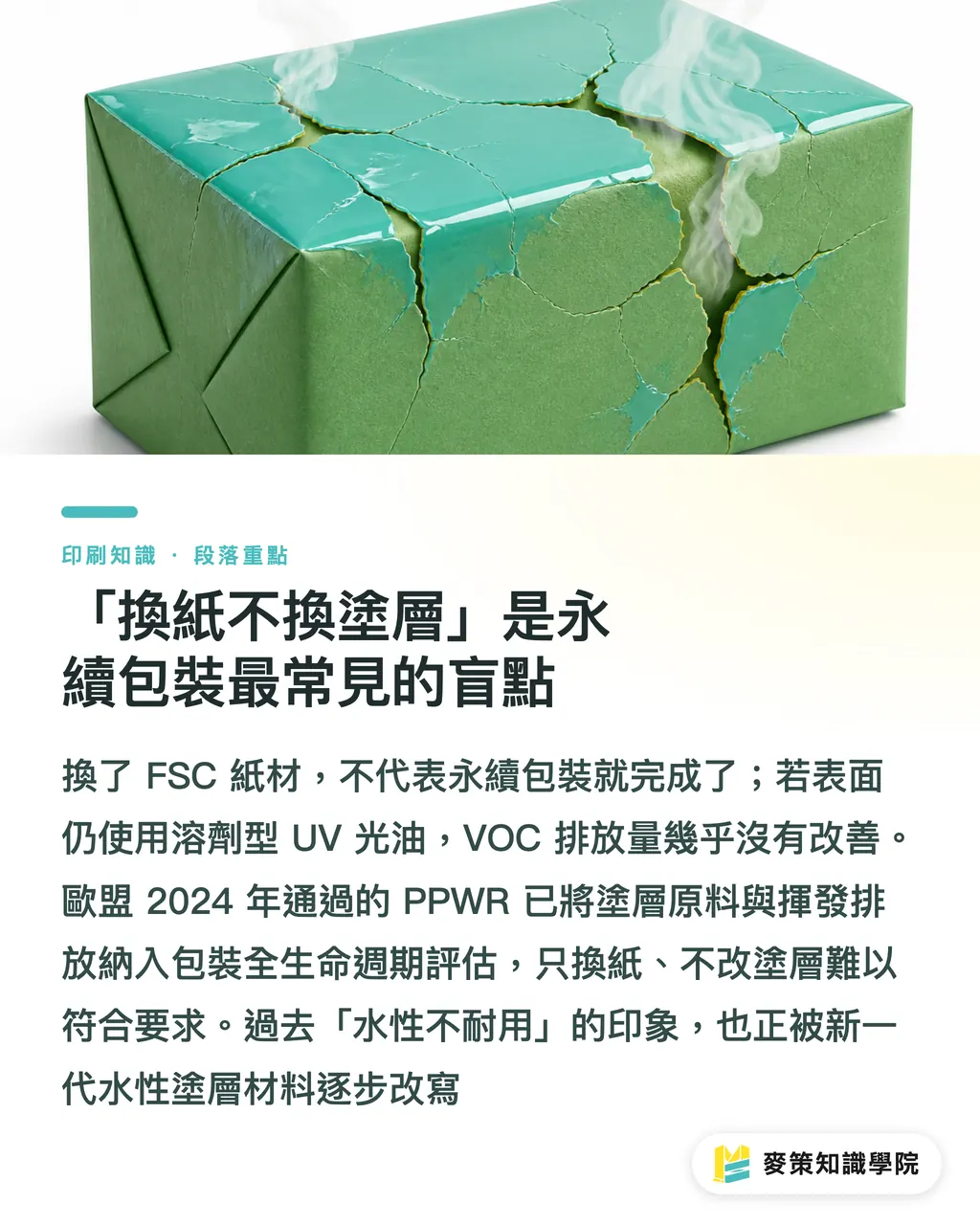
After brand clients get FSC certification (Forest Stewardship Council, ensuring paper comes from responsibly managed forests), they often feel their sustainable packaging job is done. But what I see on press floors is almost always the same: the paper changed, but the surface varnish is still solvent-based UV, and VOC emissions have not improved at all
The EU's PPWR (Packaging and Packaging Waste Regulation), passed in 2024, holds brands accountable for the environmental impact across a package's entire lifecycle. Raw material sourcing and volatile emissions from finishing coatings both fall within scope. Changing only the paper while leaving the coating untouched simply will not hold up under this regulatory framework
The problem is that the printing industry has long held the belief that waterborne is eco-friendly, but not durable. That made sense with older waterborne coatings, but new material research is overturning it
How Do Waterborne Bio-Based UV Coatings Work?
Let's break down the terminology first
Waterborne: Water serves as the dispersion medium, replacing reactive diluent monomers in traditional UV formulas. VOCs drop significantly. In the past, the trade-off was weaker film formation and poor mechanical strength
Bio-based: The resin backbone partially or fully comes from renewable biological resources, like plant oil-derived acrylates (bio-based acrylate) or lignin derivatives (lignin derivative), replacing petrochemical raw materials
UV curing: Once applied on press, specific wavelengths of ultraviolet light trigger photoinitiators (photoinitiator) to start a chain polymerization reaction, forming a crosslinked network in seconds. No high-temperature baking is needed, which minimizes paper warping
The core breakthrough in recent research is finding a way to integrate bio-based components into the waterborne UV resin backbone. This delivers high crosslinking density after curing, making up for the strength shortcomings of older systems. Abrasion resistance, impact resistance, and substrate adhesion all improve noticeably. Water as the carrier, plants as the backbone, and UV light locking it down. When all three come together, eco-friendliness and durability can truly coexist
What Is the Fundamental Difference from Traditional UV Varnishes?
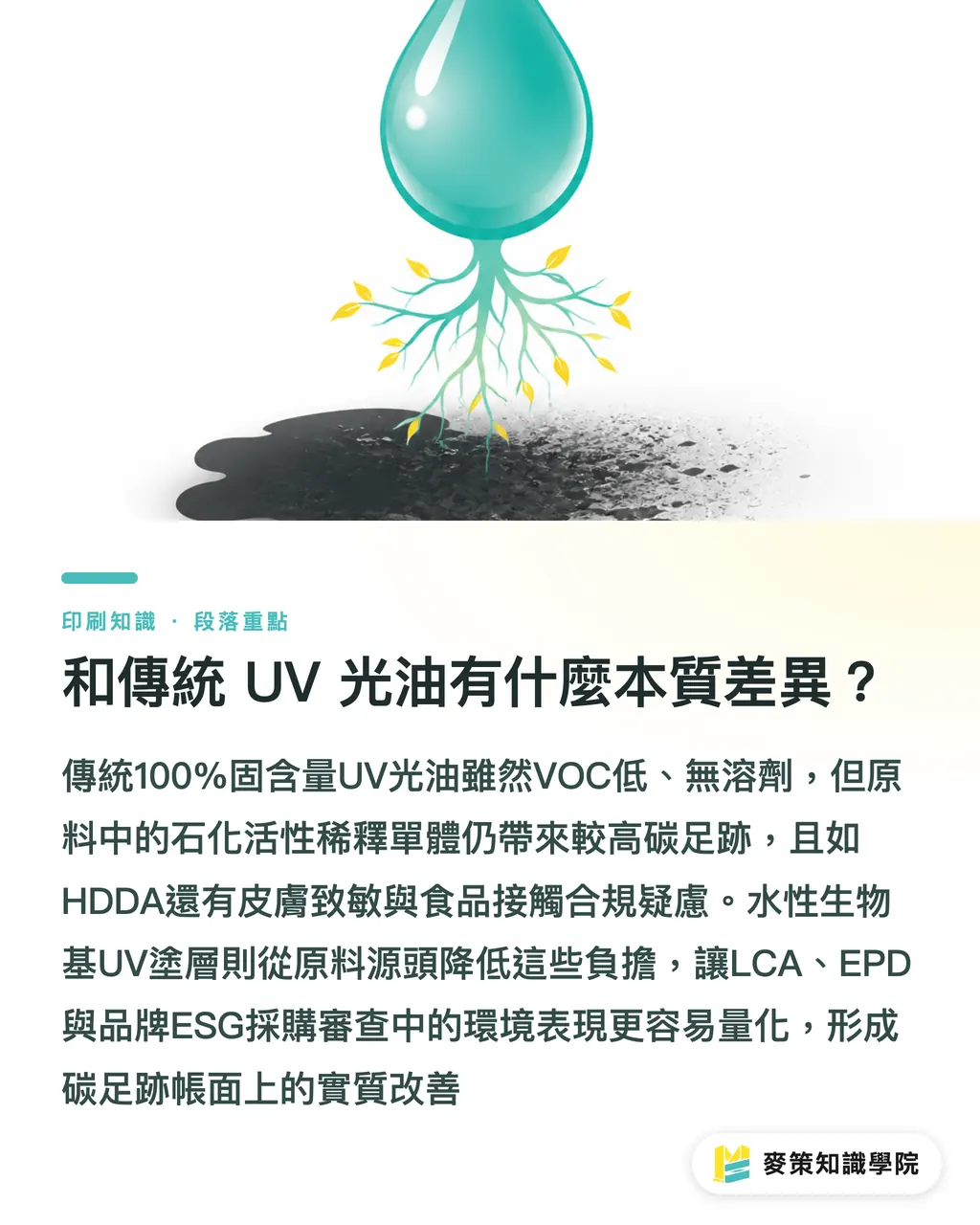
Traditional 100% solid UV varnishes (solvent-free) already have low VOC emissions, with no water and no volatile diluents in the coating. The issue lies on the raw material side. Most reactive diluent monomers come from petrochemical sources with substantial production carbon footprints. Certain monomers, like 1,6-hexanediol diacrylate (HDDA), also raise skin sensitization concerns, making compliance reviews for food contact materials increasingly troublesome
Waterborne bio-based UV coatings shift this logic right from the source of the materials, improving LCA (Life Cycle Assessment) figures across the packaging supply chain. For printers that need to issue EPDs (Environmental Product Declarations) or complete brand ESG procurement audits, this is not just a vague sense of being greener, but a concrete difference that translates into measurable metrics
The difference between the two systems comes down to the carbon footprint ledger, and more and more procurement teams are watching that ledger closely
Which Orders Should Prioritize This Transition?
Not every job needs a material swap. Based on my experience with client projects, these types of orders are the highest priority for evaluation:
・Consumer packaging exported to EU markets, where PPWR lifecycle assessment requirements directly affect post-press material selection
・Food-grade cartons or foodservice bags, where finishing coatings are regulated by food contact material standards and petrochemical monomers carry higher compliance risks
・Major brand clients facing ESG supply chain audit pressures who need verifiable carbon reduction data from their packaging
For local orders with lower regulatory pressure and no export needs, traditional UV varnishes still offer advantages in process maturity and cost control. Identifying which clients have genuine compliance needs is the most effective material upgrade strategy, rather than switching everything just to feel more eco-friendly
What Can Small and Mid-Sized Printers Do Right Now?
Waiting around is not the answer, but there is no need to rush into a full-scale switch right now. Waterborne bio-based UV coatings are still in the early stages of adoption in the Taiwan market, with suppliers and product specs still maturing. You can start with two things:
1. Request technical data sheets (TDS) from your current coating suppliers to check VOC numbers and raw material petrochemical origins. This creates your baseline for future comparisons
2. Ask suppliers if they have bio-based content percentage data. Collecting this now gives you a reference chart ready when replacement opportunities come up
Once you do these two things, you will have a snapshot of where you stand, instead of just a vague pledge to be greener. MINDS has built deep experience in finishing planning for high-end custom packaging. If you are evaluating a transition path to sustainable finishing materials, you can also reach out directly to the Mai Strategy Knowledge Academy consulting team to discuss which orders make the most financial and strategic sense to start with
Key Takeaways
・The environmental loophole in sustainable packaging often lies in the finishing coating. Switching paper without changing the varnish falls flat on lifecycle assessment ledgers
・Waterborne bio-based UV coatings achieve both low VOCs and high mechanical strength, with the key being increased crosslinking density after curing
・Bio-based resins replace petrochemical raw materials with plant oil derivatives or lignin, providing verifiable, reportable carbon footprint data across the supply chain
・The EU PPWR (2024) includes finishing coatings in full packaging lifecycle assessments, creating real compliance pressure for EU export orders
・The first step to take now: Request TDS from suppliers, confirm VOC values and bio-based content, and build a comparison baseline for future transitions
Further Considerations
When faced with this issue, small and mid-sized printers in Taiwan tend to fall into two extremes: thinking 'I don't export so this doesn't concern me,' or believing 'just getting an eco-label solves everything.' The real risk sits in the middle. ESG procurement audits by major local brands are already expanding into print finishing. Coating raw material sources and VOC data will soon be required entries on vendor scorecards. Organizing TDS data for your finishing formulas now is not just about regulatory compliance, but about giving yourself an advantage that competitors lack during procurement evaluations
Further Reading
FAQ
- How does the abrasion resistance of waterborne UV coatings compare to traditional UV varnishes?
- Older waterborne UV formulas had weaker abrasion resistance due to film uniformity issues. Newer waterborne bio-based UV formulas compensate by increasing post-cure crosslinking density, noticeably improving abrasion resistance, impact resistance, and adhesion. However, because formulas and substrate combinations vary widely, always run proofing and press tests before drawing conclusions
- Does 'bio-based coating' mean 'biodegradable'?
- They are two distinct concepts. Bio-based means the raw materials come from renewable biological resources, not that the material naturally degrades in the environment. Clarify this with your supplier to avoid mixing up the terms and misleading clients or auditors
- Do existing UV curing systems need to be replaced to adopt waterborne bio-based UV coatings?
- UV curing equipment generally does not need replacement. However, you must check formula viscosity, solid content compatibility with existing coater setups, and whether your UV lamp wavelengths match the absorption peaks of the formula's photoinitiator. Verify each of these with your coating supplier before deciding
- What specific requirements does the EU PPWR have for finishing coatings?
- The EU PPWR (Packaging and Packaging Waste Regulation, passed in 2024) requires brands to assess the full lifecycle environmental impact of packaging. Raw material origins, VOC emissions, and whether finishing coatings affect packaging recyclability all fall under its scope. Brands exporting to EU markets and their print suppliers should review their processes ahead of time
- If we only serve the local Taiwan market with no exports, is it necessary to pay attention to waterborne bio-based UV coatings now?
- Regulatory pressure is indeed lower than for exporters, but ESG supply chain audits from major domestic brands are already expanding to post-press finishing. The sooner you organize TDS data for your coating materials, the more concrete numbers you will have during procurement evaluations, rather than just claiming to be eco-friendly
Related articles


The Print × AI weekly
The print and AI know-how designers, brands and enterprises can use before they commit — one email, every week
MINDS Free Tools
AI background removal, a LINE sticker maker, spine & imposition calculators — all free, right in your browser, no upload.
MINDS Group
Need actual printing or gifting services?
From premium printing to online ordering and festive gifts — the MINDS Group sister brands take it from here.