

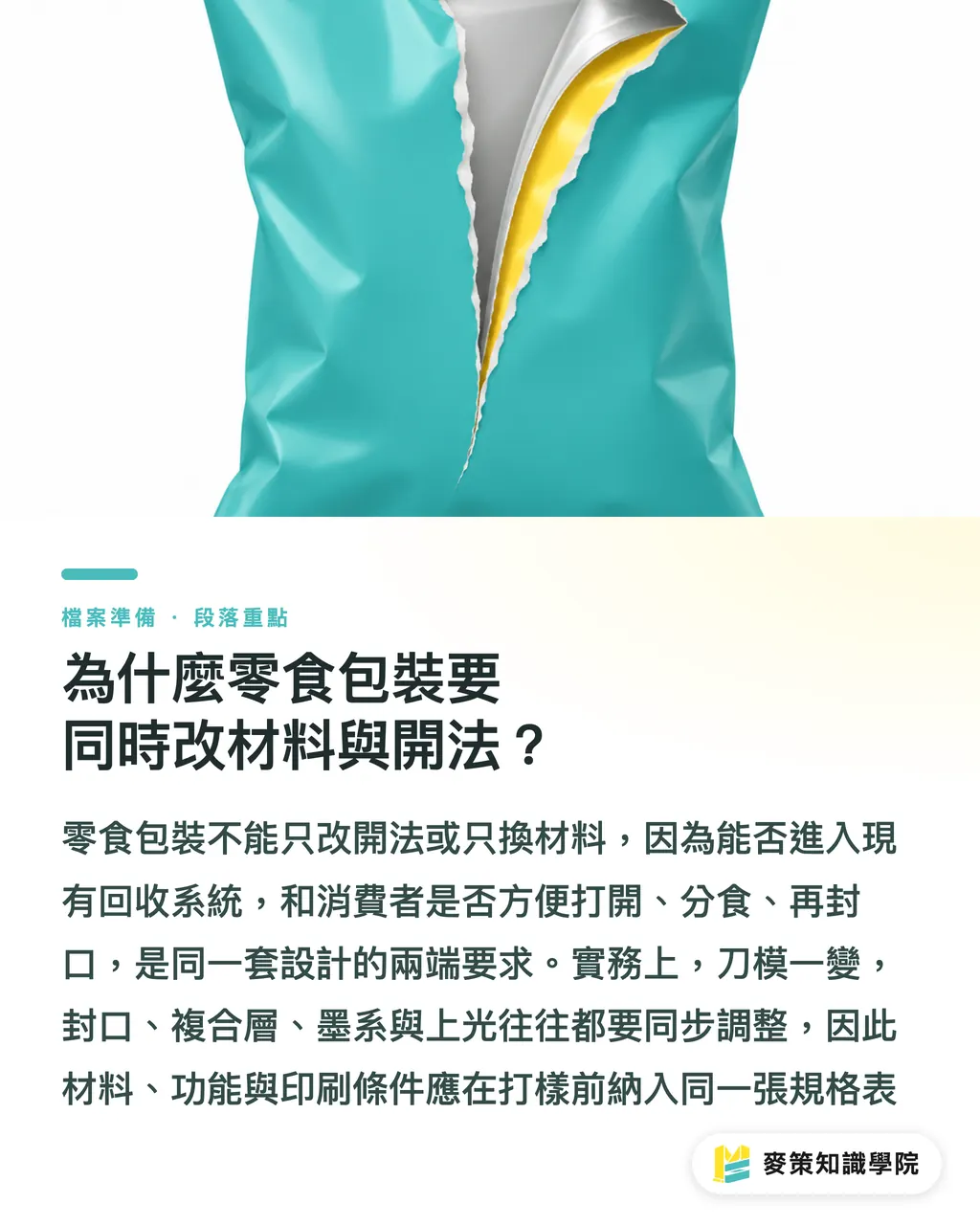
Why do snack packages need to change both materials and opening methods?
That is because whether a material can enter the recycling stream and whether consumers can open it easily, share it, and store it neatly are two sides of the same packaging requirement. recycle-ready means designing the package structure around what existing recycling systems can process. The focus is on material combinations, multilayer construction, and post-processing that do not work against one another
Packaging Insights, an industry publication covering food and packaging, notes in Recyclable Structures and Convenient Formats Reshape Snack Packaging that the global snack-packaging market is adopting recycle-ready structures and moving toward single-material construction at the same time. It is also redesigning three use cases: opening, sharing, and resealing. The signal is direct for prepress staff: once the dieline changes, the sealing method, multilayer construction, ink system, and coating or finishing steps may all need to change with it
The point I repeat most often on packaging projects is this: don't treat the dieline as the last drawing. Brands need shelf recognition, and printers need to produce the package consistently. That means the design file has to put materials, function, and printing conditions on the same specification sheet. If the missing details are only filled in at proofing, the project is usually already one round behind
How does recycle-ready translate into a design file?
To bring recycle-ready into the design file, start by spelling out the material structure, then treat the opening and post-processing as one set of engineering requirements. single-material means using the same class of substrate as much as possible for the main packaging layers, reducing the difficulty of separation and identification while still checking barrier performance, sealing, and food-contact requirements
I would not treat recycle-ready as something that becomes valid just by printing an environmental claim on the package. It still has to be checked against the materials, multilayer construction, and actual recycling conditions
・Single-material direction: Design and recycling communication become more straightforward, but barrier performance, sealing, and printability must be confirmed together at the front end
・recycle-ready structure: It can be adjusted to existing material and equipment conditions, but multilayer construction, post-processing, and recycling instructions cannot be vague
Designers should leave at least three fields in the final artwork file: substrate, multilayer construction, and coating or sealing method. If these three are not written down, the supplier has usually received only an appearance, not packaging specifications they can quote and proof
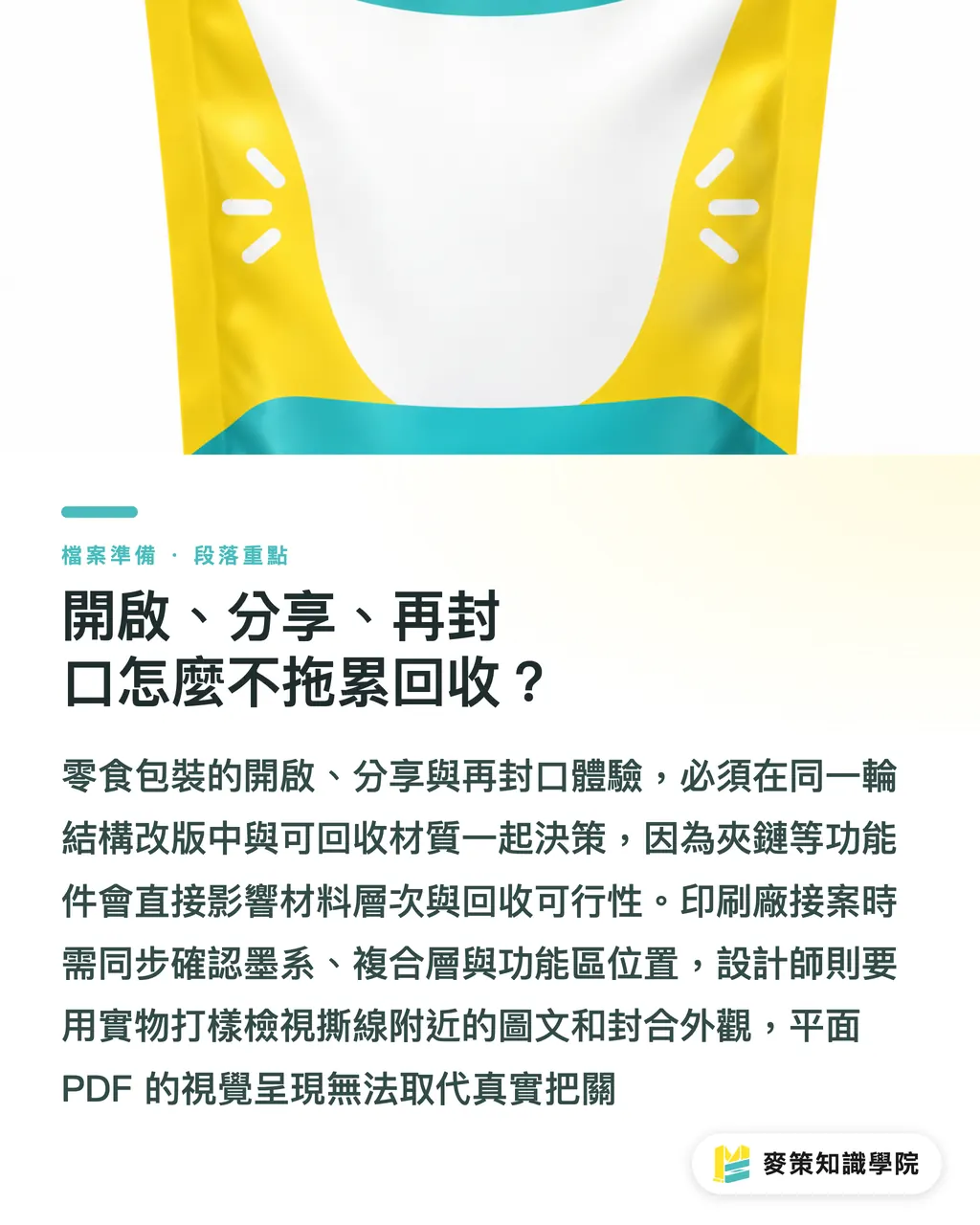
How can opening, sharing, and resealing avoid undermining recyclability?
Function does not automatically undermine recyclability. The thing that gets out of control is when the opening component, material layers, and sealing process are each decided separately. Convenience in snack packaging usually shows up in three moments: opening it for the first time, sharing it with others, and sealing it back up when there is some left
Resealable features such as a zipper can improve the user experience, but they may complicate a single-material direction. That is why you cannot wait until after the artwork is complete to ask whether the package is recyclable. The global snack-packaging market is currently putting recyclable structures and opening, sharing, and resealing formats into the same redesign cycle precisely because these functions affect one another
When a printer takes on this kind of job, it should at least confirm the ink system, multilayer construction, coating steps, and position of the functional zone together. Designers need to inspect the graphics and copy near the tear line, whether the opening works smoothly, the appearance after sealing, and shelf-facing recognition on the physical proof. A good-looking flat PDF cannot replace a physical check
What are the three gates designers need to clear before handing off files?
Before handing off files, designers need to clear three gates: materials, use, and printing. All three can be answered through the specifications and a physical proof, and only then is the job ready to go to press
・1|Materials gate: State the substrate, multilayer construction, sealing method, and recycling approach on the specification page. Add food-contact or supplier limitations to the notes. Do not hand over only a dieline and CMYK artwork
・2|Use gate: Use separate layers to mark the opening, tear line, sharing zone, and resealing position. Check that bleed and safe areas stay clear of the functional lines, then use a physical sample to confirm the first opening and resealing
・3|Printing gate: Put the ink system, coating, small type, reverse type, and barcodes on the proofing checklist. Ask the printer to confirm whether the multilayer construction and post-processing change the recycling approach. Do not substitute a PDF preview for a physical assessment
This is the three-gate Mai Strategy print handoff I use. Even when a revision changes only the front-panel copy, it is less likely to miss the dieline and functional zone
How should Taiwan's small and mid-sized printers and brand clients respond?
Small and mid-sized print shops should bring recyclable and easy-open formats into the specification meeting before quoting. Brand clients should first define the user experience and material conditions that cannot be compromised. These jobs involve material compliance, food-safety requirements, sustainability claims, campaign schedules, and whether the equipment can produce the result consistently. If documentation is added only at prepress, both revisions and proofing will be pushed back
・Brand clients: Spell out the three actions, opening, sharing, and resealing, as well as the recognition elements that must remain on the shelf-facing front
・Designer: Put the dieline, materials, multilayer construction, ink system, and coating notes in the same handoff package
・Printer: Confirm the workable scope before quoting and proofing. Do not wait until the client has revised the artwork to say that the functional component or post-processing has to be changed
Brands can bring the specifications to MINDS for discussion when they need strong shelf recognition and fully customized proofing. For retail printing with more fixed specifications and a leaner budget, they can look to Mai Printing. From what I have observed over years on the production line and on the client side, whenever recyclability, convenience, or shelf recognition enters the process late, proofing and revisions usually pay the bill in the end

Key takeaways
・Recyclable design starts with the material structure, then moves to the surface appearance
・Opening, sharing, and resealing must be validated together with the dieline, sealing method, and multilayer construction
・When the design file clearly states the ink system, coating, and multilayer construction, the printer has a chance to reproduce the result consistently
・If a brand clarifies recyclability and convenience before quoting, revision costs will not fall on the last round
Further thoughts
Print manufacturers can move material, functional, and process conditions into the quotation stage, while designers can treat the dieline and material notes as part of final artwork. If AI (artificial intelligence) and SaaS (software delivered online through a subscription) are brought into packaging workflows, the first thing worth doing is to turn Mai Strategy's three-gate print handoff into fields, checks, and response records. That way, the reasoning behind every revision is retained instead of saving only the latest PDF
Further reading
FAQ
- What does recycle-ready mean for snack packaging?
- recycle-ready means arranging materials, multilayer construction, and post-processing according to what existing recycling systems can handle. It cannot be established by adding environmental wording to the package surface alone
- Is single-material always better than other structures?
- single-material uses the same class of substrate for the main packaging layers, which usually makes separation and identification easier to manage. But barrier performance, sealing, food-contact requirements, and actual recycling conditions still need to be checked first
- What information should designers provide before sending snack packaging files to press?
- At a minimum, provide the dieline, notes on materials and multilayer construction, opening and resealing positions, ink system and coating requirements, and the items to verify in the physical proof
- Can an easy-open format undermine recyclable design?
- Not necessarily. The risk is whether a zipper or another functional component changes the material combination or post-processing. Opening, sharing, and resealing must be validated together with the recycling approach
Related articles


The Print × AI weekly
The print and AI know-how designers, brands and enterprises can use before they commit — one email, every week
MINDS Free Tools
AI background removal, a LINE sticker maker, spine & imposition calculators — all free, right in your browser, no upload.
MINDS Group
Need actual printing or gifting services?
From premium printing to online ordering and festive gifts — the MINDS Group sister brands take it from here.