
Overview
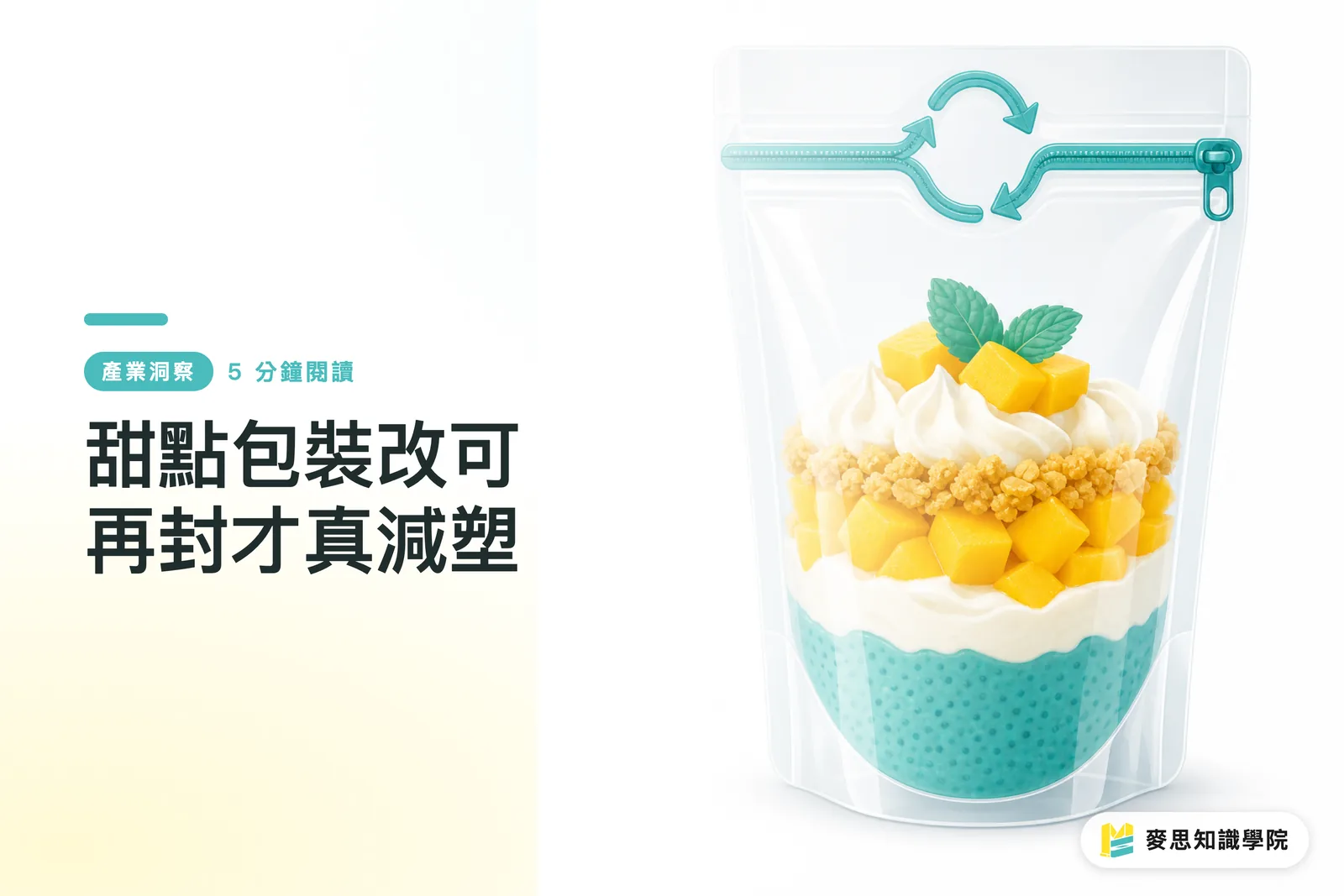
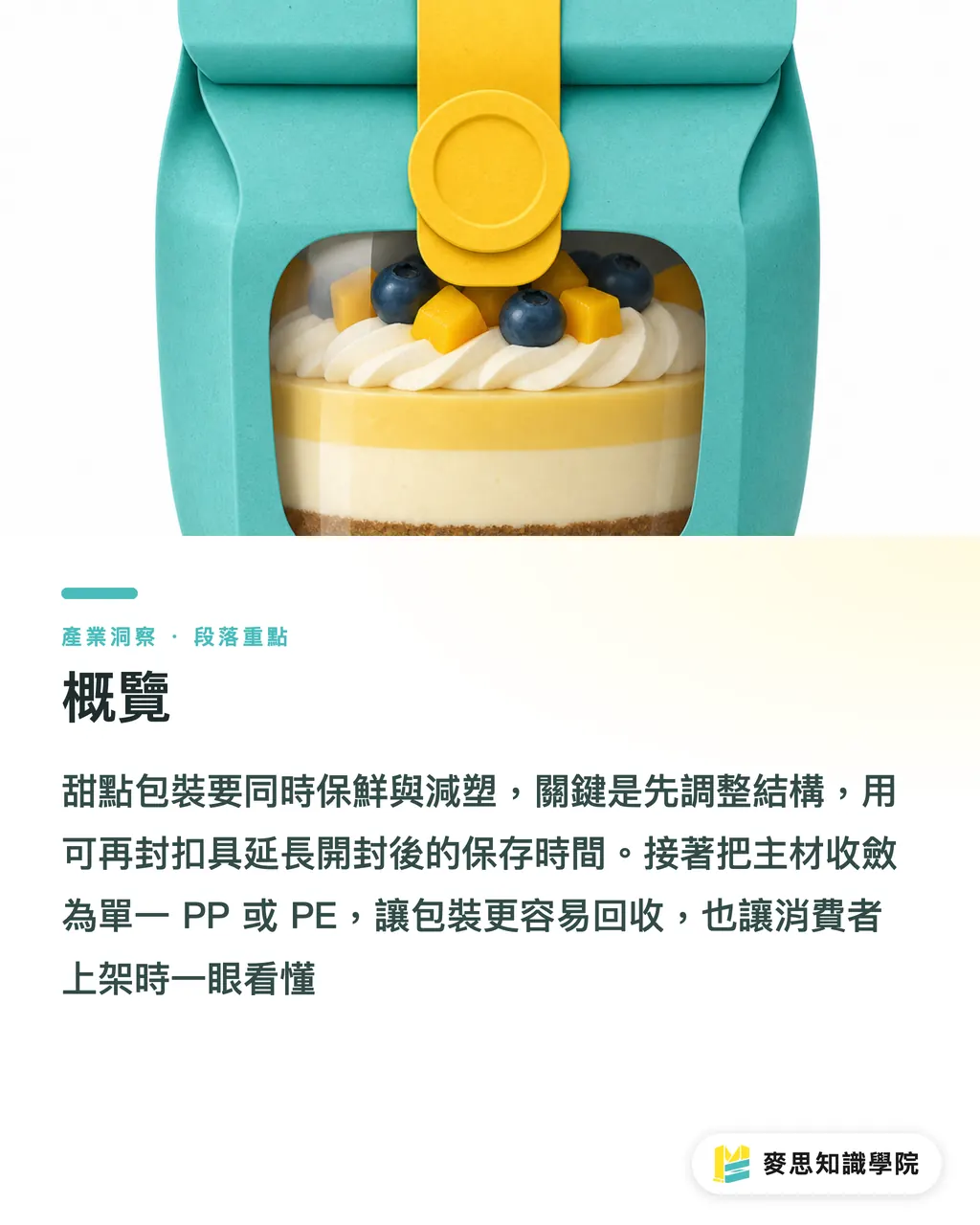
When dessert packaging has to keep product fresh and cut plastic at the same time, my move is to change structure first: a resealable closure to stretch post-open shelf life, then pull the main material down to a single PP or PE. That is also the standard opening move from MINDS (MS) — what we call the "three press-check gates" — when food packaging goes through a refresh
・Can the material actually be recycled?
・Can the closure be used again?
・Once it's on the shelf, can a shopper read it at a glance?
Why does resealable structure come first in dessert packaging?
The annoying thing about dessert packaging is that the trouble usually starts after the pack has been opened
Cookies going soft is one version. A tub of ice cream picking up off-flavors after repeated scooping is another
The Packaging Insights piece — Dessert packaging prioritises freshness with resealable and recyclable formats — puts resealability and recyclability in the same case, and I think it lands on the real pain point of a dessert-pack refresh: cutting plastic can't push consumers to throw food out faster
A resealable closure isn't just an extra plastic part. From the production line, it pulls on three things at once
・The heat-seal area has to be generous enough, otherwise the film lifts around the closure, and that's even more obvious on chilled desserts
・Shoppers need to close it with the same motion every time. If the feel is too tight, they give up on it
・The opening has to match how the product is actually eaten. A family-size bag, a share pack, and a single-serve cup can't all run the same closure
How do resealable and recyclable actually hold together?
・Resealable structure: the pack can be closed again after opening. Strip locks, lid snaps, or re-stick seals are the usual ways to do it. The point is to cut moisture pickup, flavour crossover, and waste from not finishing the pack in one go
・Single-resin construction: the body of the pack uses one plastic family as much as possible, PP or PE, for example, and avoids mixing in paper, aluminium, PET, or adhesive layers so the recycler doesn't have to dismantle mixed materials first
The Packaging Insights case says a single PP or PE structure can ride existing recycling streams. On the press floor, that sentence has two prerequisites
The body resin has to be clean. The closure, label, ink, and adhesive can't drag the whole pack into a composite that's hard to separate
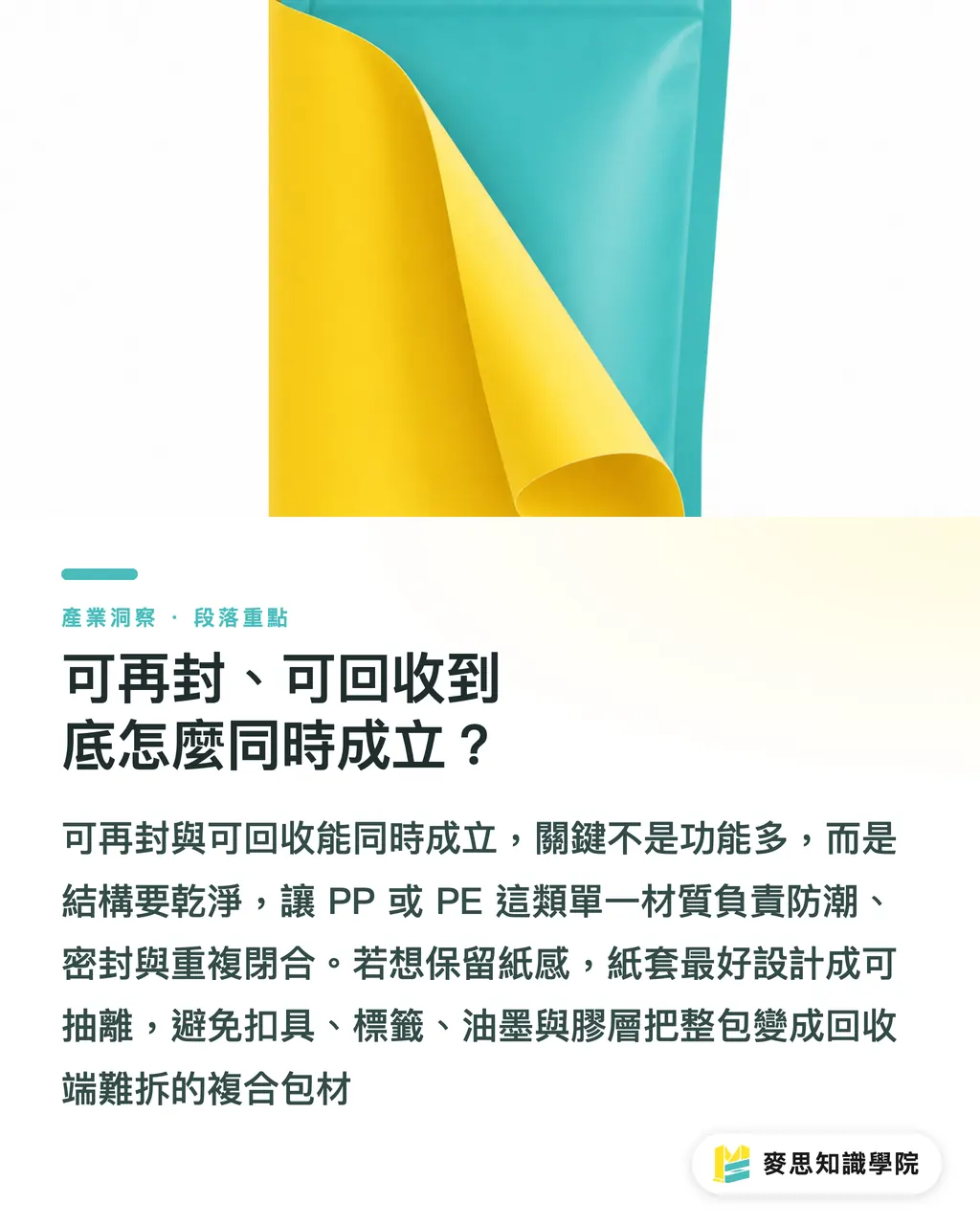
If you want a paper feel on the outside, my suggestion is to make the paper sleeve removable
If the inner layer needs moisture protection, let PP or PE handle the sealing on its own
Paper does the visual and the stiffness. Plastic does the moisture barrier and the seal. The two shouldn't be glued together so tightly that the recycler can't take them apart
What four landmines should Taiwan's bakery and ice-cream packaging avoid?
When a Taiwanese brand brings in this kind of dessert packaging, I'd run it past four landmines first, designs that look green on screen but turn into a headache at the sorting facility
・A paper box lined with a plastic film. Consumers toss it in the paper bin; the sorter sees a composite layer and the day gets long
・A PP main bag with a PE closure strip. Both plastics are common, but they melt at different temperatures and run on different recycling streams. "It's all plastic" isn't the same as compatible
・Too many matte films, gloss films, and spot finishes stacked on top of each other. The visual pops, and so does the sorting and reprocessing burden
・A reseal patch that's too small. After a few open-close cycles it stops sealing, and the consumer ends up reaching for a zip-lock bag anyway
If a brand already has bakery bags, frozen-dessert cups, or ice-cream outer wraps in hand, the Mai Strategy Knowledge Academy consulting team usually starts by tearing apart one physical sample, looking at material layers, seal path, and labelling to see whether they're fighting each other, before quoting a refresh
What three things should a designer check before sending files to press?
It's easy for the design side to hear "single PP or PE" and assume the bag has to be plain
The Packaging Insights case is explicit that visual differentiation still has to hold up on the shelf. That's a real point, because dessert packaging sells the difference in a refrigerated case or on a bakery shelf in the first half-second
・Draw the dieline all the way to the opening. Confirm the die-cut, the closure, and the heat seal aren't stealing each other's real estate
・Step the visual file back to shelf distance. The main colour, the flavour colour, and any clear window need enough separation to read
・Before the file leaves the studio, ask about the material family. The label, ink, adhesive, and bag body should all line up under the same recycling call
When a fully custom proof is needed, MINDS (MS) is a better fit for mid-to-high-end commercial printing and packaging samples, especially on jobs where colour, paper sleeve, and plastic inner layer all need to be reviewed at the same time
Where should a small-to-mid print shop start sampling?
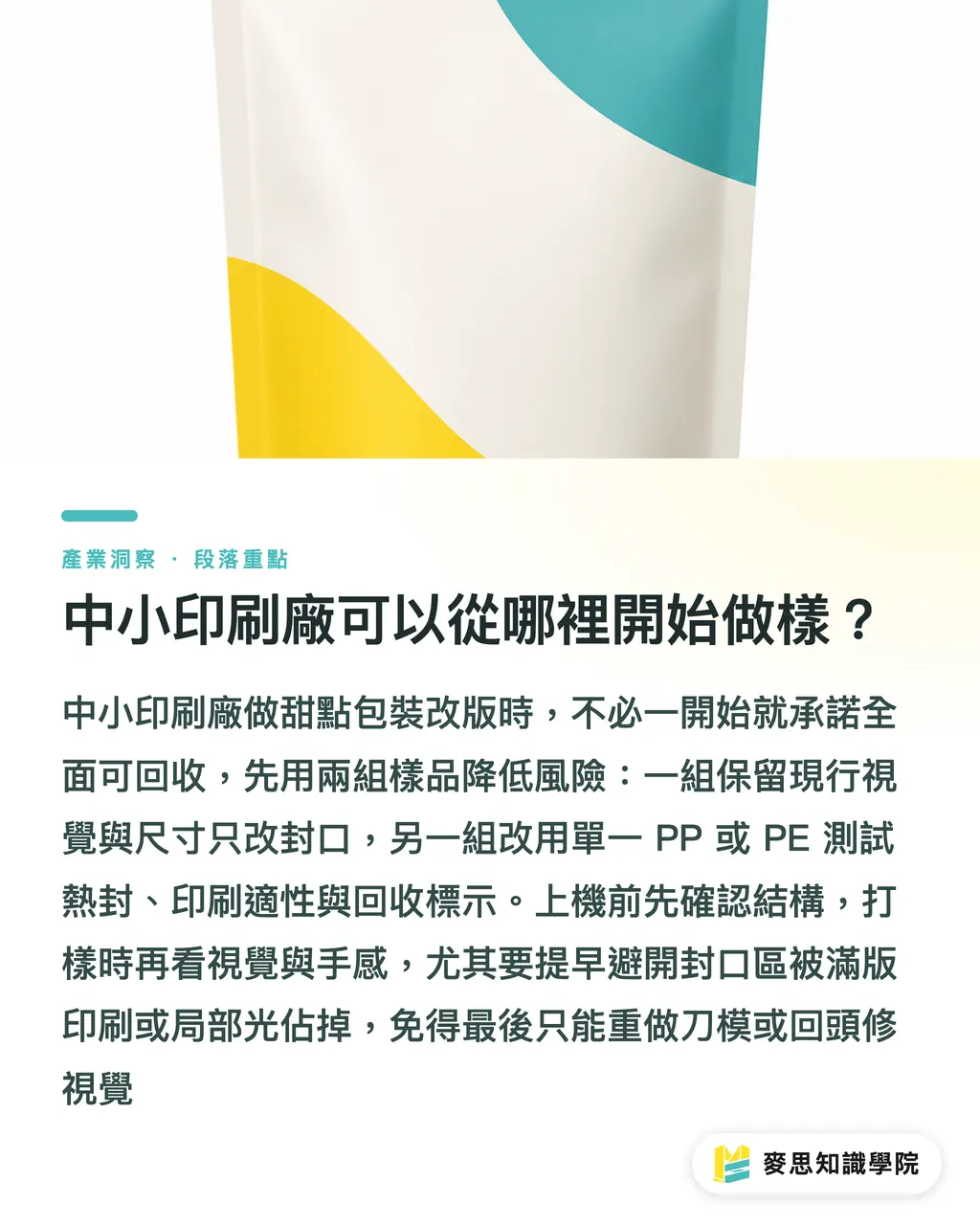
A small-to-mid print shop doesn't need to promise every dessert pack is recyclable on day one. The steadier play is to make two sets of samples first
・Sample A keeps the current visual and dimensions and changes only the closure, to test whether shoppers will actually re-seal it
・Sample B switches the main material to a single PP or PE, to test heat seal, printability, and whether the recycling marking can be made unambiguous
On the floor I usually ask for one pre-press discussion and two rounds of samples
The first run checks whether the structure actually works. The second run checks the visual and the hand-feel
The worst case is a signed-off visual file where the seal area has been eaten by full-bleed print or a spot finish. At that point you're either re-cutting the die or reworking the visual, and nobody's laughing on either side
Key takeaways
・Deal with resealability first so post-opening waste doesn't get ignored. That's what stops dessert plastic reduction from being a film-thickness exercise
・Single PP or PE has to be checked as a whole pack. Body, closure, label, and adhesive all count
・Visual differentiation can't be sacrificed. A sustainable pack nobody can read on the shelf won't get reordered
・Taiwan's small-to-mid print shops can validate with two sets of samples first. No need to tear up the whole product line on day one
Further thinking
The takeaway from this one is pretty plain: a packaging refresh has to move out of the sample room and in front of the quote. On the print-and-make side, PP, PE, paper sleeves, labels, and adhesive should be pulled together into one material decision sheet that can actually be priced against. On the design side, the opening and heat-seal positions should be marked on the first layout draft. AI tools can be put to work checking the spec sheet for missing material families and recycling marks. SaaS fits well for keeping the sample log, seal testing, and client sign-off on a single case record. For clients asking whether their current dessert packs can be changed, the Mai Strategy Knowledge Academy consulting team can start from tearing down one physical sample, no need to bulldoze the entire product line from the start
Further reading
FAQ
- Does switching dessert packaging to resealable mean more plastic?
- Resealability raises the design bar for the closure, but it doesn't necessarily raise total plastic usage. The point is to move from multi-layer laminate films to a single PP or PE, and stretch the time the pack stays usable after opening
- Is a single PP or PE pack guaranteed to be recyclable in Taiwan?
- The resin name alone isn't enough. Body, closure, label, ink, and adhesive all have to be judged together. If the PP or PE is mixed with a paper film, an aluminium layer, or a hard-to-separate adhesive, the recycler may still reject it
- What's the most common designer mistake?
- Treating recyclability as a flat-label problem and ignoring the die-cut, the opening, the heat seal, and the special finishes. In dessert packaging, the structure has to actually run before any logo goes near the pack
- Which product should a small bakery brand start with?
- Pick items that get opened and re-closed, share-pack biscuits, chilled desserts, family-size ice cream. These products show the value of a resealable structure fastest
- Where can MINDS (MS) help?
- The Mai Strategy Knowledge Academy consulting team can tear down your current packaging and build a material-and-structure checklist. When you need mid-to-high-end, fully custom commercial print samples, you can hand off to MINDS (MS) from there
Related articles
The Print × AI weekly
The print and AI know-how designers, brands and enterprises can use before they commit — one email, every week
MINDS Free Tools
AI background removal, a LINE sticker maker, spine & imposition calculators — all free, right in your browser, no upload.
MINDS Group
Need actual printing or gifting services?
From premium printing to online ordering and festive gifts — the MINDS Group sister brands take it from here.