
Which part of the label supply chain will PPWR hit first?
Documents and responsibility assignments take the first hit. Materials, structures, and label information only move into implementation after that
PPWR (Packaging and Packaging Waste Regulation, the EU regulation on packaging and packaging waste) governs packaging design, materials, recycling, and information responsibilities, requiring the supply chain to spell out its compliance data
The regulation took effect on August 12, 2026. By September 25, UNFEA (National Union of Adhesive Label Manufacturers, France's national union of adhesive label manufacturers) had reported a rise in compliance questionnaires, meaning label printers had to go back to ink, adhesive, and other material suppliers to request documentation
From my years of watching label projects, the hardest part is not getting the press to run. It is that sales has already promised, "We can accommodate that," while the shop floor cannot clearly say who is responsible for the EU declaration of conformity (the document used to confirm that a product meets the applicable requirements). In PPWR's First Challenges for Label Manufacturers, responsibility gaps can leave delivery dates stuck in an endless email loop
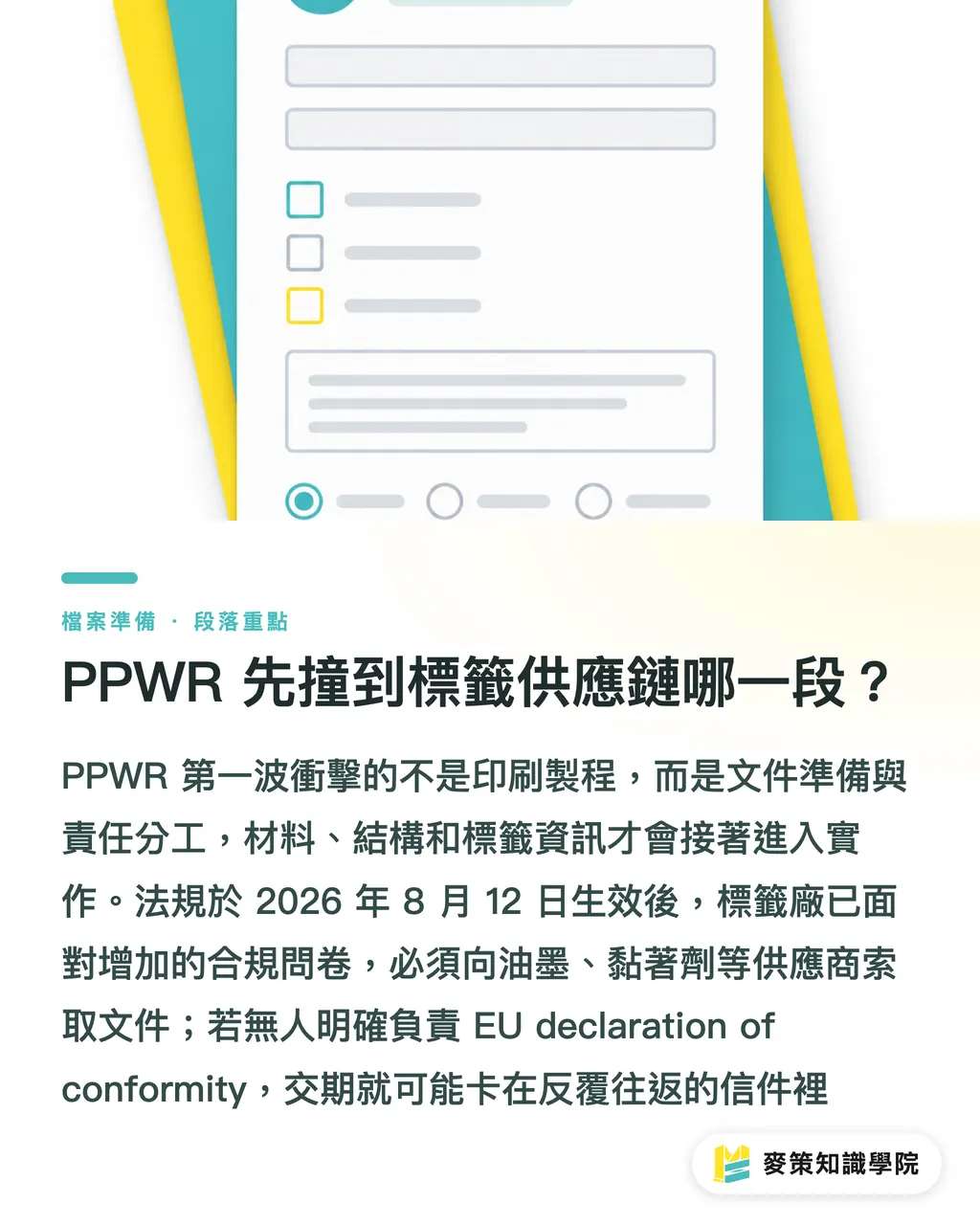
Why do compliance questionnaires get stuck at the printer?
Because the printer receives a label order, but the customer is asking for a documentation pack covering inks, adhesives, and other materials. Without a shared document-responsibility matrix across the supply chain, the questionnaire gets rebuilt at every stop
UNFEA's problem statement is very specific: people across the supply chain have different understandings of who collects, organizes, and returns supplier documents, and who signs the EU declaration of conformity. PFAS (per- and polyfluoroalkyl substances, commonly used to check whether materials involve restricted substances) documentation is relatively easy to obtain. Adhesives suitable for eco-design, recycled materials, and a glass deposit-return system still need to be confirmed case by case
When I take an order, I write the responsibilities in three lines:
・1. The brand provides the product's intended use, sales markets, and the questionnaire that needs a response
・2. The printer lists the label structure and materials, then requests the matching documents from suppliers
・3. Suppliers confirm the document version and scope of application, and the printer organizes everything for the brand to review
Make the document trail clear first, and later revisions have something solid to work from
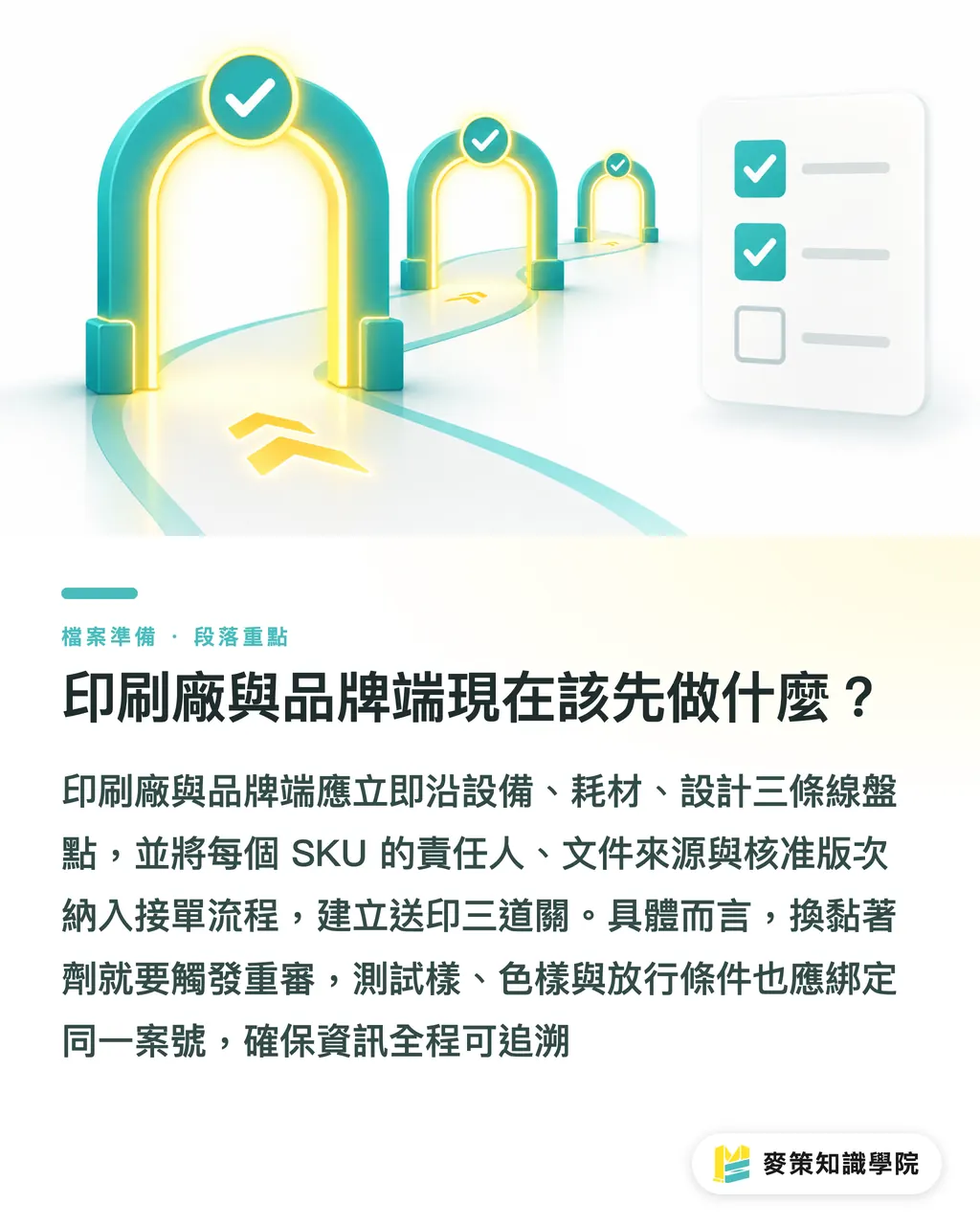
What should printers and brands do first?
Start by auditing three tracks, equipment, consumables, and design, and put each SKU's (Stock Keeping Unit, a single inventory item) owner, document source, and revision number into the order-intake process. This is the Mai Strategy three-gate print workflow I would use
・1. Equipment gate, confirm that the equipment and process can run the target material consistently, and keep test sheets, color proofs, and release conditions under the same job number
・2. Consumables gate, list the ink, adhesive, and substrate suppliers, and flag missing items immediately
・3. Design gate, have prepress (pre-print production, including file checks, conversion, and checks before sending to print) review materials and information at the same time as artwork changes. Changing the adhesive should trigger a new review
The work instructions a designer receives should answer, at minimum, what material this label uses, who provides the evidence, and which version has been approved. For mid- to high-end fully customized jobs, bring in MINDS for a joint check. For standardized print jobs ordered mainly online, Mai Printing is the better fit
Which three checks are easiest for designers to miss before delivery?
The easiest thing to miss is that the layout, materials, and documents are updated separately. Someone changes a recycling icon, but the version number, adhesive, and supplier information do not get updated with it. Before delivery, I always run the same three checks:
・1. Materials, do the substrate, adhesive, and printing conditions match the customer-approved version?
・2. Structure, if a glass deposit-return system is involved, has the adhesive documentation been obtained?
・3. Files, do the PDF, proof, material documents, and customer response all point to the same job number?
Run a self-check on a real work situation: the customer changes only one icon, the designer keeps using the old PDF, but procurement switches material suppliers. The layout may be correct, while the documentation is already out of sync. Check the filename, version number, and material fields together before conversion. It usually saves more trouble than chasing missing documents after printing
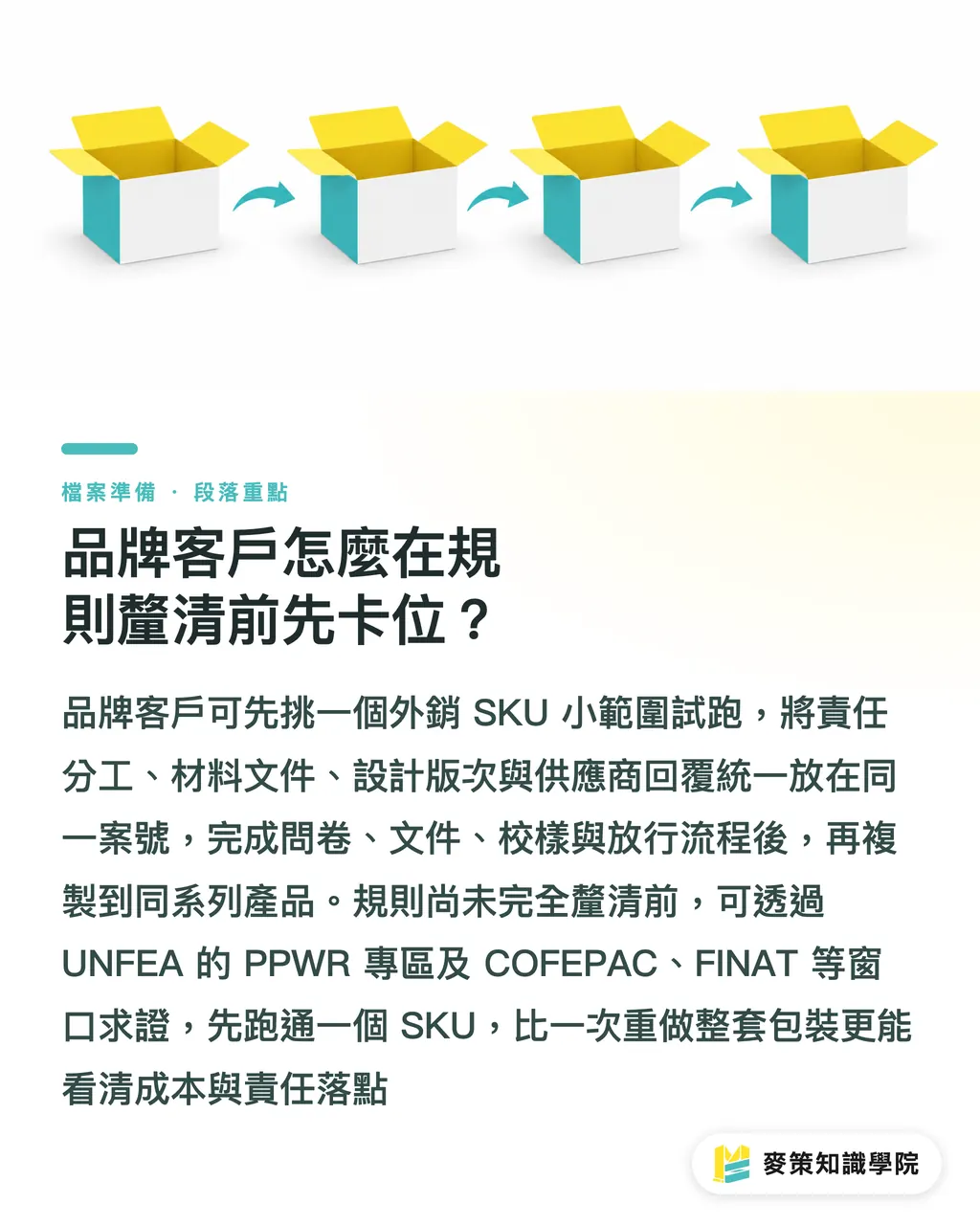
How can brand clients get ahead before the rules are fully clarified?
A brand client should pick one export SKU for a small pilot. Put the responsibility matrix, material documents, design revision, and supplier responses under one job number, then copy the setup to other products
UNFEA set up a PPWR section in July 2026, and Avery Dennison has also held webinars. For food-contact questions, COFEPAC (French Committee for Paper and Cardboard Packaging, France's committee for paper and cardboard packaging) and FINAT (the European self-adhesive label industry association) are useful existing channels for verification
・1. Assign who answers the customer and who follows up with suppliers for documents
・2. Confirm that changes to materials, adhesives, and the design revision are linked
・3. Complete the questionnaire, documents, proof, and release for one SKU, then expand to the rest of the product line
Brands that lack the staff to organize this can ask the Mai Strategy Knowledge Academy consulting team to clarify the responsibilities and handoff fields. Getting one SKU all the way through shows where the costs actually land more clearly than reworking the whole packaging system at once
Key takeaways
・PPWR's first wave of pressure will land on questionnaires, documents, and responsibility. It will not wait for a press problem to appear
・Label printers need to connect ink, adhesive, and other material documentation back to each SKU
・When designers deliver files, the version number, materials, and proof should all point to the same job number
・Brands should run one export SKU first. That is when the real cost of chasing missing documents becomes visible
Further thoughts
On the manufacturing side, supplier documents need to be part of order intake and release, not left sitting in a procurement inbox. On the design side, put the material fields and version number in the work order so an artwork revision does not change only the copy and graphics. AI (artificial intelligence) can help compare questionnaire fields, filenames, and missing documents, but the EU declaration of conformity still needs confirmation from a clearly assigned owner. If SaaS (Software as a Service, software delivered over the internet) is to serve packaging supply chains, every piece of evidence should be tied to the SKU, material, revision, supplier, and approval record. The next step is simple: choose one export SKU and run it from questionnaire to proof in full
Further reading
FAQ
- When does PPWR start affecting label printing?
- PPWR took effect on August 12, 2026. UNFEA reported more compliance questionnaires by September 25, so label printers need to organize their material and responsibility documents now
- Which suppliers should label printers ask for information first?
- Start with ink, adhesive, and other label-material suppliers. Request their documentation and tie the version and scope of application back to each SKU. PFAS documentation is currently relatively easy to obtain
- What should designers check before delivering files?
- Check the substrate and adhesive, the compatibility documentation for a glass deposit-return system, the version number after revisions, and whether the PDF, proof, and customer response all use the same job number
- How should a brand client without a full regulatory team get started?
- Choose one export SKU for a pilot. Assign who answers the customer and who follows up with suppliers, then keep the questionnaire, documents, proof, and release record under the same job number
Related articles

The Print × AI weekly
The print and AI know-how designers, brands and enterprises can use before they commit — one email, every week
MINDS Free Tools
Imposition calculator and preflight file check — free prepress tools, right in your browser.
MINDS Group
Need actual printing or gifting services?
From premium printing to online ordering and festive gifts — the MINDS Group sister brands take it from here.