
What's New in the PPWR FAQ? Penalties, Traceability, and Inventory Rules
The European Commission's August 2026 PPWR FAQ addresses three areas most prone to practical mistakes: penalty calculation, technical documentation for traceability, and existing inventory handling. For export manufacturers, this guide is more practical than the regulation text itself because it explicitly details how customs and member state market surveillance authorities will conduct inspections
On penalties, the FAQ specifies that member states must establish administrative fine caps and floors structured around the core PPWR framework, while exact amounts will be set by national legislation. Germany has already acted. The draft VerpackDG (German Packaging Act implementation rules) is aligning with PPWR, imposing stricter requirements on B2B packaging regarding Design for Recycling (DfR), minimum recycled content ratios, and registration filings than current LAGA guidelines
Traceability is a central focus of this FAQ update. The EU requires that packaging placed on the market must trace its material composition, recycled content percentage, and DfR evaluation results. This information must be maintained as technical documentation and submitted within strict deadlines upon audit. For printing plants, this means every single order requires written proof detailing inks, coatings, basis weights, and DfR rationale
Regarding inventory, the FAQ outlines transition principles. Packaging lawfully placed on the market before the PPWR mandatory enforcement date may continue to circulate during its shelf life. Items failing to comply after the mandatory date must be removed from shelves. While this rule provides a buffer, it applies only to inventory produced before the enforcement date, meaning production lines must maintain verifiable proof of production dates
・Penalties: Set by individual member states within the framework established by PPWR, with Germany's VerpackDG tightening rules further
・Traceability: Requires technical documentation, submitted within specified limits during audits
・Inventory: Stock produced before the enforcement date may circulate, provided production timing can be proven
Why Germany's VerpackDG Deserves a Closer Look
Germany has long led EU packaging regulation, and details in VerpackDG often serve as a blueprint for other member states. For Taiwanese manufacturers, understanding German enforcement gives an early look at upcoming directions in France, the Netherlands, and the Nordics
The current draft of VerpackDG focuses on three major areas:
・First, B2B packaging no longer receives a DfR grace period. Previous loopholes using the excuse of 'industrial use only, not sold through retail channels' are closing
・Second, minimum recycled content thresholds are directly written into mandatory clauses, setting distinct target values by material. Printers must renegotiate contracts with material suppliers
・Third, registration filings shift from voluntary to mandatory. Packaging not registered in LUCID (the German Packaging Register) cannot enter the market. This rule is already active
In practice, Taiwanese suppliers frequently overlook the registered entity requirement. Under German law, the obligation to register rests on the party placing packaging on the German market for the first time. While European importers are legally responsible, Taiwanese printers are often asked for due diligence documentation when brand clients lack a European corporate entity. In short, compliance pressure flows directly from brand clients down to print manufacturers
・B2B packaging: DfR grace period eliminated
・Recycled content ratio: Mandatory targets by material type
・Registration: Unregistered packaging prohibited from market entry
Inks, Coatings, Basis Weight: Three Immediate Action Items for Prepress
When legal requirements reach execution, pressure lands on technical decisions made in prepress departments. Based on recent client projects, three technical choices frequently incur underestimated costs
For inks, recycling compatibility varies significantly between water-based and UV-curable formulations. PPWR DfR evaluation frameworks (such as RecyClass and CEPI compatibility testing) flag specific ink layers as recycling obstacles. Metallic inks on PET shrink sleeves and solvent inks on PE laminations present high risks. Designers must verify with ink vendors early on whether specific inks passed CEPI/RecyClass testing rather than waiting for finished samples
Coatings and laminations represent another common blind spot. OPP film extrusion, PET lamination, and spot UV varnishes, long considered standard surface treatments, directly lower recyclability scores under DfR evaluations. Brand clients are actively reviewing whether varnishing is mandatory, opting to replace spot UV with calendering where possible, especially on paperboard folding cartons
Basis weight and material specifications require a full SKU inventory audit. A folding carton using 350 gsm duplex board with gray back was standard in the past. Today, meeting DfR and recycled content goals may require switching to 100% recycled fiber or higher FSC-certified pulp proportions. This shift impacts costs, lead times, and stiffness testing
・Inks: Prioritize ink formulations certified by CEPI/RecyClass tests
・Coatings: Replace spot UV varnish with calendering and minimize film laminations
・Basis weight: Audit SKUs to evaluate recycled fiber content and FSC ratios
Pre-Delivery Checklist: Incorporating Compliance into Procurement Specifications
Brand clients and prepress teams share the responsibility of translating PPWR and VerpackDG mandates into concrete procurement specifications. Relying on verbal agreements risks compliance failure at final inspection
First, audit SKUs and Bill of Materials (BOM). Every packaging unit exported to the EU needs a detailed material composition breakdown listing paper substrates, inks, coatings, lamination layers, and recycled fiber percentages. This document forms the foundation of all compliance traceability files
Second, mandate DfR evaluation reports from suppliers. Ink manufacturers, material vendors, and laminators should declare recyclability for their respective components. Printers must aggregate these inputs into a master DfR report rather than leaving brand clients to piece it together from scratch
Third, ensure production dates and inventory flows are fully traceable. ERP or MES systems must generate production timestamps for every batch, which is vital for proving inventory status after enforcement deadlines take effect
・BOM: Maintain a material composition table for every SKU
・DfR: Collect tier-by-tier supplier declarations and consolidate into a master report
・Traceability: Keep production timestamps recorded in ERP/MES systems
Priority Actions for Small and Medium Printing Plants: Functionality First, Perfection Second
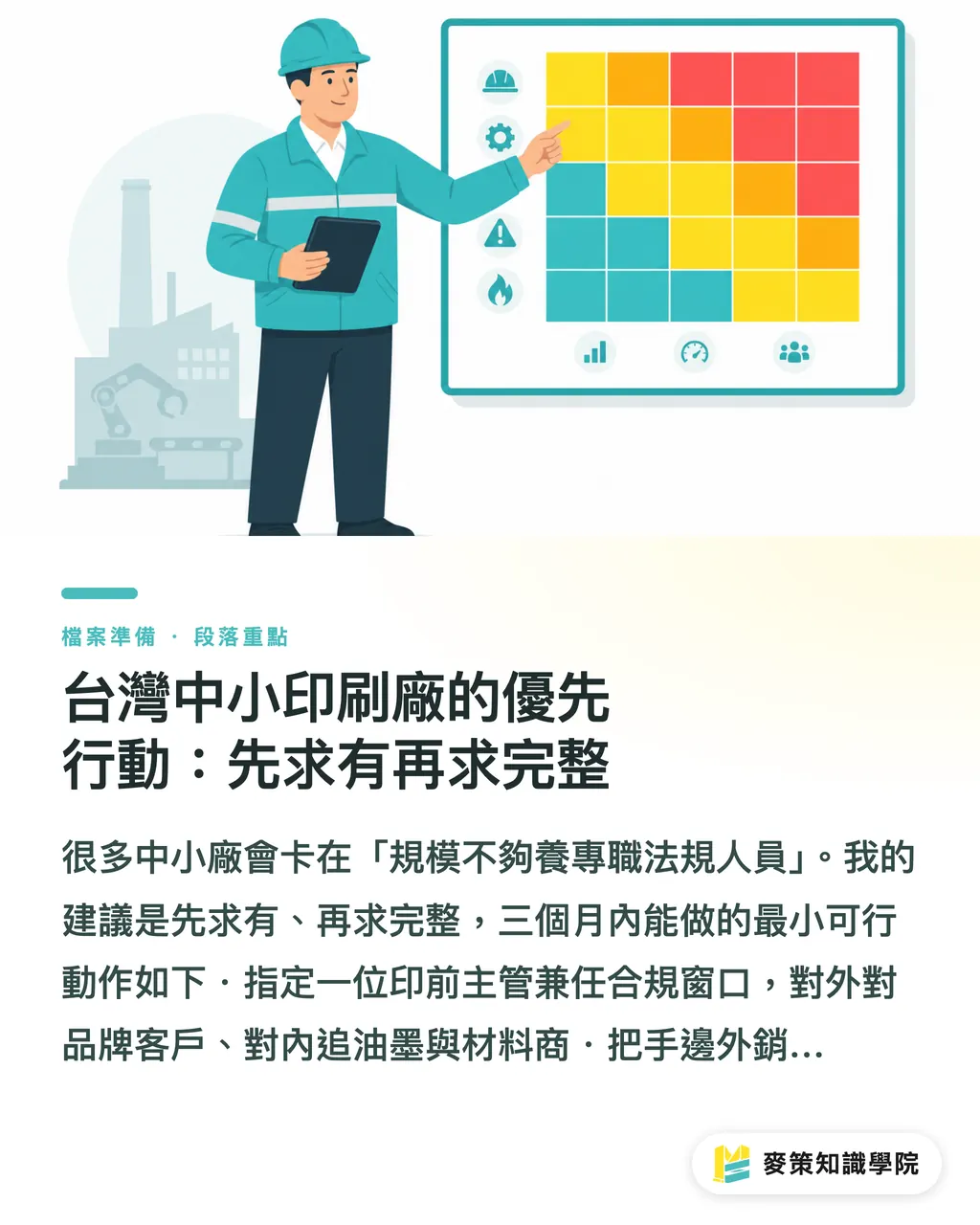
Many small and medium-sized printers stall because they lack the scale to hire full-time compliance specialists. My advice is to establish functional basics first before refining them. Here is a minimum viable action plan executable within three months:
・Appoint a prepress manager as the designated compliance liaison to communicate with brand clients externally and track ink and material vendors internally
・List all SKUs currently exported to the EU, mark their existing substrate and ink specifications, and map out high-risk areas
・Request CEPI/RecyClass test reports from your top two ink suppliers, securing documentation for your most frequently used inks
・Clarify responsibility for registration filings and due diligence with brand clients, documenting commitments clearly in procurement contracts
Completing these four steps dictates whether European orders will face unexpected blocks between late 2026 and 2027. Once established, you can evaluate phase-two steps like adopting automated DfR assessment software or recycled material traceability platforms. If you need to integrate compliance requirements directly into procurement specifications and proofing workflows, refer to Mai Strategy Knowledge Academy's Compliance Procurement Checklist to see how regulatory clauses transform into step-by-step prepress operational checklists
Key Takeaways
・The August 2026 PPWR FAQ update provides immediate official guidance by clarifying penalties, technical traceability, and inventory transition rules
・Germany's VerpackDG removes DfR grace periods for B2B packaging and mandates minimum recycled content ratios, setting a precedent for other member states
・Inks, coatings, and basis weights represent three technical prepress decisions that directly dictate DfR scores yet are frequently underestimated
・Responsibilities between brand clients and printing suppliers must be defined in writing within procurement contracts, eliminating ambiguity around registration and due diligence
・Auditing SKUs and BOMs is the starting point for compliance; without these records, downstream traceability documentation collapses
Further Reflections
For printing plants, pressure from PPWR and VerpackDG will not stay confined to a handful of European accounts. As brand clients apply European compliance lessons to packaging specifications in other global markets, technical entry barriers for packaging materials worldwide will rise in parallel. Prepress investments in DfR evaluation capabilities and recycled content tracking workflows will yield strong returns in coming years. For brand clients, defining compliance parameters in procurement specs early prevents costly rejections during final inspection. For AI and SaaS developers, automated DfR scoring, ink recycling compatibility databases, and cross-border registration tools present promising opportunities
Further Reading
FAQ
- When does the PPWR take effect?
- The EU PPWR applies in phases starting February 2026, with specific material and design requirements rolling out gradually. The FAQ serves as the primary guidance document during the transition
- What is the difference between Germany's VerpackDG and the PPWR?
- The PPWR is the overarching regulation at the EU level, while VerpackDG is Germany's national implementation decree. Implementation rules in Germany are often stricter than the core framework, serving as a reference model for other member states
- Are printing plants legally responsible for PPWR compliance?
- Legal liability falls on the entity placing packaging on the EU market for the first time. In practice, however, brand clients require printers to provide due diligence and technical documentation, transferring compliance pressure down the supply chain
- Which inks are categorized as obstacles to recycling?
- Metallic inks, specific UV-curable formulations, and solvent inks incompatible with PE/PET laminations carry high risks. Actual classification depends on compatibility test results published by CEPI or RecyClass
- Can existing inventory still be sold?
- Packaging legally produced before the PPWR enforcement date may circulate throughout its remaining shelf life. Non-compliant items produced after the enforcement date must be pulled from the market, making production date documentation essential
Related articles

The Print × AI weekly
The print and AI know-how designers, brands and enterprises can use before they commit — one email, every week
MINDS Free Tools
Spine width and imposition calculators — skip the manual math, free in your browser.
MINDS Group
Need actual printing or gifting services?
From premium printing to online ordering and festive gifts — the MINDS Group sister brands take it from here.