
Why Can't Export Packaging Rely on Eco-Friendly Slogans Anymore?
International buyers and customs officials now demand hard data and traceability records, not marketing slogans. Over the past few months, I spoke with several clients preparing to export to Thailand and Europe. Their biggest shock was finding out that claiming to use "eco-friendly paper" got rejected by foreign distributors at step one. The first wave of measures under the EU's Packaging and Packaging Waste Regulation (PPWR, a new EU regulation mandating recyclability and minimum recycled content in packaging) kicks in by 2026, turning recycled content targets into mandatory requirements. This means you must show exactly what percentage of recycled material is in your packaging
Southeast Asian markets are moving fast too. In Thailand's food packaging sector, competition has shifted squarely toward sustainability certifications and innovative materials. Buyers fear being accused of greenwashing, so they scrutinize suppliers more aggressively than ever. I often remind clients that modern packaging regulations tie visual presentation directly to material composition. If you get blocked here, it does not matter how good your product is, it will never hit the shelves
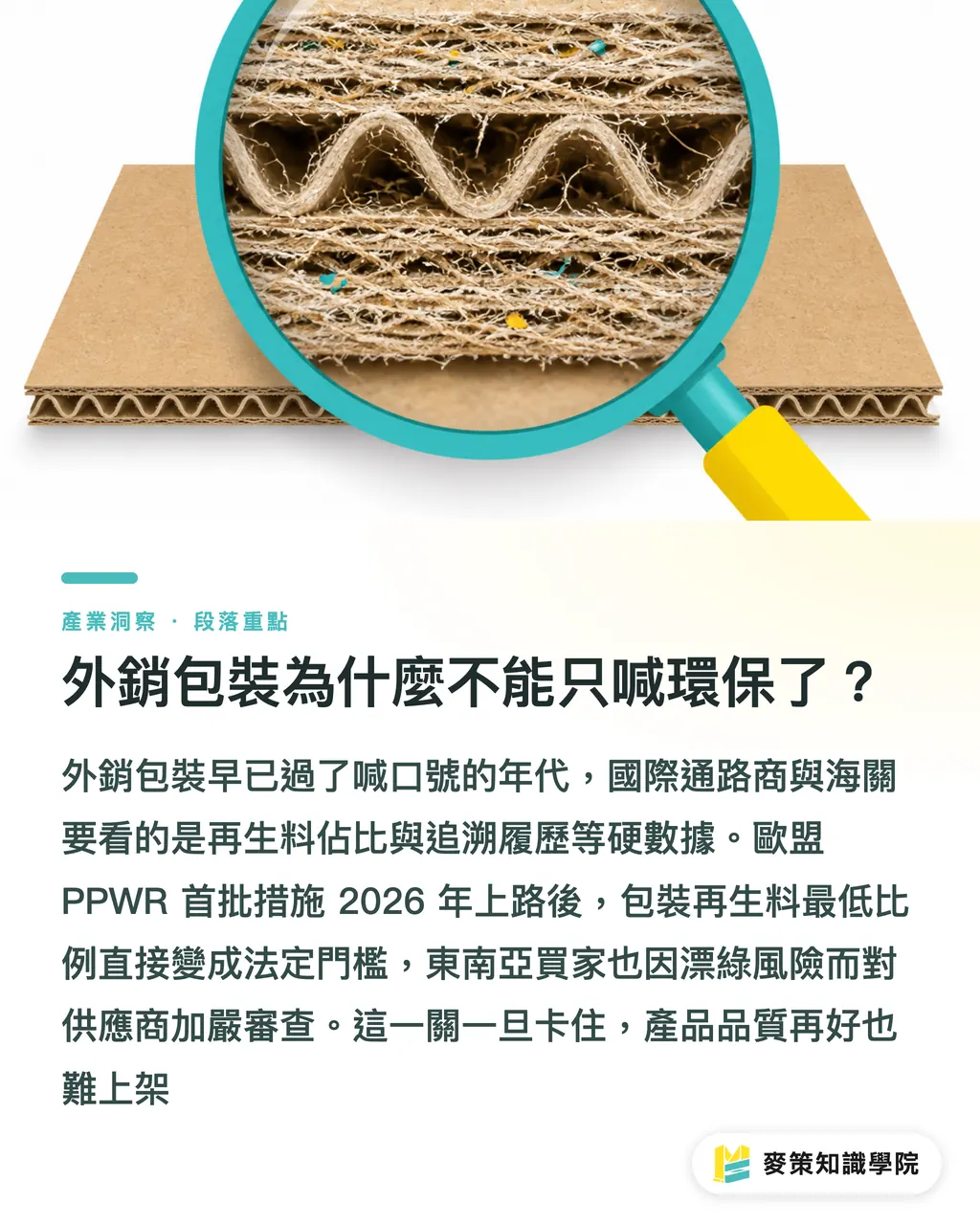
What Are EU and Southeast Asian Buyers Actually Looking For?
They are checking whether your packaging has a transparent, verifiable trail from creation to recycling. UK supermarket chain Aldi recently disclosed the recycling pathways for its flexible plastics, responding directly to strict EU transparency demands. When major retail chains lead the way, every supplier down the chain must provide matching data
Specifically, export buyers focus on several key metrics. First is the verified percentage of recycled content, backed by certificates from upstream paper mills or plastic manufacturers. Second is standardized recycling labeling, you cannot just draw a generic chasing arrows icon, it must comply with local regulations. Finally, ink and adhesive compatibility. If your ink impedes paper recycling, the entire package fails. This directly relates to the rollout of Extended Producer Responsibility (EPR, policies holding manufacturers financially accountable for product lifecycles and waste management), making brands responsible for their products from start to finish. If these verification standards feel overwhelming, reach out to the Mai Strategy Knowledge Academy consulting team for a quick supply chain checkup to see if your current materials can pass
How Can Small and Medium Manufacturers Ensure Material Traceability?
The safest approach is putting the "Mai Strategy Three-Gate Print Check" framework into practice before placing production orders, assigning traceability responsibilities to every step. Many small and medium print shops or designers hesitate to take export orders, worrying regulations are too complicated or mistakes will cost them money. When you break the process down and control things at the source, there is nothing to panic about
1. Gate 1: Check origin and certifications. Request copies of current-year FSC (Forest Stewardship Council) or other eco-certifications from paper or material suppliers, and make sure batch numbers match
2. Gate 2: Verify inks and finishing. Confirm that inks and adhesives used by the print shop comply with halogen-free standards or specific environmental directives, which are especially strict for food packaging
3. Gate 3: Compile digital records. Assemble all collected material certificates and production logs into a single digital dossier, and deliver it to the brand alongside the shipment
These three checkpoints give you a solid baseline defense. Do not wait until a client audits your facility to scramble and call paper distributors asking what stock you actually bought
How Will Upcoming Regulatory Timelines Impact Design?
Design freedom will face tighter restrictions, with plain packaging and lightweighting becoming the norm. From plain packaging initiatives in the UK to plastic reduction mandates across island nations, regulations are getting serious. This means past design habits like piling on visual effects, combining multiple materials, and running heavy, full-coverage ink will fall out of favor in global export markets
I have noticed brand attitudes shifting from passive compliance to proactive disclosure. During the design phase, we need to assess these key areas:
・Prioritize mono-materials: Avoid composite structures like paper laminated with plastic or mixed plastic resins, which make recycling extremely difficult
・Cut down on overpackaging: Whether designing refill packs or simply trimming box thickness, lightweighting is the most direct way to reduce EPR fees
・Leave room for traceability: Reserve enough layout space for recycling labels and traceability QR codes, rather than filling every inch with visuals
This is not an environmental slogan. It is a market entry barrier reshaping export supply chains. Getting comfortable with designing within these constraints early on will give you a real edge when bidding for international contracts
Key Takeaways
Export packaging cannot clear customs on slogans alone. It requires precise proof of recycled content percentage and compliant recycling labels
Retail channels in Western and Southeast Asian markets are strictly vetting material recycling compatibility. Using the wrong ink or glue can result in entire shipments being rejected
Implementing a three-gate verification process and locking in certified material supply chains early in design is essential for mitigating risk
Future packaging design must adapt to plain packaging and lightweighting trends, with mono-material structures taking center stage
Further Considerations
For Taiwanese printers and designers, tightening global regulations act as an industry filter. Only businesses capable of supplying material histories and mastering circular design will qualify for high-margin export supply chains. For SaaS providers, building tools that let small and medium shops easily generate and share digital material dossiers will be a major growth opportunity over the next two years
Further Reading
FAQ
- What is the PPWR, and how does it affect Taiwanese packaging?
- The PPWR is the EU's Packaging and Packaging Waste Regulation, which sets targets for recycled content and packaging reduction. When Taiwanese brands export to the EU, their packaging must meet these recycled material ratios and design-for-recycling standards to enter the market
- When a client asks for packaging "transparency," what do I actually need to provide?
- You need to provide proof of material origins (such as FSC certification), data on recycled plastic percentages, and proof that your inks and adhesives meet local recycling compatibility standards
- Why are multi-material composite packaging designs discouraged now?
- Because multi-material composites, like plastic-laminated paper, drastically increase downstream recycling complexity and costs. Under EPR schemes, this leads to higher waste processing fees for brands and can even cause retailers to reject products
Related articles
The Print × AI weekly
The print and AI know-how designers, brands and enterprises can use before they commit — one email, every week
MINDS Free Tools
AI background removal, a LINE sticker maker, spine & imposition calculators — all free, right in your browser, no upload.
MINDS Group
Need actual printing or gifting services?
From premium printing to online ordering and festive gifts — the MINDS Group sister brands take it from here.