
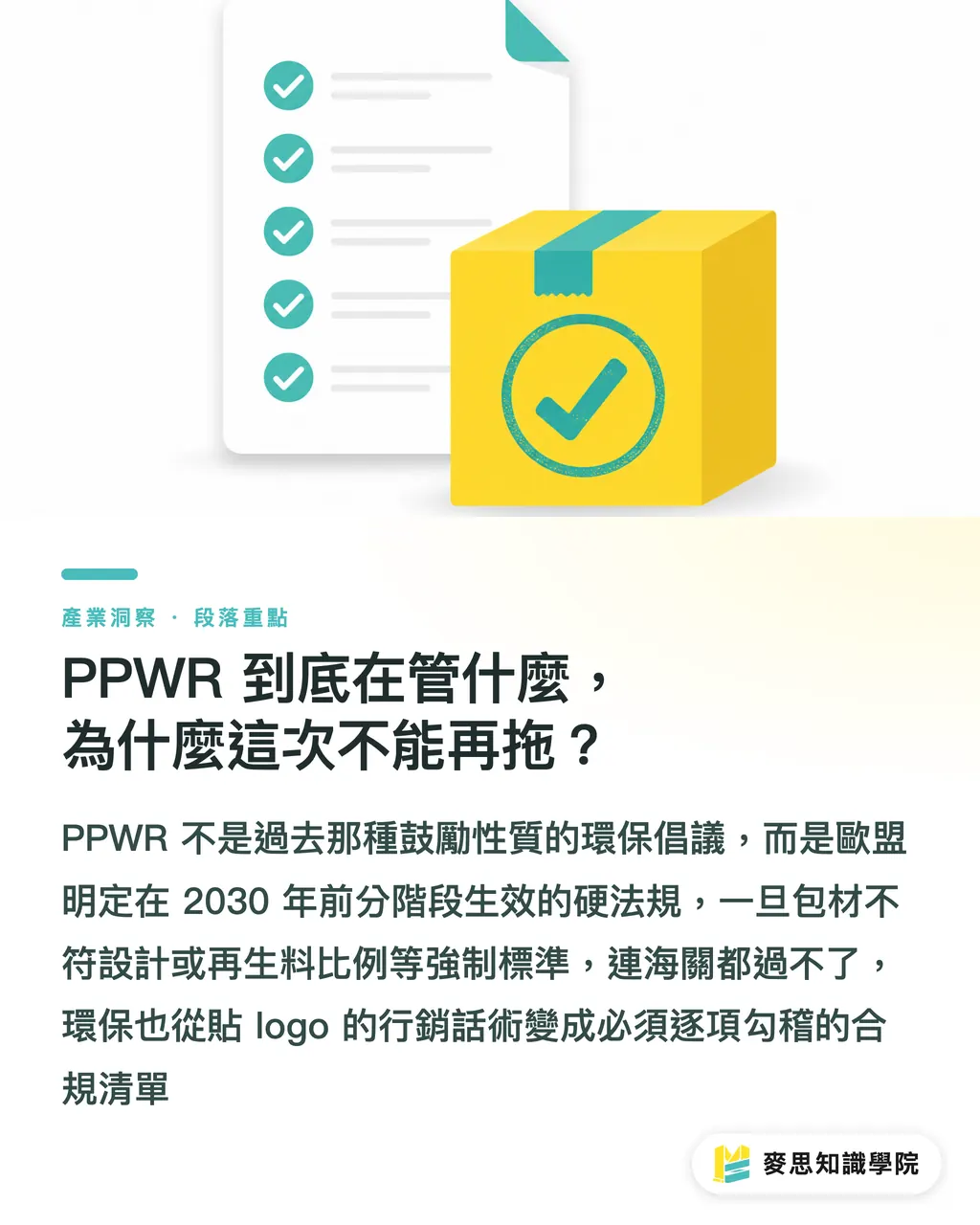
What exactly does PPWR regulate, and why can't this wait any longer?
Let's be direct: the EU Packaging and Packaging Waste Regulation, or PPWR, is not like the old soft rules that merely "encouraged recycling." It is a set of hard requirements, written line by line, that will take effect in phases before 2030
Among the export clients I have worked with over the past month or two, the anxiety has shifted from "Can the quote go any lower?" to "Will my packaging actually clear customs?" That shift matters
PPWR comes down to four core issues, and each one directly affects your packaging specifications:
・Minimum recycled content: mandatory ratios are set by plastic material category. It is not enough to simply claim you used recycled material
・Mandatory recyclable design standards: packaging must be classified as "recyclable" to circulate in the EU market, and it will be reviewed from the design stage
・Ban on excessive packaging: void space inside boxes will be capped, so the old habit of putting a small product in an oversized box will be blocked
・Digital Product Passport (DPP): packaging must be able to disclose material composition, recycling information, and supply chain history
Over the past decade-plus, I have seen too many companies treat "sustainability" as marketing language: put a green leaf logo on the package and send it to market. After PPWR, that approach will no longer work. Sustainability becomes a compliance checklist that must be verified item by item
Which products will be scrutinized first, and how do you know if you are at risk?
Not all packaging materials take effect at the same time. You first need to identify which phase you fall into, because that determines what you should tackle this year
Based on recent industry discussions, the categories most likely to face strict scrutiny first are plastic flexible films, single-use consumer packaging, and e-commerce shipping packaging. They are high-volume, difficult to recycle, and frequently associated with overpackaging
To determine whether there is risk, I usually ask clients to start with three actions:
・Audit the material structure: Is your packaging made from a single material or a multilayer composite? Composite films are most likely to get stuck at the "recyclable design" stage, because materials that cannot be separated are difficult to recycle
・Measure the void space: Put the product inside the box and visually estimate how much of the internal volume the product occupies. If something palm-sized is packed in a box twice its volume, you are already in the red zone for overpackaging
・Check the source of recycled content: Can you provide traceable proof of the recycled content in the plastic pellets you currently use? If you cannot provide proof, it effectively does not count
A real-world example: many Taiwanese food exporters like to use aluminum-metallized composite films. They do provide strong barrier performance, but the aluminum layer and plastic layer are bonded together, making them impossible for recyclers to separate. Under PPWR's recyclability rating, this structure would receive a low score, which means the material will need to be reselected
What should the design side change first, and how should priorities be set?
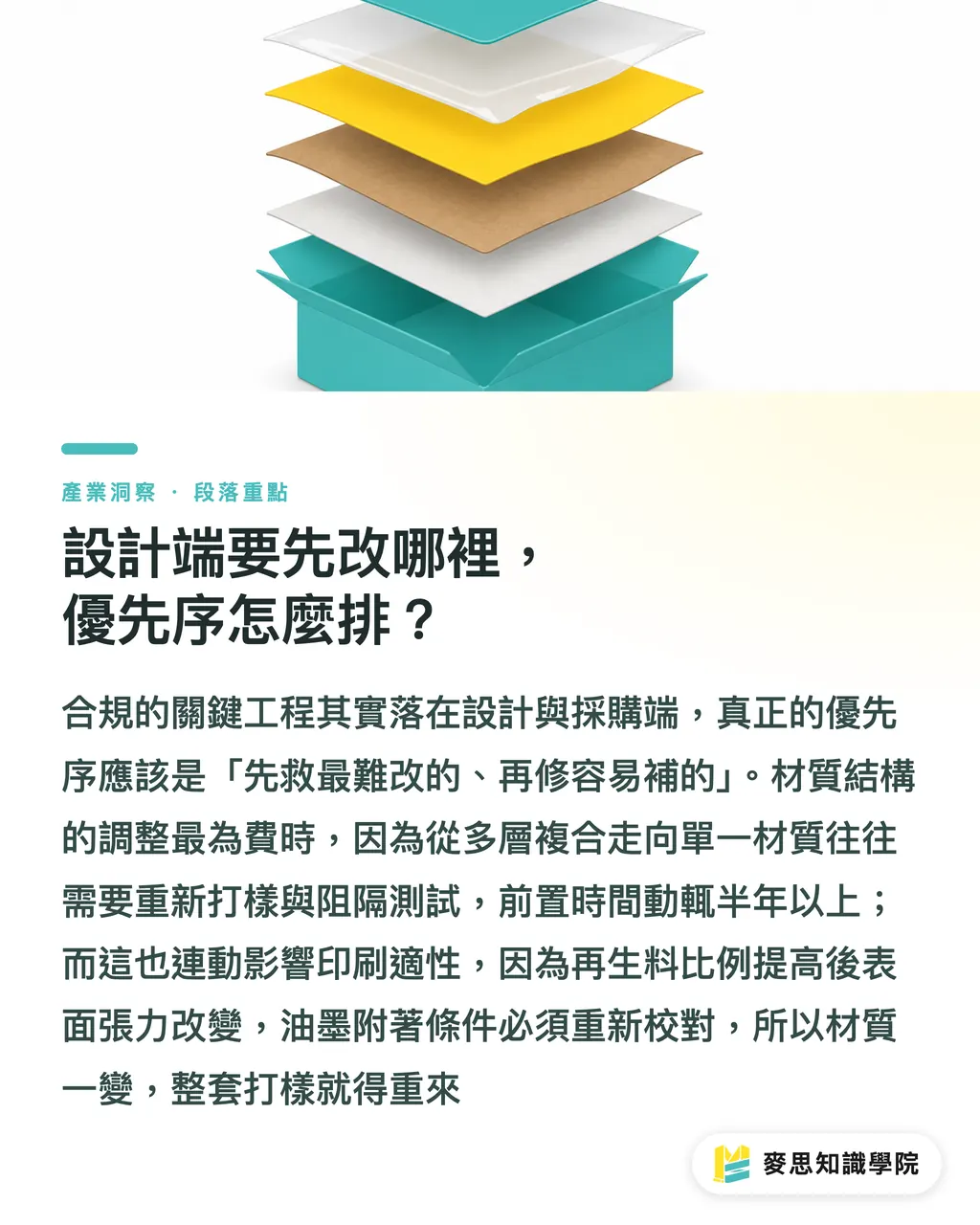
Compliance is not just a legal department issue. The real work happens on the design and procurement sides. The priority I set for clients is: fix the hardest things first, then address what is easier to supplement later
The first priority is changing the material structure. Moving from multilayer composites to mono-material packaging involves the most engineering work and the longest lead time. It often requires new prototypes, new barrier testing, and new sealing tests. This can easily take six months or more, so it should start first
The second priority is adjusting packaging size and structure. Excess void space is relatively easier to solve. You can reopen the die line, change the insert, or downsize the box. This can be calculated together with your printing and post-processing partners
The third priority is supplementing documents and labeling. This includes the data fields required for DPP disclosure, recycling marks, and material labels. These are data organization tasks and can be handled after the material choice is finalized
One detail is often overlooked: when recycled content increases, ink adhesion and printability change as well. The surface tension of recycled plastic differs from virgin material. If you apply the same printing conditions directly, ink rub-off or dot gain can easily occur. So once the material changes, proofing has to be redone. This is why I keep emphasizing lead time
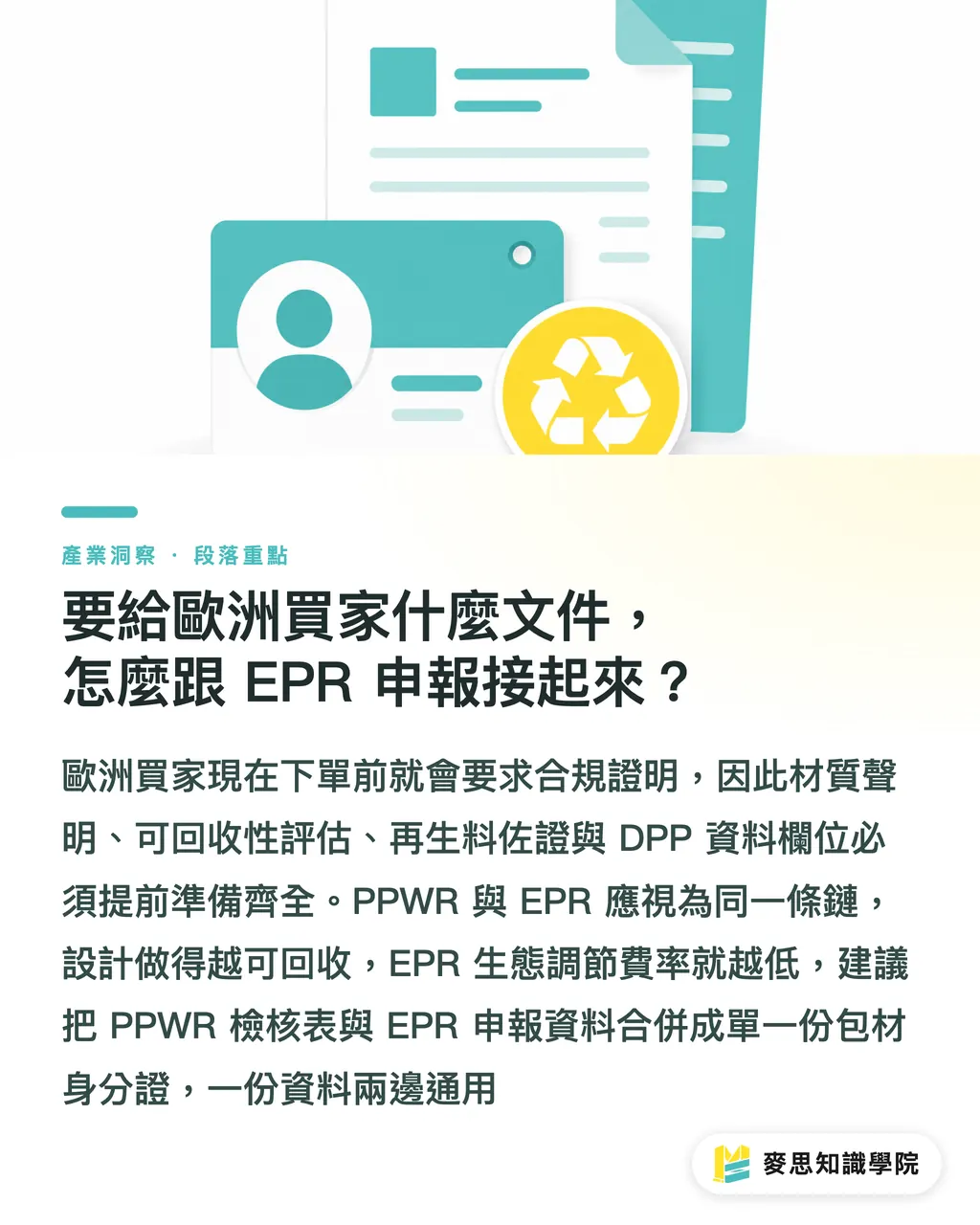
What documents do European buyers need, and how does this connect to EPR reporting?
European buyers are now asking for compliance proof before placing orders. If your documents are incomplete, the order may be transferred elsewhere. This is not a scare tactic; it is something I have encountered recently in practice
You should prepare documents in several areas:
・Material declaration: what each layer is made of, its proportion, and how much recycled content it contains. This must correspond to PPWR classifications
・Recyclability assessment: explain which level your packaging would fall under within the EU recycling system
・Evidence of recycled content: third-party traceable proof of recycled content, not a self-declaration
・DPP data fields: organize the data structure required for the passport in advance, so it can connect once the system goes live
PPWR and EPR, or Extended Producer Responsibility, are part of the same chain and should not be treated separately. EPR governs how much recycling fee you must pay for packaging waste, and it is increasingly moving toward eco-modulated fees: the harder your packaging is to recycle and the less recycled material it uses, the higher the fee
In other words, strong PPWR design compliance can lower EPR costs. These two issues belong to the same ledger. Doing recyclable design properly means passing market access requirements while also reducing long-term reporting costs
In practice, I recommend merging the PPWR design checklist and EPR reporting data into one "packaging identity card." Put the material, weight, recycled content ratio, and recyclability grade all in the same file. One dataset can serve both sides, and any later documents can be generated from it
Key Takeaways
PPWR is a hard regulation taking effect in phases before 2030. Recycled content ratios, recyclable design, void-space limits, and DPP requirements directly affect your packaging specifications
Start risk assessment with three actions: audit the material structure, measure void space, and verify proof of recycled content sources
The design-side priority is to first address the hardest-to-change multilayer composite materials, then adjust size and structure, and finally supplement documents
Structures that cannot be separated, such as aluminum-metallized composite films, will receive low recyclability ratings, so material reselection should begin early
PPWR and EPR are part of the same ledger. Proper recyclable design helps pass market access requirements while lowering reporting fees
Further Thoughts
If you want to put this into practice, I would suggest starting with one thing in the second half of the year: choose the packaging item with the highest EU export volume and make it your pilot project. Review it from material structure all the way through void space, and create the first "packaging identity card." This document can later be replicated across all product items, making it the highest-ROI starting point. For designers, this means recyclability must be part of material selection from the ideation stage, rather than something patched in after the visual design is finalized. For teams adopting digital tools, the DPP data fields are a practical entry point: structure the material, batch number, and recycling information now, and future integration with passport systems will save a large amount of manual work. The most worthwhile investment in this transition is turning compliance from "last-minute document patching" into "built-in specifications," aligning material, printing, post-processing, and documentation end to end. This is exactly where a fully integrated approach can help
FAQ
- When does PPWR take effect, and should Taiwanese exporters act now?
- PPWR is an EU packaging regulation that will take effect in phases before 2030. Because material changes and new proofing can easily take six months or more, exporters should start auditing EU-bound packaging now and set revision priorities
- If I already have FSC or other environmental certifications, does that mean I comply with PPWR?
- Not necessarily. PPWR focuses on concrete specifications such as recycled content ratios, recyclable design, void space, and DPP disclosure. A single certification cannot cover all requirements; each item must be mapped individually
- What is packaging void space, and what happens if it exceeds the limit?
- Void space refers to the empty portion inside a box other than the product itself. PPWR sets limits on excessive packaging. Putting a small product in a large box may be treated as non-compliant and should be addressed by downsizing the box or adjusting the insert
- What is the relationship between PPWR and EPR? Should they be prepared separately?
- They are part of the same chain. PPWR governs design compliance and market access, while EPR governs recycling fees. Better recyclable design leads to lower EPR fees, so it is best to prepare them together in one packaging data file
- Do composite film packages always need to be changed to mono-material structures?
- Multilayer composite films are difficult to recycle because the materials cannot be separated, so they are likely to receive low recyclability ratings. If your product depends on the barrier performance of composite film, you should evaluate mono-material or recyclable structures early and redo proofing
Related articles


The Print × AI weekly
The print and AI know-how designers, brands and enterprises can use before they commit — one email, every week
MINDS Free Tools
AI background removal, a LINE sticker maker, spine & imposition calculators — all free, right in your browser, no upload.
MINDS Group
Need actual printing or gifting services?
From premium printing to online ordering and festive gifts — the MINDS Group sister brands take it from here.