
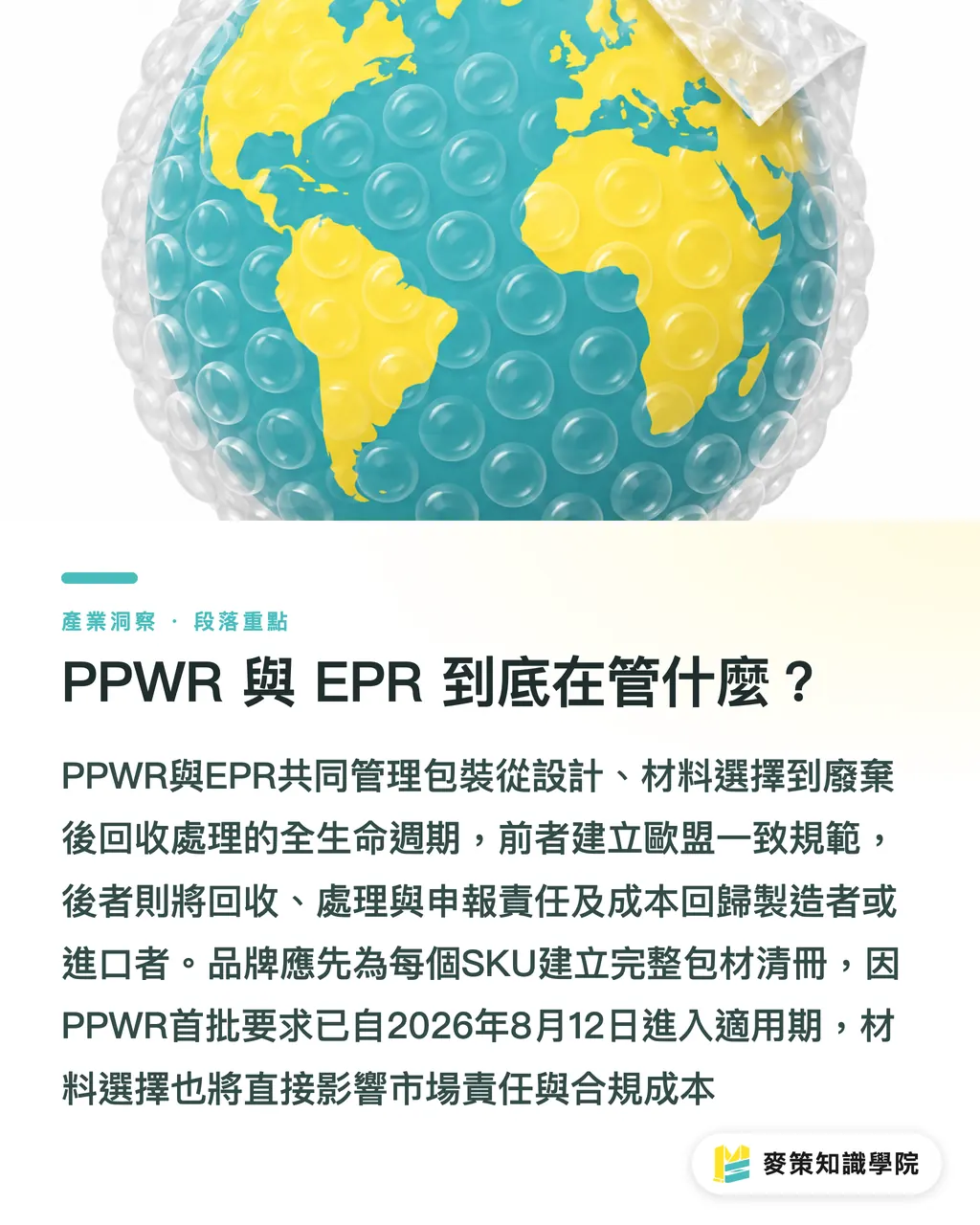
What Exactly Do PPWR and EPR Regulate?
PPWR and EPR cover responsibility across a package's journey from design and materials to post-consumer waste handling. Brands should start by creating a packaging inventory for every SKU (individual product or packaging item)
PPWR (Packaging and Packaging Waste Regulation, the EU regulation covering packaging's full life cycle) is an EU framework that replaces fragmented national rules with phased requirements. EPR (Extended Producer Responsibility) puts the costs of packaging collection, treatment, and reporting back on product manufacturers or importers, so material choices are tied to market responsibilities
In its September 24, 2026 explanation, the Flexible Packaging Association (FPA, an industry association that publishes information on the flexible-packaging sector and policy) says the first PPWR requirements began applying on August 12, 2026, with further requirements rolling out over several years. The EU aims to reduce waste and compliance costs through a consistent framework, expand secondary raw-material markets, and move toward climate neutrality by 2050. For details, read PPWR Is Here: What Packaging Teams Need to Do Now
1. Which Packaging and Markets Should a Brand Inventory First?
Step one is to place packaging, products, and sales markets in the same matrix, so you know which rules apply to each SKU
I ask brands to record at least three types of information before sending a design to print or requesting a quote:
・1. For each SKU, record the material name, composite structure, printing, and surface finishing. Do not write only "paper box" or "plastic bag."
・2. Separate the export regions and the responsible party in the project, marking the EU, Maine, Oregon, and California separately
・3. Keep supplier declarations, recycled-content documents, and version dates under the same job number as the proofing files
The US cannot be handled with a single "nationwide EPR" table: Maine's next steps remain unclear, Oregon's EPR law has been upheld by the courts, but the National Association of Wholesaler-Distributors (NAW, an industry organization representing the wholesale sector) will appeal again. California Governor Newsom vetoed AB 2253, a recycled-content labeling bill, amid economic headwinds. Map the markets first, so procurement knows whether it needs more documentation or a structural change
2. How Do You Build Design for Recyclability into Proofing?
Step two is to build recyclability into the proofing requirements, so design choices are reviewed alongside the recycling systems in the target market
Packaging structure, printing, coating, lamination, and sealing cannot be approved separately. A package may look recyclable, but if the target market has no corresponding sorting and processing pathway, the brand may still lack the evidence it needs to hand over
・1. Tag the material and finishing before the design is sent to print. A visual-only submission is not enough
・2. At the proofing stage, confirm that the structure meets the target market's design-for-recyclability requirements, and list uncertain items for verification
・3. Include unnecessary components, difficulty of separation, and the labeling method in the review. Do not use a recycling symbol as a substitute for material evidence
Do not rush into a redesign
The aseptic pouch industry has already built the 2030 PPWR design-for-recyclability target into its product roadmaps. That year is a reminder to brands that packaging designed now may stay with the product through several purchasing and redesign cycles. Today's structural choices will affect next year's orders
3. How Should Brands Keep Recycled-Content Documentation?
Step three is to establish a chain of documentation for recycled content and material sources, so the brand has documents ready when someone asks, "How can you prove this claim?"
For every print job, I require the team to retain at least the following:
・1. Supplier name, material specifications, and batch or shipment reference information
・2. The recycled-content declaration and its validity date, with supplier or third-party verification documents attached where needed
・3. The design file, purchase order, proof approval, and production version under the same document number
California's rejection of AB 2253 is a reminder that recycling-labeling and recycled-content rules are shaped by state law and economic conditions. Before printing "contains recycled content," do not rely on a verbal assurance. First confirm that the material documents can be delivered with this shipment
If a brand wants to reorganize its packaging specifications and printing conditions together, it can discuss the feasible scope of mid- to high-end, fully customized commercial printing with MINDS
A paper sample cannot replace documentation
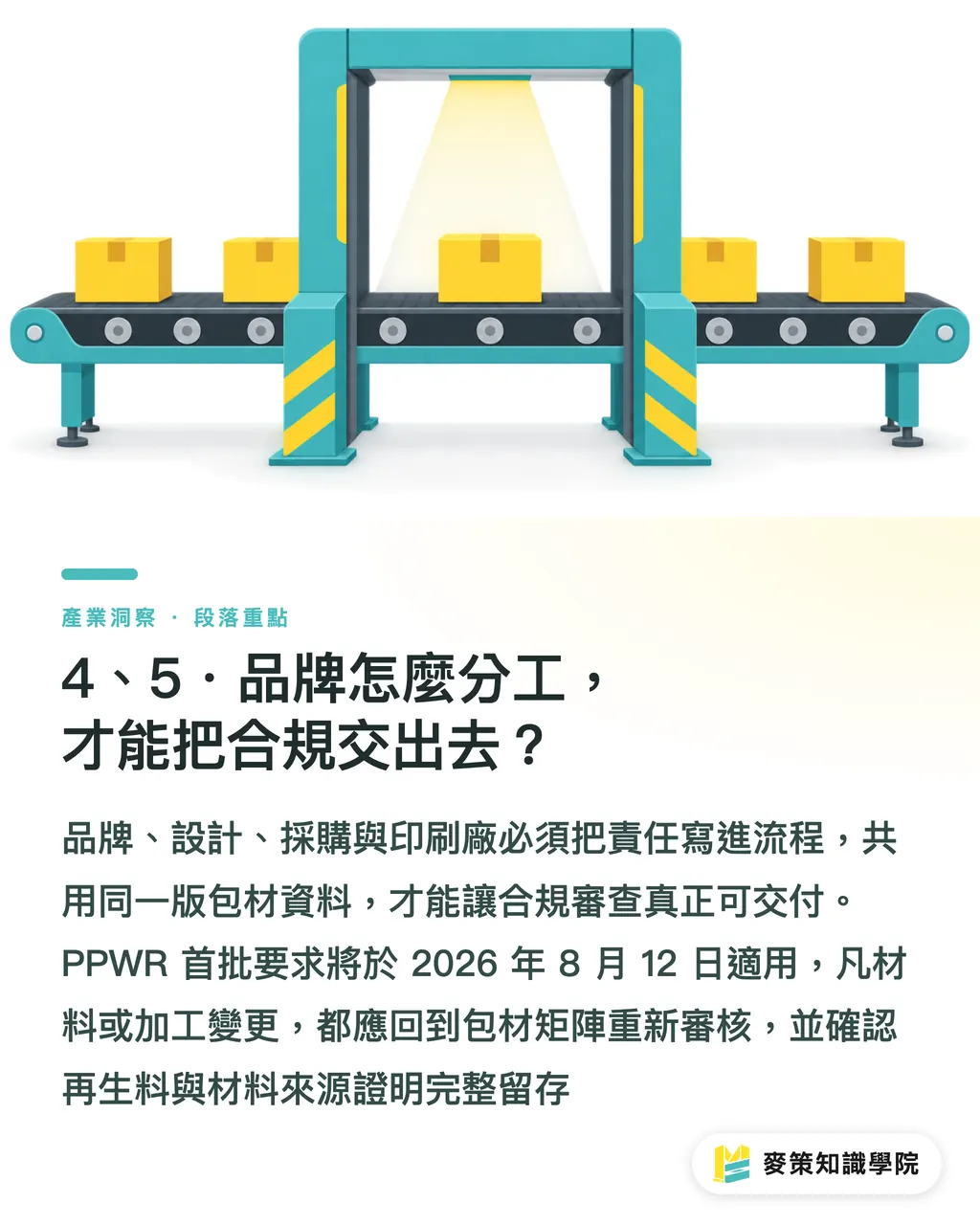
4 and 5. How Should Brands Divide Responsibilities to Hand Off Compliance?
Steps four and five are about writing responsibilities into the workflow and keeping records that can be delivered at every review
PPWR's first requirements began applying on August 12, 2026, and further requirements will be phased in over the following years. The most common failure on the print floor is not that people do not know about PPWR. It is that the structure changes in the design file while the purchase order and material evidence remain tied to the previous version
・1. The brand confirms the sales market, customer claims, and final approver. The design team confirms the structure and version
・2. The printer, material supplier, and procurement team provide documents under the contract. Sales locks the checklist when quoting and placing the order
・3. Set an approval field for each stage: quoting, proofing, production, and shipping. Any change to materials or finishing sends the job back to the same packaging matrix for review
Mai Strategy's three-gate print-submission check turns the five steps into three decisions:
・① Market gate: Confirm the EU or the relevant US state, the responsible party, and the applicable timeline
・② Structure gate: Confirm the design-for-recyclability requirements and printing conditions
・③ Documentation gate: Confirm that proof of recycled content and material origin can be delivered with the job
This record does not need to be fancy. The brand, design, procurement, and printer should all work from the same version of the information
Key Takeaways
・PPWR is now in its application period, so packaging compliance must move upstream from shipping to design and procurement
・US EPR varies by state. Maine, Oregon, and California cannot be handled under one set of assumptions
・Recyclability is not an icon. Structure, finishing, the recycling pathway, and documentation all have to line up
・Without a documentation chain behind a recycled-content claim, a brand has no dependable answer to give when it is time to deliver
Further Thoughts
Print manufacturing should treat material and finishing documents as part of the deliverables. Designers should attach structural and market notes beside the concept draft. Use AI first for specification extraction, version comparison, and missing-document alerts. SaaS (software as a service) lets each SKU stay linked to its market, materials, documentation, and approver. As a next step, a brand only needs to choose one packaging SKU for export and enter it in the inventory. Missing documents will surface quickly. If you need to turn the rules into internal workflows, talk it through with the Mai Strategy Knowledge Academy consulting team
Further Reading
FAQ
- When does PPWR begin to apply?
- According to the Flexible Packaging Association article published on September 24, 2026, the first PPWR requirements began applying on August 12, 2026. Further requirements will be phased in over several years, so brands should start preparing their packaging inventories and documentation now
- Are EPR and PPWR the same thing?
- No. PPWR is the EU regulation on packaging and packaging waste. EPR is the system that places collection, treatment, and reporting responsibilities on manufacturers or importers. In the United States, EPR programs are moving forward separately in each state
- What should a Taiwan brand do first?
- Start with the SKU that has the highest export volume or the most frequent redesigns. Record its materials, structure, printing and finishing, sales market, and supplier documentation. Then decide on design changes and the division of responsibilities
- Can a recycling symbol by itself count as compliance?
- No. A recycling symbol is not complete proof. The brand must also confirm the target market's design-for-recyclability requirements, material source, and recycled-content documents, and make sure those documents follow the proof and production versions
Related articles


The Print × AI weekly
The print and AI know-how designers, brands and enterprises can use before they commit — one email, every week
MINDS Free Tools
Spine width and imposition calculators — skip the manual math, free in your browser.
MINDS Group
Need actual printing or gifting services?
From premium printing to online ordering and festive gifts — the MINDS Group sister brands take it from here.