
Overview
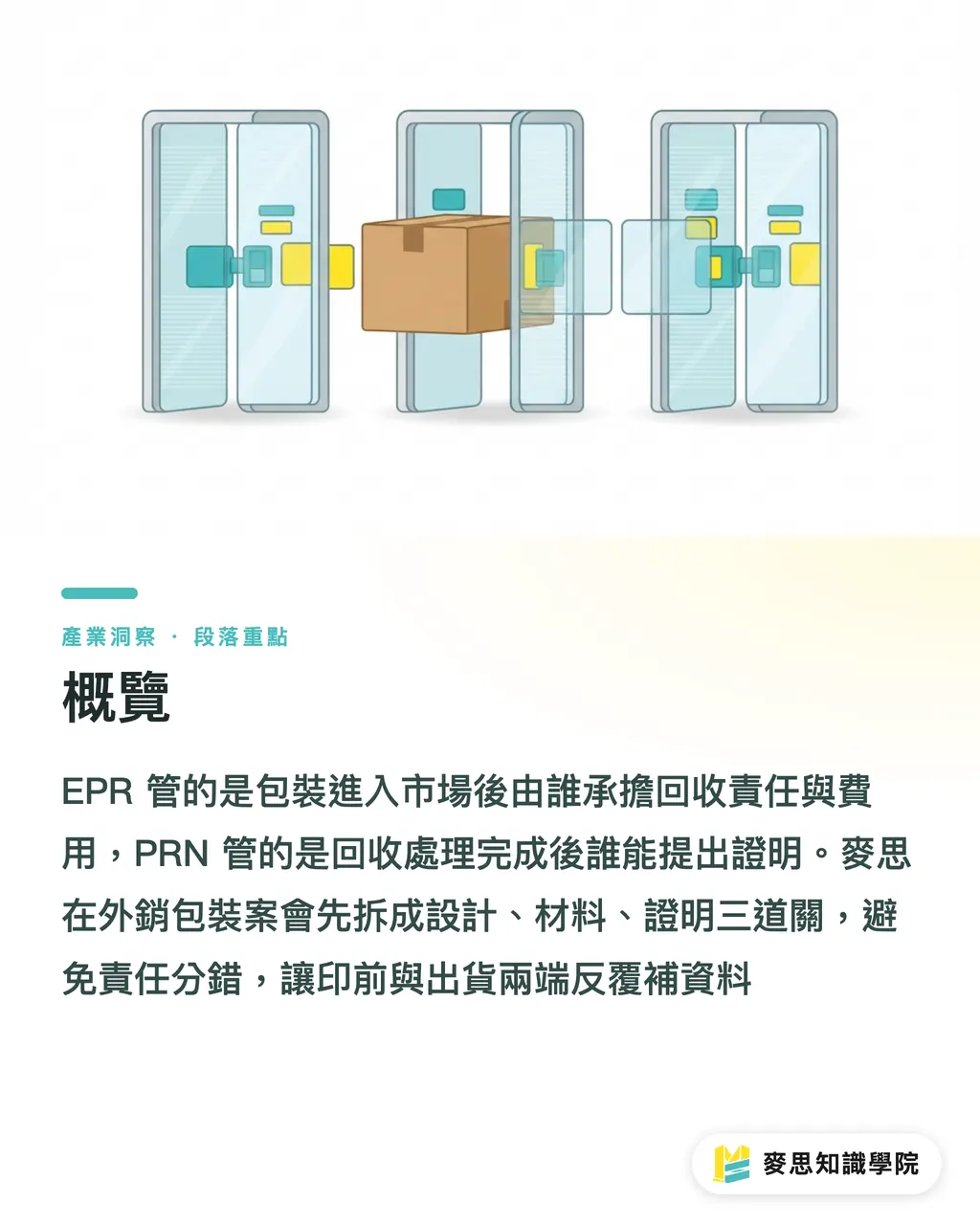
EPR dictates who places packaging on the market and who bears recycling responsibilities and fees. PRN determines who can provide proof once recycling and processing are complete. MINDS breaks export packaging projects down into three checkpoints: design, material, and documentation. When responsibilities are misallocated, fixing paperwork later almost always bottlenecks pre-press and shipping
What is the Actual Difference Between EPR and PRN?
EPR (Extended Producer Responsibility) shifts post-market packaging recycling, reporting, and cost liabilities onto brands, importers, or market distributors
PRN (Packaging Recovery Note) is a UK certificate proving that packaging waste was recycled or processed. It focuses on proof of recycling outcomes and obligation offsets, and cannot replace a material design review
For export brands, EPR and PRN are two separate ledgers. EPR is the obligation ledger, while PRN is the evidence ledger. EPR asks who must report and pay, while PRN asks where the recycling proof is
Working on the shop floor, what I fear most is clients assuming that having a PRN guarantees packaging compliance. Packaging structure, material composition, finishing processes, and market placement responsibilities are usually decided long before a PRN even exists
Why is the UK Debating the Division of Labor Between pEPR and PRN?
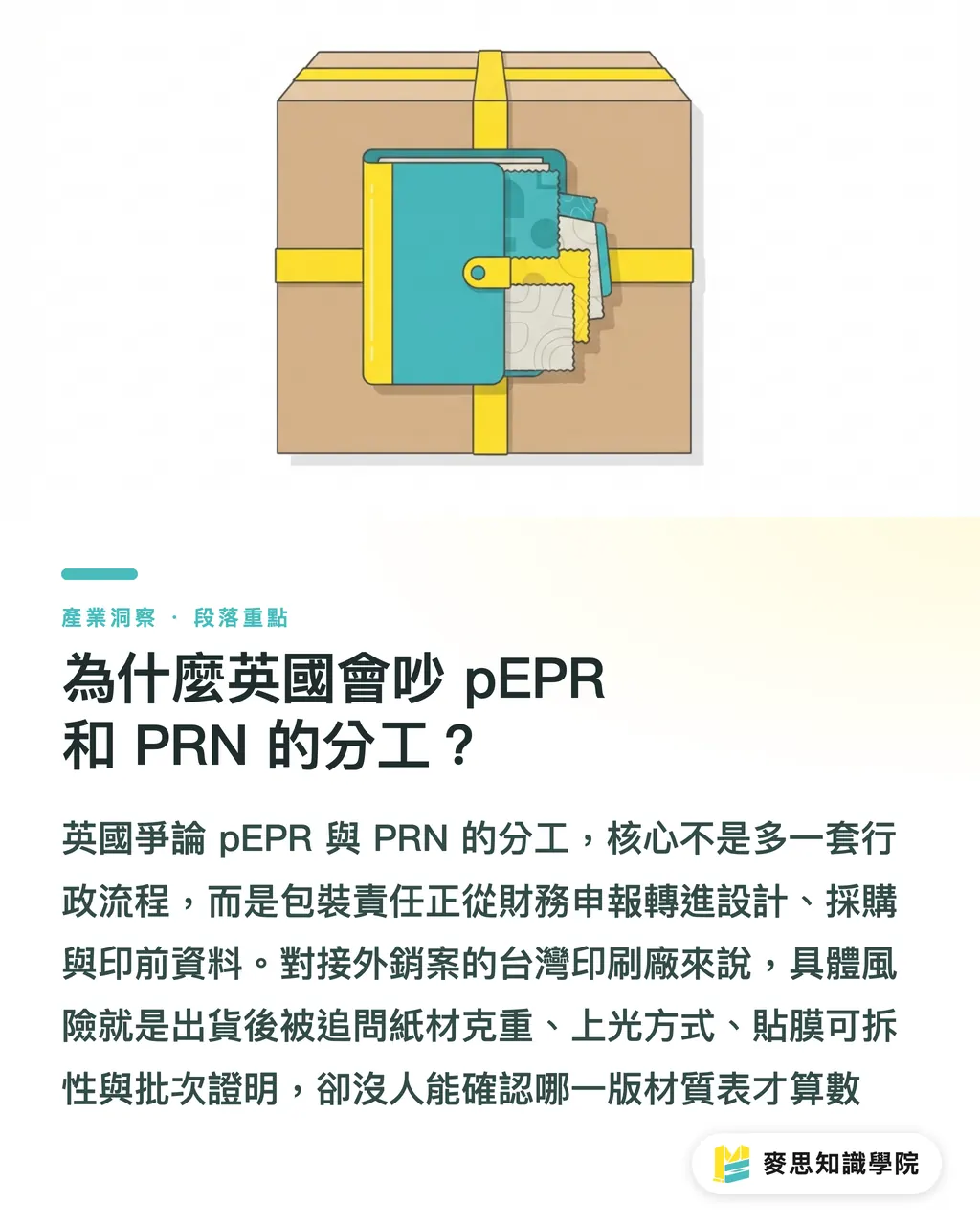
As reported by Packaging Insights in Beyondly urges recovery note reform, Beyondly called for a clearer separation of roles between UK pEPR and Packaging Recovery Note systems. I interpret this signal in one way: packaging liability has moved from finance department reporting forms to design studios, purchase orders, and pre-press folders
pEPR involves fee liabilities and market distribution data, while PRN involves recycling evidence and compliance records. If the four key roles, brand, importer, packaging supplier, and recycling compliance provider, do not clarify responsibilities upfront, the most common headache after shipping is surprisingly mundane: nobody knows which version of the material spec sheet is binding
For Taiwanese print service providers handling export orders, this is not just a UK administrative issue. Clients push these questions upstream to the supply chain: paper weight in gsm, varnish type, film lamination detachability, composite material reporting methods, and batch certificate locations
What Information Must Be Prepared Before Designing Export Packaging?
The three print-ready checkpoints at MINDS start with three questions: can materials be clearly specified, will finishing treatments alter recyclability assessments, and can document versions be traced back to the exact shipment batch? If these three items are not aligned early on, discussing EPR and PRN later becomes a non-stop exercise in submitting missing paperwork
・① Material Check: Paper, plastics, composite materials, varnishes, lamination, adhesives, and special coatings must be clearly listed up front. EPR examines market entry liability and fee tiers, while PRN looks at recycling proof
・② Design Check: Die-cut windows, lamination, foil stamping, spot UV, hangtags, and inserts must be evaluated separately, rather than brushed off under the blanket phrase 'recyclable'
・③ Documentation Check: Supplier material spec sheets, pre-press revision logs, BOMs, shipment batch numbers, and client sign-off records must match a single unified version. That way, when UK or international retail channels follow up later, the original paper trail is easy to trace
If export packaging touches UK or multi-national sales channels, I suggest asking MINDS to break down materials and finishing treatments into a reporting sheet before prototyping. At minimum, align on three fields: material name, finishing impact, and document version
What Should Print Vendors Manage vs. What Should Brands Manage?
I divide responsibilities into four layers so procurement, design, print, and legal teams do not pass the buck during meetings
・Brand or Importer: Confirm whether you qualify as a producer under local regulations, and take charge of reporting scope, fee liabilities, and retail channel requirements
・Print or Packaging Supplier: Provide material specs, paper weight, finishing details, revision versions, BOMs, shipment batch numbers, and supplier material certificates when needed
・Designers and Procurement: Before finalizing decisions on packaging structure, windows, lamination, foil stamping, hangtags, and inserts, ask whether these choices complicate EPR reporting and recycling proof
・Compliance or Recycling Service Provider: Handle PRNs or equivalent recycling certificates, ensuring proofs match brand reporting data
Taiwanese small and medium print shops may not be legally obligated to report EPR overseas, but in practice they are often the primary data source. Printers should not quietly shoulder their clients' overseas financial liabilities. Contracts and quotation forms must state the exact scope of data provided
What 4 Actions Should Small and Medium Print Vendors Take First?
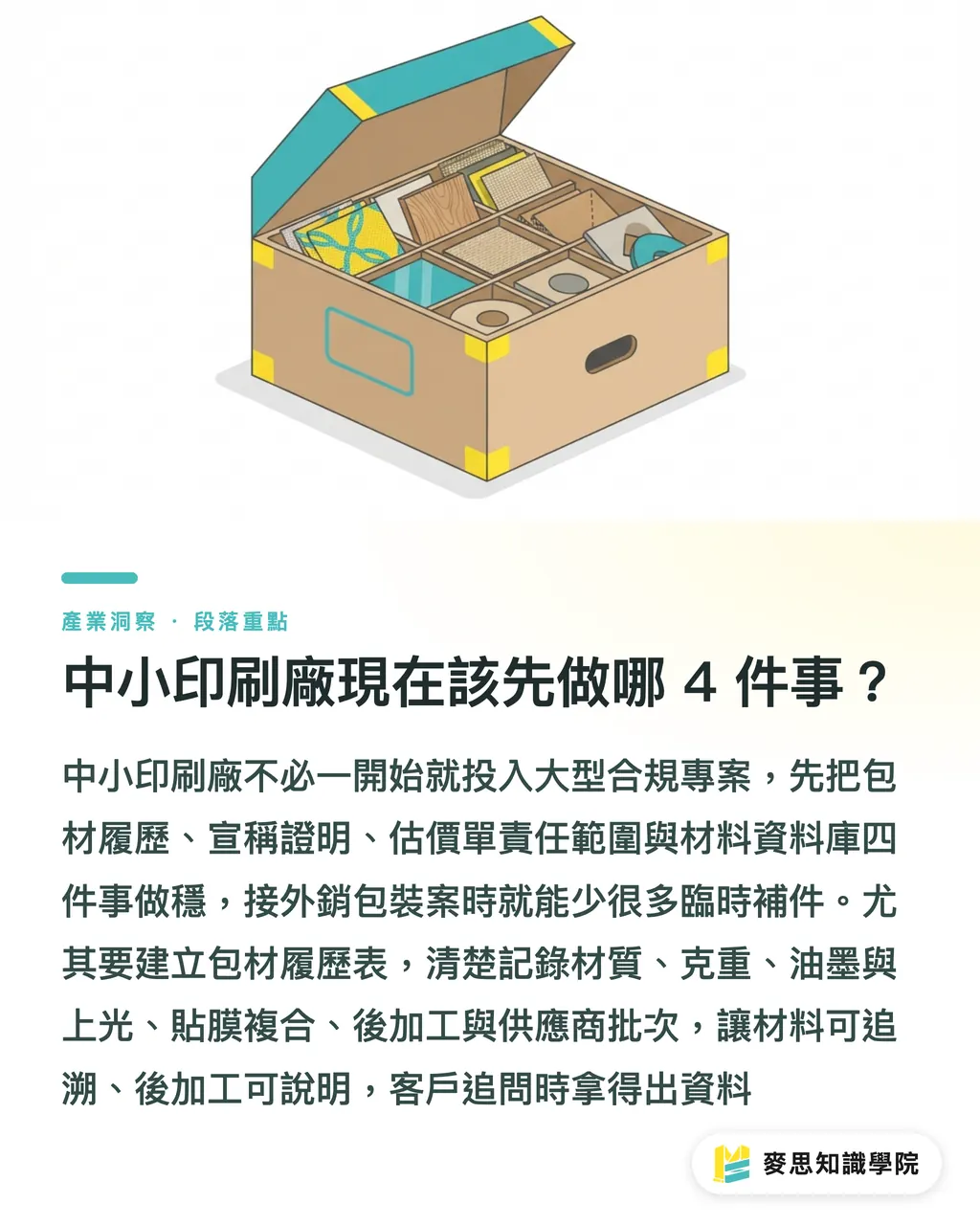
Small and medium printers do not need to launch massive compliance overhauls right away. Nailing four smaller practices first will save countless emergency paperwork fixes on export packaging jobs
・Build a packaging material log with at least these fields: material type, paper weight, ink/varnish, film lamination/composites, finishing treatments, and supplier batch numbers
・Convert terms like 'recyclable', 'recycled content', 'bio-based', and 'compostable' into verifiable data fields rather than leaving them as buzzwords in pitch decks or design proposals
・Add a line for compliance documentation scope in quotation forms, explicitly listing which files the printer provides and which filings, fees, and PRN certificates belong to the brand or importer
・Using SaaS or AI tools to organize material databases works well, but liability attribution still rests on target markets, contracts, and local regulations. Tools excel at managing version control, tracking missing files, and alerting upcoming deadlines
For mid-to-high-end fully customized commercial printing projects, MINDS focuses on two core priorities: material traceability and clear finishing specifications. Creating beautiful packaging is not enough; export projects must produce supporting documentation the moment clients ask
Key Takeaways
・EPR manages liability and costs, while PRN manages recycling certificates. Mixing them up leads to endless post-shipping paperwork headaches on export jobs
・Packaging material logs must be established during pre-press. Chasing material details only when clients prepare filings is usually too late
・'Recyclable' is not a marketing slogan; it is a combined set of materials, structures, finishing treatments, and documentation
・Printers may not be legally obligated for EPR, but they will inevitably serve as critical suppliers of compliance data
Further Considerations
For print manufacturers, the next step is turning materials and finishing into searchable trace logs. For design teams, it means incorporating recycling and reporting complexity into material selection during proposals. For AI and SaaS developers, genuinely useful products do not render legal judgments for clients; they manage packaging data, revision histories, supporting documents, and expiration alerts. The consulting team at Mai Strategy Knowledge Academy approaches these export cases by helping businesses establish a unified packaging responsibility checklist that procurement, design, pre-press, and legal teams can share
Further Reading
FAQ
- What is the biggest difference between EPR and PRN?
- EPR covers brand or importer responsibilities for packaging recycling, reporting, and fees, while PRN covers certificates proving recycling or processing outcomes. Export packaging projects should manage obligation ledgers and evidence ledgers separately
- Do Taiwanese print vendors need to handle UK EPR obligations themselves?
- Taiwanese print vendors are not necessarily legal EPR reporting entities in the UK, as actual liability depends on market distributors, importers, and contractual roles. However, printers are usually required to supply material specs, finishing details, revision logs, and batch data
- What information is most commonly missed during the packaging design phase?
- Finishing details like lamination, varnishing, foil stamping, die-cut windows, composite materials, and inserts are most frequently overlooked. These specifics impact EPR reporting scope as well as alignment with PRNs or recycling certificates
- When should brand clients ask about EPR and PRN?
- Brand clients should address EPR and PRN questions before finalizing designs. Once materials and structures move into prototyping or mass production, modifying packaging responsibility documentation becomes significantly harder
- How can SaaS or AI tools assist with packaging compliance?
- SaaS or AI tools are great for organizing packaging logs, tracking revisions, identifying missing files, and setting certificate expiration alerts. Legal liabilities and market obligations must still be assessed by brands, importers, and compliance advisors according to local regulations
Related articles
The Print × AI weekly
The print and AI know-how designers, brands and enterprises can use before they commit — one email, every week
MINDS Free Tools
AI background removal, a LINE sticker maker, spine & imposition calculators — all free, right in your browser, no upload.
MINDS Group
Need actual printing or gifting services?
From premium printing to online ordering and festive gifts — the MINDS Group sister brands take it from here.