
What Is Extended Producer Responsibility (EPR)?
Extended Producer Responsibility (EPR) is a regulatory mechanism that shifts post-consumer recycling and disposal costs of products onto brand producers. The law requires companies to pay fees to Producer Responsibility Organizations (PROs) to fund municipal waste management and recycling systems. This forces brands to factor packaging recyclability and material disassembleability into core design decisions right from the start
Packaging manufacturer American Packaging Corporation (APC) highlights that while companies used to pick packaging based mainly on consumer visual preferences and basic sustainability marketing, mandatory regulations now drive these decisions. If packaging relies on hard-to-recycle composite films or mixed materials, the fees paid to PROs will rise sharply
Looking at recent cases with several export food and electronics brands, many business owners still think printing a recycling symbol on the box is enough to pass customs. But inspection mechanisms in European and US markets are already way ahead. This is no longer a public relations topic for corporate social responsibility, but an operational cost recorded directly on financial statements
Why Export Brands Must Update Packaging Structures Immediately
US states like Oregon have launched and begun enforcing EPR legislation, and the countdown for EU PPWR regulations is underway. Packaging that fails to comply with circular economy standards faces tiered punitive fines and retail return risks
Based on my long-term observations on production lines and client sites, brands previously laminated multiple materials, such as plastic film with aluminum foil and paper, to pursue moisture barrier, oxygen barrier, and glossy looks. Modern processing facilities can rarely sort or recycle this structure, leaving brands with the highest recycling fee tier
Export brands wanting to avoid regulatory penalties and supply chain disruptions must get clear on three current market realities:
・Green tariffs turned into operating costs: European and US markets charge penalty rates on hard-to-recycle packaging through PRO mechanisms. The more complex the packaging, the higher the fee
・Clearer procurement red lines: Major international retailers and e-commerce platforms have started auditing vendor packaging material breakdown sheets. Products without single-material proof will be denied shelf placement
・Legalized burden of proof: Verbal green marketing is no longer valid. Brands must provide traceable proof of post-consumer recycled (PCR) content percentages along with third-party certification reports
How Brands and Packaging Suppliers Can Transition to Mono-Materials
The key to transitioning to mono-materials lies in replacing traditional composite films with recyclable single plastics (such as all-PE or all-PP) or FSC-certified single paper materials, while optimizing structural design to maintain original compressive and moisture-resistant strength
Don't rush to swap out every material at once. Switching blindly often causes poor sealing on production lines or damaged packaging. We recommend that brands use the 'MINDS (MS, mid-to-high-end fully custom commercial printing) Packaging Compliance Three-Step Framework' for a systematic transition:
・① Single-material assessment: Clean up past multi-layer lamination structures and switch to single polymers (mono-material) or single paper, making sure materials hit 100% recyclability standards in existing recycling streams
・② Non-toxic coating and ink review: Choose eco-compliant water-based coatings and vegetable-based inks to prevent heavy metals and chemical residues from interfering with paper repulping or plastic remelting quality
・③ High-ratio PCR introduction: Within allowed physical strength limits, gradually increase the percentage of post-consumer recycled (PCR) content in packaging to cut EPR fee expenses directly
To make sure your packaging structure meets international compliance standards during early development, consult the Mai Strategy Knowledge Academy consulting team for professional guidance from material selection to prepress artwork finalization
How to Balance Sustainability with Packaging Aesthetics
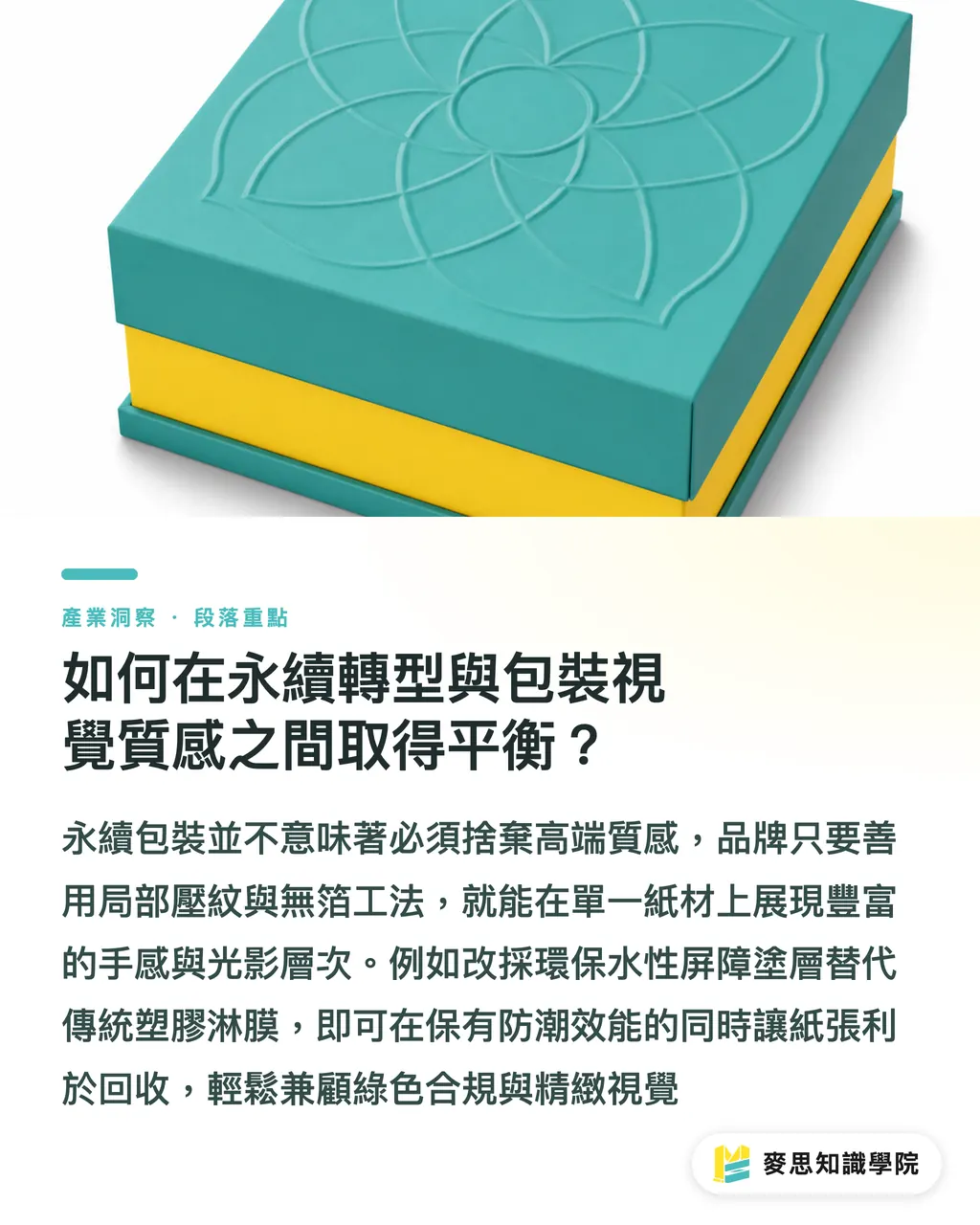
The secret to upgrading sustainable packaging texture is using structural cutouts, localized embossing, and eco-friendly water-based inks instead of traditional plastic hot foiling and large-area debossing, creating refined brand visuals without adding material complexity
It is simple: sustainability does not mean packaging has to look rough or cheap
Many brand designers worry that paper boxes made of mono-materials or without composite films will lose their original sheen and luxury feel. In reality, through precise proofing and embossing techniques, pure paper packaging can deliver rich tactile depth and subtle light play
During prepress artwork finalization, keeping these technical adjustments in mind lets you hit both ESG green compliance and high-end visual standards:
・Ditch plastic film coating: Switch to eco-friendly water-based barrier coatings instead. They supply basic moisture protection without hindering paper repulping and recycling later on
・Reduce hot foiling surface area: Replace large-area gold foil with high-detail metallic ink printing or foil-free embossing techniques, minimizing metal layer interference with recycling machinery
・Simplify structural inserts: Cut down foam inserts and plastic handles, replacing them with all-paper folding structures to secure products, making sure consumers can sort and recycle the packaging directly after unboxing
Key Takeaways
・EPR regulations have shifted packaging recycling costs from governments to brand owners, making design choices the main driver of future financial fees
・Mono-materials and PCR recycled content have become standard procurement requirements and entry barriers for European and US brands
・Applying the 'MINDS (MS) Packaging Compliance Three-Step Framework' lets businesses complete material transitions step by step while keeping packaging strength
・Using foil-free embossing and water-based coatings preserves premium packaging aesthetics without messing up the recycling process
Final Thoughts
Faced with global EPR regulatory waves, brand owners and packaging printers can no longer view packaging as pure visual design. It must be raised to the level of supply chain risk management and regulatory compliance. Companies should audit their current packaging bills of materials right away, lead sampling of mono-material alternatives for items exported to Europe and North America, and turn compliance challenges into a competitive edge in international markets
Further Reading
FAQ
- What is Extended Producer Responsibility (EPR), and how does it directly affect brands?
- Extended Producer Responsibility (EPR) requires brand owners to pay for the recycling and disposal of packaging waste. If packaging uses hard-to-recycle multi-layer composite materials, the brand will face higher fees, directly raising export operational costs
- What are the benefits of using mono-materials in packaging?
- Mono-material packaging uses a single polymer or paper type, making it easy to sort and remelt in current recycling systems. This helps brands cut EPR fees and meet strict customs and retail listing rules in European and US markets
- How can brands maintain packaging texture without adding material complexity?
- Brands can use localized paper embossing, foil-free debossing, and eco-friendly water-based metallic inks to replace traditional plastic hot foiling and lamination. This creates rich visual and tactile layers without interfering with paper repulping and recycling
- How can printers help brand clients handle EPR regulations?
- Printers should proactively offer eco-friendly material options certified by ISO and FSC, assist clients during prepress with plastic reduction evaluations, and help brands build transparent, traceable packaging material lists
Related articles

The Print × AI weekly
The print and AI know-how designers, brands and enterprises can use before they commit — one email, every week
MINDS Free Tools
AI background removal, a LINE sticker maker, spine & imposition calculators — all free, right in your browser, no upload.
MINDS Group
Need actual printing or gifting services?
From premium printing to online ordering and festive gifts — the MINDS Group sister brands take it from here.