
Why does U.S. e-commerce packaging recycling get stuck on money first?
Because as e-commerce packaging volumes rise, recycling systems have to handle more work at the same time, while the financial arrangements do not keep pace
An e-commerce order may look like a single shipping carton on the surface, but in practice it often sends an inner box, cushioning, sealing tape, and labels into the recycling process as well. Each item adds another material to sort, process, and assess for fees
The problem I see most often on the print floor is that the design file records dimensions, color, and finishing, but not what the packaging is made of or how much is used. By the time the shipment is ready, the brand has to go back and hunt for the data
That habit can still be patched by hand in a single market. Once cross-border e-commerce scales up, the data gaps scale with the orders
So what is holding the United States up is not whether a single carton can be recycled. It is who pays, who reports, and who passes the data to the recycling system. Taiwanese export brands also have to deal with pressure from both channels and regulations

How does EPR push recycling fees back to brands and platforms?
EPR (Extended Producer Responsibility) is a system that extends responsibility for recycling packaging after it enters the market, along with processing and related costs, to producers, brands, or companies that place products on the market
In this U.S. e-commerce context, brands and platforms share the cost of recycling, giving recycling systems a new source of funding. Packaging decisions therefore become tied to reporting and payment
If the same paper box is changed to a composite structure or gains another layer of finishing, the brand often has to review the packaging category, quantity basis, and reporting version at the same time. Changing only the dieline and quote is not enough
・Look at the data first
・Then look at the cost
EPR spreads recycling costs that used to be hidden in the purchase price across the company's workflow. That gives design, procurement, platform operations, and finance records they can each reconcile. Waiting until a requirement appears and then backfilling the records is the easiest way to turn one small revision into a recalculation of the entire packaging batch
Why will EPR rewrite the division of labor between brands and printers?
Because once recycling fees enter the company's books, packaging stops being just a specification on a design file and becomes business data jointly maintained by the brand, platform, and supplier
Brands know the sales markets and channel responsibilities, printers know the paper, finishing, and production quantities, and platforms may know how products reach consumers. If each party keeps its data in a separate spreadsheet, the numbers will not line up when the filing is due
I see EPR as an industry-wide lever for redistributing responsibility. Where the cost lands often depends on who can clearly explain what the packaging contains, how much went out, and who is responsible
If a brand only says, "We need to meet sustainability goals," but does not define the market, packaging scope, quantity basis, and document format, the printer can only guess. Those guesses usually surface after shipment, when rework and supplemental paperwork are both more painful
What three sets of data should Taiwanese brands prepare first when exporting to the United States?
Taiwanese brands should have a packaging list, reporting fields, and payment records ready first, because EPR links packaging decisions made before shipment to recycling responsibilities after the products enter the market
I handle this with MINDS' three-gate print workflow, so design, printing, and brand finance work from the same data
・① Packaging gate: List the outer carton, inner box, cushioning, tape, and labels, with their materials, quantities, and markets
・② Reporting gate: Match them to the brand or platform contact, payment milestones, and responsible person, and save the printer's specification sheet in the same file
・③ Recordkeeping gate: Keep proofs, purchasing quantities, shipping batches, and payment records, then compare them whenever the packaging is revised
These three gates do not ask the printer to interpret U.S. rules on the brand's behalf. They make sure the data the supply chain can provide is ready first. The brand still has to confirm its own reporting and payment responsibilities
If the brand wants to align the data during the proofing stage, it can bring the checklist into a custom-printing discussion with MINDS. Confirm the paper, finishing, and quantities first, then discuss the unit price
How should packaging design and procurement respond to EPR's funding pressure?
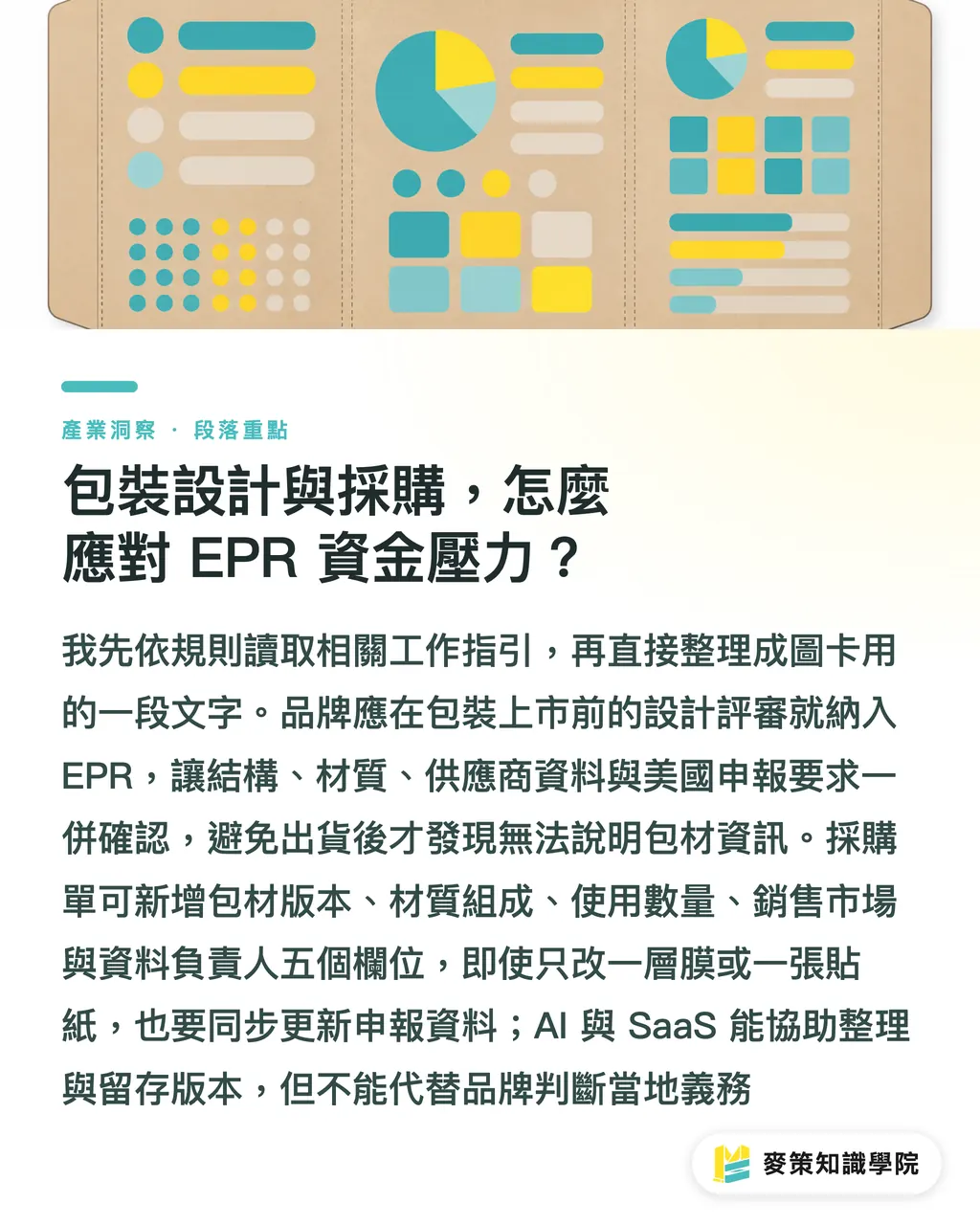
Brands should put EPR into the design review before packaging goes to market, so the structure, materials, supplier data, and U.S. reporting requirements are checked together
The mistake I see most often on the print floor is treating packaging as a single design file. Once the file is sent out, everyone talks only about color, the dieline, and the schedule. By shipment time, no one can clearly say what this batch of packaging contains
A purchase order can add five fields: packaging version, material composition, quantity used, sales market, and data owner. Even changing one film layer or switching to a different sticker means the reporting data has to be checked at the same time
AI (Artificial Intelligence, software capabilities that help organize data) is well suited to organizing BOM (Bill of Materials, a list of packaging materials and components), orders, and proof files. SaaS (Software as a Service, software services that provide data-management functions through the cloud) is better suited to retaining versions, permissions, and payment records
Neither can decide the brand's local EPR obligations. Put the responsible person in the form first, so the team knows whom to ask the next time the packaging is revised
Key takeaways
・EPR first changes how recycling fees are paid, then changes the order in which packaging decisions are made
・Every time e-commerce packaging adds another material, the brand has one more piece of data to explain clearly
・What a printer delivers should not be only the finished product. It should also include packaging specifications that can be reconciled
・Before exporting to the United States, getting reporting and recordkeeping in order saves far more trouble than chasing data after shipment
Further thoughts
Manufacturers and printers can turn packaging specifications, finishing methods, and batch quantities into standard delivery fields. The design team should update material and disassembly information every time it revises a package. On the brand side, put the EPR owner into the launch checklist instead of leaving finance to take over at the very end. AI can help organize fields from BOMs, orders, and proof files. SaaS should retain version, permission, reporting, and payment records, so someone can trace every packaging batch. If the team needs to put these practices into an export-packaging project, it can discuss worksheets and responsibilities with the Mai Strategy Knowledge Academy consulting team
Further reading
FAQ
- What is EPR?
- EPR is Extended Producer Responsibility, a system that extends responsibility for recycling, processing, and related costs after packaging enters the market to producers, brands, or companies that place products on the market
- Why does U.S. e-commerce packaging recycling need EPR funding?
- E-commerce packaging volumes are increasing, putting existing recycling systems under both processing and financial pressure. EPR has brands and platforms share the cost of recycling, providing a new source of funding
- What should Taiwanese brands prepare before exporting to the United States?
- They should first organize a packaging list, reporting fields, and payment records, then align the materials and quantities of the outer carton, inner box, cushioning, tape, and labels in the same set of data
- Does the printer need to handle the brand's EPR reporting?
- The printer can provide paper, finishing, quantity, and batch data, but the brand and platform must still confirm their own reporting and payment responsibilities. Regulatory decisions cannot be pushed entirely onto the printer
- Can AI or SaaS solve EPR directly?
- AI is suited to organizing BOMs, orders, and packaging fields, while SaaS is suited to retaining versions, permissions, and payment records. Neither can determine the brand's local EPR obligations
Related articles




The Print × AI weekly
The print and AI know-how designers, brands and enterprises can use before they commit — one email, every week
MINDS Free Tools
AI background removal, a LINE sticker maker, spine & imposition calculators — all free, right in your browser, no upload.
MINDS Group
Need actual printing or gifting services?
From premium printing to online ordering and festive gifts — the MINDS Group sister brands take it from here.