

Why Export Brands Cannot Afford to Wait While EPR Lawsuits Fly
Packaging compliance has shifted from a PR sustainability vision to a hard requirement for export procurement. Right now, rollout across the seven US states that passed Extended Producer Responsibility (EPR) packaging laws is a mess. According to on-the-ground reporting from Packaging Dive, implementation is riddled with uncertainty, moving at different speeds in every state and facing stiff legal pushback
The clearest example is the National Association of Wholesaler-Distributors (NAW) suing over EPR laws in Colorado and Oregon, while California's law faces legal challenges from 17 Republican state attorneys general. This regulatory uncertainty has triggered what Rachel Oster of Diversion Strategies calls a 'freeze response' among small and mid-sized businesses. Most decided to sit on the sidelines, waiting for lawsuits to settle and detailed rules to clear up before touching their packaging design
Visiting export packaging plants over the past few months, I saw a harsher reality on the shop floor: regulations might stall in court, but purchase orders from global brands will not wait. To avoid future compliance headaches and return risks, major brands are already demanding material breakdowns and traceability records on current orders. While your competitors are still reading the news and waiting, having your data and recyclable material options ready means overseas orders under tight corporate deadlines will naturally come your way
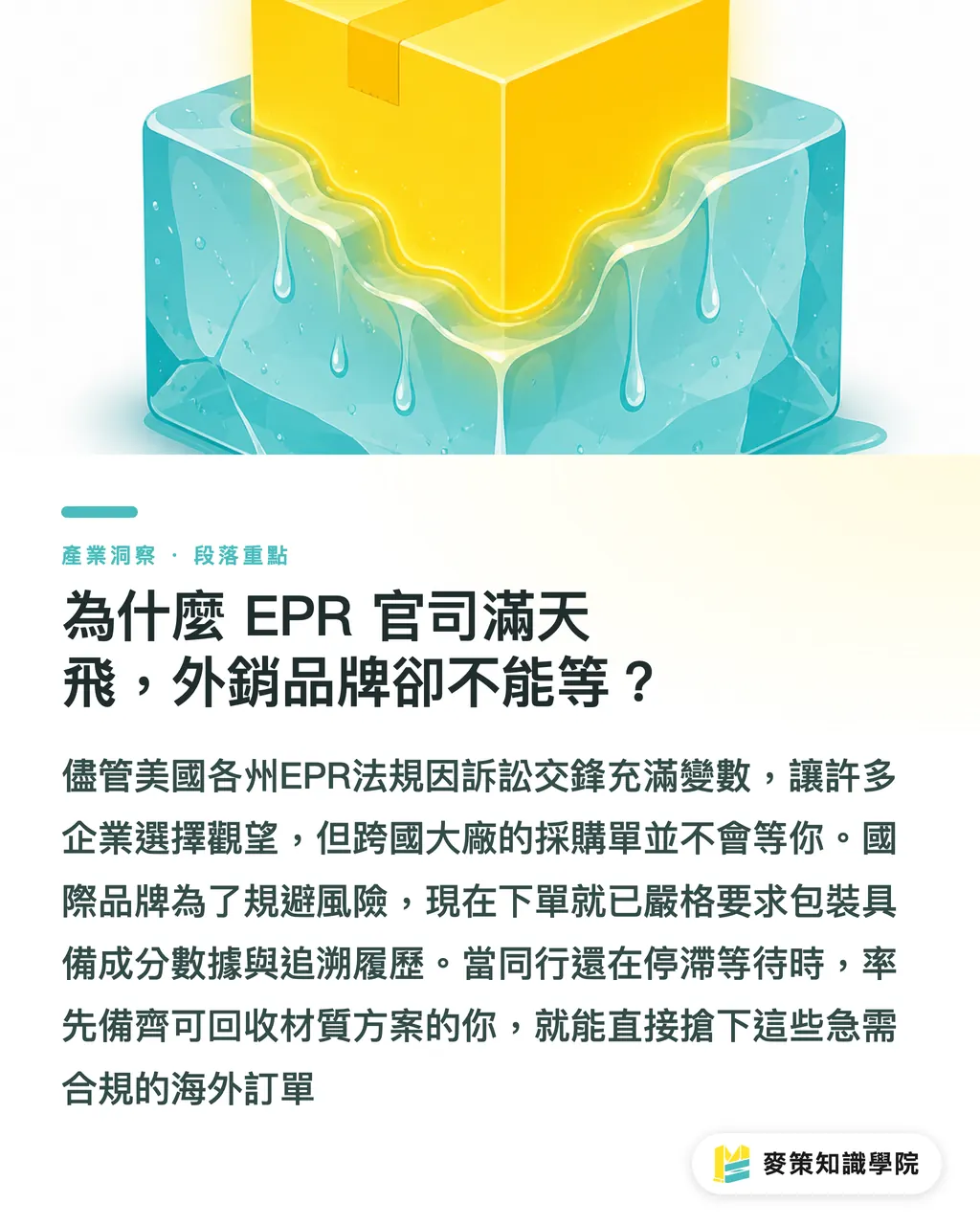
How Does Ecomodulation Work, and Why Does It Flip Traditional Sourcing Logic?
Ecomodulation is the core pricing engine within EPR systems that determines how much producers pay in recycling fees. Put simply: the easier your packaging is to recycle and the more post-consumer recycled content it contains, the lower the fee. On the other hand, if you use multi-material laminates that disrupt recycling, you face hefty penalty rates
The impact on brand owners and packaging designers is very real. Sourcing used to be purely about physical specs: low unit cost, good moisture barrier, and sharp color reproduction. Adding EPR fees turns that entire cost structure upside down. For instance, an unrecyclable foil-laminated coffee pouch that costs $1 to produce might end up costing far more in total than a $2 mono-material (Mono-PE) flexible pouch once penalty fees kick in
With this shift in pricing logic, early material choices directly dictate future profit margins. Scott Cassel, CEO of the Product Stewardship Institute (PSI), put it bluntly: 'Packaging shifts take time. You don't need to wait five years for state rules to settle before taking action. You should start now.' Those five years cover tooling, material testing, and line trials. If you wait until mandates kick in, your product simply will not make it onto retail shelves
Capitalizing on the Regulatory Info Gap: What Data Must Printers Prepare?
In this value chain shakeup, waiting on the sidelines is the riskiest move. This is an elimination game, and brands are looking for suppliers who can solve their compliance anxiety. Based on our recent work helping clients handle factory audits, small and mid-sized businesses can no longer stop at 'what can I print.' They must evolve to 'what can I prove.'
Export brands must now report highly granular data to different authorities, down to the exact grams of paper in a folding carton or the exact resin code of a plastic barrier film. Print shops that still rely on manual Excel spreadsheets cannot keep up with these frequent data requests. Factories need to build an internal material traceability database, digitizing supplier records for inks, eco-friendly adhesives, FSC certification numbers for paper, and PCR (post-consumer resin) percentages
If you can deliver a clean, complete, audit-ready bill of materials faster than your competitors, the order is usually yours

Beyond EPR Pressure: Why Refills and Lightweighting Are the Ultimate Hedges
As EPR calculations grow more complex and state standards diverge, smart brands are turning to a straightforward hedging strategy: cutting packaging weight at the source or switching to refillable models
Conversations with foreign buyers over the past few months show that demands for lightweighting have become uncompromising. If a 250 gsm board works, they will not touch 300 gsm. If an insert can be eliminated, it goes. This is not just for green optics. EPR fees are heavily weight-based. The heavier the packaging you put on the market, the higher the tax
Refill design is also reshaping export goods. Heavy single-use plastic bottles are replaced with durable containers, while consumers buy refills in lightweight flexible pouches. This cuts total plastic consumption, slashes downstream EPR fees, and locks in repeat purchases along the way
Facing Material Upgrade Anxiety: How Brands Should Evaluate Suppliers
When launching new projects, brand owners cannot just look at physical manufacturing costs. They must require suppliers to provide structural recommendations that meet ecomodulation fee-reduction standards right at the quoting stage
This is a serious test for existing supply chains, because not every factory can handle cross-border compliance demands. If you are developing packaging for US and European export markets, work directly with partners experienced in material science and compliance practices. Teams like MINDS, which specializes in mid-to-high-end fully custom commercial printing, can offer concrete guidance on material compliance and mono-material structures early in planning. This keeps your products from running into steep penalty fees or customs holds later on
Turn other people's confusion into your barrier to entry. Upgrading your materials and locking down packaging traceability now, while competitors are stalled by lawsuits and indecision, is how you secure a real share of the market during this EPR transition

Key Takeaways
・The regulatory limbo caused by EPR lawsuits is not a time to wait, but a filter separating strong export suppliers from weak ones
・Ecomodulation directly ties recyclability to fee structures, flipping conventional procurement math on its head
・Printers that prepare material traceability data and mono-material solutions hold the strongest hand in winning export orders from global brands
・Lightweighting and refillable packaging are the most direct design strategies to hedge against weight-based EPR fees across different regions
Food for Thought
For print manufacturers and SaaS providers, the biggest opportunity in EPR is not manufacturing itself, but data proof. When brands must report packaging weights and material details to governments around the world, whoever offers a system that connects factory-floor data with instant compliance records will own the gateway to the next wave of green procurement
Further Reading
FAQ
- What challenges do EPR regulations face in the US, and why is the rollout so messy?
- Seven US states have passed EPR packaging laws, but timelines differ and industry lawsuits in states like Colorado and Oregon have stalled progress. This has left many small and mid-sized businesses hesitant and unsure which standards to follow
- What is ecomodulation?
- It is a fee structure that sets producer dues based on how environmentally friendly packaging is. Packages that are easier to recycle or contain more recycled content pay lower fees, while hard-to-recycle multi-material structures face steep penalties to steer brands toward better design
- What should export brands do right now amid this EPR uncertainty?
- Do not wait for regulations to settle. Audit your packaging structures now, look into mono-material or lightweight alternatives, and require suppliers to provide full material traceability documentation
Related articles




The Print × AI weekly
The print and AI know-how designers, brands and enterprises can use before they commit — one email, every week
MINDS Free Tools
AI background removal, a LINE sticker maker, spine & imposition calculators — all free, right in your browser, no upload.
MINDS Group
Need actual printing or gifting services?
From premium printing to online ordering and festive gifts — the MINDS Group sister brands take it from here.