
Why recycling facilities still reject packaging with the recycling triangle printed on it
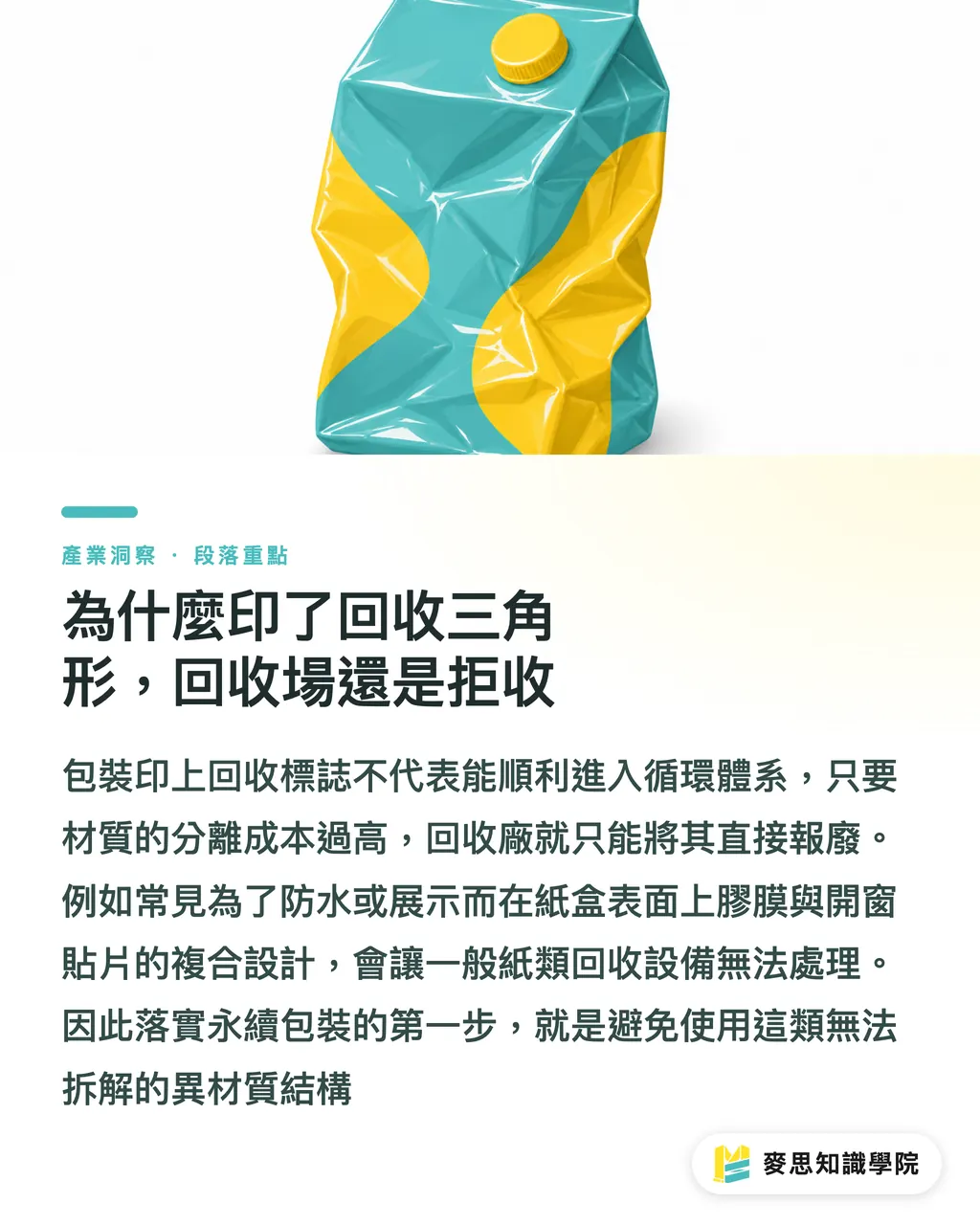
Printing a numbered recycling symbol on packaging does not mean it can enter the circular system. Once a paper box is laminated with plastic film or bonded to a different material, it becomes hard to separate on a recycling sorting line and is often scrapped outright
When the consulting team at Mai Strategy Knowledge Academy helps brands shift to sustainable packaging, the first thing we stress is removing composite designs that look polished but cannot be taken apart
In the past few years, while refining packaging with export clients, we have seen many teams assume that switching to rPET is enough to earn a sustainability ticket. The reality at recycling plants is blunt: when separation costs exceed the residual value of the material, these items end up in the incinerator
The most common traps in the industry are paper laminated with plastic film and window boxes patched with acrylic sheets
Designers often add a thin film or a partial window to the paper surface so the outer box resists water and scratches, or so the product inside can be displayed
This kind of tightly bonded mixed-material structure cannot be handled by ordinary paper pulping equipment. The whole batch of paper stock may be judged unrecyclable waste because of that film
What mono-material design means
Mono-material means that more than 90% of the full packaging set is made from one basic material, such as pure paper pulp or a single polymer like PP. The goal is to remove the recycling-side step of separating different materials, so the waste can be handled directly by one recycling line and enter the recycled-material loop
After visiting several OEM factories rushing to respond to California SB 54, the question we hear most is whether paper boxes can actually pass
International packaging rules are getting stricter, and they are asking brands to take responsibility for the last mile of the product life cycle
Instead of spending heavily afterward to hire someone for carbon accounting, it is better to simplify packaging materials at the source from the start
Flexible packaging, long treated as an unwelcome guest in recycling, is also looking for answers through mono-material designs and chemical recycling technologies
How paper box structures can replace plastic blister trays and inner liners
Once plastic inner liners are removed, product fixing and impact protection during shipping must rely on structural design made from pure paper materials
In the three-gate prepress inspection process at MINDS (MS), we ask designers to set aside flat visuals first and think about packaging support strength from a three-dimensional structural angle
These are the alternatives we most often help clients introduce in real production:
・Internal locking tab design: precise die-cut lines and fold angles create grooves in the paperboard that hold the product in place, replacing traditional vacuum-formed plastic trays
・One-piece folding box: the entire package, from outer box to inner liner, is folded from a single sheet of paper without any glue. At recycling time, it can be flattened and placed straight into paper recycling
・Corrugated buffer layer: for heavier electronics or fragile items, stacked and die-cut corrugated board can serve as a cushioning pad, with protection that fully holds its own against EPE foam
Early structural design may require a few more prototypes to test drop resistance. But once the structure is set, material preparation and inventory control in mass production become much simpler
How to choose surface finishing when you want better packaging texture
Mono-material does not mean packaging has to look dull or cheap. The key is replacing chemical coatings with physical finishing
Many clients worry that skipping lamination will make paper boxes look inexpensive or pick up fingerprints too easily
For mid- to high-end fully custom commercial printing projects handled by MINDS, we recommend using post-press finishing to raise the visual level
・Embossing and debossing: a metal plate presses three-dimensional textures into the paper surface. It is a purely physical change and does not affect recyclability
・Spot white foil or gold foil stamping: although metallic foil is involved, the deinking and pulping technology at most large recycling facilities can now handle small areas of foil stamping
・Water-based varnish: if basic abrasion and stain resistance is truly needed, a water-based coating is much safer than traditional plastic PP film
From a production-line point of view, the most premium packaging often wins with the simplest paper material, precise die-cutting, and the texture of the paper itself

Key takeaways
・The numbered triangle only identifies the material type. It does not guarantee that the local recycling facility can separate composite materials
・The core metric of mono-material design is raising the share of one material to more than 90%, reducing sorting costs at the back end
・With die-cut locking tabs and one-piece structures, pure paper can deliver cushioning and impact protection that rivals plastic blister packaging
・To balance commercial texture with the circular economy, move away from plastic lamination and use water-based varnish or physical embossing and debossing instead
Further thinking
Seen through the mono-material trend, the voice in packaging design is gradually shifting from pure graphic visuals to engineering-minded people who understand materials and structures. For brands and design planners, the next layer of competitiveness will come from making "easy to recycle" disappear smoothly into the unboxing experience. For SaaS developers or print e-commerce platforms, building "mono-material compatibility" into automated checks and quotation logic will be a serious bargaining chip for winning sustainable export orders
FAQ
- Why do paper boxes with eco labels still get rejected by recycling facilities?
- Because the paper box may have plastic film on the surface or a transparent plastic window. Tightly bonded mixed materials cannot be separated by recycling facilities with standard equipment, so they can only be burned as general waste
- If plastic inner liners are not used, will products get damaged during shipping?
- With precise paper box structural design, the mechanical support and locking tabs created by folded paperboard can fully replace plastic blister trays for impact protection and product fixing
- Paper boxes without any lamination scratch easily. What can solve this?
- You can switch to water-based varnish or eco-friendly water-based coatings to improve surface scratch resistance, or use physical finishing such as embossing and debossing to shift the visual focus and raise the perceived quality
Related articles
The Print × AI weekly
The print and AI know-how designers, brands and enterprises can use before they commit — one email, every week
MINDS Free Tools
AI background removal, a LINE sticker maker, spine & imposition calculators — all free, right in your browser, no upload.
MINDS Group
Need actual printing or gifting services?
From premium printing to online ordering and festive gifts — the MINDS Group sister brands take it from here.