

Why Recycling Plants Still Reject Packaging with Eco-Labels
Recently, I visited several OEMs rushing to comply with California's SB 54. The most common question is: why do boxes made from FSC-certified paper still fail to meet circular packaging standards?
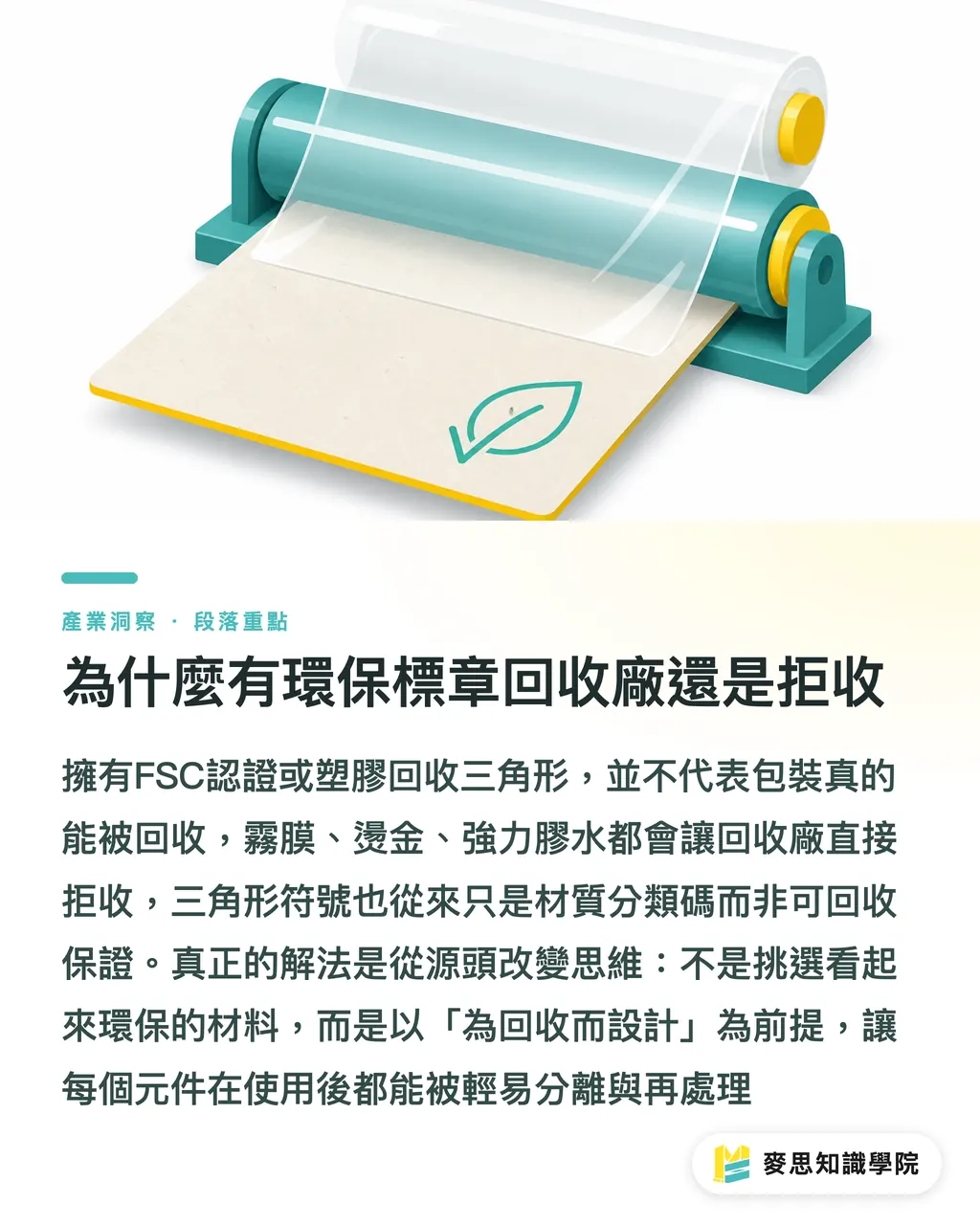
This is the most common blind spot in the industry. FSC only proves that the paper source is legal and forest-friendly. However, once you apply matte lamination, gold foiling, or even use high-tack adhesive labels, its fate at the recycling plant is often the incinerator
Another classic case is the plastic recycling triangle with a number at the bottom. Most people read it as "recyclable," but it has always just been a plastic resin identification code
If designers only look at surface labels and ignore the physical reality of "how to separate after use," the packaging is merely for show
Brand clients have been anxious about green reporting lately. We must shift our thinking from simply selecting eco-friendly materials to "Design for Recyclability (DfR)."
Five Crucial Design Rules for Circular Packaging
The core of circular design is pre-determining the end-of-life during the structural and material selection phases. Based on over a decade of printing practice and the current state of recycling plants, here are five rules you must follow:
・ Mono-materialization: Avoid composite materials as much as possible, such as paper boxes with large plastic windows. If necessary, ensure consumers can easily tear and separate them by hand
・ Washable Glues and Inks: Many ignore that label glue can directly contaminate paper pulp. Switch to water-soluble or hot-melt alkali-soluble glues to ensure they detach smoothly in the recycling plant's washing tanks
・ Structural Simplification: Reduce unnecessary accessories. We had a case where adding inseparable metal buckles caused tens of thousands of packages to be deemed unrecyclable
・ Accurate Recycling Labeling: Labels must clearly indicate which bin each component should go into. Stop just putting a vague recycling symbol
・ Avoid Heavy Metals and Fluorescent Whitening Agents: Vivid spot color inks may contain heavy metals, and adding Optical Brightening Agents (OBA) for "stark white" paper can severely interfere with the quality of recycled pulp
Why Dark Packaging Often Becomes a Recycling Minefield
Many designers use dark colors to create a sense of premium quality, but the choice of material directly determines its fate
For dark-colored paper, such as unbleached or pre-dyed kraft paper, as long as it isn't laminated with plastic, it can still be pulped at a recycling plant, though it might be downgraded to corrugated medium or gray board
However, dark plastic is a different story. Many automated sorting plants rely on Near-Infrared (NIR) spectroscopy to identify materials. Dark colors, especially black plastic, absorb light, preventing the machine from reading the reflected signals
Consequently, these dark plastic containers are rejected as waste. If you must use dark plastic, there are now specialized NIR-detectable black masterbatches available on the market
How Designers Can Use Illustrator to Self-Check Before Printing
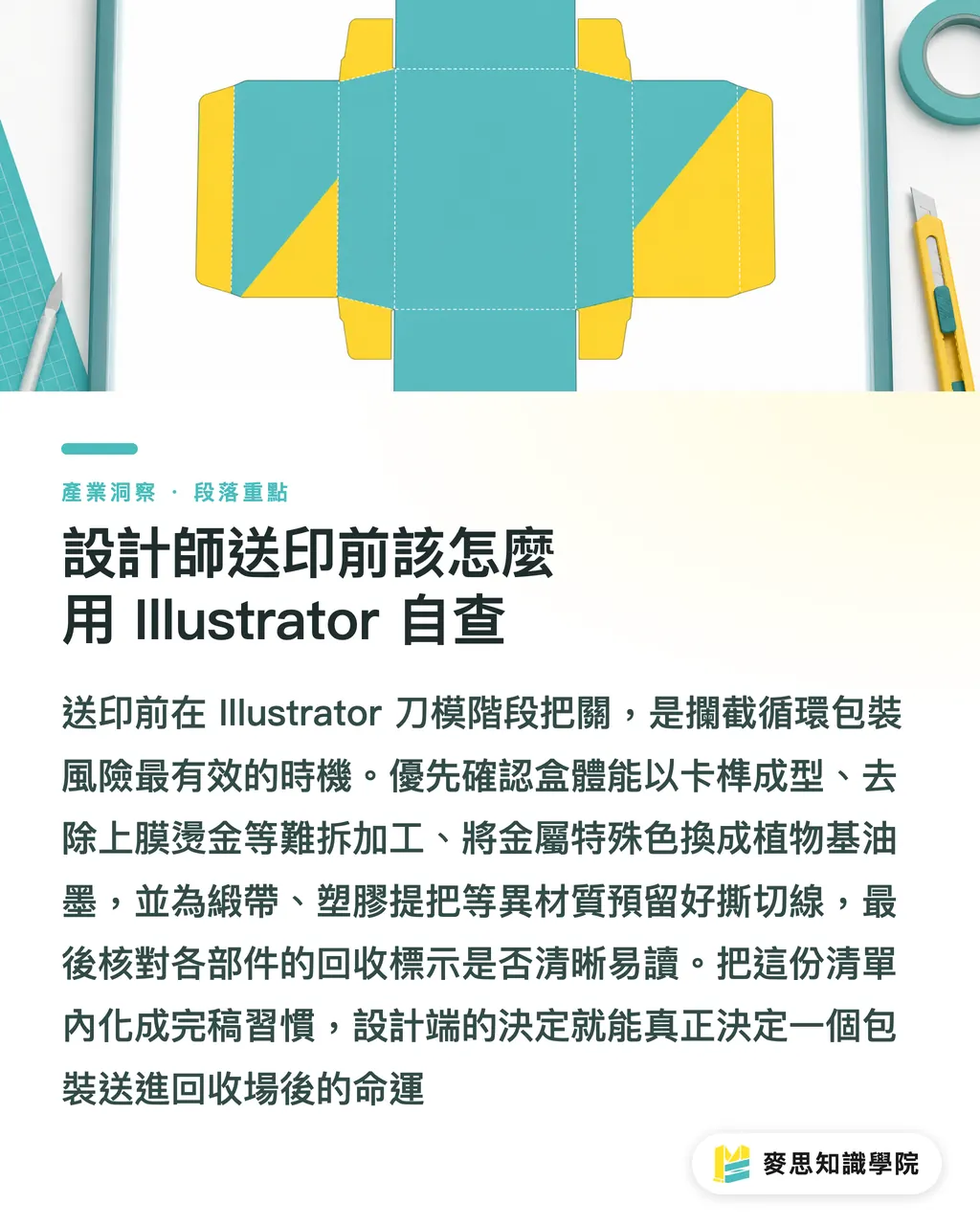
Knowing the principles is one thing; intercepting risks in Illustrator before final submission is another. Here is a checklist I often have clients use during the dieline stage:
・ Dieline Structure Verification: Check if the form can be completed using interlocking structures without glue
・ Surface Finishing Inventory: Remove all non-essential lamination and gold foiling. If water resistance is needed, switch to eco-friendly aqueous coatings
・ Accessory Separation Test: Confirm whether disparate materials like ribbons, plastic handles, or sealing stickers have pre-cut lines for easy consumer removal
・ Color and Ink Settings: Remove special colors containing metal powders and switch entirely to soy-based or vegetable-based inks
・ Labeling Check: Ensure the recycling instruction icons for all components in the file are correct and the font is large enough to be legible
Key Takeaways
・ Eco-labels do not equal actual recyclability; subsequent finishing and bonding methods are what determine the fate of the packaging
・ Composite materials are the greatest enemy of circularity. Prioritize mono-materials and ensure that glues and inks are washable
・ For dark designs, avoid standard black plastic to prevent misidentification as unrecognizable waste in automated sorting plants
Further Reflection
Many brands focus on how expensive eco-friendly paper they buy when undergoing sustainable transformation, but they neglect to examine dielines and final files from the source
Every click of a designer's mouse determines whether these packaging materials will end up in a recycling bin or an incinerator
This is also the detail MINDS Printing cares about most when providing integrated services. We help clients guard against these invisible traps during the pre-press stage, ensuring your eco-friendly intentions aren't rejected on the production line or at the recycling plant
Further Reading
・ Five Design Principles for Circular Packaging: Design for Recyclability
FAQ
- Can an FSC-certified paper box be used directly as eco-friendly packaging?
- Not necessarily. FSC only proves the legality of the paper source. If the box is laminated with inseparable plastic film or uses high-strength glue, it remains difficult to enter the pulp recycling system
- Why is dark plastic packaging often unrecyclable?
- Most recycling plants use Near-Infrared (NIR) spectroscopy for automated sorting. Deep black plastic absorbs light, making it impossible for machines to identify the material, so it is usually treated as general waste
- What is Design for Recyclability (DfR)?
- This is a strategy that considers the end of a product's life cycle during early development. It requires designers to exclude factors that hinder recycling in material selection and structure, ensuring the packaging can smoothly return to the circular system
Related articles



The Print × AI weekly
The print and AI know-how designers, brands and enterprises can use before they commit — one email, every week
MINDS Free Tools
AI background removal, a LINE sticker maker, spine & imposition calculators — all free, right in your browser, no upload.
MINDS Group
Need actual printing or gifting services?
From premium printing to online ordering and festive gifts — the MINDS Group sister brands take it from here.