
Where Should Circular Economy Packaging Start?
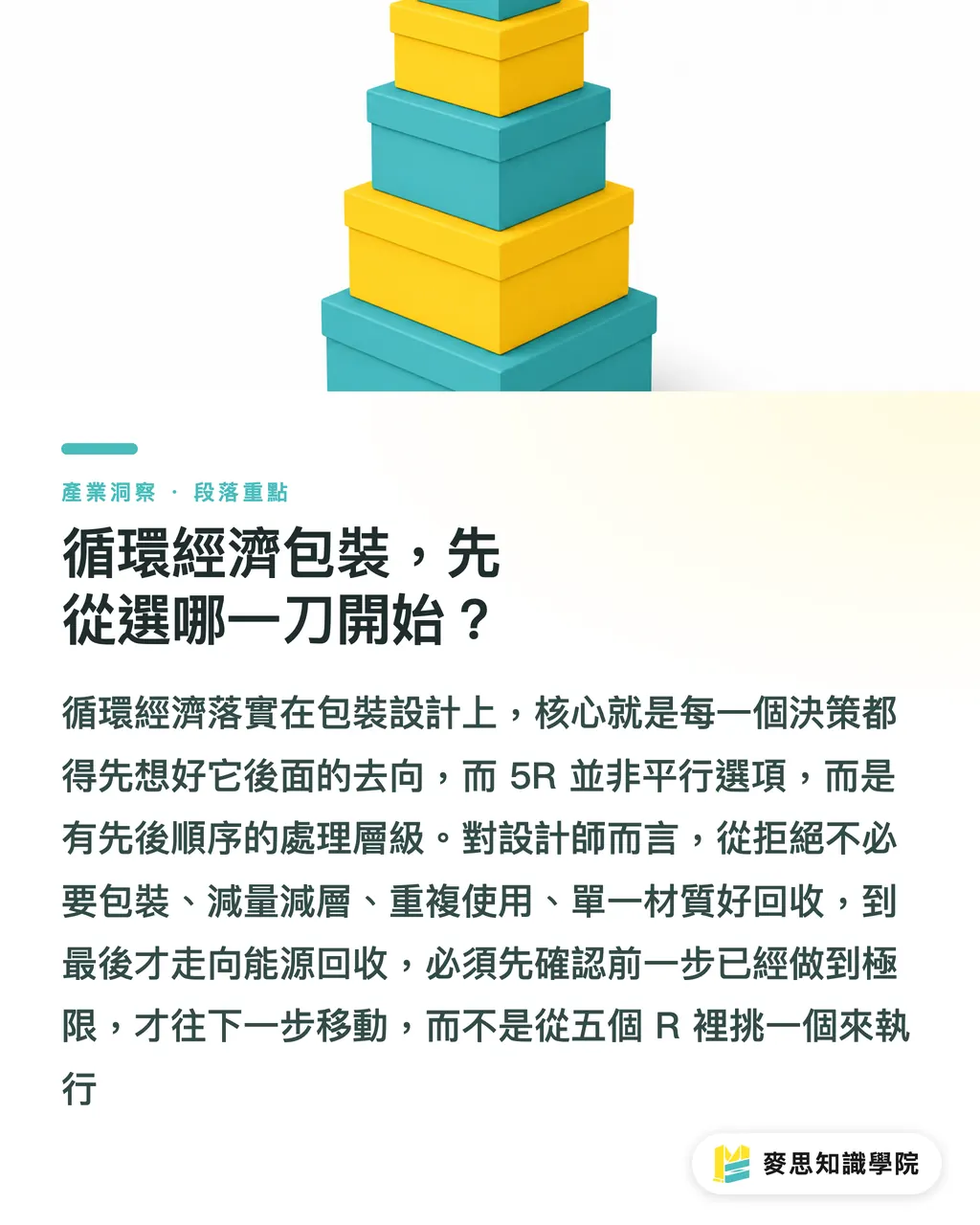
The circular economy has been discussed in packaging for ten years, but once it lands on a designer's desk, it comes down to one thing: every decision has to account for where the package will go next. The 5R framework often used here, Reduce, Reuse, Recycle, Recover, and Refuse, is not decoration. It is the order in which resources should be handled. Source reduction always comes before end-stage recycling. That is why the EU PPWR, California's SB 54, and Taiwan's recent plastic restriction and reduction policies all put "reduction" up front
I have reorganized these five Rs into five decisions designers can check directly before sending a job to print. Each one maps to choices in material, structure, and finishing
・Decision 1 | Can we skip the packaging? This maps to Refuse: reject unnecessary packaging and first ask whether the product really needs this box
・Decision 2 | Can we use less? This maps to Reduce: cut material, reduce layers, and shrink the printed area
・Decision 3 | Can it be used again? This maps to Reuse: design for repeated use
・Decision 4 | Is it easy to recycle? This maps to Recycle: use a single material and make recycling easy
・Decision 5 | Consider energy recovery only at the end: this maps to Recover. Only send it to energy recovery when the first four gates cannot be passed
At this point, you can see that these five decisions are ranked by priority. They are not five parallel options. In other words, the task now is not to "pick one R to work on." It is to confirm that the previous R has been pushed as far as it can go before moving to the next one
Why Does Source Reduction Always Come First?
Reduction comes first because it has the lowest carbon cost across the full life cycle. If a paper box uses 10% less paper, every stage saves along with it, from raw materials and transport to back-end recycling. By contrast, recycling and remanufacturing consume energy and water themselves. That is why a "high recycling rate" does not automatically mean a "low environmental footprint."
There are three reduction levers designers can actually pull:
・Downgrade thickness: switch corrugated board from B flute to E flute, or reduce the face paper from 350g to 300g. For the same carton, test the strength first before deciding
・Optimize the structure: replace a double-layer insert with a single-layer folded paper insert, or change a book-style box into a flip-top box. You save more than paper. You also save on die-cutting and lamination steps
・Reduce the printed area: change large color blocks to partial printing and remove full-bleed background color from inserts. Ink use and drying energy drop along with it
In practice, these three moves are often where the biggest cost savings appear. I spend a lot of time around production lines and client teams, and I often hear clients say, "We want to cut carbon." But the numbers they can actually see on the same season's profit and loss statement are often these most basic reduction upgrades. Start here for a simple reason: lowest cost, lowest risk, and the least pushback from recycling plants
Are Reuse and Easy Recycling Completely Opposite Design Logics?
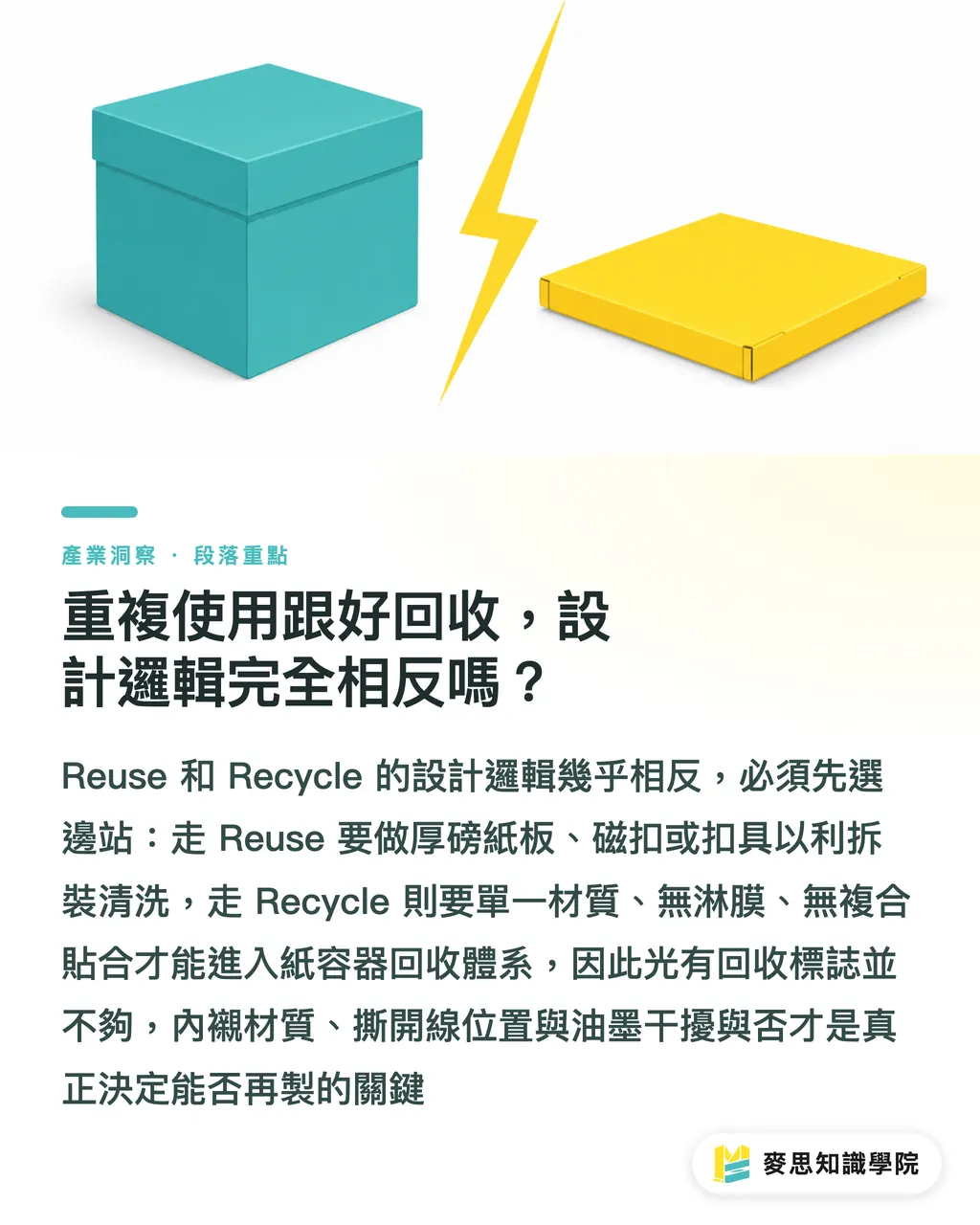
Many clients ask me whether Reuse and Recycle are two paths where you can only pick one. Yes. The design logic is almost the opposite, so you have to choose a side first
Reuse design focuses on durability, easy assembly and disassembly, and easy cleaning for return use. When commercial printing plants such as MINDS take on Reuse projects, paper box structures often shift to thick greyboard or plastic PP shells. Finishing may add magnetic closures, clasps, or hook-and-loop fasteners instead of permanent glue, because if the package cannot be opened and separated, it cannot be reused. Typical Reuse packaging includes 3C returnable shipping boxes, cosmetics VIP gift boxes, and rental loop boxes
Recycle design focuses on a single material, no hard-to-separate components, and paper fibers that are still long enough for remanufacturing. In other words, once you choose the Recycle path, almost all the design choices that make Reuse convenient, such as magnetic closures, composite lamination, and multilayer structures, have to be removed. Ideally, a paper box should be formed from one sheet of paper, and even the ears of a folding carton should avoid using a different paper stock
One common misunderstanding is that "if it has a recycling symbol, it will be recycled." Take Taiwan's paper container recycling system as an example. If the inner layer of a paper box has plastic coating or wax paper coating, the recycling plant will filter out these contaminants first. So the recycling symbol is only an entry ticket. Whether the package can enter depends on the structure. When designers draw the die line, whether the insert is made from the same material as the box body, whether the tear line avoids the coated area, and whether the printing ink interferes with pulp processing are all questions beyond the entry ticket
How Do You Avoid Processing Traps Like Multilayer Composites and Full-Bleed Dark Printing?
The three most common reasons paper boxes are rejected by recycling sites are composite materials that cannot be separated, full-bleed dark printing that interferes with optical sorting, and excessive residue from lamination glue and surface treatments. These are all decided at the design stage. Once the job reaches the production line, there is almost no room to fix them
Here is a prepress checklist for designers:
・Prioritize a single material: use paper for paper boxes and one type of plastic for plastic boxes. Avoid paper-plastic composites or aluminum foil lamination
・Limit ink color and ink types: avoid large areas of full-bleed dark color, and avoid inks with metallic sheen or fluorescent colors, which may be rejected by optical sorting
・Design tear lines carefully: keep paper box tear lines away from coated areas, avoid crease lines so deep that they damage fibers, and keep tape away from the main recyclable body area
・Keep surface treatment restrained: spot varnish is acceptable, but avoid full-bleed glossy film whenever possible. Excessive UV coating can leave residue during pulping
・Use correct recycling labels: Taiwan's recycling symbols correspond to plastic material numbers 1 to 7. A wrong label can get the item rejected instead
In practice, the easiest failure point for e-commerce cartons is full-bleed color printing paired with spot glossy film. It looks good visually, but optical sorting at the recycling plant will pick out the dark and glossy areas first, which means part of the material is effectively turned into waste. Cosmetics boxes often fail because the insert uses foam or EVA glued permanently to the paper box. This kind of composite structure is almost impossible for recycling plants to separate
3C product inserts used to rely heavily on EPS foam or Styrofoam. These materials do have recycling channels now, but processing costs are high and recycling rates are low. If the product needs cushioning, consider pulp molding or honeycomb paperboard. Both alternatives are already common in European and U.S. 3C packaging, and paperware factories in Taiwan can also build molds for production
When Is It Fine to Send Packaging to Energy Recovery?
Recover, meaning energy recovery through incineration, sounds like the worst option, but in some situations it is actually the practical end point. When a package cannot pass any of the first four Rs and is not suitable for landfill, energy recovery can at least recover heat energy
Scenarios where energy recovery is a reasonable choice:
・Composite materials that cannot be separated: examples include aluminum foil composite packs, vacuum bags, and Tetra Pak-style cartons. These structures are too costly for recycling plants to process
・Packaging contaminated by contents: examples include food sauce packets and oil-stained paper boxes. The hygiene and quality risks for paper pulp remanufacturing are high
・Single-use medical or chemical packaging: regulations may keep them out of the recycling system
・Short-life marketing packaging: examples include holiday gift boxes and limited-edition packaging. Their recycling value is low, but the volume can be large
But energy recovery is not a free pass. Under Taiwan's current incineration conditions, not every incinerator is suitable for burning packaging materials that contain PVC, chlorine, or heavy-metal inks. These materials can create dioxin or damage equipment during incineration. The designer's job is to keep materials simple and avoid chlorinated plastics and heavy-metal inks, so Recover can actually do its job
Which R Do Brands Most Often Miss?
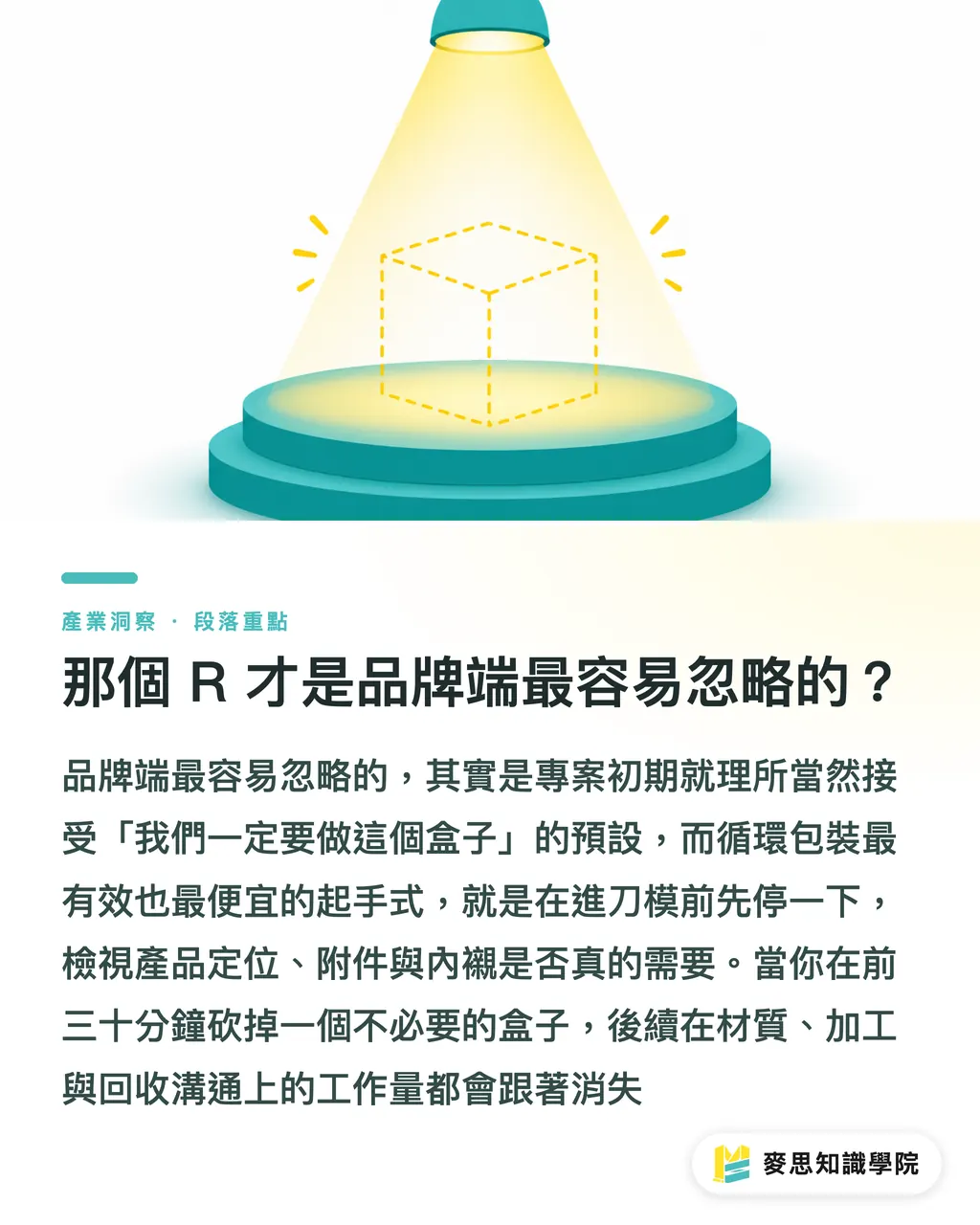
The answer is very clear: Refuse
Among the brand clients I have worked with, the most common design decision mistake is not choosing the wrong material. It is accepting the assumption at the very start of the project that "we definitely need this box." Cosmetics VIP trial kits, small accessory boxes for 3C brands, and secondary packaging for e-commerce platforms often turn out, after review, to not need that outer box at all
Brands can pause first in three places:
・Does the product positioning require physical packaging? For digital products, subscription services, and online-activated products, physical packaging is often overdesigned
・Can accessories be combined or made digital? Manuals, warranty cards, and quick installation guides can be converted into a QR Code printed on one sheet of paper
・Can the insert be removed? Many product inserts exist for display aesthetics rather than protection. The actual shipping protection comes from the outer carton
I often tell clients that the most eco-friendly packaging is no packaging. When you can cut an unnecessary box in the first 30 minutes of a project, the next 30 days of work on materials, finishing, and recycling communication disappear with it. Pause first. Do not rush into the die line. That is the cheapest and most effective opening move for circular packaging
Key Takeaways
・5R is an order, not a menu: start with Refuse, then Reduce, then Reuse, then Recycle, and only use Recover at the end
・Reduction comes before recycling: using one less sheet of paper saves more cost and carbon than recycling one ton of paper
・Reuse and Recycle follow opposite design logic: you have to choose a side first. You cannot mix them casually
・The recycling symbol is only an entry ticket: composite materials, full-bleed dark color, and lamination glue are the real main reasons for rejection
・The most effective circular design is to remove unnecessary packaging itself
Further Thinking
For print manufacturers, circular packaging is a shift in order structure. In the past, clients asked for packaging that was "beautiful and premium." Now, more and more brands first ask, "Will the recycling plant accept this box?" That means traditional finishing items such as die-cutting, lamination, and varnishing need to be redesigned, and production lines must build internal checks for material simplicity and ink restrictions
For graphic designers, the prepress checklist matters more than aesthetics. If a beautiful cosmetics box is rejected because its insert uses composite materials, the early design work is basically reset to zero. I suggest putting the circular 5R framework into the brief during the proposal stage and deciding with the client which R the project will follow, so you do not discover halfway through the design that the direction conflicts
For people working in AI applications and SaaS, this field has two tool opportunities worth entering. The first is automated compliance checking for materials and structures, where designers upload die-line files and AI automatically flags composite areas, full-bleed print areas, and hard-to-recycle parts. The second is packaging carbon estimation for brands, connected to material databases and recycling plant processing coefficients. Early products in both categories are already appearing in Europe and the United States, while the Taiwan market still has room to catch up
Further Reading
・How Should Circular Economy Packaging Be Designed? 5 Decisions from Source Reduction to Full Recycling Flow
FAQ
- What should come first in circular economy packaging design?
- First ask, "Can we skip the packaging?" Then ask, "Can we use less?" Refuse and Reduce are the two lowest-cost actions with the highest carbon reduction benefit, and they should come before Recycle
- Can a paper box be recycled just because it has a recycling symbol printed on it?
- Not necessarily. The recycling symbol is only an entry ticket. Whether a recycling site will accept it still depends on whether the main material is single-material, whether there is plastic coating or aluminum foil lamination, and whether the printing interferes with optical sorting. Composite materials and full-bleed dark printing are common reasons for rejection
- Which is more eco-friendly, Reuse or Recycle?
- It depends on the number of uses. Reuse has higher design costs and higher carbon emissions per item at the start, but if it is used enough times, it can bring down the average cost. Recycle is simpler to design and has a lower single-use cost, but every recycling and remanufacturing cycle still consumes energy. The two follow almost opposite design logic, so you have to choose a side first
- What is the most common recycling trap for e-commerce cartons?
- Full-bleed color printing combined with spot glossy film is the most common one. Dark colors and glossy film are picked out during optical sorting, which effectively turns that material into waste. A better approach is partial printing with restrained paper-based surface treatment
- Which types of packaging can reasonably go to energy recovery?
- Packaging made from inseparable composite materials, packaging contaminated by contents, medical or chemical packaging, and short-life marketing packaging are often more practical candidates for energy recovery than forced entry into the recycling system. But chlorinated plastics and heavy-metal inks should be avoided, since they can generate dioxin during incineration
Related articles
The Print × AI weekly
The print and AI know-how designers, brands and enterprises can use before they commit — one email, every week
MINDS Free Tools
AI background removal, a LINE sticker maker, spine & imposition calculators — all free, right in your browser, no upload.
MINDS Group
Need actual printing or gifting services?
From premium printing to online ordering and festive gifts — the MINDS Group sister brands take it from here.