
Why Recycling Centers Still Reject Boxes with the Triangular Recycling Symbol
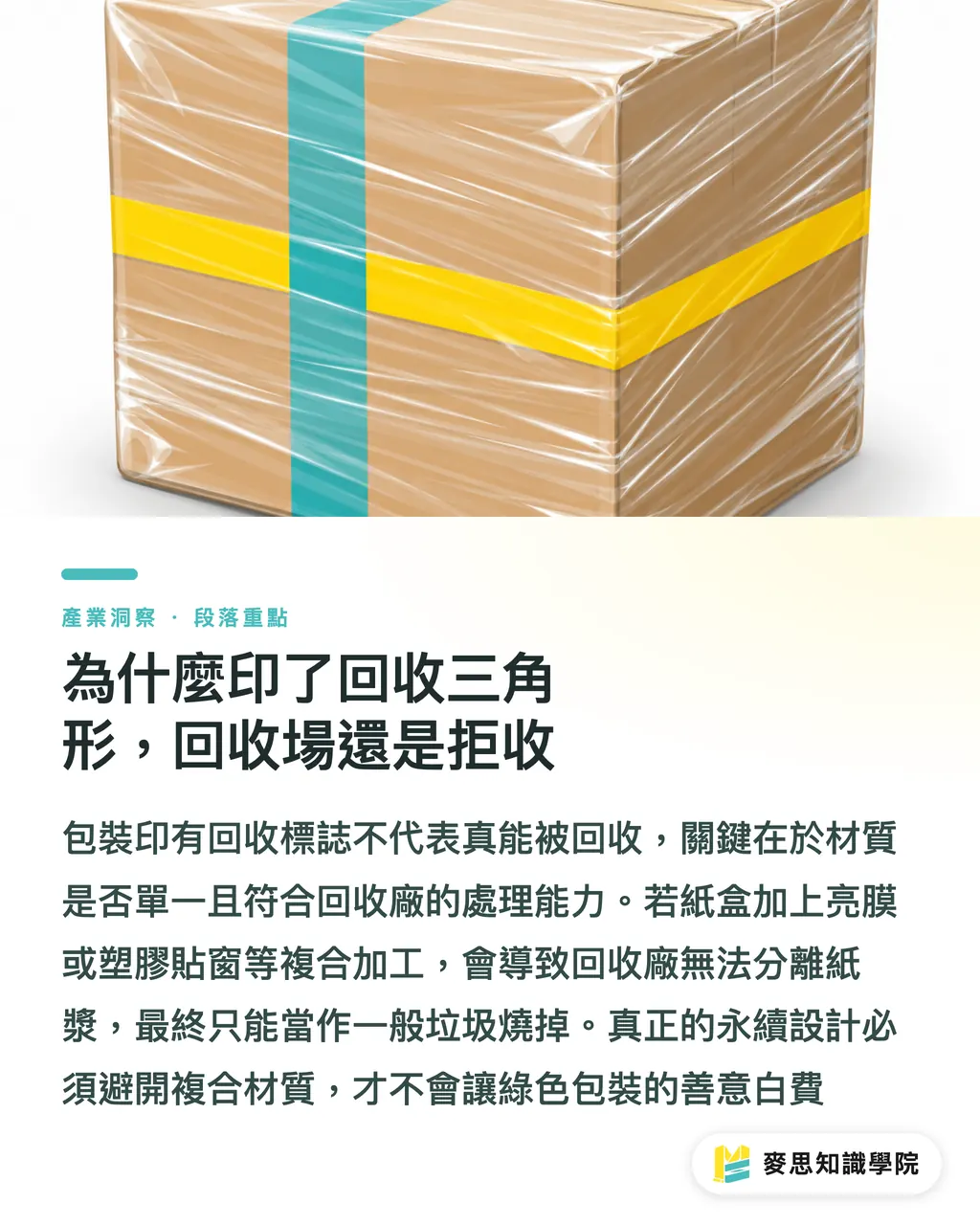
Having a recycling symbol printed on a package doesn't guarantee it will enter the circular economy. The key to whether a paper box is accepted by a recycling facility lies in whether it is made of a single material and avoids composite processes that interfere with pulp separation
At the MINDS production floor, the most common scenario we encounter is clients spending their budget on green packaging, only for the entire batch of boxes to end up being burned as general waste due to a single glossy lamination or plastic window
A key point must be clarified here: composite materials refer to processes where paper is tightly bonded with different materials like plastic film or aluminum foil. This makes it impossible for recycling plants to separate impurities in a single process, making it the number one landmine of sustainable design
The reality of recycling lies not in what the label says, but in whether the pulper at the recycling facility can process it
When front-line workers see a plastic film that cannot be torn off the paper surface, they usually pick it out and discard it immediately
This is what saddens me the most after years on the production floor: many brands start with the best intentions, only to stumble on the finishing process at the final mile
Do Lamination, Foil Stamping, and Plastic Windows Affect Paper Box Recycling?
This has been the most frequently asked question in my recent client meetings
To achieve scratch resistance, water resistance, or to create a premium brand feel, designers often add various post-press finishes. However, these choices are exactly what determines the fate of the packaging
Let me break down the most common finishing landmines we encounter on the production line:
・Lamination and Coating: Applying a BOPP plastic film (glossy or matte lamination) to the paper surface prevents the paper from pulping easily, making it the most common recycling killer. If water resistance is needed, eco-friendly water-based coatings are now available as alternative options
・Foil Stamping: This involves stamping metallic foil onto the paper. Small accent areas usually do not interfere with the pulp separation process at recycling facilities, but large-area foil stamping increases the difficulty of recycling
・Windows and Multi-Material Bonding: Gluing PET or PVC plastic sheets to expose the contents will cause the entire box to be rejected if there is no tear line designed to allow consumers to separate them by hand
・Magnets and Handles: Magnetic clasps hidden inside cardboard layers are a recycling plant's nightmare, and ribbon or cotton rope handles also require manual removal. Try to replace them with interlocking paper structures
The 'MINDS Printing (MS) Three Submission Gates' You Should Ask the Printer Before Pitching
To balance aesthetics and sustainability, we cannot rely on intuition or guess the manufacturing processes
Before the design is finalized and ready for production, I recommend that designers and buyers use the 'MINDS Printing (MS, mid-to-high-end fully customized commercial printing) Three Submission Gates' to review the packaging:
・Gate 1: Can this finishing process be replaced with a single material? Evaluate whether physical processes like embossing or debossing can replace foil stamping, or if paper tabs can replace magnets glued to the box body
・Gate 2: Are the joints of different materials easy for consumers to disassemble by hand? If plastic handles are absolutely necessary, the structure must be designed so that users can understand at a glance and easily remove them
・Gate 3: Can the fibers and weight of this paper withstand shipping friction without a protective lamination? Once the protective film is removed, you need to select paper with sufficient surface strength to resist wear and tear
If you get stuck during these steps, feel free to contact a sales representative at MINDS Printing with your die-line drawings. We can help you find realistic and feasible alternatives from both structural and paper material perspectives
How SMEs with Limited Budgets Can Tackle This
In recent years, regulations have become stricter, and when many brands want to introduce sustainable packaging, their first reaction is to worry that eco-friendly materials are too expensive
In fact, simplifying the finishing process can often reduce production costs
By skipping a layer of lamination or a foil stamp, the saved finishing costs can be used to upgrade the paper itself. For example, switching to uncoated paper with a natural texture allows the tactile feel of the material to carry the brand's tone
I have also seen many clever die-cut designs that use hollowed paper cutouts instead of traditional transparent plastic windows. The visual effect is more three-dimensional, and it completely solves the recycling pain point of composite materials
Focusing efforts on paper structure and layout design showcases a brand's design capabilities and sincerity far better than piling on various post-press finishes

Key Takeaways
・The recycling logo is merely an admission ticket; the key factors in determining whether packaging is recyclable are single-material construction and a dismantlable structure
・Lamination is the biggest killer of paper recycling. Try to replace it with water-based coatings or by selecting high-strength paper materials
・When different materials are unavoidable, mechanisms must be designed to allow consumers to intuitively dismantle them by hand
・Use the 'MINDS Printing (MS) Three Submission Gates' to screen finishing processes early in the design stage, preventing non-compliance issues discovered only after printing
・Budgets saved by reducing composite processing can be put toward upgrading the tactile experience of the paper itself and the structural design
Further Thoughts
From production realities, future packaging design will inevitably lean toward subtractive aesthetics
For designers and print professionals, what we need to practice is no longer how to stack various flashy finishing techniques together, but how to use the simplest materials and structures to achieve the dual task of protecting products and conveying brand value
Familiarity with paper properties and mastery of die-line structures will be the most competitive professional fundamentals for the next decade
FAQ
- Can paper boxes with matte or glossy lamination still be recycled?
- Usually not. The plastic film tightly bonded to the paper surface hinders the pulping process at recycling facilities. Most of this packaging can only be treated as general waste and sent to the incinerator
- Will foil stamping on the packaging affect recycling?
- Small-area foil stamping accents can be physically separated during the pulping process and will not affect overall recycling. However, full-surface, large-area foil stamping runs the risk of being rejected
- If a transparent window is required to display the product, how can it be designed sustainably?
- The preferred method is to use a die-cut hollow to expose the product directly. If dustproofing is absolutely necessary, ensure the transparent plastic sheet is secured with only partial adhesive and include a perforated line to guide consumers to tear it off
- Can magnetic clasps in the packaging be thrown into paper recycling?
- Absolutely not. Magnets hidden within the cardboard disrupt the recycling production line. It is recommended to use physical interlocking paper structures instead of magnetic closures
Related articles



The Print × AI weekly
The print and AI know-how designers, brands and enterprises can use before they commit — one email, every week
MINDS Free Tools
AI background removal, a LINE sticker maker, spine & imposition calculators — all free, right in your browser, no upload.
MINDS Group
Need actual printing or gifting services?
From premium printing to online ordering and festive gifts — the MINDS Group sister brands take it from here.