
Which Loophole Is the FDA Actually Closing?
The FDA is closing the information gap created by GRAS self-determinations. As reported by Packaging Dive on August 11, 2026, the FDA's proposed rule requires companies to submit more safety data before launching new ingredients and food contact substances, while also requiring retroactive notifications for existing self-determined substances
The FDA (US Food and Drug Administration) is the federal agency regulating the safety of food, drugs, and food contact materials in the United States. GRAS (Generally Recognized as Safe) is a safety pathway under US food law where companies determine a substance is safe based on expert consensus, historically allowing them to bypass prior FDA review
This GRAS framework has been in place since 1958, with the self-determination pathway established in 1997. The proposed rule is open for a 120-day public comment window, and the FDA has proposed a 45-day pre-filing review alongside a 180-day safety determination timeline. Print shops must treat these timelines as scheduling risks during intake instead of treating compliance as last-minute paperwork before shipment
Why Designers Are Directly Affected
Designers are directly involved because chemical risks in food packaging are often locked in at the layout specification stage. Food contact substances refer to components in packaging substrates, inks, coatings, and adhesives that may contact or migrate into food. The issue is not just whether a material visibly touches food, but whether it can migrate into food under actual conditions of use
For US-bound paper boxes, pouches, and coated papers, choosing full-bleed dark solids, spot UV, gloss lamination, heat-seal adhesives, or inner barrier coatings immediately triggers requirements for data on mineral oils, bisphenols, and photoinitiators. Photoinitiators are chemical compounds that trigger curing when UV ink is exposed to light, and their migration risks must be vetted specifically for food packaging
A migration test measures whether packaging components transfer into food or food simulants under defined temperature, time, and simulant conditions. Do not rush into production. A great-looking proof only means your colors are right, not that your materials are compliant
Which Materials Need Auditing First?
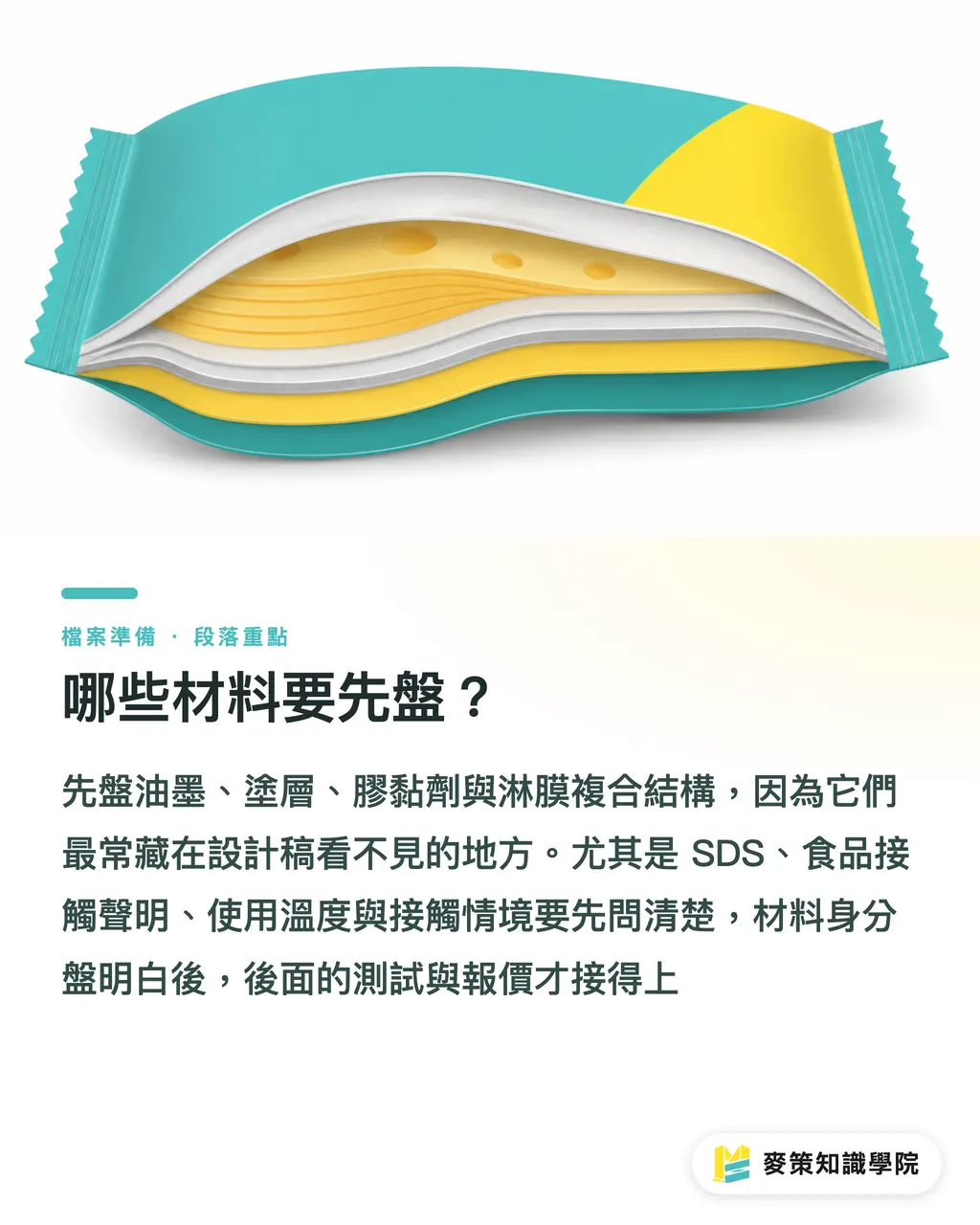
The first things to audit are inks, coatings, adhesives, and coated or laminated structures. These four areas are usually invisible in design files. The most dangerous phrase on a print shop floor is 'we have always printed it this way.' When US regulations shift, passing a previous shipment guarantees nothing for the next batch
・Inks: Verify whether they contain mineral oils, bisphenols, or UV photoinitiators, and clarify usage restrictions for both food-contact and non-food-contact sides
・Coatings: Add aqueous coatings, UV varnishes, release coatings, and barrier coatings to the bill of materials instead of just writing 'gloss finish.'
・Adhesives: Check SDS and food contact statements for pouch laminations, laminated paperboards, side-seam glues, and label adhesives
・Extrusion Coatings and Laminations: Specify service temperatures and contact scenarios for PE coatings, foil laminations, and retort pouch structures
That is the baseline. Once material identities are documented, testing and pricing can move forward on solid ground
How to Build Compliance Specifications into Pre-Press Files
Before finalizing pre-press artwork, write food contact risk specifications directly into the job notes rather than handing over only dielines, bleeds, and color codes. I use the Mai Strategy Three Print Checkpoints to review food packaging files, which designers can apply in Adobe Illustrator (AI) or InDesign before sign-off. Adobe Illustrator is a vector layout application where packaging dielines, bleeds, and spot colors are standardly finalized
・1. Material Checkpoint: Annotate inks, varnishes, laminations, coatings, and adhesives in the AI file or PDF. Avoid vague notes like 'standard material.'
・2. Condition Checkpoint: State whether food contact is direct or indirect, and specify conditions like refrigeration, microwave heating, retort processing, or extended pallet stacking. These conditions change migration testing parameters
・3. Documentation Checkpoint: Request the SDS, food contact statements, and material change notifications. An SDS (Safety Data Sheet) is a supplier document detailing chemical hazards, composition, and handling requirements
For US-bound gift sets, co-branded packaging, or premium cartons, partner with MINDS during early sampling to narrow down material and finishing options. For short-run online orders, review the product options on MINDS Print to select materials and finishes tailored to simpler food contact scenarios
How Brands Should Update Packaging RFPs
Brand RFPs must establish material responsibility as a condition for quoting, not just dimensions, quantity, unit price, and lead time. An RFP (Request for Proposal) outlines specifications, acceptance criteria, and vendor obligations. For food packaging, compliance documentation must be a prerequisite for acceptance
・Food Contact Statements: Require suppliers to certify that inks, coatings, adhesives, and substrates are suitable for the intended food contact scenario
・Change Notifications: Require raw material suppliers to provide advance written notice to both the brand and the print converter before substituting any ink, glue, or film
・Testing Responsibilities: Define explicitly in the RFP who pays for and provides migration testing, toxicological profiles, third-party lab reports, or existing FDA clearance status
・Scheduling Buffers: Factor in the FDA's proposed 45-day pre-filing and 180-day safety determination review periods so brand teams have enough runway when switching materials
In April 2026, New York approved its own mandatory GRAS notification system, adding state-level pressure on top of federal rules. If a brand waits until incoming inspection to verify compliance, the issue will not be whether the packaging could be printed, but that nobody will sign off on releasing finished goods
Key Takeaways
・Food packaging compliance starts before pre-press finalization, not after proofs are already made
・As GRAS self-determinations shift to mandatory notification, material supplier transparency will dictate how fast you can take on jobs
・Every unverified layer of ink, coating, or adhesive from the design stage adds direct return and recall risk for the brand
・Define material responsibilities clearly in your RFP so quotes are based on real compliance costs rather than guesswork
Strategic Considerations
For print converters, the next priority is building a searchable ledger of approved inks, coatings, adhesives, and films. For designers, pre-press checklists need a dedicated field for food contact conditions. For AI and SaaS teams, the highest-value feature is not generating pretty mockups automatically, but flagging material constraints, export destinations, and document statuses before pricing a job. If your team needs to turn food packaging pre-press workflows into an internal checklist, consult the Mai Strategy Knowledge Academy consulting team for a full specification audit
Further Reading
FAQ
- Will the FDA's proposed GRAS rule affect Taiwanese print shops?
- Yes, if the packaging is exported to the United States or supplied to US brands. Food cartons, pouches, and coated papers that use unnotified food contact substances may require supplementary safety data and notification filings
- What should designers verify before handing off food packaging artwork?
- First verify whether inks, coatings, lamination adhesives, label glues, and extrusion coatings are rated for food contact. Then confirm if there is direct food contact, and whether the package will face refrigeration, heating, retort cooking, or extended stacking
- What is the difference between GRAS and a Food Contact Notification?
- GRAS is a regulatory pathway where a substance is deemed safe based on expert consensus, which historically allowed self-determination. A Food Contact Notification (FCN) is a submission specifically for food contact substances, requiring manufacturers to provide intended conditions of use, migration data, and toxicological evidence for FDA review
- What minimum requirements should brands add to a packaging RFP?
- Brands should add at least four items: food contact statements, material change notifications, testing data responsibilities, and schedule buffers. Spelling these out ensures print shops know whether their quotes must account for compliance documentation costs
Related articles




The Print × AI weekly
The print and AI know-how designers, brands and enterprises can use before they commit — one email, every week
MINDS Free Tools
Imposition calculator and preflight file check — free prepress tools, right in your browser.
MINDS Group
Need actual printing or gifting services?
From premium printing to online ordering and festive gifts — the MINDS Group sister brands take it from here.