

Why Does Printing Ink Migrate into Food?
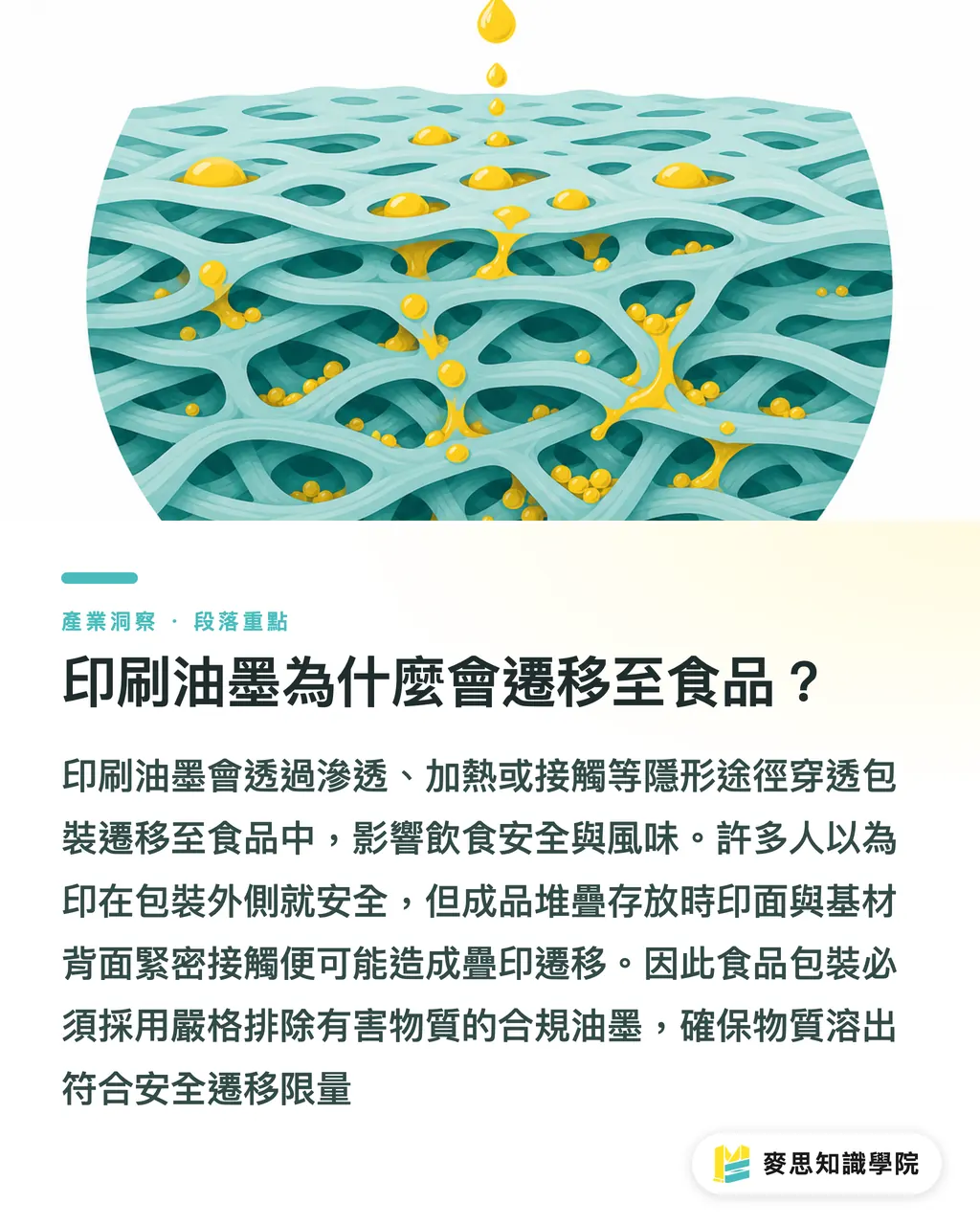
Printing ink migrates into food primarily because chemical components in the ink penetrate packaging substrates through processes like penetration, stacking contact, heat volatilization, or high-temperature retort cooking!
First, a standard definition for industry peers: FCM (Food Contact Materials) refers to packaging, label, and container materials that come into direct or indirect contact with food under normal use conditions! These materials must satisfy strict safe migration limits to ensure printing inks and chemical components do not leach out, taint food flavor, or jeopardize consumer dietary safety!
Based on my years observing production lines and client projects, many prepress designers assume packaging is safe as long as printing is on the outside. In reality, ink migration happens through 4 hidden pathways:
・Penetration migration: Ink molecules directly penetrate the pores of paper or film, seeping into the back layer of packaging that contacts food
・Set-off migration: When printed rolls are wound or finished proofs are stacked in storage, the printed surface comes into tight direct contact with the back of another substrate, transferring chemicals
・Gas-phase migration: During microwaving or heating, volatile organic compounds in inks and coatings form gas particles under heat and contact food
・Retort extraction migration: During high-temperature sterilization or high-pressure retorting, core components of packaging ink are extracted by fats or moisture
In the past, the industry often spoke of low-migration inks. Today, European and US regulations have unified the terminology to 'compliant migration inks'! Citing EuPIA's (European Printing Ink Association) Guideline on Printing Inks applied to the non-food contact surface of food packaging materials and articles and the Swiss Ordinance on Printing Inks, ink formulations must strictly exclude toxic heavy metals and carcinogenic compounds!
Why Is Packaging Still Rejected Even When Suppliers Have Ink Test Reports?
Having raw ink test reports alone does not mean the finished packaging is compliant. Food safety regulations ultimately inspect and penalize the finished packaging product, not individual raw ink ingredients!
Many brand buyers and prepress staff fall into a trap, thinking an SGS test report from the ink manufacturer makes everything bulletproof. Hold on! Inks must pair with specific barrier substrates (like virgin unbleached paper with heat-resistant, greaseproof coatings) and achieve complete curing and drying to build a complete safety defense system!
If a printer secretly swaps out auxiliary materials during production, or if printing speed doesn't match the UV curing lamp intensity, incomplete ink curing will cause migration levels to spike above legal limits! If you run into material or structural confusion during early planning, reach out to the MINDS Printing team for help assessing overall packaging material and ink compatibility!
Tighter regulations have also been a major focus in recent years! The German Printing Ink Ordinance takes full effect in January 2026, covering direct contact, foreseeable contact, and indirect contact scenarios. It will become a core standard for cross-border packaging! Additionally, the EU SUPD (Single-Use Plastics Directive) drives plastic reduction by banning traditional acrylic and polyurethane emulsions in paper packaging barrier coatings. Only un-chemically modified natural polymers are permitted, significantly raising technical hurdles for printing processes and coating formulations!
How Can Designers Perform Food Safety Self-Checks Before Prepress Hand-Off?
Designers and prepress personnel can run through the 'MINDS Three-Gate Check Before Printing' process before sending files to print, keeping quality tight from material structure and ink curing down to finished product testing!
This actionable 'MINDS Three-Gate Check Before Printing' covers three steps:
① Structural & contact surface evaluation: First, clarify whether the packaged food makes direct contact with packaging! If contact is direct, the printed surface must remain on the outer layer, and the inner layer must use virgin unbleached paper paired with compliant heat-resistant coatings. If using flexible packaging laminates, ensure the middle barrier layer has sufficient thickness
② Material-ink matching & curing verification: Confirm the choice of compliant migration inks adhering to the German Printing Ink Ordinance, and require the printer to explicitly state UV curing intensity, printing speed coating density, and lamp maintenance parameters on the print order
③ Finished product testing & document review: Check the final product extractables and migration limit test reports provided by the printer, and clearly mark greaseproof coating boundaries and processing bleed areas in the prepress file
Prepress hand-off self-check checklist:
・Prepress file specs: Ensure printed graphics maintain a safety margin of at least 3 mm from trim lines and inner fold lines to prevent set-off migration along edges during stacking
・Bleed & color settings: Verify that your Illustrator file is set to CMYK color mode to prevent color conversion from creating excessively heavy ink coverage that hinders drying
・Material barrier verification: Confirm that the inside of the paper box has a tested and approved waterproof and greaseproof coating, keeping the direct contact surface entirely free of ink
・Processing & note instructions: State the nature of contents (high oil, high acid, microwavable, or retort needed) on the print order and notes section, requiring the printer to run dedicated production lines to prevent cross-contamination
That's it! Solid execution on these points will dramatically slash your risk of rejected print jobs and costly returns!
How Can Gravure & Label Printing Adapt to Green Food Safety Regulations?
In response to international food safety and ESG regulations, flexible packaging and food label printing are rapidly phasing out traditional nitrocellulose inks, shifting toward high-barrier PU (polyurethane)-based inks and compliant label adhesives!
In gravure printing for flexible food packaging, traditional Nitrocellulose inks break down easily under high-temperature lamination and retort processing, releasing harmful substances. Because of this, the industry is making a full shift to PU ink systems! PU inks offer excellent heat resistance and adhesion while reducing volatile solvent usage!
When it comes to Food Label printing, you can't just focus on the front face stock and nutrition label printing. The Adhesive on the back carries its own risk of chemical components migrating through into the container's inner wall! Choosing pressure-sensitive adhesives and face stocks certified for indirect food contact is the real key to compliance!
Cleanliness and maintenance on the shop floor can't be ignored either! If a printer fails to thoroughly wash press lines and printing cylinders during job changes, leftover non-compliant inks or cleaning fluids will contaminate the entire run! Vehicle exhaust and strong odors in warehouse environments can also penetrate paper materials, causing gas-phase migration! For more practical case studies on green packaging transformation and compliance printing standards, check out the analysis compiled by the Mai Strategy Knowledge Academy Consultant Team!
Key Takeaways
・Food packaging compliance testing targets the finished product, not individual raw ink materials. Never rely solely on raw material SGS reports
・Ink migration occurs through 4 main pathways: penetration, set-off, gas-phase, and retort extraction. Prepress design must clarify the contact type of packaged contents
・Implement the 'MINDS Three-Gate Check Before Printing' prior to printing, strictly evaluating everything from structural judgment and ink curing to finished product extraction reports
・Gravure printing should speed up phasing out nitrocellulose inks in favor of PU-based inks, while label printing must focus on adhesive migration risks
・Prepress files must accurately set up CMYK colors and bleed boundaries, while print orders should explicitly specify high-oil or high-heat processing needs
Further Considerations
For graphic designers and print buyers, food safety and packaging compliance are by no means the sole responsibility of the printer, they are decided right at the initial prepress file setup! As the German Printing Ink Ordinance comes into full effect and EU plastic reduction policies advance, designers must build an integrated 'material-and-ink' prepress mindset, taking barrier structures, ink curing conditions, and adhesive safety into account early in the design stage! Printers and brand buyers should introduce GMP (Good Manufacturing Practice) standards and dedicated production lines. Only then can they minimize rejection risks and build brand trust under stringent food safety regulations!
Further Reading
FAQ
- Why can finished packaging still fail extractable limits even when using low-migration inks?
- Because compliance testing targets the finished packaging product! If fading lamps on curing equipment leave inks incompletely dried, or if the printer swaps in paper substrates with insufficient barrier properties, ink components will still migrate to the food contact surface via penetration or set-off!
- If food labels are printed on outer packaging, does the adhesive on the back carry migration risks too?
- Yes! Chemical components in the pressure-sensitive adhesive on label backings can migrate through plastic or paper containers via penetration or gas-phase migration. Food labels must therefore use face stocks and compliant adhesives that meet indirect food contact safety standards!
- What Illustrator prepress settings can designers use to help prevent ink migration?
- During prepress, strictly control total ink limit, keep graphics at least 3 mm away from trim and fold lines to prevent set-off migration, and note content attributes (high oil, high acid, microwavable/retort) on the print order so the printer can select appropriate compliant inks and curing parameters!
Related articles


The Print × AI weekly
The print and AI know-how designers, brands and enterprises can use before they commit — one email, every week
MINDS Free Tools
Spine width and imposition calculators — skip the manual math, free in your browser.
MINDS Group
Need actual printing or gifting services?
From premium printing to online ordering and festive gifts — the MINDS Group sister brands take it from here.