
Overview
Low Migration Ink is a specially formulated ink designed for food packaging. By carefully selecting low-molecular-weight raw materials and highly chemically stable resins, it helps keep the transfer of chemicals from the printed packaging layer into food within international regulatory safety limits
Why Can Packaging Ink Become a Hidden Food Safety Risk?
Packaging ink matters to food safety because consumers usually judge a product by its printed appearance, while small-molecule chemicals in the ink may pass through the packaging material and contaminate what is inside. In a 2026 food safety report, global ink giant Flint Group stated plainly that ink is not just a decorative layer. It can be a source of contamination. Regulators including the FDA, EFSA, and China's NHC have already set strict limits on chemical residues from packaging inks. If volatile solvents or photoinitiators are found leaching out during market sampling, the entire batch may face forced removal from shelves and a brand crisis
Food packaging printing is structurally divided into two main types: direct food contact (DFC) and indirect food contact (IFC)
・Direct food contact packaging (DFC): materials where the printed surface touches food directly, such as fruit labels and paper straws. These carry the highest regulatory protection requirements because the substrate cannot block any substance
・Indirect food contact packaging (IFC): packaging where a barrier layer sits between the printed surface and the food, such as dry noodle outer boxes or cheese outer wraps. But if the wrong barrier material is chosen, chemicals can still migrate through
Many brand owners think good-looking print is enough
Not so fast
If downstream purchasing ignores the low-migration properties of ink, the brand is often the one fooled by the proof. In regular production, working with a professional team like MINDS, which understands high-end fully customized commercial printing and packaging material properties, allows material barriers and chemical stability to be considered from the earliest printing stage, helping avoid costly shelf-removal losses later
How Do Ink Chemicals Migrate All the Way Into Food?
Ink chemicals migrate into food mainly through four pathways. Most of these chemical molecules are completely colorless and odorless to the eye. From more than a decade of advising production lines and clients, I have seen many food brands fail testing because they only guarded against "visible color differences" while ignoring "invisible chemical movement."
Common mechanisms of ink migration into food include:
・Diffusion migration: molecules from the printed layer slowly pass through paper or plastic film into the food as time and temperature change
・Set-off migration: when printed products are wound or stacked for storage, ink from the outer layer transfers by pressure onto the inner contact surface of the package below
・Gas-phase migration: volatile organic compounds evaporate into gas inside the closed packaging space, then condense and attach to the food surface
・Cooking or heat migration: during high-temperature sterilization or microwave heating, residual solvents are catalyzed by heat and released faster
There is also an extremely common purchasing blind spot here: specifying soy ink equals safe and eco-friendly
Simple
Soy ink mainly replaces petroleum-based solvents. But soy oil itself does not guarantee high curing performance or low migration. If the resin or photoinitiators in the ink formula do not meet food-grade low-migration standards, they can still contaminate food through gas-phase transfer or set-off. In addition, nitrocellulose (NC) inks, often used in traditional flexible food packaging, carry higher risks in heat resistance and solvent residue. The international mainstream is now moving faster toward PU polyurethane-based inks and water-based low-migration systems
How Should Brands Avoid Pitfalls When Buying Food Packaging Ink?
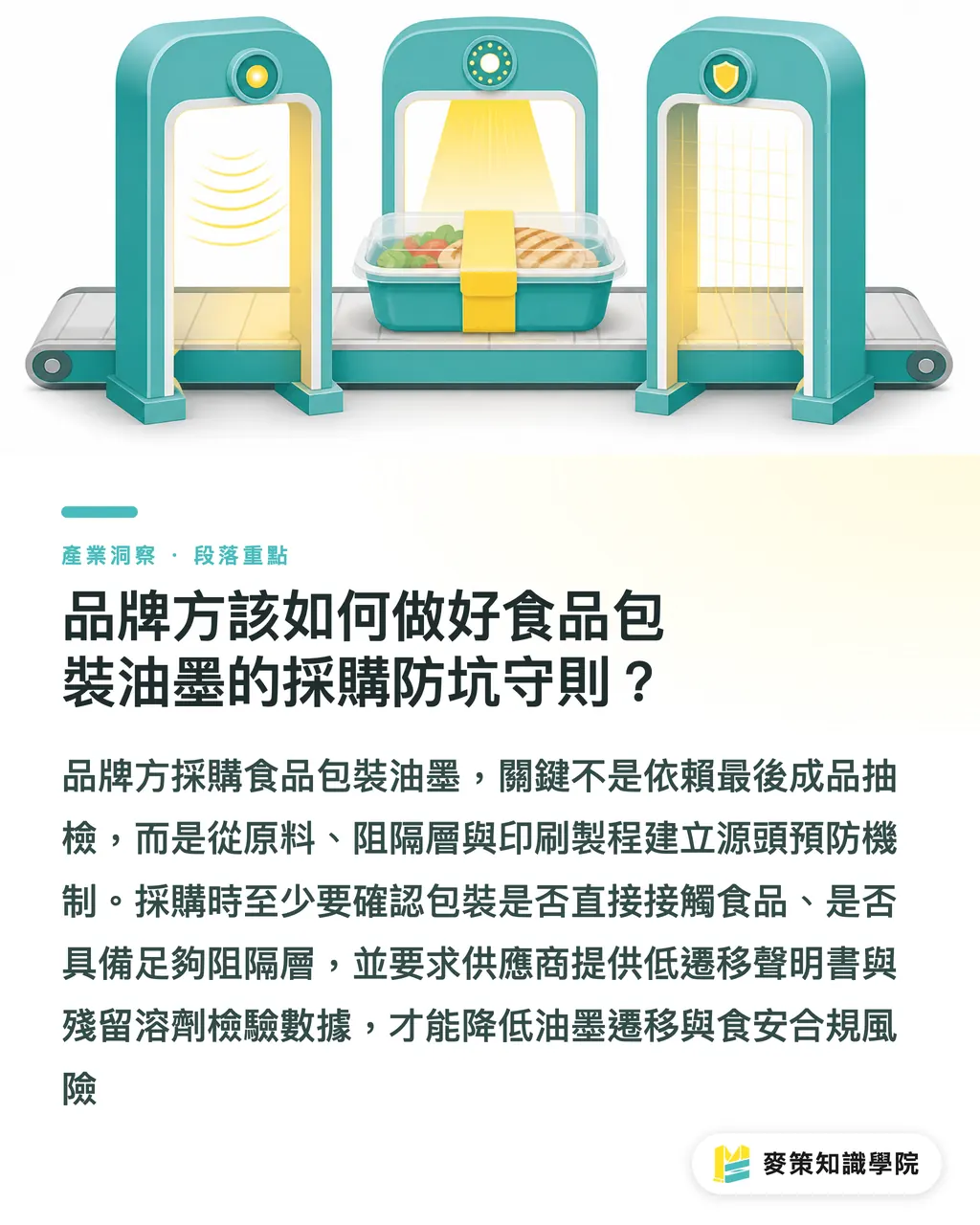
The key to safe food ink purchasing is building prevention at the source, rather than placing all food safety hopes on final finished-product sampling. A single test report cannot cover production-line variation. The work must start with raw materials and the printing process
Brand purchasing and design teams should adopt the "Mai Strategy Three Print-Submission Gates" review framework
・① Identify the food contact type and barrier-layer structure: confirm whether the packaging is DFC or IFC, assess whether the paper or composite film has enough chemical barrier performance, and avoid using standard ink on materials with no barrier layer
・② Check suppliers' low-migration compliance documents: require the printer and ink supplier to provide a Declaration of Compliance (DoC) for low migration that meets FDA or EFSA limit standards, along with chemical migration test reports
・③ Verify curing quality and solvent residue testing: require UV/LED low-migration ink or water-based ink, and ask for residual solvent test data from gas chromatography (GC) upon delivery to confirm complete curing and no off-odor
If the brand has questions about current packaging chemical compliance or ESG transition workflows, it can also seek a professional assessment from the Mai Strategy Knowledge Academy consulting team, which can help clarify compliance standards from design handoff through production print submission
Key Takeaways
・Packaging ink is not just visual decoration. Chemical migration risks directly affect food regulatory compliance and food safety
・Ink migration includes four major pathways: diffusion, set-off, gas-phase transfer, and cooking or heating. A soy ink label alone cannot guarantee low-migration safety
・Direct food contact (DFC) and indirect food contact (IFC) must be strictly distinguished. Substrates without a barrier layer must use high-standard low-migration formulas
・Purchasing decisions should apply the "Mai Strategy Three Print-Submission Gates" from the source, requiring suppliers to provide qualified low-migration proof and solvent residue test data
Further Thinking
Food packaging safety regulations are tightening worldwide. In the future, competitiveness in packaging printing will move from simple price comparison and color performance toward supply chain transparency and chemical safety. For Taiwanese food brands and print manufacturers, adding low-migration inks and PU or water-based green transition plans to ESG strategy early can prevent major regulatory risks from product recalls and build a food safety defense line that earns the trust of international buyers
Further Reading
FAQ
- Does soy ink always meet safe migration standards for food packaging?
- Not always. Soy ink replaces petroleum solvents with vegetable oil, but if the resin, pigments, and photoinitiator chemicals in the ink have not been formulated for low migration, they can still migrate into food during stacking or through gas-phase transfer. Brands must look for a low migration certification label
- What is set-off migration in packaging ink?
- Set-off migration means that when printed packaging is wound or stacked for storage, the ink on the outer printed layer comes into tight contact with the unprinted inner layer of the adjacent package above it. This causes ink chemicals to transfer to the inner layer, which can then directly contaminate food during filling
- What food safety documents should brands request from the printer before placing a packaging order?
- Brands should ask the printer for an ink Declaration of Compliance, low-migration test reports that meet FDA or EFSA requirements, and solvent residue analysis data from production-line shipments to confirm that both materials and processes are fully compliant
Related articles


The Print × AI weekly
The print and AI know-how designers, brands and enterprises can use before they commit — one email, every week
MINDS Free Tools
Spine width and imposition calculators — skip the manual math, free in your browser.
MINDS Group
Need actual printing or gifting services?
From premium printing to online ordering and festive gifts — the MINDS Group sister brands take it from here.