
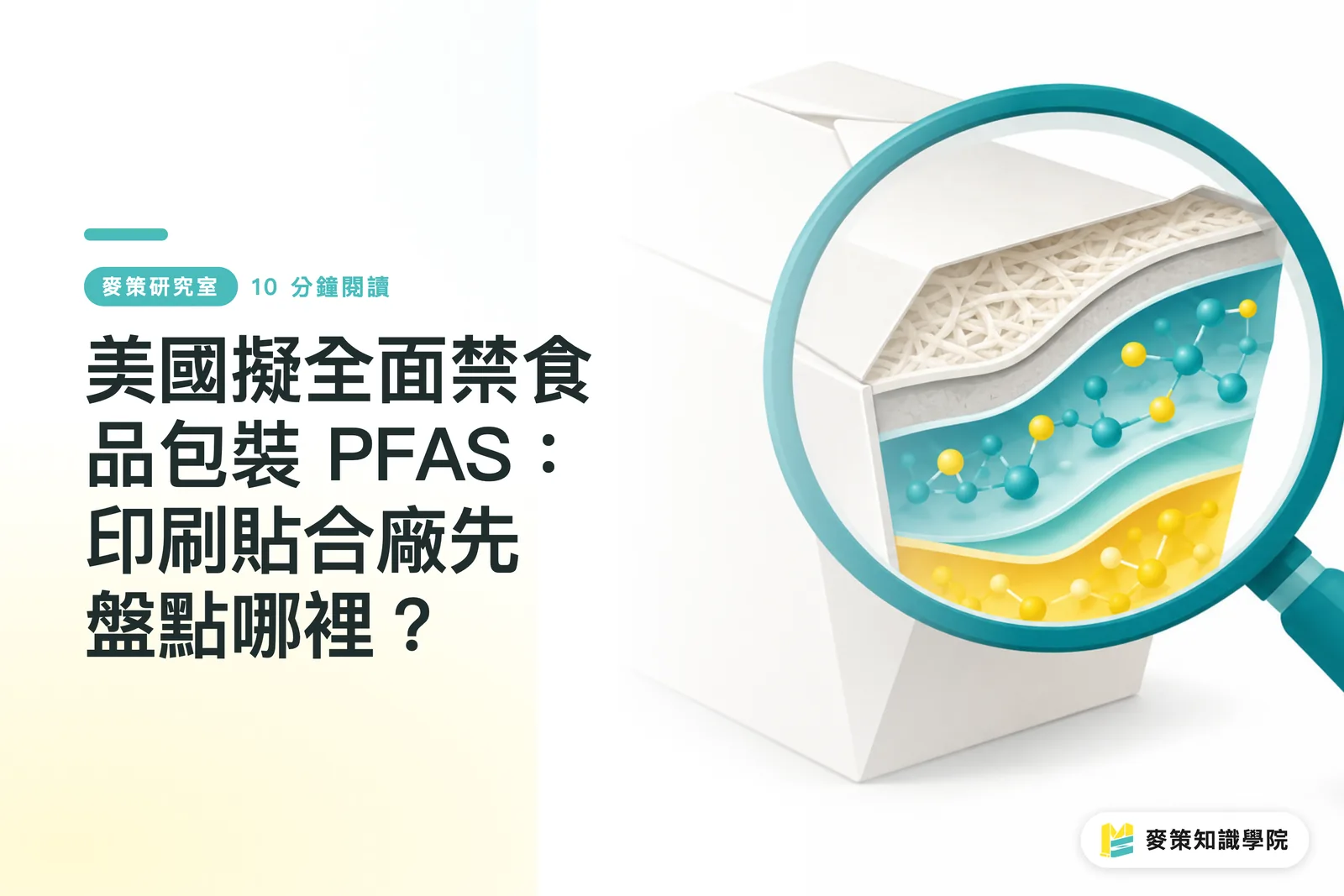
Overview
Last week, the owner of a company that exports folding cartons to North America messaged me: "The US is going to ban PFAS again. We only handle printing and varnishing, so this shouldn't have anything to do with us, right?" I hear this question a lot. The answer usually isn't the one people hope for. PFAS may not be in the main materials you purchase. They could be in grease-resistant coatings, varnishes, ink additives, or a formula a supplier changed without telling you. This article looks at what Taiwan's printing and laminating plants should check, what evidence they need to prepare, and when they should have it ready as the US considers a federal ban on PFAS in food packaging
What exactly would this US federal bill ban, and when would it take effect?
The bill would prohibit manufacturers from intentionally adding PFAS to food packaging. If the Senate version passes, the ban would take effect on January 1, 2028. According to Packaging Dive's report, the sponsors are Senators Maggie Hassan (Democrat) and Tommy Tuberville (Republican). The bill would amend the federal Food, Drug, and Cosmetic Act. In the House, Debbie Dingell introduced a similar bill in July
This isn't the first attempt. Hassan introduced the Keep Food Containers Safe from PFAS Act in 2021. It passed a Senate committee in 2022, then stalled. The bill could still get stuck, but two things stand out this time. First, it has sponsors from both parties. Second, the same report says more than a dozen US states have already passed laws restricting PFAS in packaging
My take: whether the federal bill passes isn't the main point. Customers' purchasing requirements have been tightening in response to state laws for some time. Federal legislation would simply make that line consistent across the country
Where could PFAS be hiding in a printing or laminating plant?
The most common place is the grease- and water-resistant functional layer on fiber-based packaging. Packaging Dive reports that PFAS have been widely used in paper wrappers and food containers because they perform so well against grease, heat, and water. Many packaging companies have chosen to stop using them in recent years
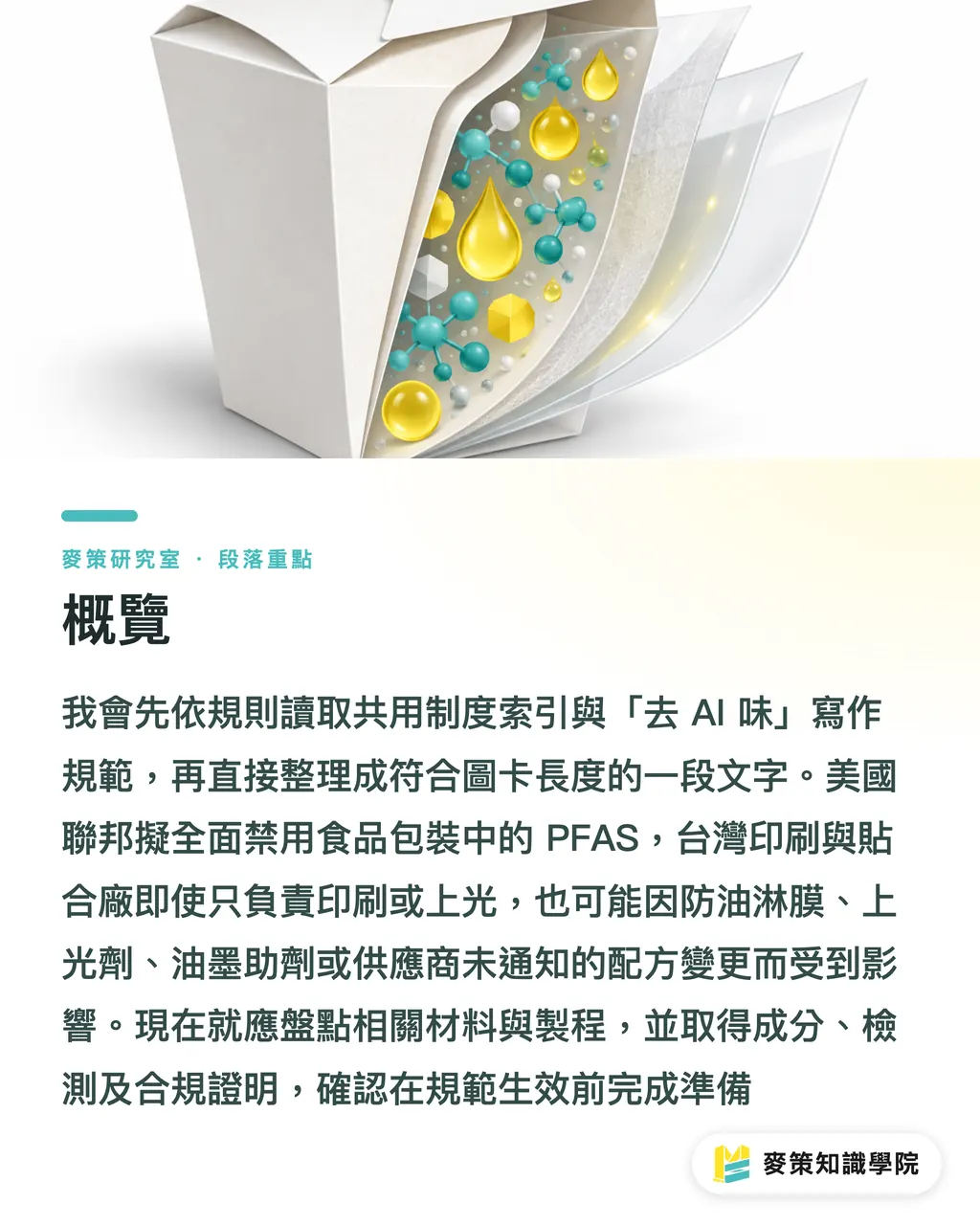
For printing and laminating plants, the risk is usually in the process materials, not the main substrate:
・Grease-resistant coatings and water-based barrier coatings: Older formulas or cheaper alternatives may still use fluorinated chemicals
・Varnishes and surface treatment agents: Some wear-resistant or anti-blocking formulas contain fluorinated waxes
・Ink additives: Some slip agents and scratch-resistant additives use fluoropolymers such as PTFE wax. Under a broad definition of PFAS, these substances could be included. That's my analysis; the definitions in the applicable regulations will determine the actual scope
・Laminating adhesives and release materials: Fluorinated ingredients sometimes show up where a low surface energy is needed
These materials have one thing in common: most don't appear on the customer's BOM. They're process materials the plant chooses for itself. Once a brand customer asks for a declaration that all packaging is free of intentionally added PFAS, the responsibility falls on you
How do you prove that PFAS was not intentionally added?
You need two kinds of evidence: written declarations from suppliers and third-party test results. Neither is enough on its own. The US FDA says the science and instruments needed to detect these "forever chemicals" at very low concentrations weren't available until 2012, according to the Packaging Dive report cited above. Once testing became possible, the claim "we didn't add any" could be checked
The EU has put numerical limits in place. The EU Packaging and Packaging Waste Regulation (Regulation (EU) 2025/40) restricts PFAS in food-contact packaging, setting limits based on three measurements: individual PFAS, the sum of PFAS, and total fluorine [1]. The EU's packaging waste policy addresses restrictions on these substances within the same set of rules as recycling and waste reduction [2]
For manufacturers in Taiwan, the distinction matters: the US bill uses intent, asking whether PFAS was intentionally added, while the EU uses measurable concentration limits. If you supply both markets, the simplest approach is to meet the stricter standard. A supplier declaration without total fluorine test results probably won't get past a European customer's audit
What three things should you do first?
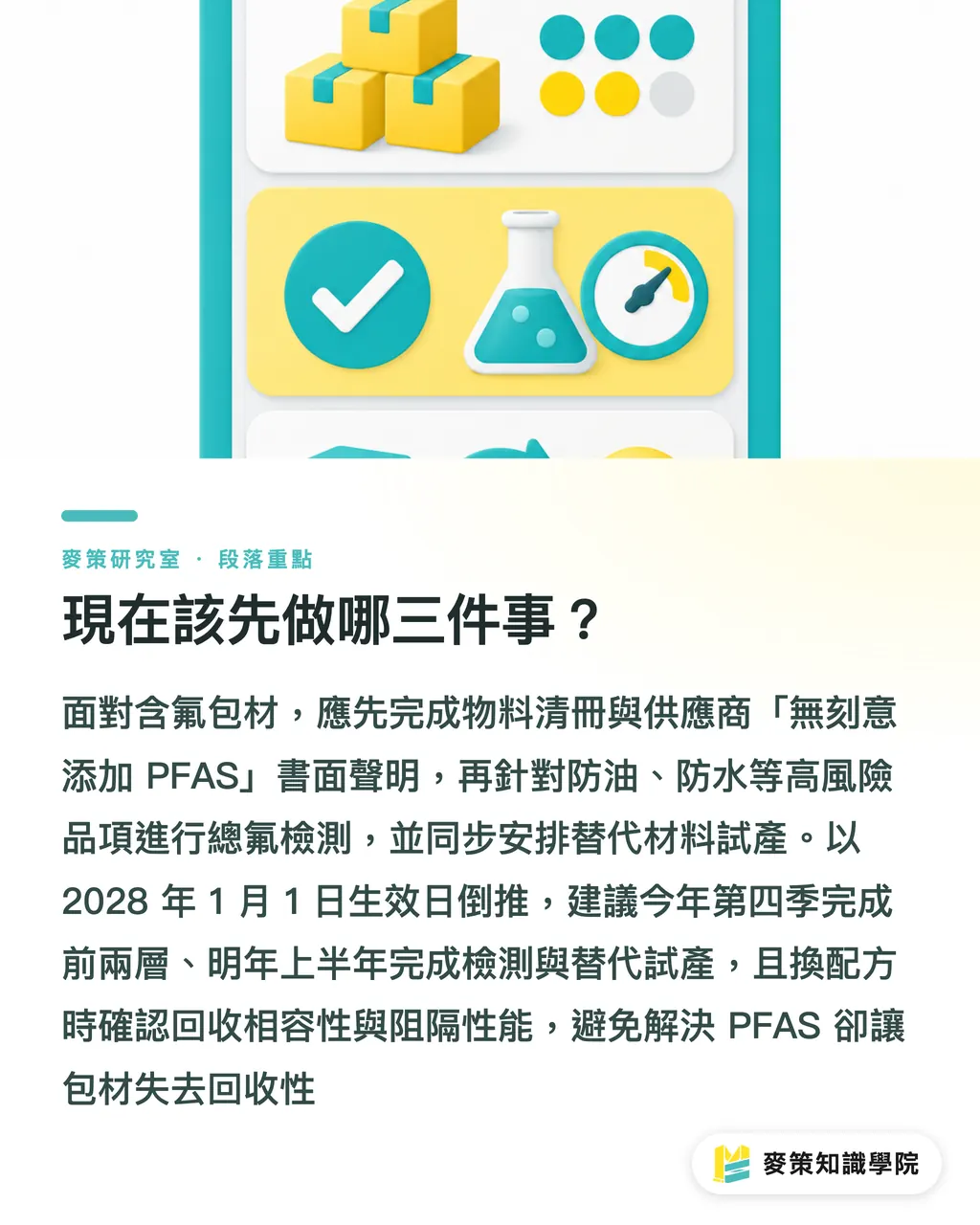
Start by checking your formulas, then get written declarations, and finally arrange testing and replacements. I call this the "three-layer check for fluorinated formulas":
・Layer one: Materials inventory. List every process material that may contact food packaging, including inks, varnishes, coatings, adhesives, and release paper. Record the supplier and formula version for each
・Layer two: Supplier declarations. Ask each supplier to confirm in writing that PFAS has not been intentionally added, and to state the scope of the PFAS definition they use. If a declaration doesn't say what definition it uses, treat it as no declaration at all
・Layer three: Testing and replacement. Send high-risk items, such as grease- and water-resistant functional layers, for total fluorine screening. If fluorine is found, align with brand customers on the pilot schedule for replacement materials
One thing about replacement materials often gets overlooked: a fluorine-free barrier coating isn't necessarily more "environmentally friendly." Research on packaging life cycle assessments reminds us to look at a material's full life cycle, not just whether it contains one chemical [3]. When changing a formula, check recycling compatibility and barrier performance too. You don't want to solve the PFAS problem only to end up with packaging that can't be recycled
Work backward from the proposed effective date of January 1, 2028. After allowing time for brand customer validation, pilot production, and inventory run-down, plants probably have only a little over a year of usable time. I recommend completing the first and second layers in the fourth quarter of this year, then testing high-risk items and running replacement pilots in the first half of next year
This approach has its limits. If your products don't contact food, such as general commercial print work or non-food retail packaging, or if your customers only sell domestically, the urgency is much lower. Still, definitions in US state laws and EU rules could expand the scope. The bill is also still a proposal. Its final wording, effective date, and exemptions could all change. Start the inventory now, but wait until customer requirements are clear before switching formulas at scale
Key takeaways
・A bipartisan US Senate bill would ban the intentional addition of PFAS to food packaging. If passed, it would take effect on January 1, 2028
・For printing and laminating plants, PFAS risks are more likely to be in grease-resistant coatings, varnishes, ink additives, and laminating adhesives than in the main substrate
・The US bill uses an intent-based standard, while the EU PPWR sets measurable limits for PFAS and total fluorine. Plants exporting to both markets should meet the stricter standard
・A supplier declaration alone isn't enough. You also need written documentation that states the PFAS definition used, along with total fluorine test results
・Assess recycling compatibility and life cycle impacts when choosing fluorine-free alternatives. Avoid replacing one problem with another
Further thoughts
PFAS rules are shifting packaging compliance from "printed correctly" to "materials clearly documented." For manufacturers, version control for process material formulas will become a condition for winning orders. A formula changed without notice, or changed without a record, can cost you a customer. For designers, functional requirements such as grease and water resistance need to be settled during specification, not handed to the plant to figure out after the artwork is finished. For AI adoption, a practical use is to have language models review supplier SDSs and compliance declarations, then flag a missing PFAS definition or an outdated formula version. For SaaS, the market gap is a traceability system that connects materials inventories, supplier declarations, test reports, and customer requirements in an audit-ready record. Plenty of questions remain: How will the final US federal rules define PFAS? Who will have to prove whether it was intentionally added? And who will bear the testing costs for smaller plants? All three will affect the real costs for manufacturers in Taiwan, so they're worth watching
References
[1] EUR-Lex: Full text of the EU PPWR. EUR-Lex
[2] European Environment Agency: EU packaging waste page. European Environment Agency
[3] Mendeley (indexing a Journal of Cleaner Production paper): Meta-analysis of packaging life cycle assessments. Mendeley (indexing a Journal of Cleaner Production paper)
FAQ
- When would the US federal PFAS ban for food packaging take effect?
- Under the bill introduced in the Senate by Hassan and Tuberville, the ban on intentionally added PFAS would take effect on January 1, 2028, if passed. The bill is still a proposal, and the final date could change
- Could food packaging PFAS rules affect a printing plant that doesn't make paper stock?
- Yes. PFAS may be present in varnishes, grease-resistant coatings, ink additives, and laminating adhesives selected by the printing plant. If a brand customer asks for a declaration that all packaging is free of PFAS, these process materials are in scope
- How can you prove that PFAS was not intentionally added to food packaging?
- You need two kinds of evidence: a supplier declaration that states the PFAS definition used, and third-party test results, such as total fluorine screening. If you also export to the EU, you need to meet the PPWR concentration limits for individual PFAS, the sum of PFAS, and total fluorine
- How does the US PFAS bill differ from the EU PPWR?
- The US bill uses an intent-based standard focused on whether PFAS was intentionally added. The EU PPWR sets measurable PFAS concentration and total fluorine limits for food-contact packaging, making its testing requirements more explicit
- Is switching to a fluorine-free coating always better for the environment?
- No. A replacement coating could affect recyclability and barrier performance. Assess a material's environmental impact over its full life cycle, not just whether it contains PFAS
Related articles



The Print × AI weekly
The print and AI know-how designers, brands and enterprises can use before they commit — one email, every week
MINDS Free Tools
AI background removal, a LINE sticker maker, spine & imposition calculators — all free, right in your browser, no upload.
MINDS Group
Need actual printing or gifting services?
From premium printing to online ordering and festive gifts — the MINDS Group sister brands take it from here.