
Overview
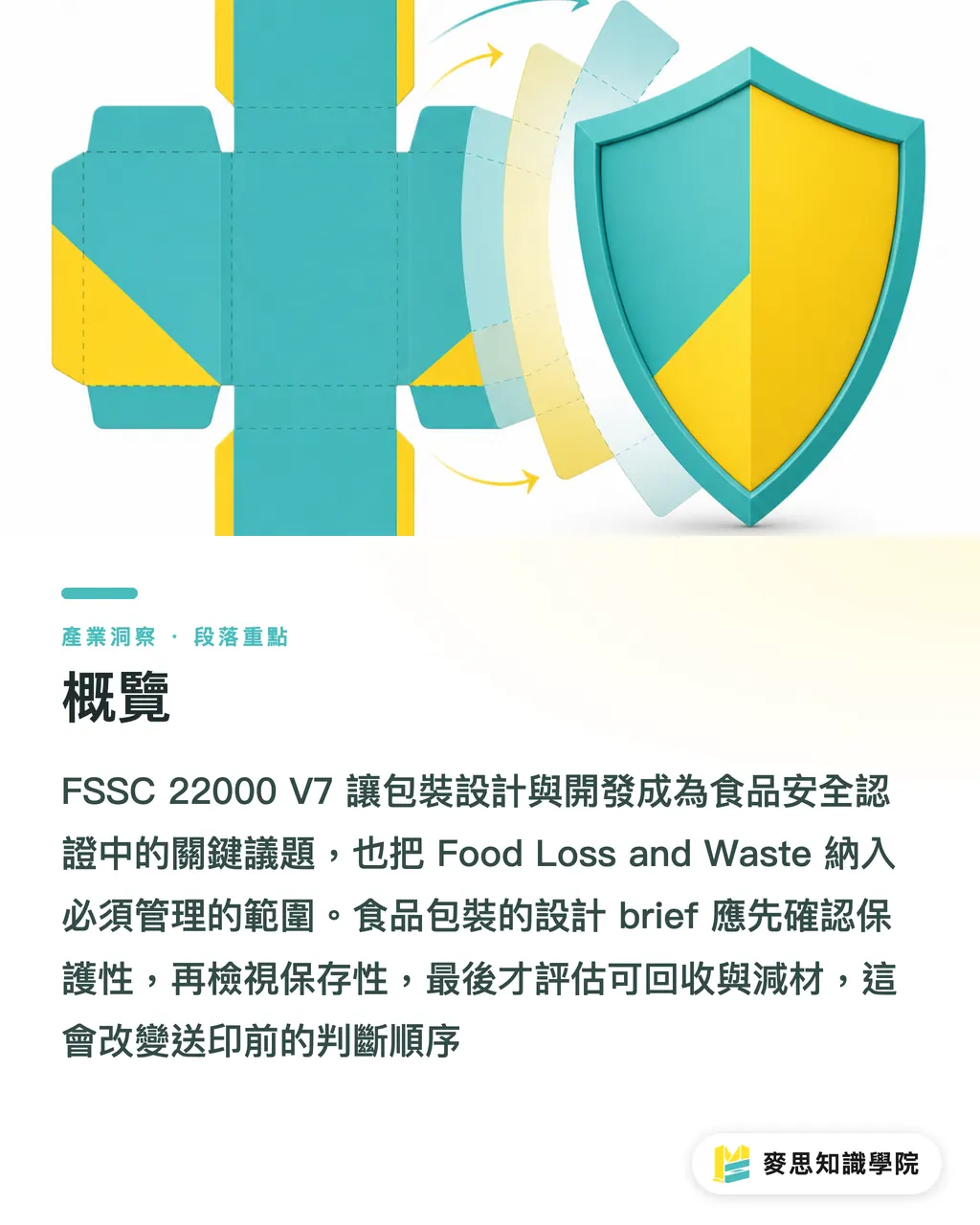
FSSC 22000 V7 adds new packaging design and development requirements and pulls Food Loss and Waste into the food safety certification scope. MINDS Printing (MS, a mid-to-high-end fully custom commercial printer) suggests a three-gate check for packaging production jobs: protection first, then preservation, and only after that recyclability and material reduction. That order reshapes how a food packaging brief gets written
What exactly did FSSC 22000 V7 change?
FSSC 22000 is a food safety management system certification framework that links ISO management systems with industry prerequisite programs. It's used to confirm that every link in the food chain can keep risk under stable control
As Packaging Insights notes in FSSC 22000 V7 food packaging waste reduction rules, Version 7 adds packaging design and development requirements. FSSC, working with WPO and AIP, folded Food Loss and Waste into packaging principles, and the impact reaches more than 40,000 certified organizations
My read on this is blunt: responsibility for food packaging has been reattached to the food itself. A lot of projects used to treat packaging as a print job, a container, or an ESG talking point. The new certification language puts packaging back inside the food chain and asks whether it can get food through the supply chain safely, stably, and intact
Food Loss and Waste means the amount of food lost or thrown away between production, transport, retail, and before household use, because of spoilage, handling problems, or simply not getting finished
Why can't food packaging only talk about recyclability?
Recyclability still matters, but food packaging has to hold up in four scenes first: early protection after production, crushing and temperature/humidity swings during transport, shelf life at retail, and the conditions before and after the consumer opens it
Printers know the pain usually sits in small details: where a seal sits, one coating choice, a window cut size, one label's information hierarchy. Any of these can change how well packaging blocks light, moisture, oxygen, stacking damage, and identifiability. These details almost never show up in a slick visual pitch, but they're often what decide whether packaging survives the field
Now that FSSC 22000 V7 puts Food Loss and Waste inside packaging principles, designers can't just write "10% less plastic" or "mono-material" as the win condition. Brands can't wave a recyclability logo and call sustainability done either. If food gets scrapped early because the packaging didn't protect it, that lighter-looking package just moved the waste somewhere else
How should mid-size printers move responsibility upstream?
MINDS Printing's three-gate check for packaging jobs works as a framework mid-size printers can use to talk with food brands. You don't need to wait until files are finished to find out the material, structure, and preservation conditions don't line up
・Gate one, protection: nail down what the package has to defend against. Usually moisture, breakage, crushing, leaks, light exposure, or odor transfer. This needs to be settled before material and structure design starts
・Gate two, preservation: confirm the food's timeline from factory to opening, the temperature range, the retail channel, and how it gets stacked. You can't judge food packaging design from a static shelf mockup alone
・Gate three, recyclability and material reduction: only after the first two gates hold, then talk paper conversion, plastic reduction, mono-material, ink and surface finishing choices
I'd suggest Taiwan's mid-size printers build these three gates into a pre-quote questionnaire. Ask about preservation and logistics conditions at least one more time, and turn down a rush job with incomplete info. That often saves more than patching up a batch of returns later
How should designers and brand buyers rewrite the brief?
A food packaging brief has to grow from "size, material, print method, quantity" to "product state, preservation conditions, logistics path, opening scenario." Those four columns pull design and print decisions much closer to real-world use
・For designers: leave room in the layout for preservation instructions, batch numbers, expiry dates, barcodes, or QR codes that actually stay readable. Food packaging info isn't done when it fits, it has to stay clear on the shelf and at home
・For brand buyers: when comparing quotes, don't stop at unit price for the same spec. Ask the vendor to spell out material choices, processing limits, and transit risk. All three directly affect food waste
・For packaging printers: when you proof, don't only check color accuracy and die-cut. Loop back and ask about product weight, retail stacking, and whether it's chilled or ambient. Ask those questions early and the client trusts you more, not less
If a food brand is revising its packaging materials, bring MINDS Printing in early in the brief to discuss material, structure, and print constraints together. By the time the design is locked, most of the responsibility has already been cemented into the wrong choices
Key Takeaways
・Sustainability in food packaging starts with cutting food waste, then looks at how much material you trimmed
・FSSC 22000 V7 pulls packaging design into the food safety conversation. Printers can't sit at the end of the line anymore
・Good packaging has to hold up across four scenes: production, transport, retail, and pre-household-use
・The thing mid-size printers most need isn't new equipment, it's that pre-quote brief that asks the right questions
・The recyclability logo is an outcome, not where food packaging design starts
Further Thinking
For print manufacturing, FSSC 22000 V7 pushes food packaging jobs into material and structure discussions earlier. For designers, visual pitches have to draw in preservation, identifiability, and the opening scenario all at once. For AI and SaaS teams, the opportunity is turning the packaging brief into checkable fields: preservation conditions, logistics path, material limits, compliance notes, version history. Every revision should leave a trail. The advisor team at Mai Strategy Knowledge Academy looks at this issue and the point isn't to make packaging sound more complex, it's to help brands skip one mistake before sending to print that would end up scrapped
Further Reading
FAQ
- What does FSSC 22000 V7 have to do with food packaging?
- FSSC 22000 V7 adds packaging design and development requirements and brings Food Loss and Waste into packaging principles. Food packaging now needs to show it helps protect and preserve the food inside
- Why can't food packaging only be judged on recyclability?
- If food packaging doesn't protect well enough, the food can be wasted during transport, at retail, or before use. Recyclability still matters, but it has to be weighed alongside food safety, preservation, and real-world use conditions
- How should Taiwan's mid-size printers respond to FSSC 22000 V7?
- Mid-size printers can add four question categories before quoting: product state, preservation conditions, logistics path, and opening scenario. That moves them out of the file-output seat and upstream into packaging design
- What extra fields should a designer add to a food packaging brief?
- A food packaging brief should include preservation conditions, retail channel type, stacking method, expiry date, and where batch info sits. That ties visual design and material choice to the responsibility of keeping the food safe
- How can brand buyers reduce food packaging risk?
- When comparing quotes, brand buyers should ask vendors to explain material choices, processing limits, and transit risk. Comparing unit price on the same spec alone tends to hide preservation and scrap costs
Related articles


The Print × AI weekly
The print and AI know-how designers, brands and enterprises can use before they commit — one email, every week
MINDS Free Tools
AI background removal, a LINE sticker maker, spine & imposition calculators — all free, right in your browser, no upload.
MINDS Group
Need actual printing or gifting services?
From premium printing to online ordering and festive gifts — the MINDS Group sister brands take it from here.