
Why is the Epson F370 a good fit for personalized-product shops?
The Epson SureColor F370 suits small personalized-product shops because it packs heat-transfer printing into a compact body, supports 13×19-inch prints, and lowers the barrier to first-time operation with guided touchscreen setup
On September 23, 2026, Epson announced the F370 at Printing United Expo, a U.S. printing-industry trade show. It introduced Sublimation Primer for Cotton at the same event, giving small shops a chance to consider the equipment and material together when planning purchases. A small shop can start by testing small runs of varied personalized products, then decide whether to scale up. See Epson's official press release: SureColor F370 and Cotton Primer
Officially, the target users are creators, small businesses, schools, and growing customization shops. The F370 is positioned as a way for users to produce saleable samples first. A small shop does not need to estimate from the scale of a full production line on day one
The F370 supports wireless, USB, Wi-Fi Direct, and mobile printing. Epson also lists a one-year limited warranty and technical support. These features handle file intake and operation. Someone at the shop still needs to oversee heat pressing, quality checks, and packing. A compact machine does not make the workflow automatic
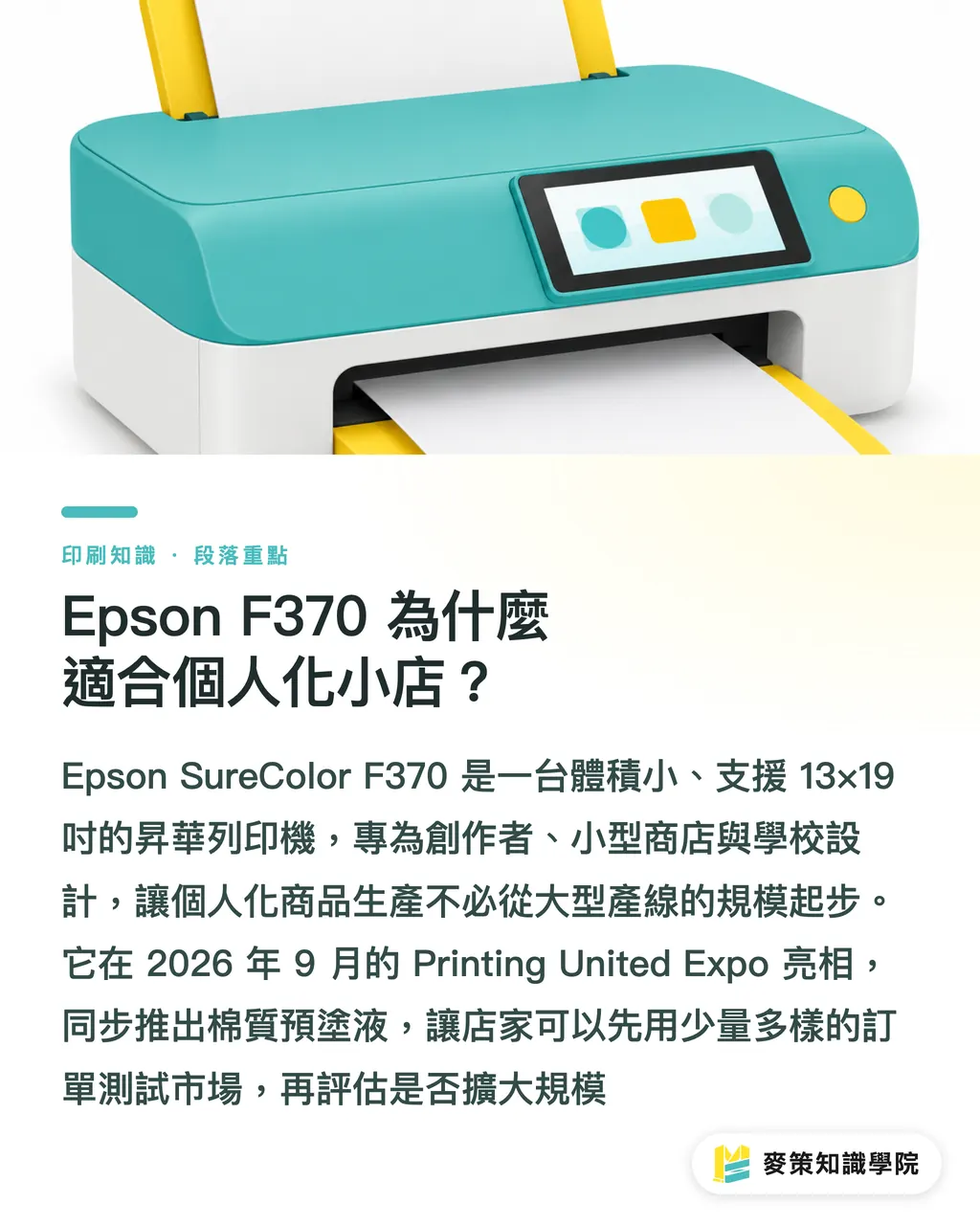
How does the cotton primer expand the scope of heat-transfer printing?
The cotton primer brings white and light-colored cotton apparel into the dye-sublimation workflow, giving small shops a way to test custom cotton garments alongside traditional polyester products
Dye-sublimation printing puts the image on transfer paper first, then uses heat to move the dye into a compatible material, allowing the image to bond and develop its color on the finished product
Polyester fibers typically accept this type of dye, while cotton fibers behave differently. Epson therefore uses Sublimation Primer for Cotton to add a dye-receptive coating to the fabric before heat transfer
I see this as one more step in the material workflow. It does not mean every cotton fabric automatically becomes printable. Epson's announcement specifically refers to white and light-colored cotton apparel. Dark cotton garments, different weaves, and finished garment surfaces should be sampled one by one. Confirm the primer application, drying, and heat-transfer settings against the product instructions and the fabric conditions
How does the F370's design fit small-shop work?
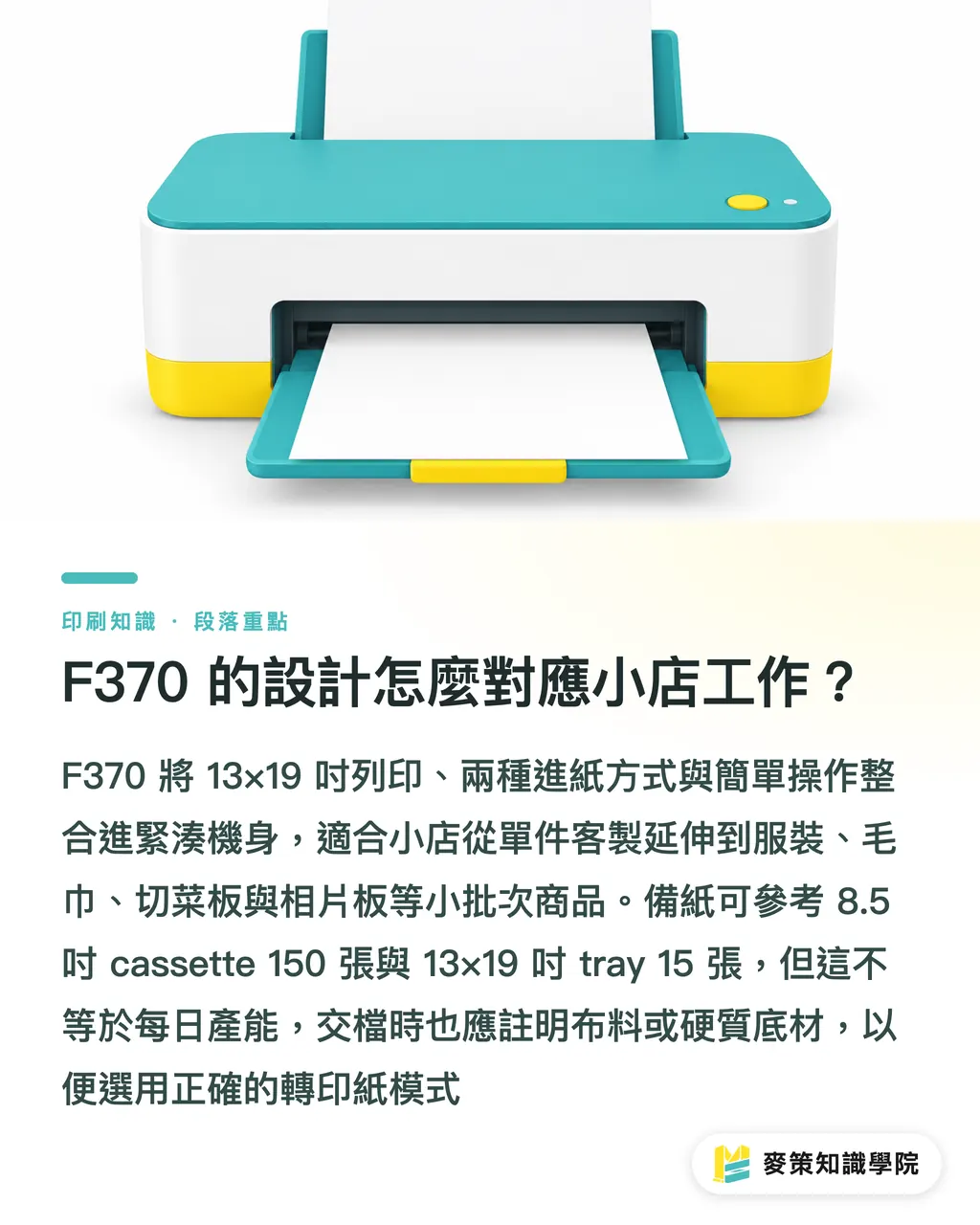
For small shops, the F370's most practical design choices are its 13×19-inch print size, two paper-feed options, and simple operation in a compact body. That lets an order start with small-format sheets and one-off custom jobs
Official specifications list an automatic-switching 8.5-inch cassette that holds 150 sheets and a 13×19-inch tray that holds 15 sheets. These numbers help a shop plan paper supplies, but they are not daily production capacity. Primer application, heat pressing, cooling, inspection, and packing still have to happen afterward
The official application list includes the following:
・Apparel and towels, suitable for small-batch personalization
・Cutting boards and photo panels, extending into hard-surface products
・Home décor, signage, and promotional items, for testing different applications
Transfer Paper Modes adjust print settings for fabric and hard-surface products. When handing off files, the designer should state the substrate clearly rather than sending only an image file
Is the F370 and cotton primer worth the investment for a small shop?
It is worth running a small-batch validation first, but a shop should not shift its entire product line to cotton before testing the substrates
・Pros: 13×19-inch printing and a compact body suit small shops with limited space that want to start with small custom runs
・Pros: The cotton primer brings white and light-colored cotton garments into the test range, expanding product options
・Cons: Cotton products add primer application and sample-management work, so the process cannot simply be copied wholesale from polyester products
・Cons: The announcement does not list wash-resistance conditions and processing parameters for every type of cotton fabric, so purchasing decisions should not be based on a display sample alone
When I assess equipment like this, I first ask whether the shop can reproduce the result consistently instead of letting the first pretty sample make the decision. The 8.5-inch cassette holds 150 sheets, and the 13×19-inch tray holds 15. Those are paper-feed capacities, not finished-piece counts. What the shop needs to calculate is the hands-on time per product
How should Taiwan's small and midsize manufacturers respond to this demand?
Taiwan's small and midsize manufacturers should start with custom products that use small quantities and clearly defined substrates, then pass the sample specifications to the design, order-intake, and manufacturing teams
Check the materials first
Do not rush to place an order. Make samples first
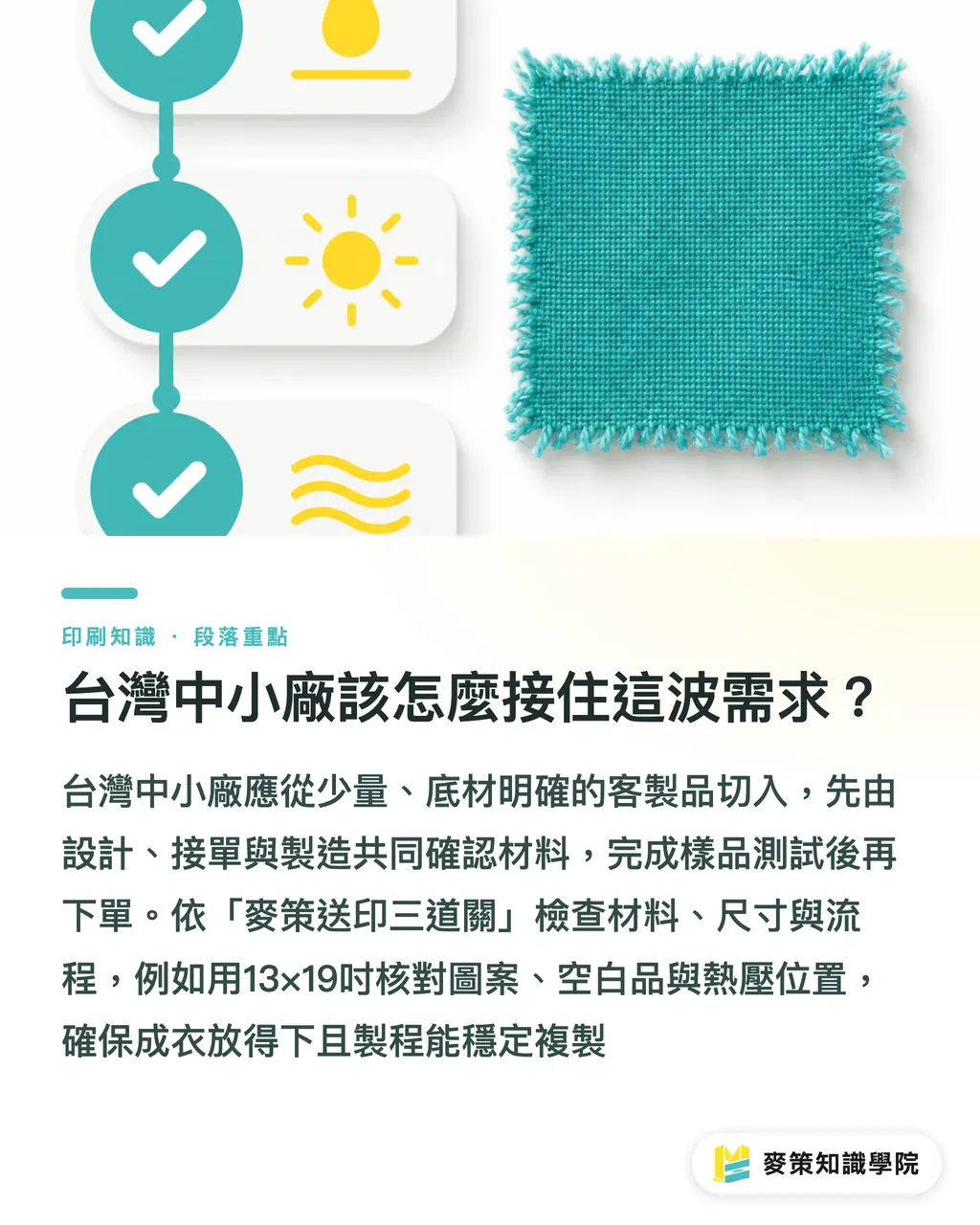
I would use Mai Strategy's three-gate proofing check to organize sample testing
・① Material gate: Test white and light-colored cotton apparel separately from polyester products, and record the color, hand feel, and appearance after heat transfer
・② Size gate: Use the 13×19-inch format to check the artwork, blank product, and heat-press position. This prevents a file from fitting the format while the garment cannot fit on the press
・③ Workflow gate: Run printing, primer application, heat transfer, and packing once from start to finish. Record the labor time, then adjust the process according to Epson's guidance and the fabric conditions
For small-batch testing, contact Mai Printing (MYS). For high-end, fully customized work, contact MINDS (MS) to confirm the production process. For SaaS (software as a service) providers, product fields should at minimum state the substrate color, whether primer is required, the 13×19-inch limit, and the proofing conditions
Key takeaways
・The F370's entry-level value lies in its compact body and 13×19-inch working size, which let a shop start with small-batch products
・The cotton primer expands material choices, but white and light-colored cotton apparel still needs to be sampled item by item
・The 150-sheet cassette and 15-sheet large-format tray are paper-feed specifications, not finished-product capacity
・A custom-order page should clearly state the substrate, color, primer requirements, and proofing conditions
Further thoughts
AI-generated artwork can speed up style proposals, but it cannot verify the hand feel, color, or usable heat-press area after cotton priming. The design team should first bring the artwork variations into one shared size spec, then the production team can make the final call with a physical sample. The SaaS order page should spell out the substrate color, primer requirements, and proofing status so there is one less round of back-and-forth before delivery. The next step is simple: make a material card first, recording the substrate, artwork dimensions, processing conditions, and the customer's confirmation
Further reading
FAQ
- Can the Epson SureColor F370 print on cotton apparel?
- With Epson's Sublimation Primer for Cotton, the F370 can bring white and light-colored cotton apparel into the dye-sublimation workflow. Epson's announcement does not list dark cotton garments or every cotton product as universally supported
- What does 13×19 inches mean on the F370?
- It is the print working size. It is not the same as the usable area on a garment, and it does not represent actual capacity once heat pressing, inspection, and packing are included
- Should a small shop buy the equipment first or test the products first?
- Make samples on the substrates you plan to sell first. Confirm the color, hand feel, workflow, and turnaround time, then decide whether the F370 fits your order rhythm
- Can cotton primer replace polyester heat-transfer printing?
- The cotton primer is a way to bring white and light-colored cotton garments into dye-sublimation printing. It expands the range of materials you can test, but polyester and cotton products still need separate settings and sample checks
Related articles





The Print × AI weekly
The print and AI know-how designers, brands and enterprises can use before they commit — one email, every week
MINDS Free Tools
Imposition calculator and preflight file check — free prepress tools, right in your browser.
MINDS Group
Need actual printing or gifting services?
From premium printing to online ordering and festive gifts — the MINDS Group sister brands take it from here.