
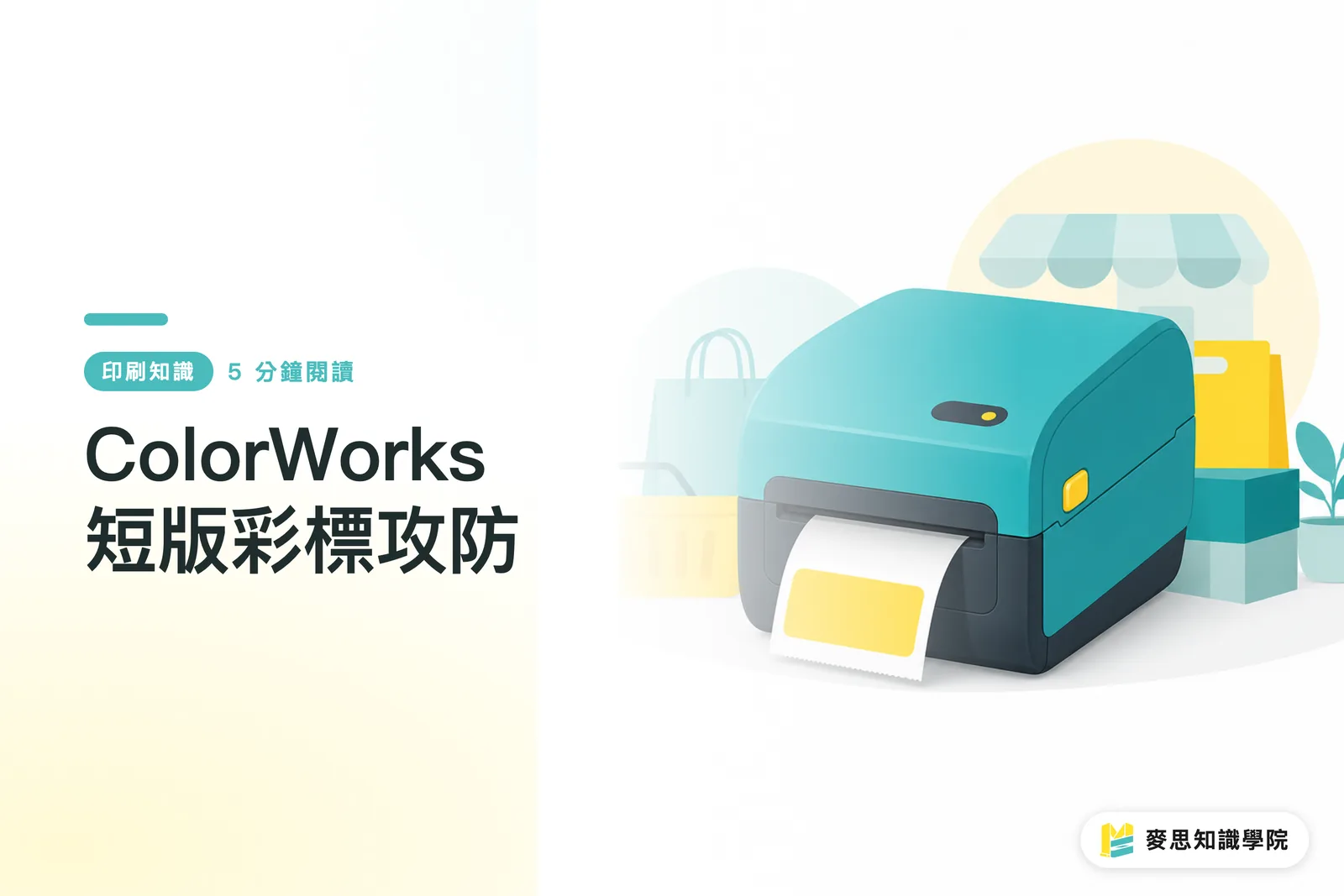
Who Does Epson ColorWorks Actually Impact?
The key takeaway from the Packaging Insights report is Epson introducing ColorWorks, a small color label and badge printer line targeting small businesses, on-site instant printing, and short-run needs under 500 pieces, priced around the $10,000 mark. This isn't the heavy-machinery logic of traditional print shops; it puts color label capabilities right inside small brands' own shops
Short-run color labels refer to product labels with small print volumes per run, fast version changes, and full-color needs. They are common in new product market tests, event badges, seasonal packaging, and restocks for small e-commerce sellers
I've seen plenty of these needs on the ground. Clients don't lack printing knowledge, they just can't wait through proofing, file revisions, scheduling, and delivery. When 300 stickers need to hit shelves tomorrow, a desktop printer looks extremely attractive
・Who takes the hit: Rush label orders under 500 pieces with simple files and basic material requirements
・Who holds the ground: Labels requiring special materials, die-cuts, finishing, retail compliance, and brand consistency
・Who loses out first: Vendors selling nothing beyond 'printing it out for you,' because Epson is moving that capability right onto the client's desk
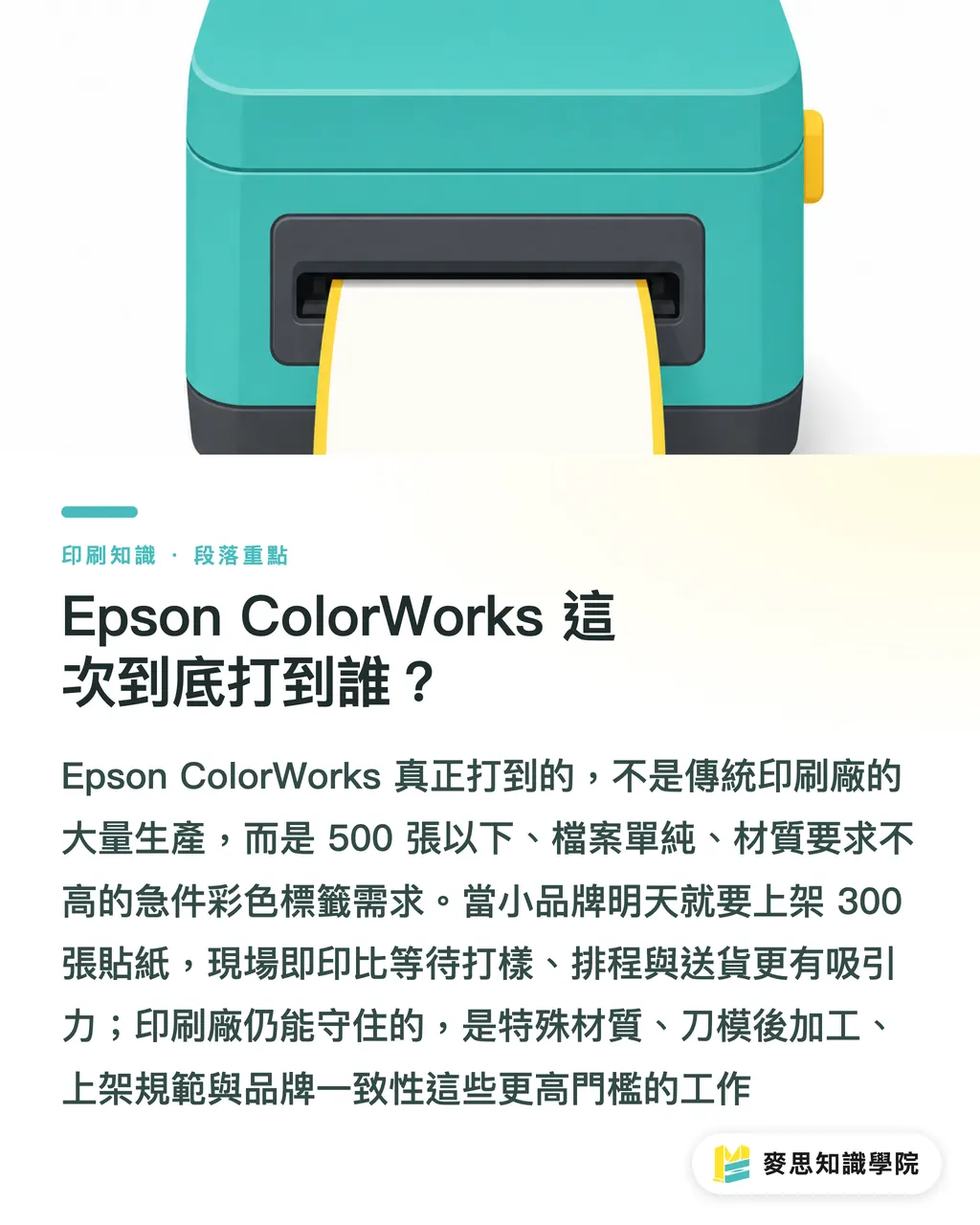
Why Has the Under-500 Segment Become a Battlefield?
Orders under 500 pieces used to be what many label shops hesitated to take, yet couldn't afford to drop. Multiple layouts, fragmented communication, and profit margins frequently eaten up by proofreading time. Epson ColorWorks carved out this segment, hitting small brands right where it hurts: changing product names today, changing flavors tomorrow, and restocking stickers the day after
This puts real pressure on small and medium label shops in Taiwan. Brand clients will start asking a painful question: For this volume, wouldn't it be faster if I just printed it myself?
Yet print shops don't need to view this purely as lost business. Buying a $10,000 machine doesn't automatically deliver good labels. Brands will still run into bottlenecks with color management, label substrates, barcode readability, curved bottle surfaces, cold storage conditions, and overall packaging visual consistency
I suggest print shops divide low-volume rush orders into three handling approaches:
・Low-risk tier: Event badges, temporary stickers, and internal inventory labels, where self-printing by clients is perfectly fine
・Medium-risk tier: Food, skincare, and small-batch product labels, where print shops can advise on design and materials before assisting with printing
・High-risk tier: Labels needing water or oil resistance, refrigeration durability, reliable barcode scanning, and long-term shelf presence. These should still be handled by professional printers
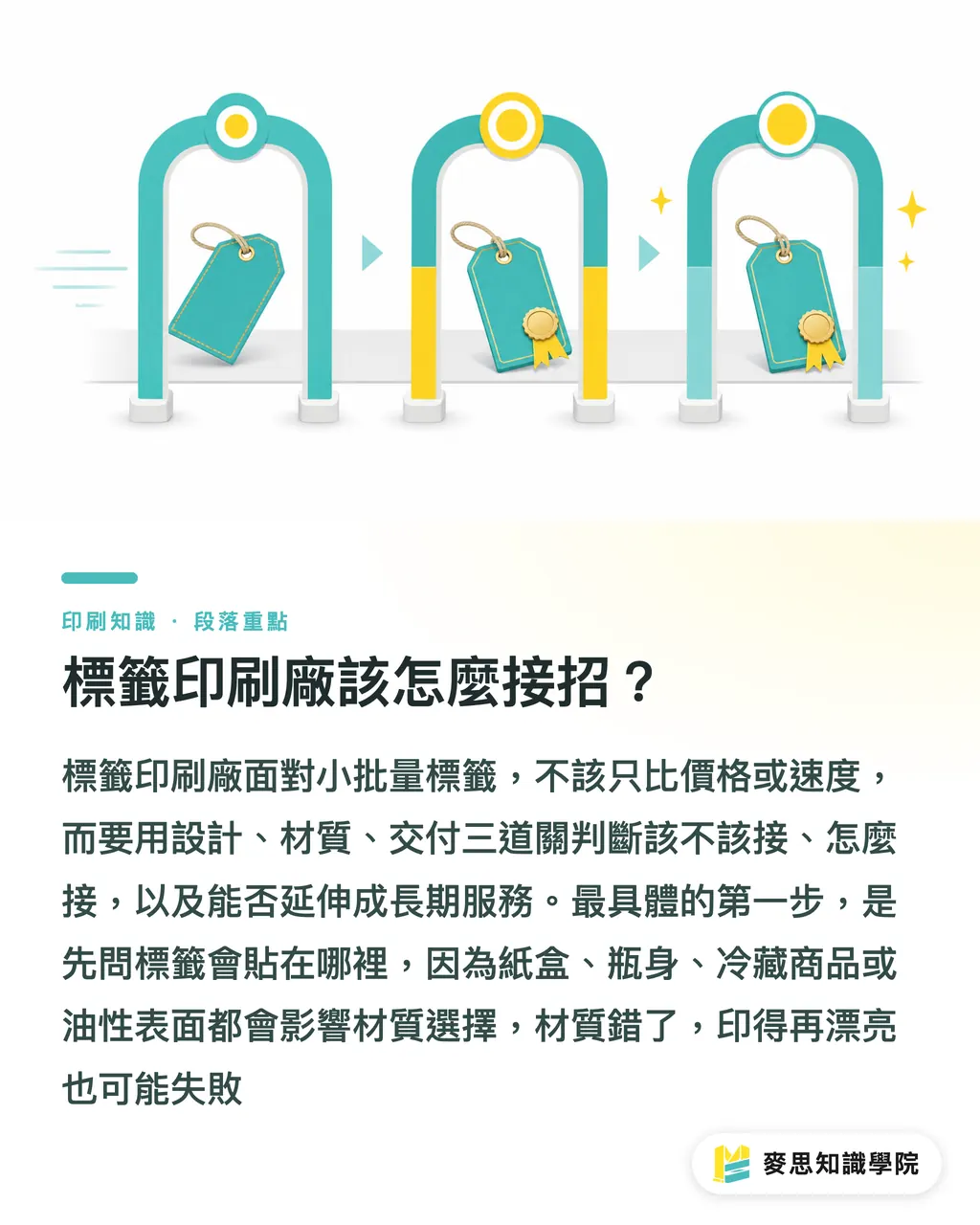
How Should Label Print Shops Respond?
The three-stage checklist for short-run labels from MINDS (MS) can be used directly to evaluate whether to accept a small-batch label job, how to execute it, and whether to convert it into a long-term service
・① Design Stage: Check text hierarchy, product names, regulatory text fields, barcodes, and color consistency first. Even for under 500 pieces, the layout shouldn't feel like a makeshift sticker
・② Material Stage: Ask where it will be applied first: cartons, bottles, refrigerated goods, oily surfaces, or event badges. If the substrate is wrong, even the most beautiful print will fail
・③ Delivery Stage: Break rush orders into design sign-off, output, slitting, packaging, and logistics, showing clients that fast turnaround isn't just about a fast machine
For mid-to-high-end fully custom commercial printing services like MINDS, the takeaway from ColorWorks is treating 'small runs' as an entry point into the client lifecycle. First help brands get their initial label version right, then connect subsequent catalogs, packaging, displays, and shipping labels
For mid-to-low-cost online ordering retail print services like Mai Print, the opportunity lies in simplifying specifications so clients can quickly order stickers, labels, and small-run packaging collateral. The point isn't competing with desktop machines on per-unit cost, but winning on file reliability and delivery stability
Should Brand Clients Buy Equipment Themselves?
If you only need event badges, temporary item stickers, or internal management tags a few times a year, on-site instant printers like ColorWorks genuinely make sense. The under-500 scenario mentioned by Packaging Insights is the classic sweet spot for self-printing
However, brand clients need to calculate three cost pillars first:
・Equipment cost: A $10,000 investment upfront, plus consumables, maintenance, raw stock inventory, and staff labor time
・Quality cost: Color, substrate, barcode accuracy, weatherability, and trimming. If any single factor slips, the issue is magnified once products hit shelves
・Brand cost: If the same product looks inconsistent across official websites, retail stores, expos, and e-commerce platforms, small brands lose consumer trust first
My recommendation is straightforward: print new product trial runs, event badges, and internal tags in-house. For official commercial releases, long-term sales, and labels needing brand consistency, handing them over to professional printers is much safer
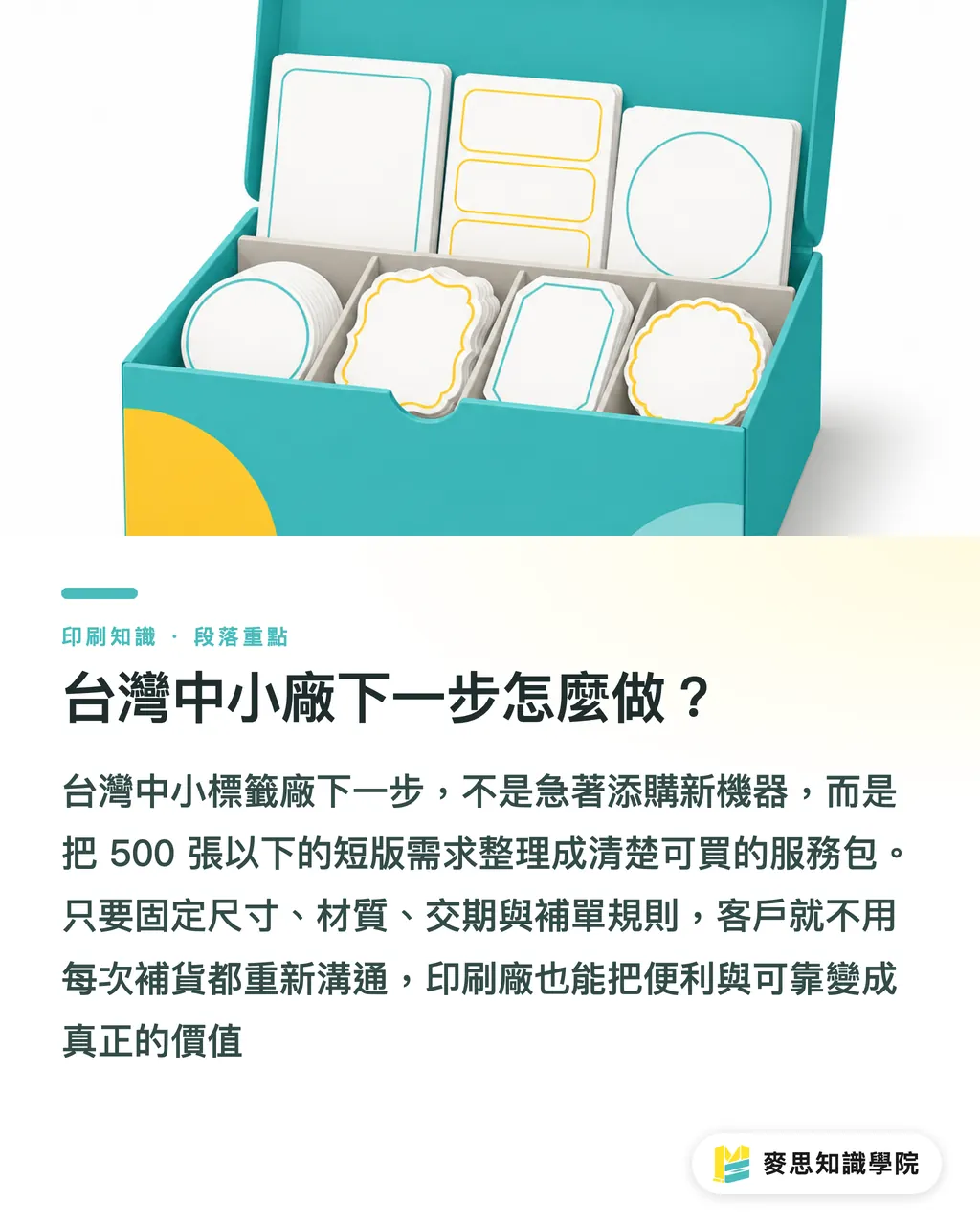
What Is the Next Step for Taiwan's Small and Medium Print Shops?
What Taiwanese label shops need to add isn't a new machine, but packaging under-500 demand into ready-to-sell service bundles. That way, clients don't have to choose between 'buying equipment' and 'requesting quotes from print shops.'
I would start adjustments with three actions:
・Turn short-run labels into fixed-spec packages, explicitly listing dimensions, substrates, lead times, and acceptable file formats to cut down on back-and-forth Q&A
・Make design preflighting a paid service, assigning responsibility for barcodes, font sizes, bleeds, regulatory fields, and label positioning
・Include logistics and reordering in quotes. The value of under-500 orders often lies in 'getting restocks tomorrow,' not just 'printing them out today.'
Lately, when talking labels with several brand clients, what I hear most isn't 'I want the cheapest option,' but 'I don't want to explain everything from scratch every time I reorder.' That statement belongs on every print shop wall
Key Takeaways
・Epson ColorWorks pushes color labels under 500 pieces into brand premises, meaning print shops will lose low-tech rush orders first
・Desktop equipment solves speed, but cannot fix substrate issues, color matching, barcode accuracy, or brand consistency
・Label shops should sell a reliable small-batch workflow across design, substrate selection, and delivery, not just printing a sticker
・The three MINDS (MS) short-run label checkpoints: clear design first, confirm substrate second, track delivery third. Only then does short-run printing turn a profit
・Brand clients can self-print temporary needs, but official retail labels should still leave quality management to professionals
Further Thoughts
For print manufacturers, ColorWorks is a wake-up call to productize short-run rush jobs instead of pushing 300-label orders through large-run workflows. For designers, label artwork isn't just about visual appeal; it must account for barcodes, font sizes, substrates, and label placement. For AI and SaaS teams, practical tools that truly land are preflight checks, version management, restock alerts, and substrate recommendations, not just generating a pretty label graphic
Further Reading
FAQ
- What impact does Epson ColorWorks have on Taiwan's label print shops?
- Epson ColorWorks will absorb a portion of color label demand under 500 pieces that feature simple specs and need urgent on-site printing. However, it will also push Taiwanese label shops to turn design, substrate selection, finishing, and logistics into clearer value-added services
- Are color label runs under 500 pieces suitable for printing in-house?
- Event badges, temporary stickers, and internal management tags are good candidates for self-printing. For official retail product labels involving barcodes, refrigeration, water resistance, brand colors, and regulatory fields, relying on a professional printer is much safer
- What are short-run color labels?
- Short-run color labels are product or event labels characterized by low print volumes per run, frequent version changes, and full-color requirements. They are common in new product market tests, small e-commerce, seasonal packaging, and exhibition badges
- How should label print shops deal with equipment like ColorWorks?
- Label print shops should package under-500 requests into fixed-spec services, bundled with design preflighting, substrate advice, and reorder logistics, so clients buy a dependable process rather than mere print output
- What types of requests are best suited for MINDS and Mai Print?
- MINDS is best suited for mid-to-high-end, fully customized label, packaging, and commercial print integration. Mai Print is best suited for mid-to-low-cost, clear-spec, online-ordered small-quantity sticker and retail printing needs
Related articles

The Print × AI weekly
The print and AI know-how designers, brands and enterprises can use before they commit — one email, every week
MINDS Free Tools
AI background removal, a LINE sticker maker, spine & imposition calculators — all free, right in your browser, no upload.
MINDS Group
Need actual printing or gifting services?
From premium printing to online ordering and festive gifts — the MINDS Group sister brands take it from here.