
Why Is Post-Press the Real Bottleneck in an Era of Labor Shortages?
Over the past six months visiting print shops across central and southern Taiwan, owners consistently told me their biggest headache isn't getting orders, but finding workers to run machines. We often assume capacity limits stem from front-end printing speeds, but the reality on the shop floor is different. When digital presses hit high outputs of 100 ppm, relying on manual shifts for downstream collating, folding, jogging, and packing renders front-end speed useless. On top of that, US May CPI hit a three-year high, and this inflationary pressure directly impacts packaging supply costs, forcing us to confront shop-floor efficiency head-on. To handle orders while keeping margins intact, filling the labor gap in post-press is an urgent priority

What Pain Points Does Epson's First Cobot Demo Solve on the Shop Floor?
That is why I closely followed Epson's moves at Automate 2026 in the US. Beyond their existing SCARA and 6-axis options, their key highlight was the public debut of their collaborative robot (Cobot). The biggest issue with traditional automation is footprint; you have to set up safety fencing around robotic arms. Epson featured SafeSense technology, using sensors to detect when workers enter the work area, doing away with physical fences entirely. For Taiwanese print shops where space comes at a premium, this offers a direct solution, making human-robot collaboration viable in crowded finishing areas
Traditional Industrial Arms vs. Cobots: How Should Plant Managers Decide?
Many plant managers tend to compare top speeds on spec sheets, but on a post-press floor handling high-mix, low-volume runs, flexibility matters far more than raw speed. Let's look at the two investment models separately:
・Traditional industrial robots: Extremely fast with high payload capacity, but require safety fences and dedicated floor space. Best for massive orders running a single spec for days
・Collaborative robots (Cobots): Fence-free and space-saving. Operators can step in anytime to clear paper jams or reload stock. Ideal for commercial printing with multiple daily job turnarounds
・Hidden cost differences: While cobot hardware itself may carry a noticeable price tag, it cuts out factory renovations, fencing work, and lengthy line shutdowns for reconfiguration, keeping overall deployment hurdles and risks much lower
How Can Small and Medium Taiwanese Print Shops Take a Practical Approach?
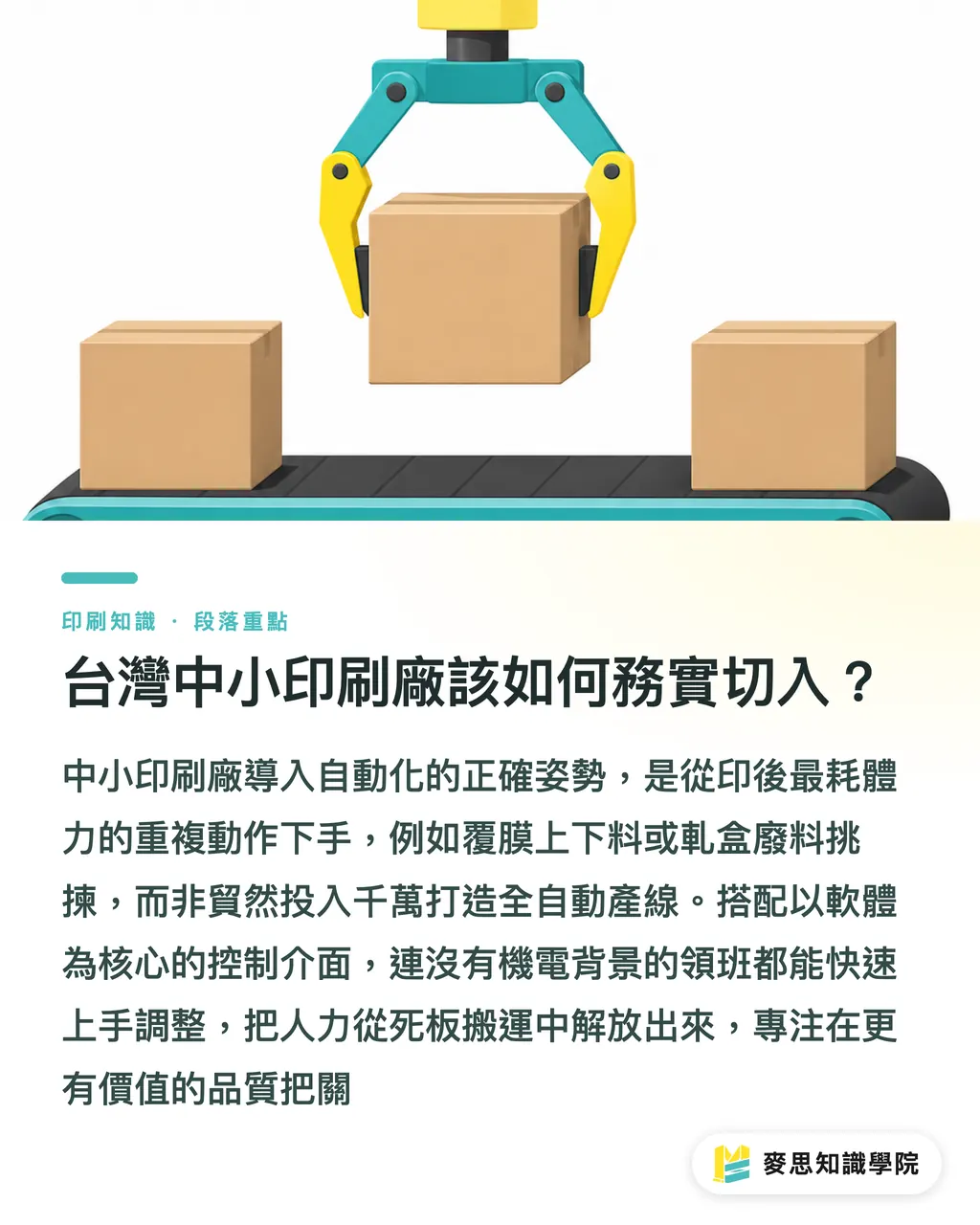
When upgrading, never aim to spend tens of millions all at once on a fully automated, unmanned production line. The right approach is picking key spots and introducing automation step by step. I recommend starting with the most tedious, physically demanding repetitive tasks in post-press. For instance, pairing Epson's IntelliFlex feeding system with vision guidance allows robotic arms to handle laminator loading/unloading or waste stripping after die-cutting. Combined with Epson RC+ development software, this software-centered control interface enables shop floor supervisors without electromechanical backgrounds to adjust parameters quickly. Freeing workers from repetitive hauling so they can focus on quality control is spending money where it counts
Key Takeaways
・The true throughput bottleneck in print shops lies not in front-end printing, but in downstream post-press finishing and packaging that heavily rely on manual labor
・Epson's cobots with SafeSense technology eliminate safety fences, significantly lowering floor-space deployment barriers
・Traditional robots push for raw speed while cobots focus on flexibility, making cobots a better fit for modern high-mix, low-volume print ordering
・Automation does not need to happen all at once; start by automating repetitive loading and unloading using vision-guided feeding systems like IntelliFlex
Further Considerations
For brand clients actively seeking digital transformation and MINDS, having finishing partners adopt flexible collaborative automation means lead times become far more predictable and yield rates improve noticeably. Once printing operations are no longer constrained by labor shortages and fatigue-induced errors, agile delivery promised by SaaS platforms and design teams gains a solid hardware backbone. As a next step, plant leaders should audit their shop floor to identify the three workstations with the highest turnover; those are prime testing grounds for introducing cobot arms
Further Reading
FAQ
- What if our factory space is too small to fit robotic arms?
- That is precisely the advantage of cobots. Powered by sensor technology like SafeSense, they do not require traditional wire mesh safety fencing. Workers can operate right alongside them, keeping the physical footprint minimal
- Does deploying this equipment require hiring a team of software engineers to write code?
- No. The trend today is software driving hardware. Development environments like Epson RC+ focus on intuitive operation, so shop floor supervisors can manage job turnarounds and fine-tune settings after basic training
- For a small print shop with a tight budget, what should be the first step in automation?
- Avoid trying to connect the entire plant from day one. Instead, pinpoint a single post-press step with the highest labor demand, such as continuous feeding for a laminator or a packing station, and deploy a cobot there for the fastest return on investment
References
Related articles
The Print × AI weekly
The print and AI know-how designers, brands and enterprises can use before they commit — one email, every week
MINDS Free Tools
AI background removal, brand stamping, and a LINE sticker maker — free design tools, right in your browser, no upload.
MINDS Group
Need actual printing or gifting services?
From premium printing to online ordering and festive gifts — the MINDS Group sister brands take it from here.