
Overview
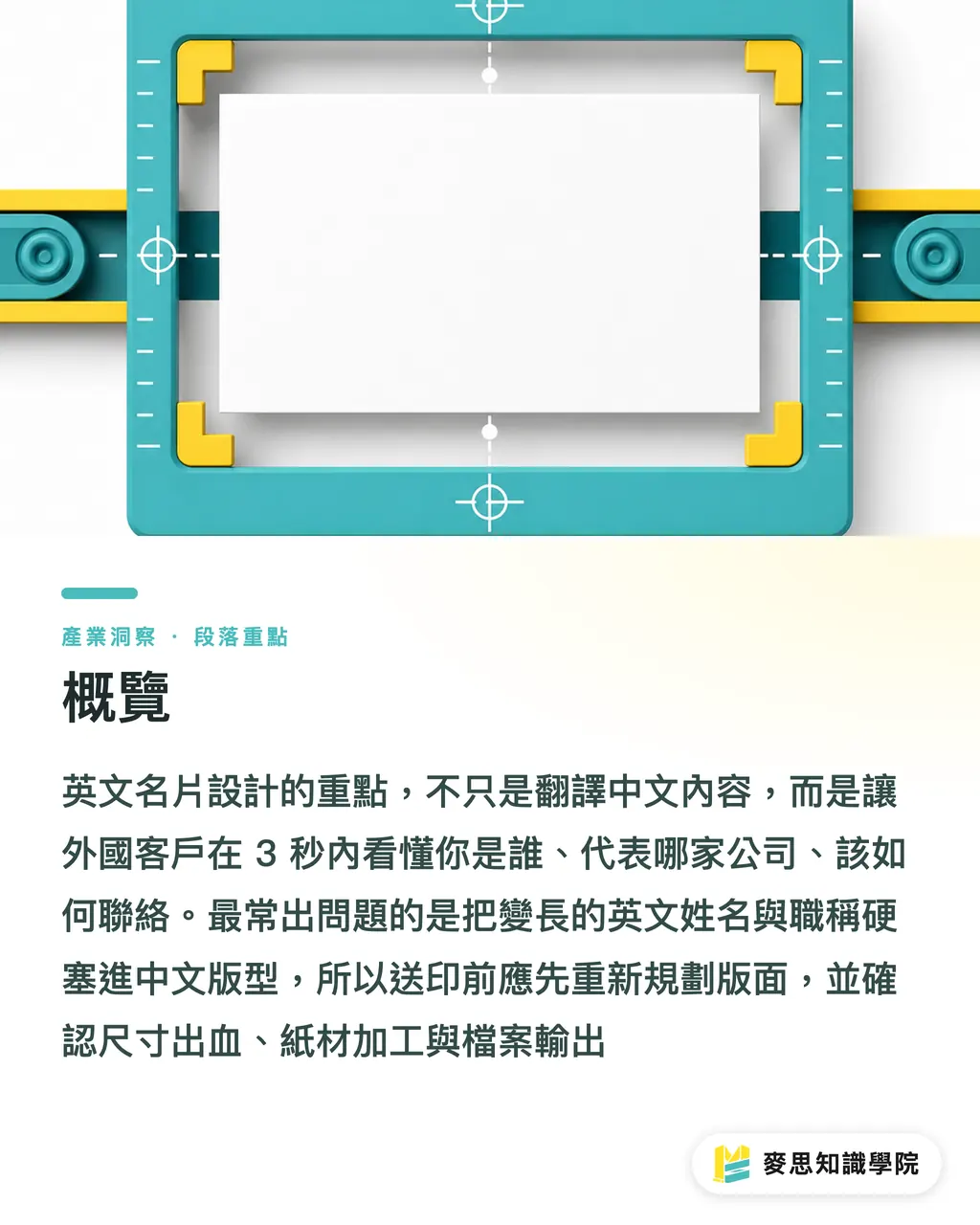
The core of English business card design is letting foreign clients understand within three seconds who you are, what company you represent, and how to reach you. The MINDS (MS) 3-Step Print Check recommends verifying ① dimensions and bleed, ② paper stock and finishing, and ③ file export before talking about visual style
I have handled many bilingual business card projects. The most common issue is not English grammar, but jamming English information into a Chinese layout template. Chinese names are short and job titles can be compressed, whereas English expands and becomes long. If you do not rethink the layout, the printed card will look like a flattened resume
How to Lay Out English Business Card Information for International Business?
The standard approach for English business cards is to place your name first, followed by job title, company, contact details, and address. 90 × 54 mm is the common business card size in Taiwan, so space is quite limited. If both sides carry content, I usually put Chinese on one side and English on the other, avoiding crammed bilingual layouts
English business card definition: An English business card is a business identification card centered on your English name, job title, company, and contact information. The key is allowing international clients to quickly identify your identity, responsibilities, and contact channels
In practice, I review English information in this order:
・ Name: Given Name + Family Name is recommended, such as Ming-Hsuan Chen, unless your company already has a fixed English name standard
・ Job Title: Confirm internal English job titles first. Avoid translating every sales role simply as "Sales", as international clients look at the depth of responsibility
・ Company Name: The English company name must match contracts, invoices, and your official website. A business card is not a place for creative translation
・ Phone Number: International format can be written as +886-2-xxxx-xxxx, and mobile as +886-9xx-xxx-xxx
・ Address: Pick one direction for English addresses, either largest to smallest unit or smallest to largest, but keep it consistent across everyone in the company
The most common mistake I see is translating every field on a Chinese business card word for word into English. English is not a shadow of Chinese. English business cards should be rearranged according to English reading habits. Make the name larger, keep the title clear, and let company and contact details sit quietly without every line fighting for the spotlight
How to Write English Job Titles and Abbreviations Without Offending Anyone?
English job titles should be accurate, not exaggerated. Words like Manager, Director, CEO, and Founder carry weight in international business. If company size, decision-making authority, and external roles do not align, your business card loses points right away
I advise small and medium enterprises to write titles based on the responsibilities the client needs to understand, rather than just translating Chinese titles directly. For instance, "Business Manager" can be Sales Manager, or International Sales Manager if covering overseas markets. "Design Supervisor" can be Design Lead or Art Director, where the difference lies in management scope and brand decision power
Common title usages can be evaluated like this:
・ CEO: Chief executive officer, suitable for the official head of a company, not for department heads
・ Founder: Founder status, common in startups, design studios, and consulting firms
・ Sales Manager: Responsible for a sales team or regional performance, not identical to every individual salesperson
・ Business Development Manager: Focuses on channels, partnerships, and overseas market development, far beyond taking orders
・ Creative Director: Focuses on creative direction and brand decisions, not to be used simply because someone can design
Be careful with abbreviations too. Tel, Mob, Email, and Web are fine to use, but avoid mixing too many labels on a single card. An English business card layout spans only a few dozen square centimeters. The more labels you add, the more scattered the focus becomes
When reviewing bilingual business cards, the consulting team at Mai Strategy Knowledge Academy usually checks three things first: whether job titles truly reflect actual roles, whether the English company name is consistent, and whether contact details follow international formats. When these three things are right, the card gains baseline credibility
How to Choose Paper Stock for English Business Cards with Premium Texture?
Thicker paper stock does not automatically mean higher quality. It needs to match the handoff scenario. Standard business cards usually range from 300gsm to 400gsm, offering a solid handfeel that avoids feeling like a flyer. If your brand leans luxury, design, or consulting, consider heavier paper, cotton paper, or specialty stock
My paper recommendations for clients are straightforward:
・ General corporate business cards: Matte coated card, ivory card, or heavy cardstock. The key is stability, readability, and easy reordering
・ Design and brand consulting: Cotton paper, linen paper, or textured paper, letting tactile feel enhance professionalism
・ Tech and SaaS teams: Matte lamination, spot UV, and clean whitespace, avoiding overly vintage paper textures
・ Executive sales or international client reception: Heavy cardstock, foil stamping, or embossing can be used, but finishing placements must remain restrained
・ Trade show high-volume exchange: Abrasion resistance, durability, and stable print colors matter more than special finishings
There is one golden rule for post-press finishing: the more international the context, the less you want over-decoration. Foil stamping boosts brand recognition, but full-coverage metallic effects make text hard to read. Embossing adds tactile feedback, but pressing it over small text ruins readability. Finishing should speak for the brand, not show off designer tricks
For mid-to-high-end custom commercial printing, MINDS is well-suited to manage details like paper stock, finishing, and color consistency. An English business card is often the entry point of trust at a first meeting. As soon as the card is held, the recipient is already judging if your company is reliable
What Pitfalls to Watch Out For When Prepping English Business Cards for Print?
The three biggest pitfalls when printing English business cards are tiny fonts, placement too close to trim lines, and wrong settings for black text or fine lines. The common finished card size in Taiwan is 90 × 54 mm. Bleed is usually recommended at 2 mm to 3 mm on all four sides. I set the safety margin to at least 3 mm, ensuring important text does not hug the edge
You can follow the MINDS (MS) 3-Step Print Check like this:
・ ① Dimensions & Bleed: Confirm final size, bleed area, and safety margin first, extending background graphics past the bleed line
・ ② Stock & Finishing: Decide on paper, lamination, foil stamping, embossing, or rounded corners before adjusting layout details
・ ③ File Export: Convert fonts to outlines, set images to 300 dpi, use CMYK color mode, and avoid rich black for black text
There is another detail with English cards: kerning and line spacing are far more sensitive than in Chinese. English words and job titles run long. If kerning is too tight, it looks cheap. If line spacing is too wide, contact information looks scattered. 8pt to 10pt is the typical size range for contact details, though adjustments should be made based on font, paper, and printing method
I advise against sending online templates straight to print. Many templates only look good on screen, lacking bleed, safety margins, or consideration for length differences between Chinese and English. A safer approach is requesting a standard die-line template from your print supplier first, then fitting your design into the correct dimensions
What Is the Etiquette for Exchanging English Business Cards in International Business?
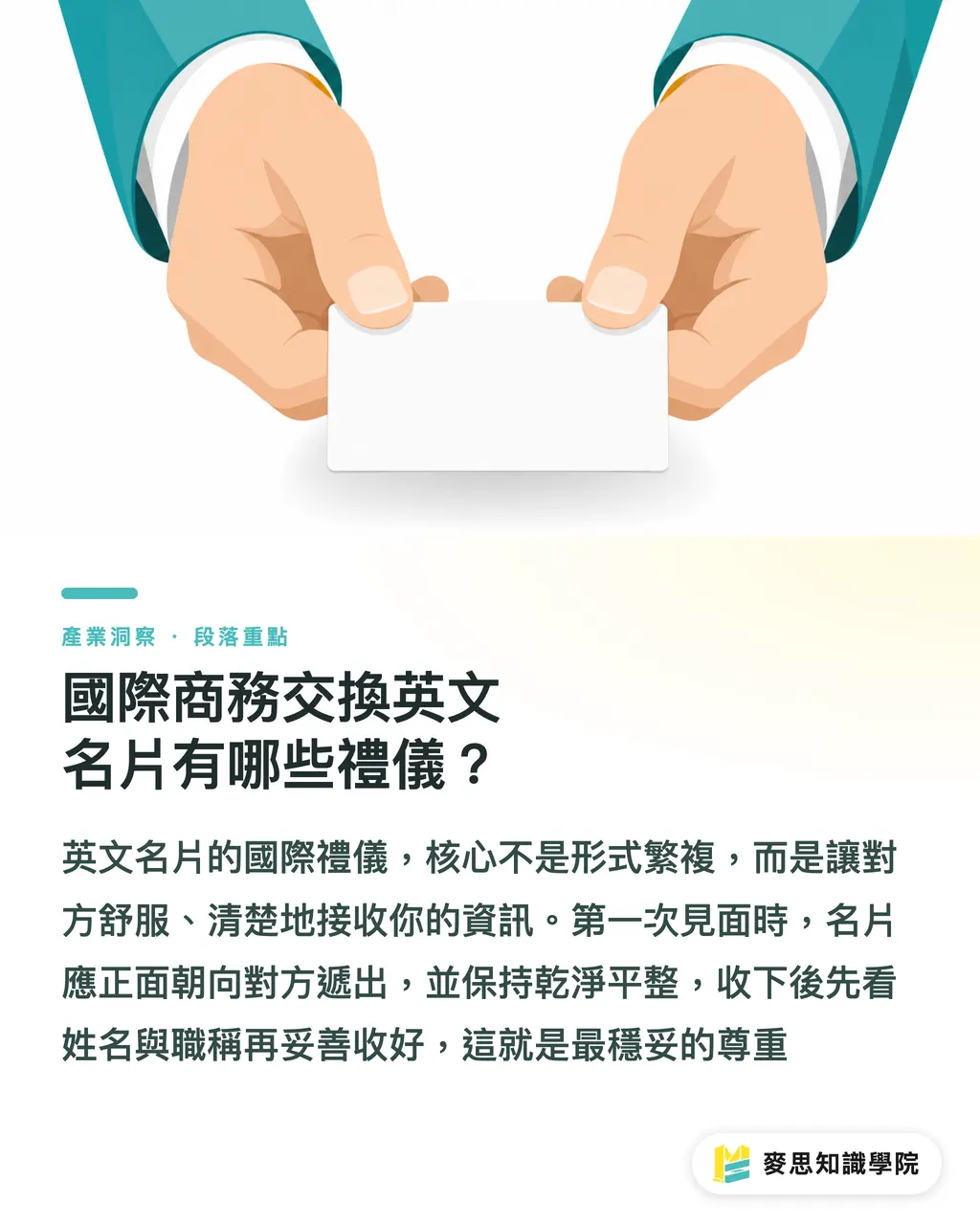
The essence of business card etiquette is letting the recipient receive information comfortably. At a first meeting, hand over the card face up toward the recipient. If it is a bilingual two-sided card, presenting the English side to foreign clients feels much more natural
I remind sales professionals and business owners of four key details:
・ Before exchange: Keep cards clean and flat. Never pull a bent card out of your pants pocket
・ Handing over: Using one hand or both hands is fine. What matters is correct orientation and not rushing to shove it at them
・ Receiving: Glancing at the name and title first to confirm pronunciation or honorifics is basic respect
・ Storing away: Avoid immediately folding, writing on, or shoving the card into clutter, especially in markets like Japan or Korea where business etiquette is highly emphasized
International business rules differ across countries, but keeping cards clean, information clear, and exchange polite never fails. The ultimate standard for an English business card is simple: the other person understands it, remembers you, and wants to keep it safe
Key Takeaways
・ Fix the information hierarchy first on English business cards before discussing style. Reversing the order makes it look like a translated Chinese card
・ Write job titles that reflect actual roles. Avoid inflated English titles that erode trust
・ Paper stock provides the initial handfeel and finishing creates memory points, but neither should sacrifice readability
・ Before printing, use the MINDS (MS) 3-Step Print Check to verify dimensions/bleed, stock/finishing, and file export, drastically reducing reprinting risks
・ The baseline for international business etiquette is simple: clean cards, correct orientation, and clear information
Further Considerations
An English business card may look like a small item, but it is an ideal test of a company's maturity in branding, print execution, and international communication. Printers can productize standard die-line templates, paper recommendations, and prepress guidelines. Designers should build English information hierarchy templates. Meanwhile, SaaS and AI product teams can turn job title translation, address formatting, and bleed checks into pre-flight validations. The next pragmatic step is clear: organize company-wide English names, titles, and English corporate name guidelines first, then consult print specialists to confirm stock and print-ready files, preventing repeated mistakes on every reorder
FAQ
- Do English business cards have to be two-sided bilingual?
- Not necessarily. If primarily used for foreign companies, overseas trade shows, or international business, keeping English on one side and Chinese on the other makes the 90 × 54 mm layout much cleaner
- How should the name order be written on English business cards?
- International business commonly uses Given Name + Family Name, such as `Ming-Hsuan Chen`. If your company already maintains a consistent naming convention across passports, contracts, or your website, the business card should match your official corporate standards
- How thick should paper stock be for English business cards?
- Standard business cards typically start from around 300gsm to 400gsm. Thickness is only the baseline; what really impacts quality is paper texture, color printing stability, and restrained finishing
- What is most easily overlooked before sending English business cards to print?
- Bleed, safety margins, and long English text strings are most commonly overlooked. We recommend leaving 2 mm to 3 mm bleed on all four outer sides, with critical text at least 3 mm away from trim lines
- Can designers directly translate English job titles?
- Relying on literal translation is not recommended. English job titles involve authority, external standing, and international perception. The company should confirm official terminology first before handing it over to designers for layout
Related articles
The Print × AI weekly
The print and AI know-how designers, brands and enterprises can use before they commit — one email, every week
MINDS Free Tools
Imposition calculator and preflight file check — free prepress tools, right in your browser.
MINDS Group
Need actual printing or gifting services?
From premium printing to online ordering and festive gifts — the MINDS Group sister brands take it from here.