
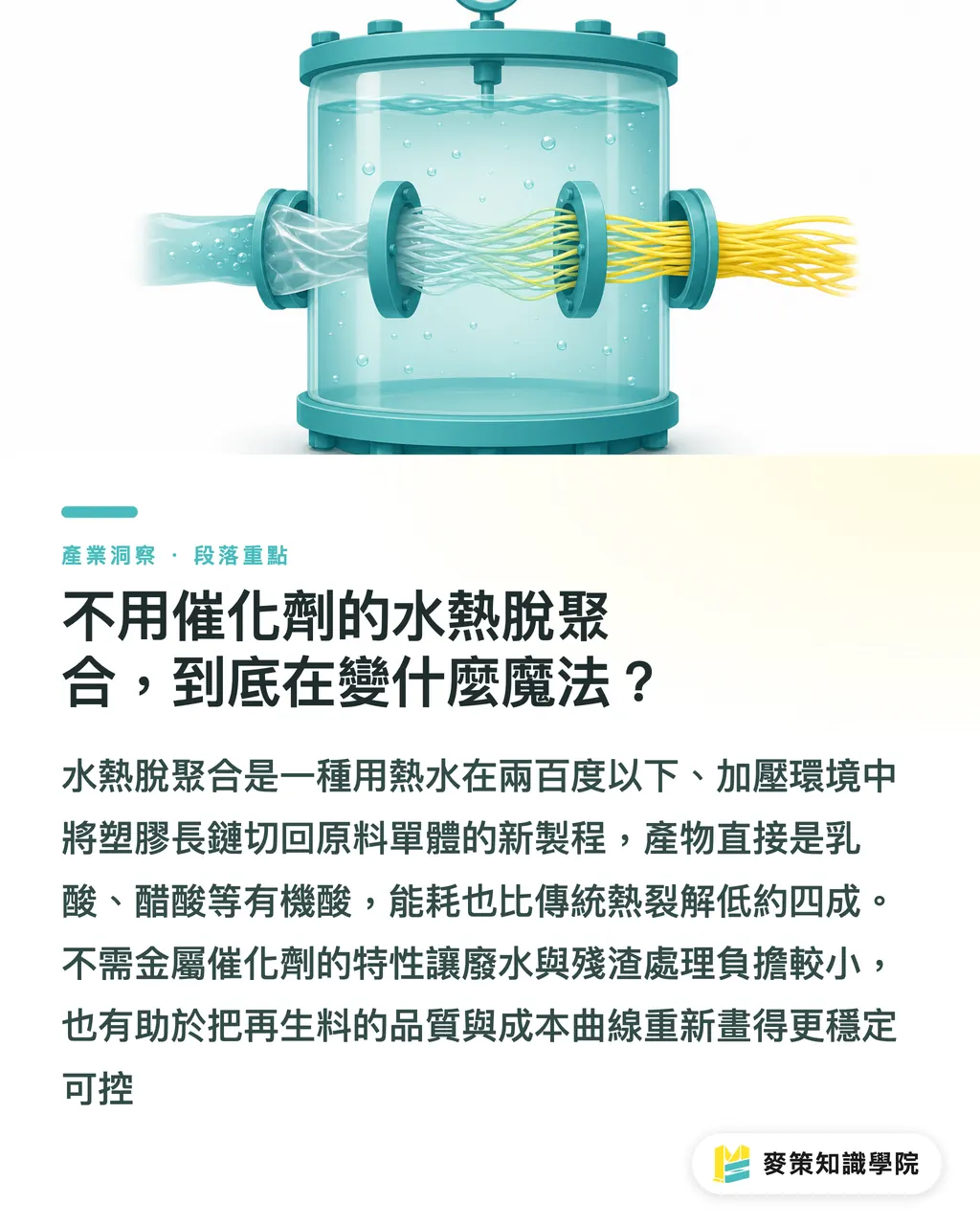
What kind of trick is catalyst-free hydrothermal depolymerization actually pulling?
This is a process that has been buzzing hard in the international packaging scene over the past six months. The full name is hydrothermal depolymerization, which in plain language means "using hot water to take plastic apart back into its raw monomers." Traditional pyrolysis relies on high temperatures above 400°C to crack plastic into oil and gas, which then gets re-refined into recycled plastic. The new process works in a pressurized water environment below 200°C, leaning on water's physical properties to cut the long chains of PET and polyolefins down. The output is organic acids like lactic acid and acetic acid right off the bat, which can feed straight into mature downstream products such as PLA, eco-friendly coatings, and cosmetic ingredients, no need to make the long loop back to plastic pellets
・Temperature range: below 200°C, far lower than pyrolysis which starts at 400°C
・Output form: organic acids like lactic acid and acetic acid that drop straight into the existing chemical chain
・Energy use: roughly 40% less than pyrolysis
・Process difference: no metal catalysts needed, so wastewater and residue treatment are less of a headache
For the print supply chain, the implication is clear: the cost and quality curve of recycled materials has a shot at being redrawn, and long-term stability will be more controllable than what today's mechanically recycled films offer
How does this connect to the BOPP and PET laminates sitting in your print shop right now?
The plastic substrates that Taiwan's small and mid-sized printers reach for most, BOPP (biaxially oriented polypropylene) film, PET (polyester) film, and the various CPP and CPE used in laminates, all belong to the polyolefin and PET family that this new process targets. Until now these films only had two recycling routes: one is mechanical recycling into recycled pellets, but films come loaded with impurities and end up downcycled; the other is feeding them into pyrolysis, but that's expensive and the output can only be refined back into fuel oil or recycled plastic, still a step short of food-grade packaging
Hydrothermal depolymerization opens up a third path: breaking waste film straight back down into organic acids, essentially bypassing the "recycled plastic quality ceiling" that has been a bottleneck for over a decade. In the short term, recycled film material costs have room to come down. In the long term, when brands write "recycled content ratio" into their sourcing specs, they'll have more process options to point to behind it, and the story will actually hold up
・BOPP film: commonly used for food packaging, book covers, sticker face stock
・PET film: commonly used for gloss laminates, release liners, heat-resistant labels
・Recycled paper coatings: the organic acids produced by depolymerization can serve as eco-friendly coating monomers, sidestepping petrochemical sources
Don't rush to swap materials yet, but start asking your film supplier: "Do you have recycled material sources tied to hydrothermal depolymerization or pyrolysis?" This question is about to go from a niche topic at technical seminars to a regular line item on RFQs
How can brands turn this card into a marketing asset?
The biggest pain point in sustainability over the past few years has been "easy to promise, hard to prove." When brands write ESG reports, they often get pushed back on because the source of recycled materials isn't clear and process-level carbon footprints don't reconcile. Retailers doing shelf-readiness reviews are also increasingly picky about material traceability. Once new processes like hydrothermal depolymerization hit scale, they fill exactly this gap: the output is organic acids, which can slot into existing chemical chains, can be talked about in carbon footprint terms, and can be told as a complete story. That's the hard substance brands can write into their sustainability white papers when communicating outward
For Taiwanese brand clients, my suggestion is a three-step play:
1. Audit existing packaging first: list the plastic films, laminates, and coatings on your main product lines, and mark out the material and share for each
2. Watch two timelines: the EU PPWR (Packaging and Packaging Waste Regulation) rollout pace, and the progress of the Taiwan EPA's recycled material incentive programs
3. Reserve narrative flexibility: leave a "recycled material source" field on new packaging design files so you're not rebuilding from scratch when it's time to revise
Playing this card early matters more than playing it pretty
Should Taiwan's small and mid-sized print shops pick up this fight now?
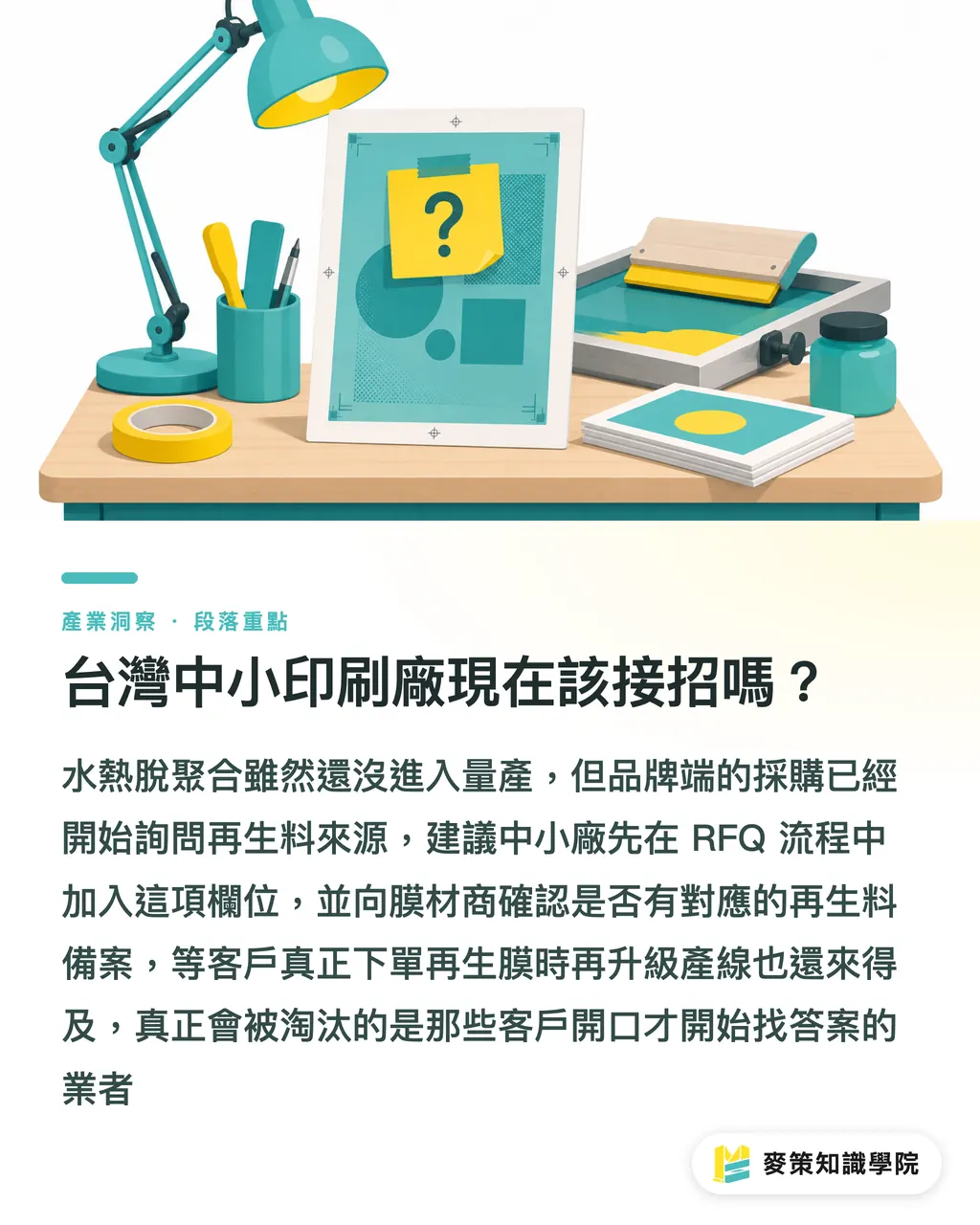
From what I've seen on production floors over the past few years, what small and mid shops fear most isn't the new technology itself, it's "not knowing when the client is going to ask." Hydrothermal depolymerization is still in the R&D and demonstration phase, and no production timeline has been locked in, but brand-side procurement windows are already moving. I'd suggest small and mid shops do two things first:
・Add a "recycled material source" field to your RFQ process. It's fine not to have an answer right now, but start asking
・Check with your long-term film suppliers whether they have backup sources tied to pyrolysis or hydrothermal depolymerization. If they do, that's one more card in your hand
As for whether to invest in new equipment right now, don't rush. The advantage small and mid shops have is speed. By the time brands actually start ordering recycled film, you'll have time to switch lines. The ones that'll get weeded out are the shops that "don't know anything and only start looking after the client opens their mouth"
Key takeaways
Hydrothermal depolymerization is a new chemical recycling process that breaks plastic back down into organic acids, below 200°C and without metal catalysts
Compared to traditional pyrolysis, energy use drops by roughly 40%, and the output drops straight into the existing chemical chain
The recycling path for BOPP and PET laminates has been opened up, and both the cost ceiling and quality ceiling of recycled film material have room to drop in tandem
Brands can use this as hard substance for their sustainability narratives, but they need to audit existing packaging early and reserve a recycled material field
For Taiwan's small and mid-sized print shops, asking suppliers "do you have a recycled material backup" matters more than rushing to invest in equipment
Further thinking
In this wave of chemical recycling progress, what's most worth the Taiwan supply chain's attention isn't the technology itself, but the fact that the bar for "complete-process storytelling" on the brand side is being raised. Once hydrothermal depolymerization hits scale, it essentially unties a compliance knot that has had brand clients stuck for ages: the inability to clearly explain recycled material sources. For print shops, starting in the second half of this year, you'll see "recycled material process category" appearing on RFQs more and more often. If you don't prepare now, you'll be chased by clients during the year-end peak season. If any of your clients are already talking EU PPWR compliance, consider sitting down with the MINDS consulting team for a substrate audit, get the film and coating share of your current products clearly mapped first, so that whatever comes next, whether it's recycled material swaps or narrative design, you have something solid to negotiate from
Further reading
FAQ
- How is hydrothermal depolymerization different from traditional pyrolysis?
- Traditional pyrolysis uses temperatures above 400°C to crack plastic into oil and gas, which is then re-refined into recycled plastic or fuel. Hydrothermal depolymerization breaks plastic down in a pressurized water environment below 200°C into organic acids like lactic acid and acetic acid, without metal catalysts and with about 40% less energy use
- Once this technology scales up, will print substrate prices drop?
- Not necessarily in the short term. The price of recycled film material is shaped by petrochemical feedstock, energy costs, and regulatory subsidies all at once. If the new process reaches scale, the recycled film cost curve has room to be pulled down over time, but the medium- to long-term picture still depends on production scale and how regulations roll out
- What can brands start preparing now?
- First, audit the plastic film, laminate, and coating share on your current packaging, and mark out material and source for each. Reserve a "recycled material source" field on new packaging design files. Track EU PPWR and Taiwan's recycled material regulations in parallel to lock in a compliance narrative early
- Do Taiwan's small and mid-sized print shops need to swap equipment now?
- No. The technology is still at the demonstration stage, and small and mid shops' edge is responsiveness. What you should do now is add "recycled material source" to your RFQ inquiry process, confirm backup options with your film suppliers, and adjust your lines once brands actually start ordering recycled film
- Which print substrates will be hit hardest by this wave?
- Films in the polyolefin and PET family, BOPP, PET, CPP, CPE, are first in line. These are exactly the plastic substrates that Taiwan's print shops run through in the highest volume. Recycled paper coatings and eco-friendly coating layers will also benefit from the supply of organic acid monomers
Related articles


The Print × AI weekly
The print and AI know-how designers, brands and enterprises can use before they commit — one email, every week
MINDS Free Tools
AI background removal, a LINE sticker maker, spine & imposition calculators — all free, right in your browser, no upload.
MINDS Group
Need actual printing or gifting services?
From premium printing to online ordering and festive gifts — the MINDS Group sister brands take it from here.