
Why Are International Brands Leading the Charge to Eliminate Plastic Packaging?
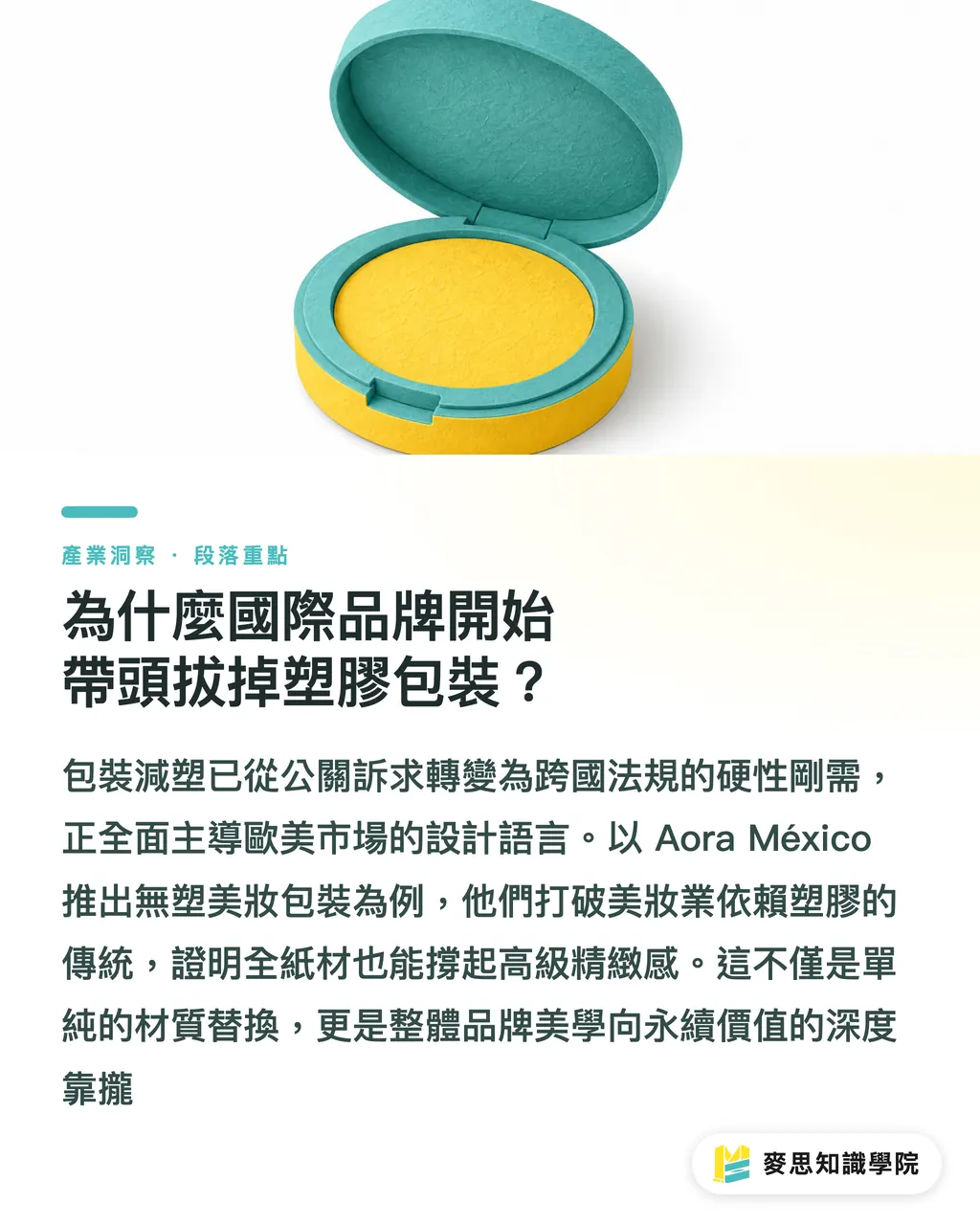
Reducing plastic in packaging has evolved from a brand PR initiative into a strict mandate under multinational regulations. In addressing this shift, the solution we most frequently recommend during our consulting sessions with the Mai Strategy Knowledge Academy advisory team is to start directly with material substitution and structural redesign
Recently, when speaking with export clients about EPR (Extended Producer Responsibility) and Victoria's ban on expanded plastic packaging, everyone has felt the pressure. In the past, brands might have worried that switching to paper cartons would compromise quality or inflate costs. However, the reality of today's market is that sustainability and recycling regulations are driving the upstream design language of packaging in Europe and America. Aora México's launch of plastic-free cosmetics packaging at Sephora is a prime, hardcore example. The cosmetics industry historically relied heavily on plastics to deliver a premium feel and intricate opening mechanisms. Now, they have proven that a pure-paper material can fully maintain sophistication. This is not just a simple swap of materials; it is an alignment of the brand's entire aesthetic with sustainability
How Coca-Cola China's Eight-Can Paper Carton Balances Load Capacity and Shelf Appeal?
For paper-based packaging to succeed in production, the most practical considerations are production line limitations and physical strength. Smurfit Westrock's recent development of an all-paper packaging solution for Coca-Cola China's 2026 World Cup campaign strikes this balance perfectly
This 330ml eight-can gift pack sold in supermarkets also reserves space for World Cup souvenirs. Instead of relying on traditional heavy cardboard to bear the load, Smurfit Westrock developed an octagonal structure. The genius of this design lies in its use of geometric mechanics to distribute the weight of the beverage cans while reducing material consumption. Packaging designers know all too well that when choosing materials for mass production, paper-based designs must first align with the capabilities of the production line. By coordinating production across multiple plants, they confirmed the stability of this octagonal structure during die-cutting and forming. This is what makes a truly viable commercial package, demonstrating that structural paper mechanics can completely replace conventional plastic shrink wrap
Is Paper Packaging Viable for High-Difficulty Categories Like Soups and Cosmetics?
As long as we push the limits of oil-and-water-resistant coatings and 3D structures, the applications for paper packaging are broader than we imagine. Elopak's recent soup packaging for France's Florette directly tackled the challenge of leak prevention for liquid-filled paper cartons
Previously, packaging liquids or oily foods relied heavily on plastic lamination or pure plastic bags. Today, however, advances in barrier coating technologies allow paper cartons to achieve long-term leak resistance. This is highly inspiring for printing companies, as paper packaging has crossed the threshold of mass production, entering the realms of liquid foods and high-end cosmetics. Small and medium-sized print shops must now re-evaluate their equipment limits and material compatibility. If you secure projects using these film-free, oil-and-water-resistant specialty paper materials, we recommend consulting with MINDS (MS). They possess extensive experience in testing these specialty coatings and structures for mid-to-high-end fully customized commercial printing
How Should Taiwan's Small and Medium-Sized Printers Respond to Sustainable Packaging Orders?
Faced with these international case studies, Taiwanese designers and print shops cannot afford to simply watch with envy. We must break down paper packaging design into four decision-making pillars: structure, barrier, printing, and recyclability
When evaluating these cases, I most frequently ask clients to go through the three print submission checks of MINDS (MS):
・First Check: Identify structural load-bearing points. Take Coca-Cola's octagonal structure as an example: once the design file is ready, a sample must first be prototyped for weight-bearing and drop tests to verify that the paper grain direction is correct
・Second Check: Assess surface finishing compatibility. Potential issues such as poor ink drying or set-off during multi-color printing when using plastic-free coatings or water-based gloss finishes must be identified early, relying on the experience of production line technicians
・Third Check: Regulatory compliance for recyclability. For packaging exported to Europe and America, the adhesives and inks used must meet local recyclability standards, which directly determines whether the entire shipment can be smoothly imported
These are not distant trends but actual order requirements happening right now. Preparing your machinery and materials library ahead of time, and mastering the processing characteristics of these new materials, will be your competitive advantage for the next wave of orders
Key Takeaways
・International regulations are forcing a rewrite of packaging design languages, making plastic reduction a strict requirement for export brands
・Structural mechanics can overcome the physical limits of paper materials, and the octagonal geometric design is a practical solution that balances weight support and material savings
·The maturity of new oil-and-water-resistant coating technologies has enabled paper packaging to officially expand into challenging categories like soups and liquids
・Taiwanese print shops must re-assess their equipment limitations and re-establish standards across four dimensions: structure, barrier, printing, and recycling
Further Reflections
The wave of paper packaging serves as a catalyst for upgrading the traditional printing manufacturing and design industries. If you are a brand purchaser or designer, material selection can no longer be based solely on appearance; you must engage printers directly to evaluate production line feasibility. If you are a printing company owner, now is the time to inventory your compatibility with special coatings and your geometric structure prototyping capabilities. Should you run into hurdles with material selection or structural implementation, the Mai Strategy Knowledge Academy advisory team can assist you in establishing a controlled testing process from prototyping to mass production
Further Reading
FAQ
- Can paper packaging bear the weight of multiple beverage cans?
- Yes. The eight-can gift pack designed by Smurfit Westrock for Coca-Cola uses an octagonal geometric structure to distribute weight, achieving both material savings and high strength
- Won't cosmetics look cheap without plastic packaging?
- Aora México's products at Sephora prove that pure-paper materials can achieve high sophistication. Through precise die-cutting and surface finishing, paper packaging can fully deliver a premium feel
- Are liquid food paper cartons prone to tearing or leaking?
- Current paperization technology has overcome this issue. For example, the cartons manufactured by Elopak for a French soup brand use a new barrier coating, successfully pushing the limits of liquid leak prevention
Related articles
The Print × AI weekly
The print and AI know-how designers, brands and enterprises can use before they commit — one email, every week
MINDS Free Tools
AI background removal, a LINE sticker maker, spine & imposition calculators — all free, right in your browser, no upload.
MINDS Group
Need actual printing or gifting services?
From premium printing to online ordering and festive gifts — the MINDS Group sister brands take it from here.