
Why can vendor quotes for the same job differ by double?
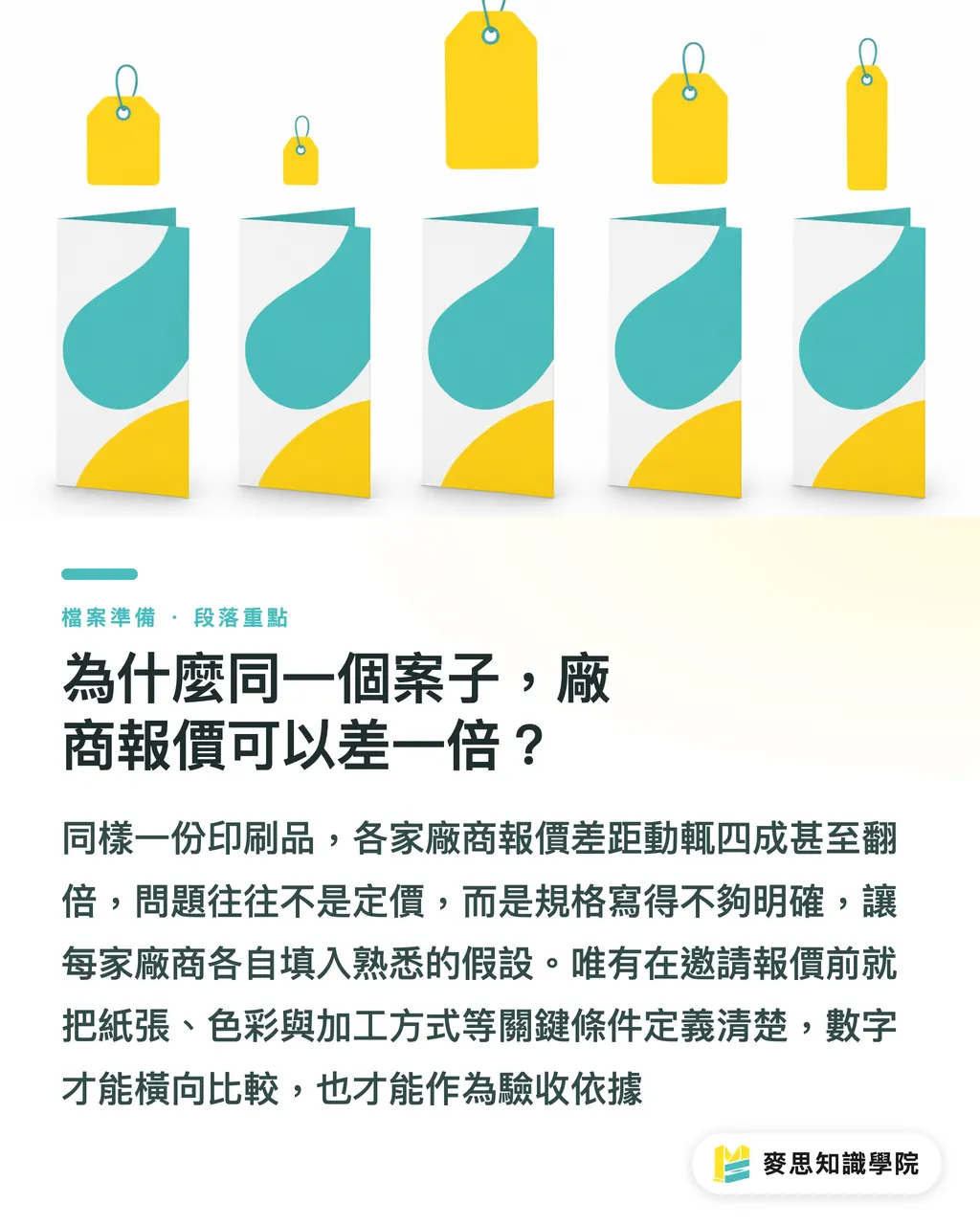
A print RFP does exactly one thing: it gets every supplier quoting on the same set of assumptions. When that happens, the numbers mean something. When it doesn't, you're not comparing pricing, you're comparing each vendor's private version of what the job is
I've spent years on both sides of the table, procurement and vendor, and the most common scene looks like this: the spec sheet says 'full color, coated paper, 500 copies, tri-fold,' goes out to five vendors, and the highest quote is easily 40% above the lowest, sometimes double. Does 'full color' mean four-color process or include spot colors? Does 'coated paper' mean 150 lb or 200 lb, domestic stock or imported? Does 'tri-fold' mean letter fold or accordion fold? Every blank gets filled in by whichever spec the vendor knows best
Quotes like that can't be compared side by side, and they can't be used to judge acceptance either
The sales consultants at MINDS Printing usually run a spec review before quoting new jobs and patch these common gaps. Not a special service, a well-formatted RFP just removes these back-and-forth rounds
---
What fields should a quotable print RFP include?
This is the mandatory list I've put together after running through procurement, sales, and vendor perspectives. Leave any field out and the quote can drift into ambiguity
Basic item info
・Item name and purpose: is it a 'promotional flyer,' 'company brochure,' or 'product catalog'? Different uses push vendors toward different paper stocks and finishing methods
・Quantity: must be exact. Print volume swings unit price hard. If reprints are possible, write it in: 'first run 1,000 copies, reserve option for 500 additional'
Size, page count, and bleed
・Finished size: the actual trimmed size, not the design canvas
・Flat size: required when there's folding
・Page or sheet count: include cover and back cover in the total
・Bleed settings: 3mm on all four sides is the Taiwan convention. Special finishing may differ, write it explicitly
Paper specs
・Type: coated, woodfree, offset, matte coated, specialty art paper
・Basis weight: cover 300gsm, interior 150gsm, fill it in that format. Pounds work too, but confirm the conversion basis with the vendor
・Origin or brand (if specified): domestic, Daya, or imported brands carry noticeably different prices. Leave it open and the vendor will pick the cheapest
・Certification requirements: FSC certification, recycled content ratio. EU-bound jobs almost always ask now, write it early, save the headache
Color specs
・Color count: CMYK four-color, or including Pantone spot, white ink, fluorescent
・Double-sided or single-sided
・When cover and interior use different color counts, write them separately. Don't use vague phrasing like 'mostly four-color'
Finishing and binding
・Lamination: matte PP, gloss PP, spot UV, aqueous coating
・Binding: saddle stitch, perfect bound, thread sewn, butterfly bound
・Fold method (when folding): half fold, tri-fold, Z-fold. Each fold changes the size math
・Other processes: drilling, foil stamping, debossing, die-cutting
Delivery and packaging
・How many working days after file confirmation, and make clear whether it's 'working days' or 'calendar days'
・Whether delivery is split into batches, plus receiving address and contact
・Packaging: loose, shrink wrap, bundles of N
Acceptance criteria
・Color tolerance: Delta E value, or comparison against an approved previous proof
・Quantity tolerance: industry default is ±5%, but for gifts or branded events, require no shortage against the order quantity
・Defect definition and replacement flow
Some vendors will say 'why write all this, just give us a ballpark.' I'd think twice about going further with vendors like that, post-press disputes usually start from someone's 'ballpark'
---
How do you write paper and color specs without trouble?
Paper is where procurement trips up most
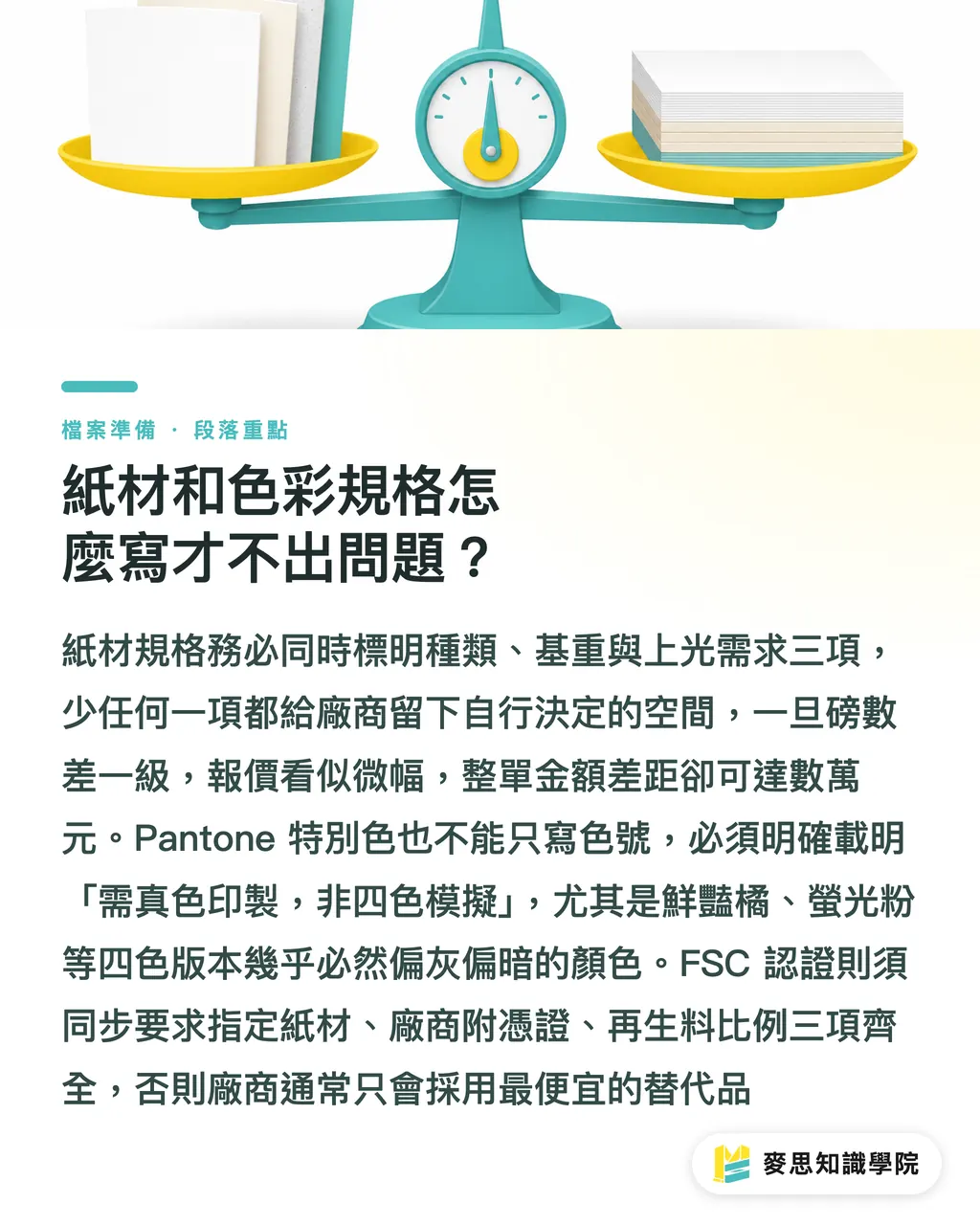
'Coated paper' in Taiwan is a fuzzy term covering dozens of grades. 150 lb and 200 lb feel different, sit differently in the hand, and finish with noticeably different gloss, yet the price gap per ream can be just NT$20–30, which compounds to thousands or tens of thousands across a full order. The correct write-up is type + basis weight + finish requirement, all three together. Leave any out and the vendor gets to decide
The easiest mistake with Pantone spot colors is mixing up 'four-color simulation' and 'true spot printing.' What a four-color press mixes from CMYK and what comes off a real fifth plate are visibly different, especially on bright orange, fluorescent pink, and deep blue, the four-color version usually goes grayish or dull. When brand color must hit precisely, the RFP needs to state 'true spot printing required, not four-color simulation' and attach the Pantone number
FSC certification has been asked about far more often these past two years, not just for sustainability claims but as a document checkpoint for import/export. Write three things into the RFP at once: specify FSC-certified paper, require the vendor to attach the certificate, and if recycled content is involved, state the percentage. Leave any out and the vendor will hand you the cheapest option
---
How do you write finishing, delivery, and acceptance criteria without leaving room for disputes?
Finishing terminology in the Taiwan trade still has no unified standard, that's just how it is
'Gloss film,' 'gloss PP,' 'gloss BOPP' can mean the same thing in different vendors' mouths, or not. The safest write-up describes the effect and function you want, then attaches a finishing example you accept: 'want scratch-resistant cover, matte PP or gloss PP acceptable, full-gloss aqueous coating not accepted'
Binding has one physical limit people forget: saddle stitch only works for booklets up to about 64 pages. Go beyond that and switch to perfect binding. Perfect-bound spines tend to show white edges when the book is opened flat, if the design has a spread image, write into the RFP 'design includes spread bleed, confirm appearance after binding,' because the vendor usually won't flag it on their own
Delivery timelines should be layered:
・Start counting from file confirmation, not from order placement
・Spell out 'working days' or 'calendar days'
・Orders around holidays need extra clarification, both sides often mean different things by 'shippable before Lunar New Year'
Acceptance criteria get skipped the most, and that's where disputes breed later. At minimum, write:
・Color standard: Delta E ≤ 5 is the commercial print baseline. For brand colors or premium items, push for ≤ 3
・Quantity tolerance: ±5% is industry default, but for situations where every piece gets used (commemorative items, client gift boxes), state 'no shortage against ordered quantity'
・Defect definition: print streaks, ghosting, registration offset, write the tolerance limit for each
・Replacement flow: how many working days after defect discovery to file, and whether the vendor reprints or refunds
Once it's all down on paper, there's something to point at afterward
---
How should finished files and reference samples be attached without wasting rounds of back-and-forth?
A well-formatted RFP saves three rounds of confirmation. Attach the right finished files and reference samples and you save two more
Finished file requirements (write into the RFP):
・Format: PDF/X-4. JPEG or RGB mode not accepted
・Color mode: CMYK, all images at 300dpi or higher
・Fonts: embed or convert to outlines
・Bleed: 3mm on all four sides, with at least 3mm safety margin from the trim line
・Spot colors: Pantone numbers tagged correctly in the PDF, don't convert to CMYK before submitting
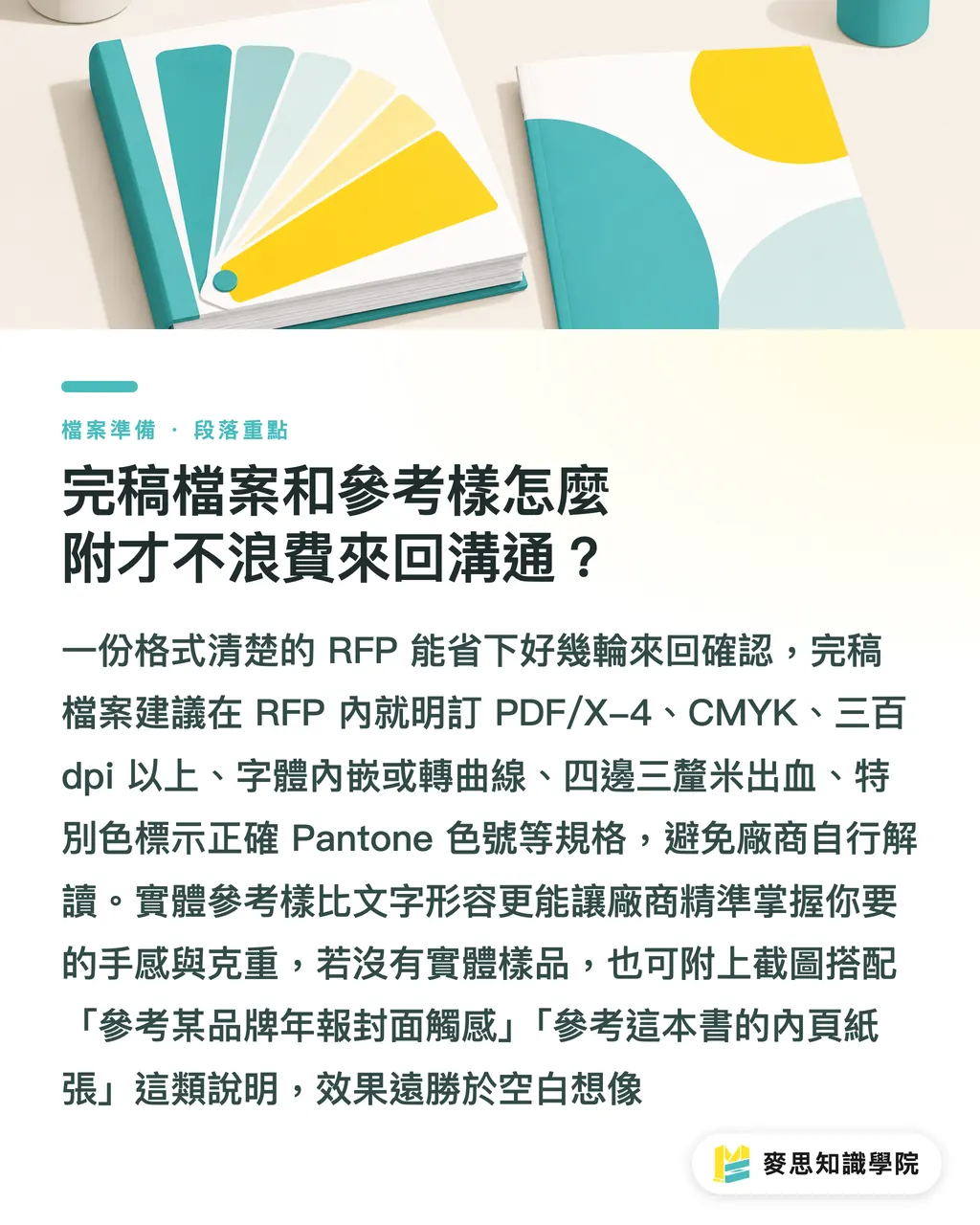
Reference samples do more work than most people think. Hand the vendor a publication or past print job whose 'feel' is close to what you want, and they can read the quality level in one glance, far more precise than describing 'premium feel, substantial' in words
For brand-new jobs with no physical reference, screenshots plus written notes still work: 'cover texture similar to [brand X]'s annual report,' 'interior paper weight similar to this book.' Not perfect, but better than nothing
If you don't want to negotiate standard items back and forth, MINDS Printing offers online spec configuration with instant quotes, suited for smaller-volume buyers who need to order fast
Key takeaways
・Quotes doubling almost always trace back to gaps in the spec sheet that let each vendor fill in their own assumptions, you're comparing assumption versions, not pricing
・A quotable print RFP must cover: item purpose, size and page count, paper type/weight/certification, color printing method, finishing, delivery timeline layers, acceptance quantity tolerance, and defect definition
・Paper should be written as 'type + basis weight + certification' together, writing only 'coated paper' is the same as not writing it
・Spot colors need an explicit label of 'true spot printing' or 'four-color simulation' — bright colors show visible difference
・Attach PDF/X-4, CMYK, 300dpi, outlined fonts, 3mm bleed, plus one physical reference sample, that combination cuts most of the confirmation rounds
Bigger picture
A print RFP isn't bureaucracy, it's a document that gets both sides aligned early. I've seen plenty of corporate procurement deals end with print quality problems that the buyer had to eat because there was no written acceptance standard in place
For designers, building your own RFP template is the cheapest investment you can make. Half an hour to fill it in before each print job saves far more than half an hour of back-and-forth and rework later
For SaaS and AI tool builders, a clearly structured RFP like this is actually the best foundation for automating print quoting, the fields are quantifiable, the specs have standard values, the acceptance conditions can be compared side by side. It's the easiest slice of the current manual workflow to digitize
If you have complex custom needs and want a spec check before placing an order, you can talk to the Mai Strategy Knowledge Academy consulting team
FAQ
- What's the difference between a print RFP and a regular inquiry form?
- A regular inquiry usually has just the item name and quantity, forcing vendors to fill in everything else by assumption. A print RFP lists every cost-driving variable (paper basis weight, color printing method, finishing, acceptance tolerance, etc.) up front, so each vendor quotes against the same assumptions, and the results can actually be compared side by side
- How detailed should paper specs be?
- At minimum: paper type, basis weight (gsm or pounds), and certification requirements. If there's a brand or origin preference, list that too. Writing only 'coated paper' and letting the vendor choose can swing quotes widely and leaves no basis for dispute later
- What's the safest finished file format to send a vendor?
- The standard is PDF/X-4, CMYK color mode, images at 300dpi or higher, fonts embedded or outlined, 3mm bleed on all four sides. Don't send JPEG or RGB, vendor-side conversion tends to shift color and they usually won't tell you
- Do acceptance criteria have to be written into the RFP?
- Yes, especially quantity tolerance and color standard. Industry defaults are ±5% on quantity and Delta E ≤ 5 on color, but if your use case demands higher precision (brand colors, gifts), push the requirement higher in the RFP. Otherwise there's nothing to fall back on later
- If I specify a Pantone number, will the vendor definitely print it as a true spot?
- Not necessarily. Some vendors default to four-color simulation unless you explicitly write 'true spot printing required, not four-color simulation' in the RFP. Four-color simulations of bright orange, fluorescent pink, and deep blue usually look visibly gray or dull, for brand identity use, say so explicitly
Related articles





The Print × AI weekly
The print and AI know-how designers, brands and enterprises can use before they commit — one email, every week
MINDS Free Tools
Imposition calculator and preflight file check — free prepress tools, right in your browser.
MINDS Group
Need actual printing or gifting services?
From premium printing to online ordering and festive gifts — the MINDS Group sister brands take it from here.