

How Can You Read a Print Quote Comparison Fairly?
Reading print quotes fairly is not about ranking three suppliers by total price. It means using the three checks MINDS Printing (MS) commonly applies: same specifications, same terms, and same accountability. Size, paper, printing method, finishing, proofing, packaging, delivery, tax, and lead time all need to be aligned item by item
A print quote comparison is a document where corporate procurement places quotes from 2 to 3 print shops in one table and compares specifications, unit prices, finishing, lead times, and attached terms line by line. The goal is not to find the lowest price, but to confirm whether each supplier is quoting against the same requirement baseline
I have seen too many procurement teams get stuck on the same question: Supplier A is 20% cheaper, Supplier B can deliver 2 days faster, and Supplier C includes proofing and freight. Which one is actually reasonable?
The real problem is not whether the price is high or low. It is that the three quotes may not be describing the same printed product at all
・Supplier A may be quoting "excluding proofing, excluding freight, excluding tax."
・Supplier B may list matte lamination, die-cutting, and foil stamping separately, making the total price look low at first and higher later
・Supplier C may document the paper stock most completely, so it looks more expensive at first glance
When the MINDS Printing (MS) consulting team helps companies review print quote comparisons, we first convert each quote back into a specification sheet rather than treating it as a price list. Print cost is built up from specifications; sincerity cannot be judged from a single total price
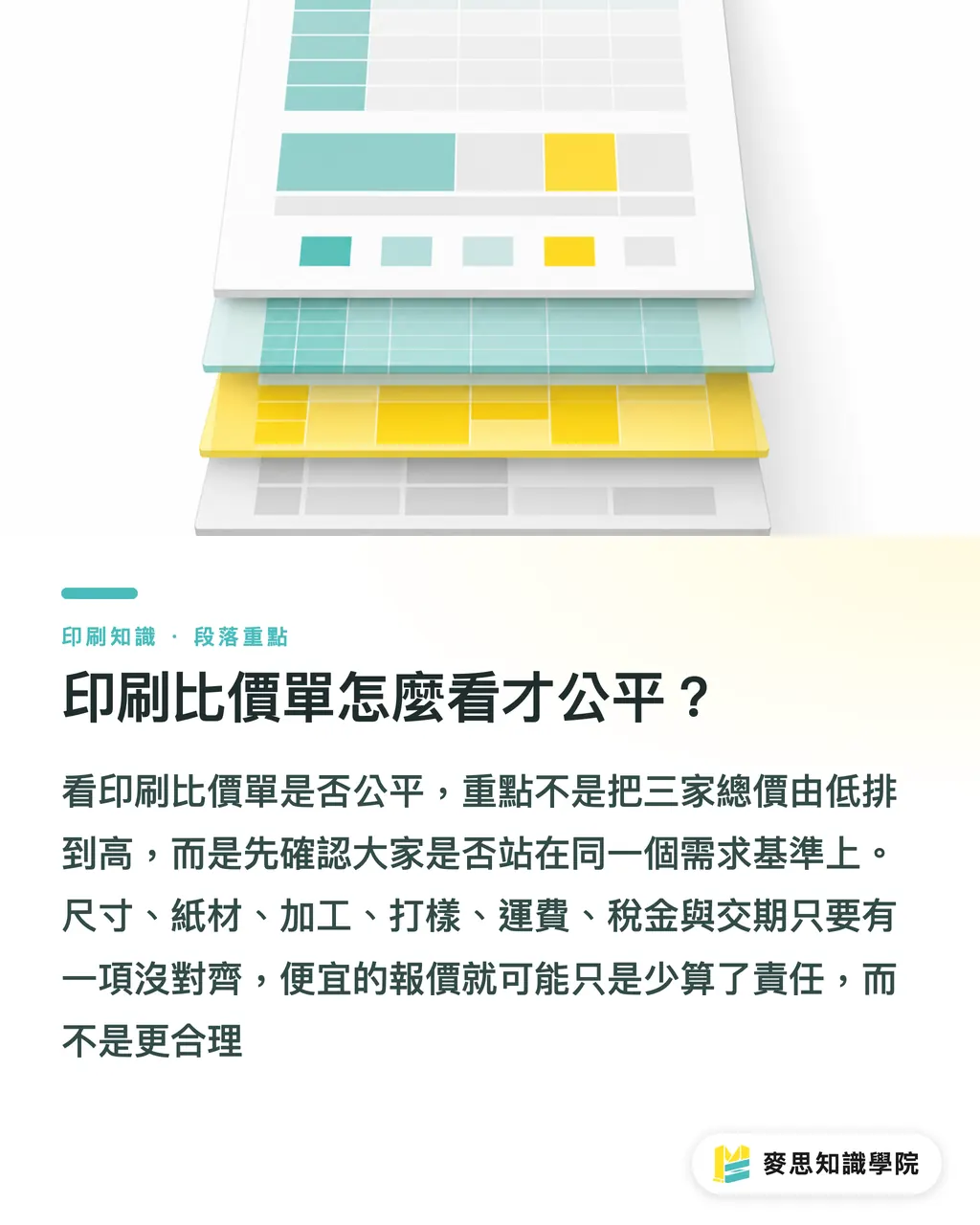
Why Shouldn't You Compare Three Quotes by Total Price Alone?
The most common mistake when comparing three quotes is that procurement compares "1,000 copies of a catalog" without confirming whether all three suppliers are using the same finished size, the same paper grade, the same finishing process, and the same lead time
Take a 16-page catalog as an example. Even if the finished product appears to be A4, the quote can still vary significantly because of sheet layout, paper weight, cover finishing, and binding method
・Size: A4, chrysanthemum 8K, or a custom trim size will each have different paper use
・Paper: Even with the same 150g art paper, brand, grade, and batch stability can still affect the quote
・Printing method: gang-run printing, dedicated plate printing, and digital printing all have different cost structures
・Color count: 4C color printing, spot colors, and single black all require different ink and color calibration time
・Finishing: lamination, spot UV, foil stamping, die-cutting, folding, and binding must all be stated item by item
・Proofing: PDF proofing, digital proofs, and contract proofs differ greatly in both cost and reliability
・Delivery: single-location delivery, multi-location delivery, and floor-by-floor handling should not be guessed from the total price
・Tax: tax-exclusive and tax-inclusive pricing differ by at least the 5% VAT basis in Taiwan corporate procurement
・Lead time: 5 working days and 10 working days create completely different scheduling pressure for the factory
My own judgment is simple: if a quote only says "one batch of catalog printing" and does not list size, paper, page count, finishing, and lead time, I would not compare its total price with another complete quote
Compared this way, cheap may not really be cheap, and expensive may not really be expensive
What Is the Right Order for a Fair Comparison?
I recommend that procurement teams use a 7-step check. Do not start with the amount. First confirm whether the three quotes are standing on the same starting line
・Step 1: Confirm whether finished size, flat size, page count, and quantity are consistent
・Step 2: Confirm whether the paper name, weight, brand, or grade is clearly stated
・Step 3: Confirm whether the printing method is gang-run printing, dedicated plate printing, digital printing, or specialty printing
・Step 4: Confirm whether all post-press finishing is listed item by item, especially lamination, foil stamping, die-cutting, and binding
・Step 5: Confirm whether proofing is included, and whether the proof type is PDF, digital proof, or contract proof
・Step 6: Confirm whether packaging, delivery, tax, and delivery locations are quoted on the same basis
・Step 7: Confirm whether lead time is counted from artwork approval or from the order date
Only after these 7 steps should you move into price judgment
If the specifications from all three suppliers are fully aligned and the price gap is still large, then you should ask further about paper sourcing, machine scheduling, outsourced finishing, payment terms, and how risk is allocated
In mid- to high-end fully custom commercial printing projects, what MINDS Printing most often helps clients supplement is not the design, but this traceable request-for-quotation sheet. When the inquiry sheet is clear, acceptance checks, accountability, and revisions are far less likely to turn into disputes
Where Are Overly Low Quotes Usually Hiding Costs?
A low price is not a problem in itself. But when the price is too low to match the cost structure, procurement should examine 3 areas more carefully: omitted specifications, separated finishing charges, and lead-time assumptions
The most typical case I have seen is Supplier A quoting much lower than Supplier B. Looking closely, we then discover that Supplier A did not include matte lamination, listed foil stamping as an extra charge, and did not specify freight. The final invoice ends up approaching Supplier B's price
・Omitted specifications: the paper is listed only as "art paper," with no weight, brand, or grade
・Separated finishing charges: the main quote includes printing only, while binding, die-cutting, foil stamping, and lamination are quoted separately
・Different lead-time assumptions: the cheap price is based on a normal production schedule, while rush pricing is charged separately
・Proofing not included: the quote looks cheap, but contract proofing or digital proofing is charged separately
・Packaging not specified: kraft wrapping, cartons, and batch labeling all carry different costs
・Delivery not specified: factory pickup, single-location delivery, and multi-location delivery create very real price differences
・Tax not specified: comparing tax-exclusive and tax-inclusive prices together can mislead procurement
I am not worried when suppliers separate items in their quotes. Separate line items are often easier to understand
What worries me more is when required items are not written down. Unwritten items usually show up later in one of two places: extra charges or finished-product quality
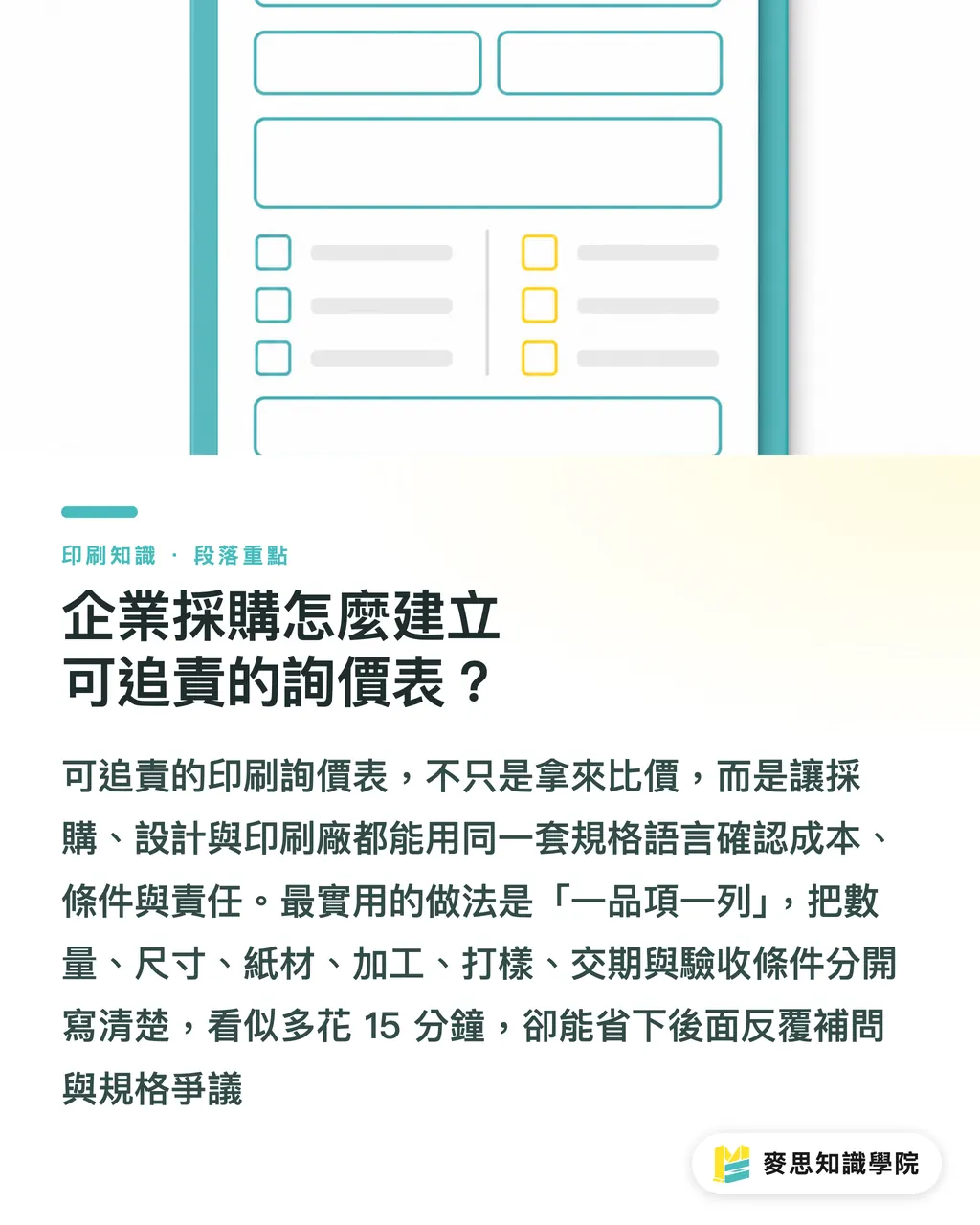
How Should Corporate Procurement Build an Accountable RFQ Sheet?
An accountable print RFQ sheet should be understandable to at least 3 people: procurement, the designer, and the print shop sales representative
Procurement reads total cost. Design checks whether the specifications have been changed. The print shop checks whether production can be carried out under those terms
I recommend using one row per item instead of stuffing all requirements into a single note field
・Item name: for example, corporate catalog, DM, packaging box, sticker, or business card
・Quantity: for example, 500 copies, 1,000 copies, or 3,000 copies, with a note on whether split delivery is allowed
・Size: write both finished size and flat size; attach drawings for special dies
・Page count: list inner pages, front cover, and back cover separately to avoid mixing 16P and 20P quotes
・Paper: specify paper type, weight, brand, or grade. If substitute paper is allowed, state the conditions in advance
・Printing: specify color count, single- or double-sided printing, and whether gang-run or dedicated plate printing is required
・Finishing: list lamination, foil stamping, spot UV, die-cutting, folding, and binding item by item
・Proofing: state whether proofing is required, the proof format, and who must approve it before mass production
・Packaging: specify how many copies per pack, whether cartons are required, and whether labels are needed
・Delivery: specify delivery address, floor level, and whether multi-location delivery is required
・Tax: state whether the quote must be tax-inclusive or tax-exclusive; do not mix both
・Lead time: state how many working days after artwork approval delivery is required; list rush conditions separately
・Acceptance: define how color variation, trimming, binding, and shortages will be handled
This sheet may seem to take an extra 15 minutes, but in practice it often saves 3 rounds of follow-up questions later
For companies with recurring print needs, I recommend keeping the RFQ sheet as an internal template. The next time the designer, procurement owner, or print shop changes, everyone can still use the same specification language
Key Takeaways
・Comparing only total price hides specification differences. A fair comparison starts with terms and conditions
・Low prices can be negotiated, but a low price that is not clearly written often turns into extra charges or quality gaps later
・The more a print RFQ sheet resembles a specification document, the easier it is for procurement to assign accountability and for the print shop to quote accurately
・Paper, finishing, proofing, delivery, tax, and lead time are the 6 categories most likely to distort quotes from three suppliers
・People who truly know how to buy printing do not simply push for the lowest price. They make sure every price difference has a reason
Further Thinking
On the print manufacturing side, quotes should be written as production conditions that can later be inspected and accepted. On the design side, file delivery should include confirmation that size, paper, and finishing will not change the cost. On the corporate procurement side, the three-supplier comparison should be organized into a traceable RFQ sheet. AI and SaaS tools can help standardize specification fields and flag missing items, but in the end, someone still needs to understand the print floor and recognize that "the same 1,000 copies" may involve completely different paper, different processes, and different risks
FAQ
- What should you check first in a print quote comparison?
- The first thing to check in a print quote comparison is whether the specifications are consistent, including size, quantity, paper, printing method, finishing, proofing, delivery, tax, and lead time. If the specifications are not aligned, the total prices are not comparable
- Is it normal for three print shops to quote very different prices?
- Yes. Large price differences among three print shops are common. The reasons may include different paper grades, whether finishing is included, whether proofing and freight are included, and whether the lead time is treated as a rush job. Break down the terms first, then judge which quote is reasonable
- What should you watch for when a print quote is too cheap?
- When a print quote is too cheap, watch for omitted specifications, finishing charged separately, proofing not included, freight not included, tax not included, and different lead-time assumptions. If these items are not clearly written, extra costs can easily appear later
- How should corporate procurement create a print RFQ sheet?
- Corporate procurement can use a one-item-per-row RFQ sheet and consistently fill in item name, quantity, size, paper, printing, finishing, proofing, packaging, delivery, tax, lead time, and acceptance conditions, so all three suppliers return quotes in the same format
- Should a print quote comparison always choose the lowest price?
- No. A print quote comparison should choose the option with clear specifications, explicit accountability, feasible lead time, and a reasonable price. If the lowest price leaves out finishing or delivery, the actual cost may be higher
Related articles





The Print × AI weekly
The print and AI know-how designers, brands and enterprises can use before they commit — one email, every week
MINDS Free Tools
Spine width and imposition calculators — skip the manual math, free in your browser.
MINDS Group
Need actual printing or gifting services?
From premium printing to online ordering and festive gifts — the MINDS Group sister brands take it from here.