

Overview
Hot Stamping is a post-processing technique that uses heat and pressure to transfer metallic foil onto paper or other materials
It gives business cards or packaging an eye-catching metallic luster, but success depends on the balance between line thickness and paper fiber
A client looks at a proof for three seconds and sighs, "It's printed well, but it feels like something is missing."
This is a sigh I hear all too often at the printing plant
The answer usually lies not in the printing itself, but in the post-processing
Adding a touch of hot foil stamping immediately broadens the visual hierarchy and brand value
Is Hot Stamping Only Available in Gold and Silver?
Many designers new to hot stamping think they can only choose bright gold or silver
In fact, modern foil technology covers a wide range of visual effects
Major manufacturers like Kurz in Germany have developed hundreds of special foils with different refractive indices and textures
Common types of hot stamping foils include:
・Glossy and Matte Metallic Foils: The classic choice; matte gold carries a low-key luxury feel, perfect for premium business cards
・Pearl and Pigment Foils: These have no metallic reflection but present saturated white, black, or pastel colors, often used on dark papers
・Holographic Foils: Seven-color luster that changes with the angle, commonly used for anti-counterfeit labels or trendy brand packaging
・Transparent Laser Foils: Retain the underlying print colors while adding local luster and patterns to the surface
What Paper Materials Are Best for Hot Stamping?
Hot stamping is a physical heat-pressure transfer; the surface characteristics of the paper directly determine the integrity of the stamp
I often remind clients that more expensive paper doesn't always yield a better result
・Coated Paper (e.g., Art Paper, Matte Coated Paper): Smooth surface, providing the sharpest edges for fine graphics and text
・Uncoated Paper (e.g., Ivory Board, Linen Paper): Highly absorbent with texture; requires increased stamping pressure, making very fine lines prone to breaking
・Deeply Textured Paper (e.g., Watercolor Paper): Large surface unevenness makes it hard for the foil to adhere completely to the valleys, often resulting in a mottled effect
When encountering specialty papers with large pores, I usually suggest switching to metallic screen printing or designing the foil patterns with thicker lines
How to Prepare Hot Stamping Files to Avoid Rejection
This is the area where I see novice designers fail most often
Hot stamping requires a separate metal plate; the file setup logic is completely different from general CMYK printing
Master a few hard indicators to significantly reduce the chance of re-runs or proofing failures:
・Independent Layers and Solid Black Settings: The stamping area must be on an independent layer and set as vector lines in 100% black (K100)
・Minimum Line Thickness Limits: Positive lines (solid) at least 0.2mm (approx. 0.57pt), negative lines (knockout) at least 0.3mm
・Minimum Font Size: Sans-serif fonts are recommended at 6pt or above; serif fonts with fine decorative lines are recommended at 8pt or above
・Avoid Mixing Large Areas with Ultra-Fine Lines: These require different temperatures and pressures; putting them on the same plate often leads to bleeding or broken lines
Understanding Cost Structures and Budgeting
When it comes to money, many buyers ask why even a small logo has a base fee
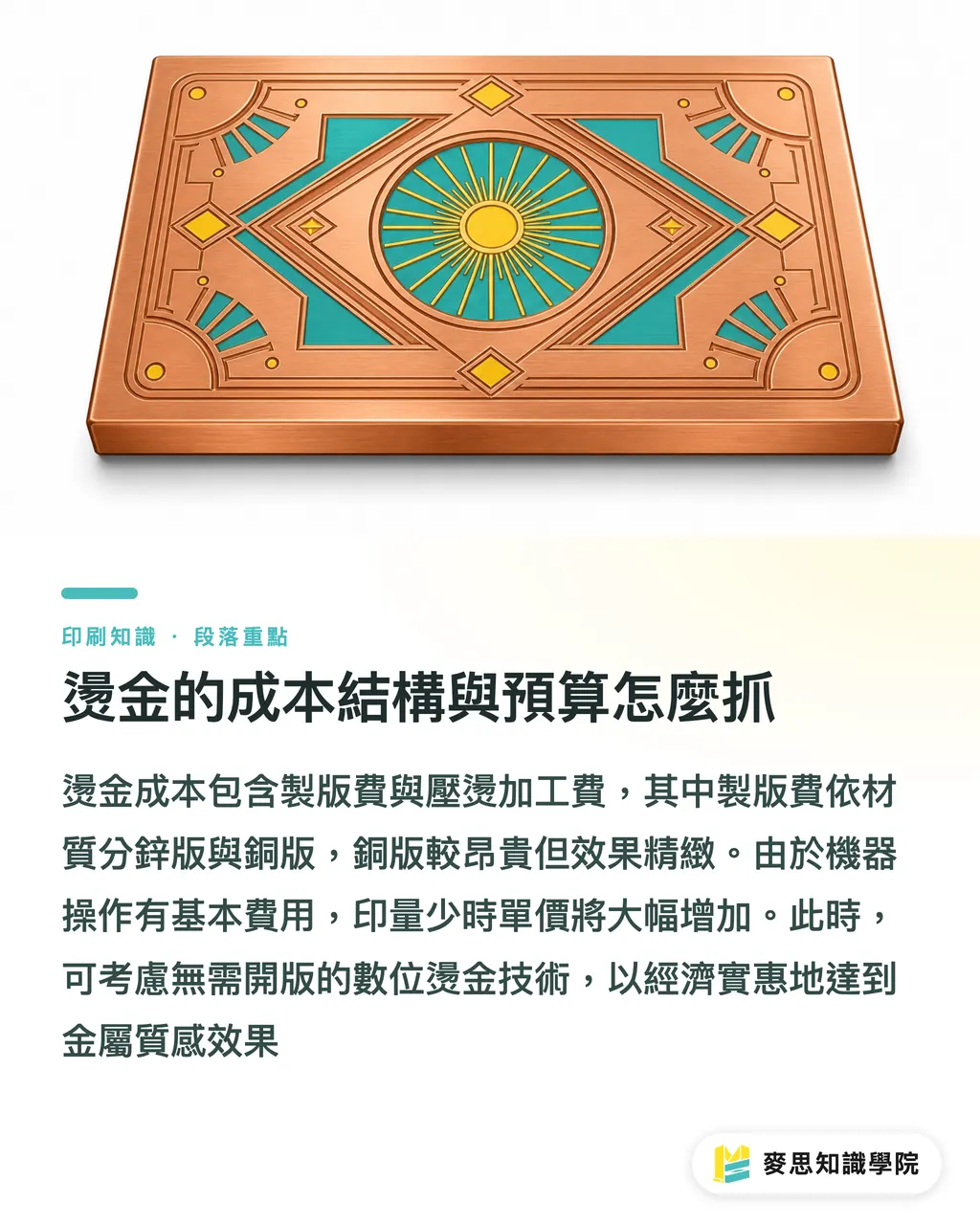
Hot stamping pricing usually includes "die-making fees" plus "stamping processing fees."
・Zinc Plates: Lower cost, suitable for general business cards and short-term promotional materials, with a durability of a few thousand impressions
・Copper Plates: High hardness and uniform heat conduction, suitable for exquisite packaging requiring extremely sharp edges, but the plate fee is usually two to three times that of zinc
・Base Setup Fee: Machine startup and calibration take time, so there is usually a minimum charge threshold; the larger the print run, the lower the unit price
If you are only printing 100 business cards, the plate and labor fees will cause the unit cost to skyrocket
In this case, I recommend considering Digital Foil (Sleeking), which achieves metallic effects for small batches without needing a plate
Key Takeaways
Hot stamping files must be set as an independent layer of 100% black (K100) vector artwork
Minimum solid line thickness must be greater than 0.2mm, and negative lines must be greater than 0.3mm to prevent bleeding
Specialty papers with deep textures are not suitable for fine foil graphics as they are prone to mottling and broken lines
Hot stamping costs include a fixed die-making fee and a per-piece processing fee; digital foil is recommended for low-volume printing
Further Reflections
In our process of promoting the MINDS printing SaaS service, the standardization of post-processing specifications has always been the most difficult yet valuable link
If designers can internalize these hard indicators as habits, and perhaps even combine AI-assisted checks for line thickness and layer settings in the future—
It would significantly reduce the back-and-forth communication time with printing plants, ensuring every creative idea lands precisely
FAQ
- Can I use JPG or PNG bitmapped images for hot stamping?
- No. Hot stamping requires a metal relief plate; files must be in a 100% black vector format (such as an AI file) to ensure sharp edges and correct color output
- Why are the edges of my foiled text blurry?
- This is usually because the font is too small, lines are below 0.2mm, or a rough, absorbent uncoated paper was chosen, preventing the foil from adhering precisely
- What is the difference between hot stamping and cold foil?
- Traditional hot stamping uses high-temperature pressure, creating a slight debossed feel with saturated metallic luster; cold foil uses screen-printed adhesive to bond the foil, which is faster and better for large areas but lacks the tactile debossed effect
- Will the cost be high for a small batch of business cards with hot stamping?
- Traditional hot stamping has fixed die-making and setup fees, making the per-card cost extremely high for low volumes. For small needs, it's recommended to find a printer offering digital foil (Sleeking), which requires no plate
- Can large color blocks and ultra-fine lines be placed on the same stamping plate?
- Highly discouraged. Large color blocks require high temperature and heavy pressure, while fine lines need lower temperature and light pressure. A single plate cannot accommodate both easily, often leading to bubbles in the blocks or blurred fine lines. Splitting them into two separate stamping passes is recommended
Related articles



The Print × AI weekly
The print and AI know-how designers, brands and enterprises can use before they commit — one email, every week
MINDS Free Tools
Spine width and imposition calculators — skip the manual math, free in your browser.
MINDS Group
Need actual printing or gifting services?
From premium printing to online ordering and festive gifts — the MINDS Group sister brands take it from here.